

866 Trolley Case Water Test: Full Spray
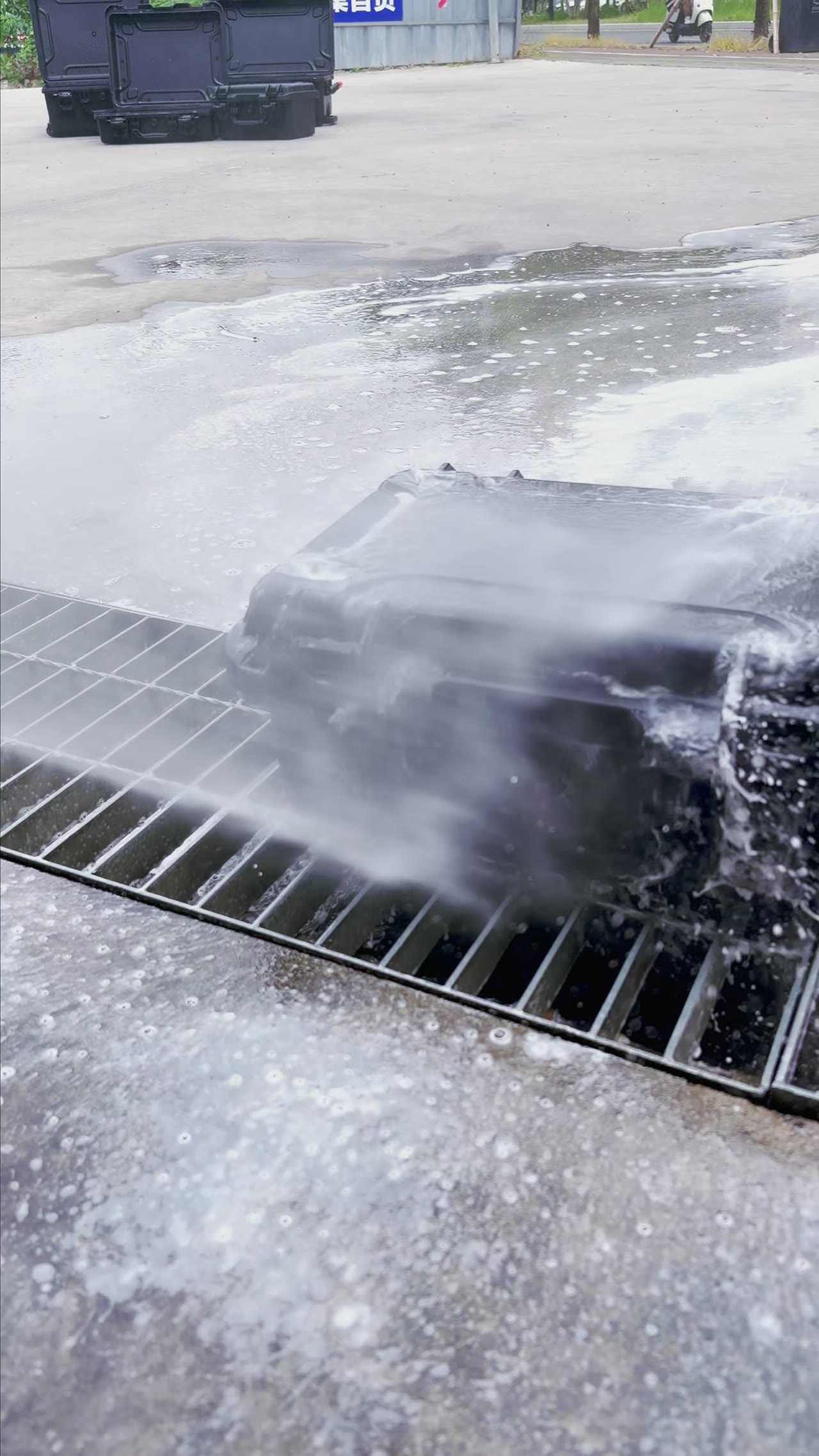
A full spray looks like weather. It is not. Every value in it was chosen by someone: nozzle at 300 mm or 800 mm, 40 L or 180 L per run, 180 s or 900 s of exposure. Change the choices and the same shell reads as leaking or tight. The clip shows water and nothing else, no layout, no water accounting, no repeat count. Read the rig correctly and you can call the verdict before the pump starts. This page puts the missing parts back and explains why a case that dripped on one bench comes out dry on the next.
01Nozzle Distance: 300 mm and 800 mm Are Two Verdicts
Impact pressure falls fast with distance. At 300 mm the jet has not spread, so it lands in a tight patch with high dynamic pressure, and if that patch sits on the lid seam it becomes a sustained point load. Back the nozzle off to 800 mm and the same water arrives as mist, delivering less per unit area, and the case that seeped now reads dry. Distance is not staging. It is part of the criterion, and a record without it cannot be reproduced.
Aim at the middle of the lid, not at the latch seats or the hinge bosses. A raised feature splits the jet in two and leaves a dry strip behind it, which looks like a spot that held, when in fact it was never hit. Measure nozzle-to-shell distance before the run and write it down. That single line settles more arguments than any note about how long the spray felt.
02Water Accounting: What 40 L Buys Versus 180 L
One pass uses 40 to 180 L, a spread of more than four to one. The volume has to match the covered footprint and the run time. Set the footprint at 1.2 m by 1.6 m and 40 L barely wets the surface before it drains away, while 180 L pools in the lid recess and lets gravity hunt for a gap. Same motion, two different tests: one measures wetting, the other measures standing water.
Account for it with a catch tray. Put a tray under the spray zone, collect the whole run, read it in a measuring cylinder, and if the figure misses the target, check the nozzle for blockage and the line for pressure drop. A half-clogged nozzle makes a thinner, faster jet with less total water, so the footage looks more violent while the test got weaker.
03Coverage Spread 15–30 Percent, Shadow 8–25 Percent
One nozzle over one face never delivers evenly. Measured spread usually runs 15 to 30 percent, wettest on the axis and driest at the four corners. Vertical skirts, the back of the handle and the four bottom edges are classic shadow zones covering 8 to 25 percent of the shell, and water simply never reaches them. Some of what gets called a clean full spray is that band never being hit at all.
There are two fixes: more nozzles, or rotate the case. Rotation needs fixed stop positions so each of four faces takes a turn. Extra nozzles need staggered heights, one high and one low, angled so two jets do not stack into double volume at one spot. Both fixes change total water, so recalculate afterwards, or you have only traded a dry patch for a soaked one.
04180–900 s: Longer Runs Buy Capillary Time
A single pass runs 180 to 900 s. At the short end the surface is only wetted; at the long end there is time for water to creep along the seam. A case that holds at 300 s and seeps a few drops at 900 s is not contradictory. Sealing depends on contact stress, and the longer water sits at the gap the more time capillarity has to pull it across.
Time also has to be paired with volume. Low volume over a long run behaves like rain and tests capillary uptake; high volume over a short run behaves like a washdown and tests dynamic pressure. The seal sees these differently, so a rig should do both. Run only one and the result covers only that one condition, which fails the moment the case meets different weather.
05Three Repeats at 5–30 °C: One Pass Proves Little
Three repeats is the floor. The first measures a freshly assembled case, the second a case that has been opened once, the third a case whose gasket has already been wet and seated against a damp groove. If any of the three seeps, the seal is sensitive to water, and a single dry pass at room temperature says almost nothing.
Hold water between 5 and 30 °C and keep it close to case temperature. Cold water contracts the trapped air and pulls a slight vacuum, so moisture that arrives gets credited to the spray; warm water raises internal pressure and lifts the lid a fraction. Let the case stand beside the rig until the two temperatures converge, then start the clock. The clip is a process record only. Acceptance comes from the formal sheet, and this footage is not a protection rating.
| Nozzle to case distance | 300–800 mm |
|---|---|
| Water per full spray | 40–180 L |
| Single pass duration | 180–900 s |
| Coverage spread | 15%–30% |
| Shadow zone share | 8%–25% |
| Spray water temperature | 5–30 °C |
| Repeat count | 3 repeats |
| Spray footprint | 1.2 m × 1.6 m zone |
FAQ
Why does moving the nozzle closer make a case fail?
A shorter throw keeps the jet narrow, so the same flow lands on a smaller patch at higher dynamic pressure, and a seam under a steady point load gives way sooner. At 800 mm the water arrives spread out and the load per unit area drops sharply. The case did not change. The loading did.
How much water should one pass use?
Anywhere from 40 to 180 L, provided the figure is recorded. Volume has to be paired with footprint and duration, and checked against a catch tray. Forty litres over 900 s and 180 L over 300 s are different tests, and results from one cannot stand in for the other.
Three clean passes, so is long-term rain exposure covered?
No. Those three ran at fixed distance, fixed volume and fixed water temperature. Outdoors the throw, the wind and the flow all drift, and stacked weight dishes the lid. Three passes show this case is stable under the stated conditions. They do not license a rating anyone can extrapolate.
How do you find the shadow zones?
Stop the spray while the shell is still wet and walk around it. Dark, beaded areas took water; pale, drying areas did not. Corners, vertical skirts and the back of the handle show up first. Add a nozzle or a rotation stop when you find one, because adding time will not reach a spot the jet never touches.