

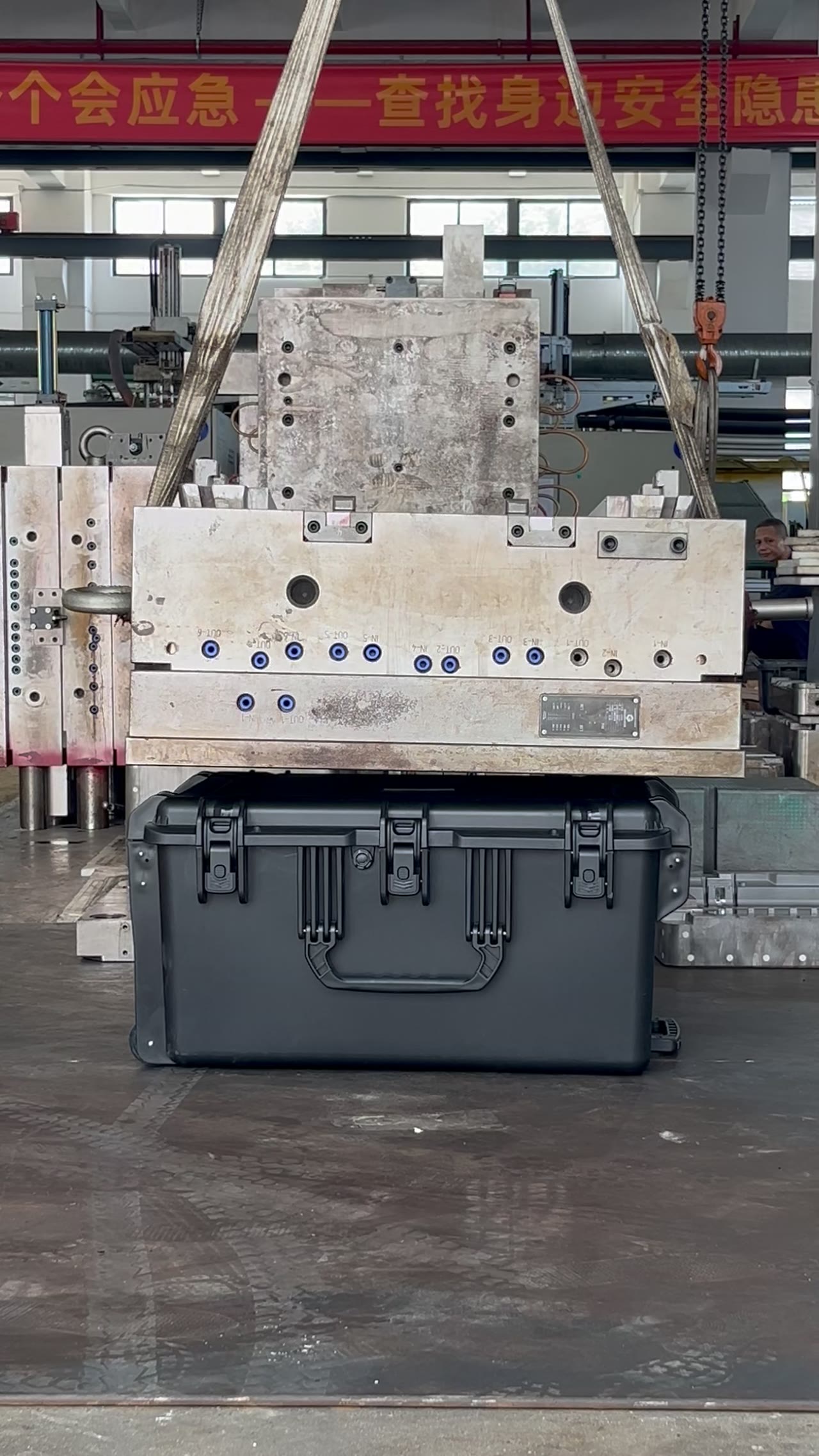
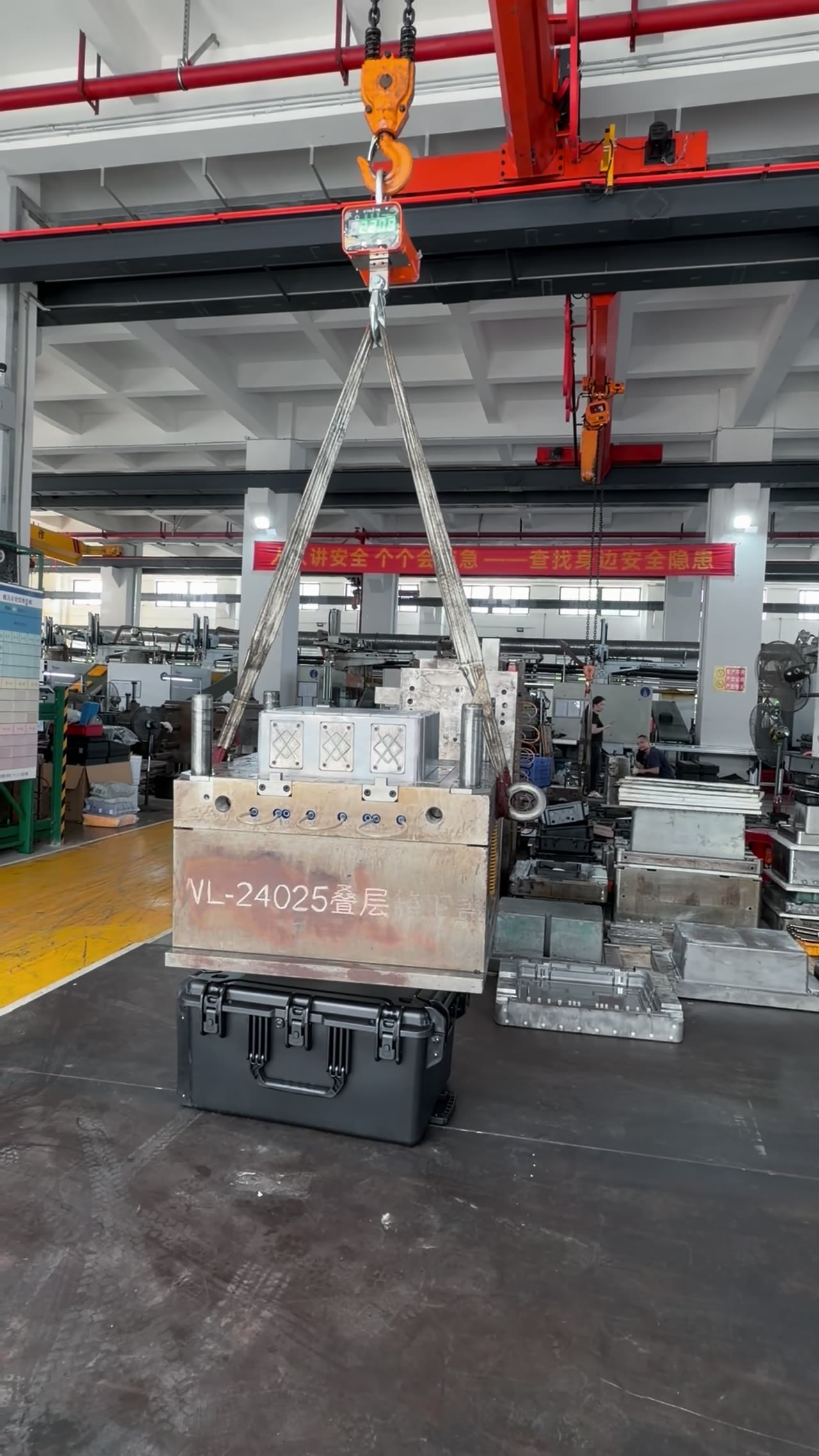
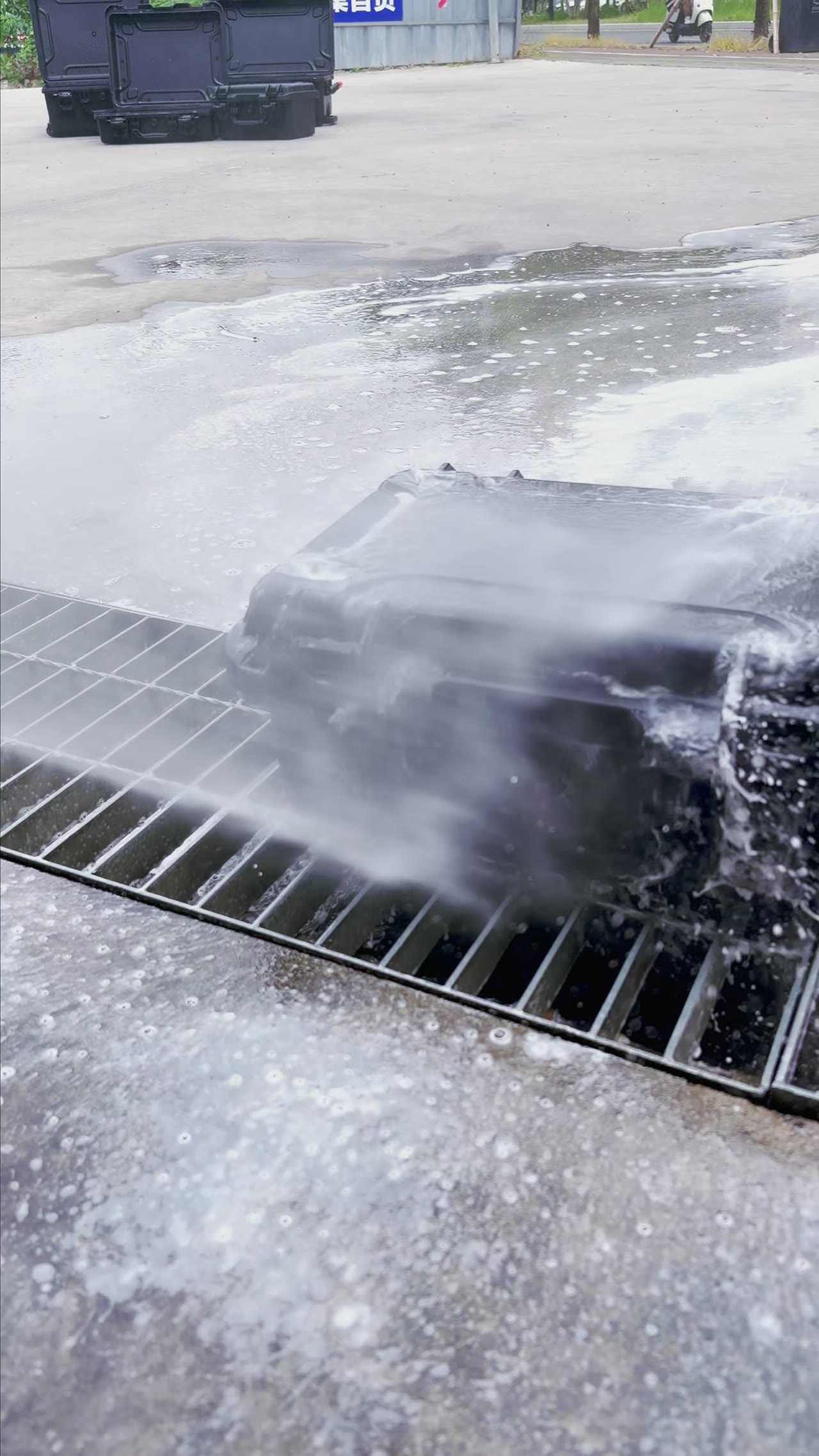
865 Trolley Case Water Test: Handle and Wheels
A plain case has one closed seal and that is the whole story. A trolley case has holes. The handle cavity has to cross the back wall, the wheel housings have to be screwed on, and the axles have to exit somewhere. None of those sit on the seal line, yet each one leads into the case or into a cavity that shares space with it. This piece walks the three families of opening: how each is closed, where cavity water drains, and why the film thrown off a rolling wheel climbs back in.
01Three families of opening a plain case never has
Handle-cavity penetrations, 2–4 of them, are the passages where the telescopic tubes cross the back wall. Wheel-housing screws, 4–8 per case, each one a route from outside straight into the base. Two axle openings, where the shaft passes through and cannot sit perfectly tight. None of this touches the lid gasket.
The handle itself runs 2–4 sections sliding on one another, and a sliding fit is not a seal and was never meant to be one. Sealing these spots with extra sealant tends to fail within months of vibration and thermal cycling — the bead lifts, and worse, it plugs the drain that should have let the water out.
02A 1.5–6 L handle cavity: water in there is not water in the case
The handle cavity holds 1.5–6 L, which is 1500–6000 mL, behind the back wall and normally separated from the main volume by a partition. Water can sit in the cavity while the main volume stays dry, and the reverse happens too. So the useful question is not whether it leaked but which layer leaked. Log the two together and the dataset stops being usable.
One to three drain holes belong at the lowest point of that cavity. A drain is an exit, not a barrier. Put it on a side wall, or leave it sitting above the floor of the cavity, and water stands in the bottom until it works through the partition seam into the main volume. Keep the opening clear of the wheel as well, or water never reaches it.
03Screws and axle bores: fasteners are not seals
The 4–8 screws at a wheel housing carry impact and side load from the wheel. They are not the sealing element. What keeps water out is face contact between housing and base, plus a sealing washer at the thread. Over-torquing does not improve that contact; it collapses the plastic seat.
A collapsed seat leaves a ring-shaped depression, and that depression then collects water. The two axle openings behave the same way. Shaft and bore always have clearance; a shoulder face blocks most of the water, and the remainder seeps past and drops into the cavity. None of that path announces itself at the time — it turns up as a damp patch weeks later.
04A rolling wheel throws water as a film
In normal pushing, tread speed runs between 0.5 and 2.0 m/s. Water lifted from a wet floor is thrown outward along the tangent — some away from the case, some toward the housing and the axle opening. The faster the roll, the thinner and more continuous the film, and the more readily it climbs a surface.
Each pass lets in roughly 2–15 mL. You cannot see that at the time; a tissue pressed there comes away barely damp. It accumulates: thirty pushes put 60–450 mL in the cavity, which is a layer across the bottom. Trolley cases therefore cannot be judged on a single wet run — the relevant figure is the total after repeated pushing.
05Land the verdict: open it, dry it, measure it
Open: unbolt the housing and look for a continuous moisture track on the cavity wall, noting which hole it starts from. Dry: wipe the wall, push the case again, see whether the track returns. Measure: collect what leaves the drain and read the volume — a 2–15 mL quantity needs a graduated container, not a glance.
All three, then conclude. Opening alone calls condensation a leak. Measuring alone calls a dry cavity sealed while water already sits in the partition seam. Run the sequence twice; if the track returns to the same place, it is fresh rather than left over from the previous trip. Footage records the run; the verdict rests on the formal record.
| Handle-cavity penetrations | 2–4 |
|---|---|
| Wheel-housing screws | 4–8 per case |
| Axle openings | 2 |
| Handle sections | 2–4 |
| Handle-cavity volume | 1.5–6 L |
| Drain holes | 1–3 |
| Tread speed | 0.5–2.0 m/s in normal pushing |
| Ingress per pass | 2–15 mL |
FAQ
Water in the handle cavity — is the case leaking?
Only if the partition is breached. With the partition intact, cavity water is drainable water and the main volume stays dry. Log the two separately; merging them turns a structural question into a sealing one.
Do the housing screws need washers?
Sealing washers, not spring washers. Face contact does the work. Torque past what the plastic seat can take and it collapses, leaving a depression that holds water.
Does a bigger drain hole let more water in?
Yes, and it lets more out. Position matters more than diameter: lowest point, facing down, clear of the wheel.
What should I do after pushing through a wet floor?
Dry the housing and the axle opening, drain into a graduated container and read the volume, then push again and check the cavity wall for a returning track. Skip a step and you either call condensation a leak or call a real leak clean.