

Quick answer: Four sites, one drill: latch order, lid angle, foam channels, and the checks before closing. The tests are 4 movement points and 6 errors.
Table of contents
- Dawn on the range: opening order and reset
- Truck and shipboard: strap points and locating grooves
- Rain, snow and grit: how the seal face wears
- Darkness: labels, latches and feel
- Air freight and lifting: valve, lift points, stacking
- Six field errors and the correct move
- FAQ
1. Dawn on the range: opening order and reset
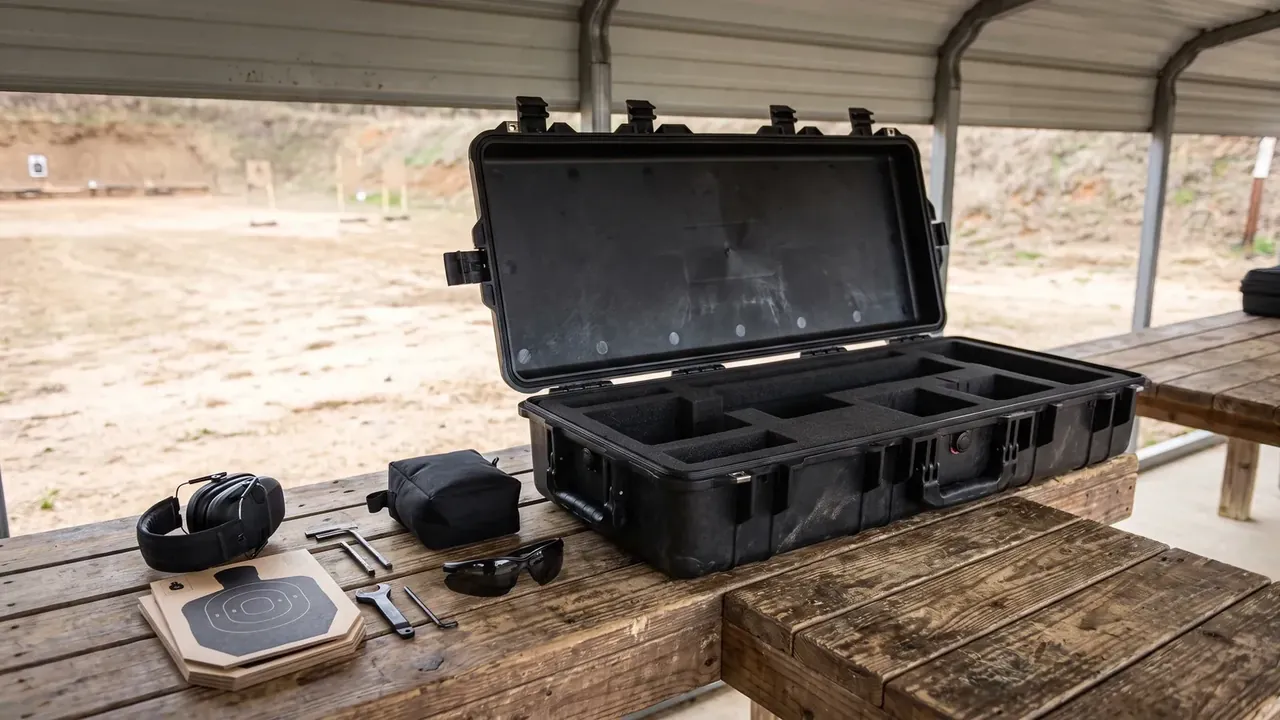
At 05:40 the firing line runs half its tubes, about 5 lux on the lane. Two staff lift four ammunition and nuclear ordnance boxes onto a bench, each on a 6 mm mat. The shell is 8 °C colder than store, so the gasket stiffens.
Latches open sides first, centre pair second: 8 seconds each, 32 in total. Reverse that and the lid crowns, opening a 2 mm gap for grit. The lid stops at 100 degrees on a 180 kg tether; past 110 degrees the webbing frays in 30 cycles.
| Movement | Time per operator | Typical deviation |
|---|---|---|
| Opening 4 latches | 32 s | Two opened, lid forced |
| Lid to 100 degrees | 3 s | Past 110 degrees, tether strained |
| Lid onto the gasket | 6 s | Gasket nipped at the rim |
| Locking four corners | 10 s | Torque above 3 N·m |
Reset is where crews slip. Check the rim, then confirm each item sits in its numbered channel. A 980 mm × 340 mm × 130 mm cavity holds 8; one off stalls the morning count. Reset runs 75 seconds, and a 6 hour shift with 12 draws stays under 20 minutes.
2. Truck and shipboard: strap points and locating grooves
A truck floor gives 4 tie-down eyes. Two 2200 kg straps cross the lid of ammunition and nuclear ordnance boxes through 12 mm grooves sized for 50 mm webbing, holding the strap off the gasket under braking.
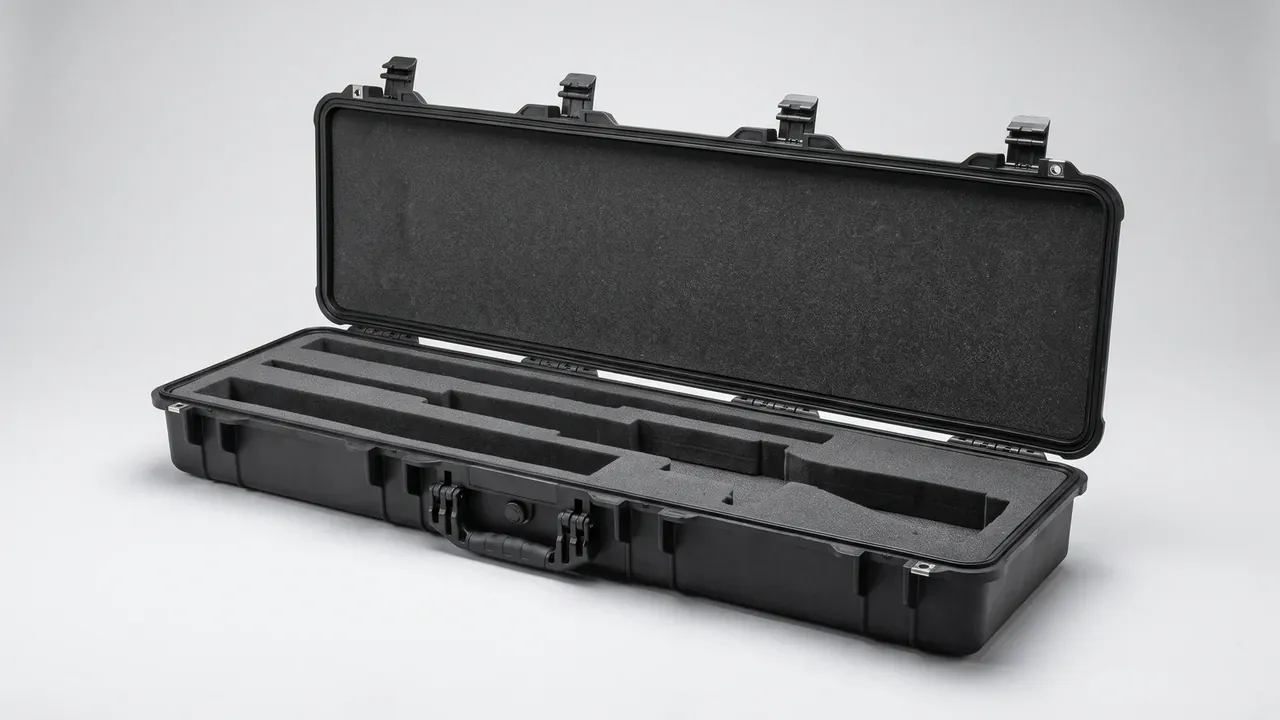
Re-tension after 200 km: at 40 °C the shell softens, tension drops 10% to 15%, and a palm finds 1 mm to 2 mm of slack. Shipboard, ammunition and nuclear ordnance boxes take 22.5 degrees of roll, 7.5 of pitch, and a 30 mm bulkhead gap filled with neoprene.
One rule breaks often: never stack ammunition and nuclear ordnance boxes on another lid. Empty is 7.8 kg against 46 kg loaded, and two-high marks the lower lid white in 3 months.
3. Rain, snow and grit: how the seal face wears
Rain does not fall in; it runs down the inner lid and pools 2 ml to 3 ml at the hinge. Tilt another 10 degrees to drip at the corner, then wipe the gasket: 15 seconds. Ammunition and nuclear ordnance boxes opened in a downpour lose at the hinge, not the sky.
On ammunition and nuclear ordnance boxes, 6 hours of dust leaves the gasket carrying sand that closing presses in as dents. Brush one way twice, wipe damp, then a thin silicone film. Compression is 25%; a 0.5 mm dent ends the seal at 24 months.
Coastal stores verify 168 hours of salt spray; the latch spring plate fails first, as 0.2 mm pitting drops locking force from 2.2 N·m to 1.4 N·m. At -32 °C drop height falls from 1.2 m to 0.8 m; at 55 °C stacking drops from 3 high to 2.
4. Darkness: labels, latches and feel
Night work leans on markings you can see and shapes you can feel. A 60 mm × 25 mm label 30 mm above the latch and a 20 mm reflective strip separate box types at 5 lux.
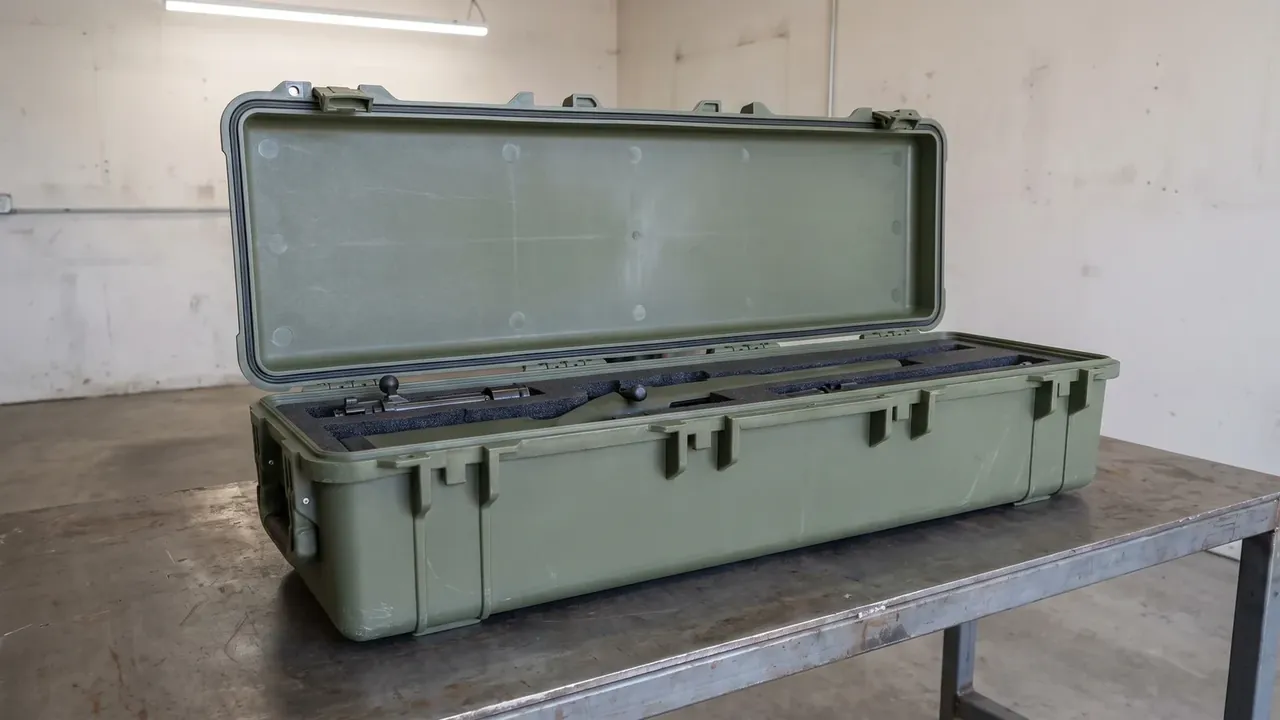
The latch has 4 mm of free travel, then a stage needing 12 kg of finger pressure. Cold gloves hide part of it, so operators on ammunition and nuclear ordnance boxes push past 3 N·m and crack the hook before 5000 cycles.
| Feature | Night cue | Cost of a misread |
|---|---|---|
| Front rim | 60 mm × 25 mm label | Wrong box to the line |
| Latch body | 4 mm free travel | Over-torque, hook cracked |
| Side wall | 20 mm reflective strip | Impact inside the cab |
5. Air freight and lifting: valve, lift points, stacking
In cruise the cabin equals 2400 m of altitude, a 3.5 kPa differential. Flip a latch on landing and the gasket is still sucked down; force the lid and the lip tears 5 mm. Vent for 3 seconds first.
Lifting ammunition and nuclear ordnance boxes means the four corner points, 150 kg each at a 3.2 safety factor. Keep the sling inside 60 degrees; at 90 the load per point rises 40%.
| Stage | Figure | Action |
|---|---|---|
| Venting before opening | 3.5 kPa | Press valve, wait 3 s |
| Lifting | 150 kg per point | Sling angle 60 degrees or less |
| Stacking | 3 high, 1.6 m | Pallet above 92 kg |
| Drop test | 1.2 m | Inspect corners on landing |
6. Six field errors and the correct move
Field errors on ammunition and nuclear ordnance boxes cluster around shift changes and weather turns. These six are ranked by frequency.
| Error | What you see | Correct move |
|---|---|---|
| Two latches, lid forced | Lid crowns 3 mm | Open all four, lid sits flat |
| Item in wrong channel | One channel empty | Reset by channel 1 to 8 |
| Wet hands at closing | Water film at gasket | Dry the lip first |
| Handle used as lift point | Hinge pin bent 0.3 mm | Four corner points only |
| Torque by feel | Crack at latch hook | 2.2 N·m driver |
Conclusion
A range, a truck bed, a ship's hold, an air freighter: the movements differ, the tests do not. Latch order, lid angle, channel numbers and three checks cover most of the risk. Write those four lines into the handover sheet and failure turns procedural instead of structural, which is cheaper. That is the case for treating ammunition and nuclear ordnance boxes as equipment with a drill.
This article discusses only the container (case body) side of specifications and design intent, and does not cover any handling, loading or use of the contents.
Related Reading
- Verification items and pass lines for ordnance cases
- Where the category boundary sits
- Ammunition stacking as it is actually laid out
- Securing and handing over a case in transit
- Marking and inspection for small arms packaging
Related Products
- 8 Series — Gun Cases; Military Equipment Cases; Camera Equipment Cases; Drone Cases; Watch Cases; Knife Cases; First Aid Cases; Electronics Equipment Cases
- WL8-2812 PP Gun Case — model WL8-2812
- All protective cases and toolboxes: 7 series, 158 models