

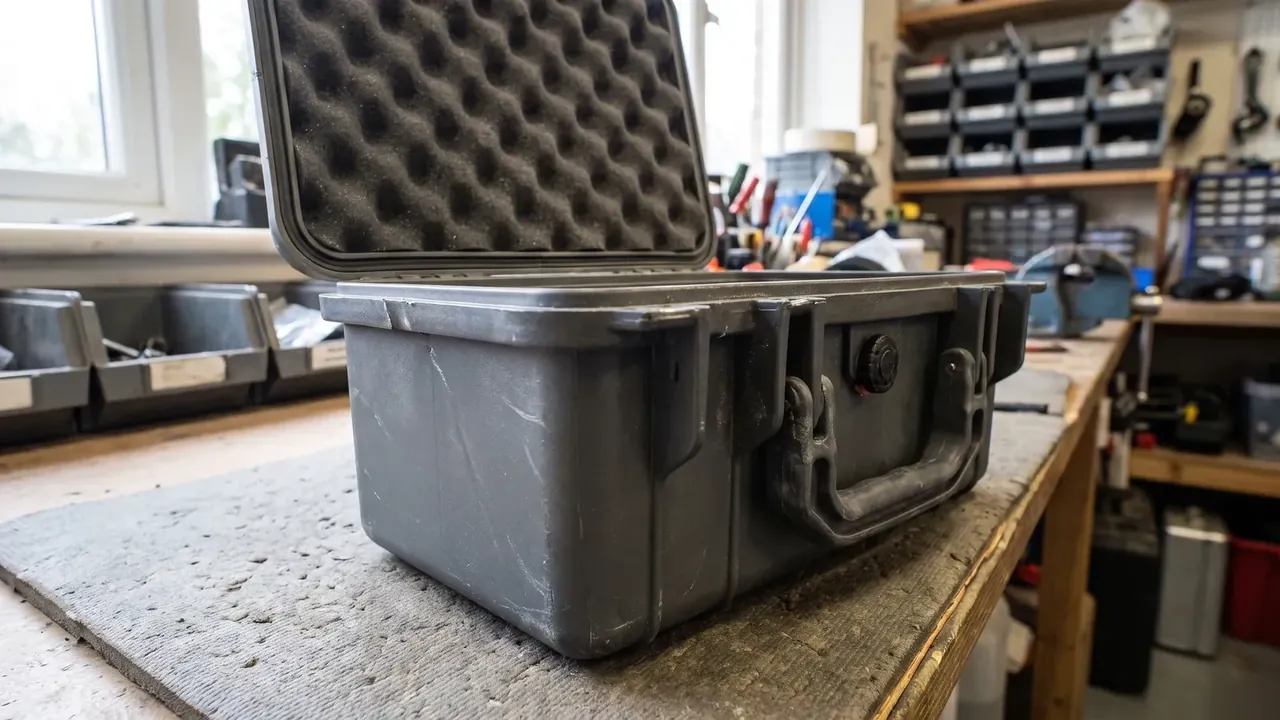
Quick answer: A spec for Ammunition and Nuclear Ordnance Boxes is a chain, not a catalogue pick: load sets the cavity, cavity sets the outside, span sets the wall, wall sets ribs and hardware. Check 6 quantities in that order.
Table of contents
- Specs Come From Load, Not From a Catalogue
- Turning the Load Into 3 Forces
- Cavity First, Outside Dimensions Second
- Span Sets Wall Thickness
- Hardware and Sealing Follow the Wall
- Writing the Numbers as a Testable Sheet
- FAQ
1. Specs Come From Load, Not From a Catalogue
The first question about Ammunition and Nuclear Ordnance Boxes is always how thick the shell needs to be. The answer sits in 4 inputs: loaded mass, stack height, transport mode and opening frequency. Two shells at 46 kg and 120 kg may differ by only 0.5 mm of wall, yet need hardware one size class apart, because impact rises with mass while latches are chosen by point load.
The order is fixed: load becomes force, force becomes span, span becomes wall, wall becomes ribs and fittings. Run it backwards and light duty ends up heavy while heavy duty ends up thin.
Stack height is the input most often left out, and it sizes the lid. The output is only 3 lines: cavity size, wall range, hardware set.
2. Turning the Load Into 3 Forces
Stacking is static. One 46 kg unit, 5 high, puts 184 kg on the bottom lid at under 0.02 MPa. But it sits for 2 years, and creep takes the lid down 3 mm into the liner.
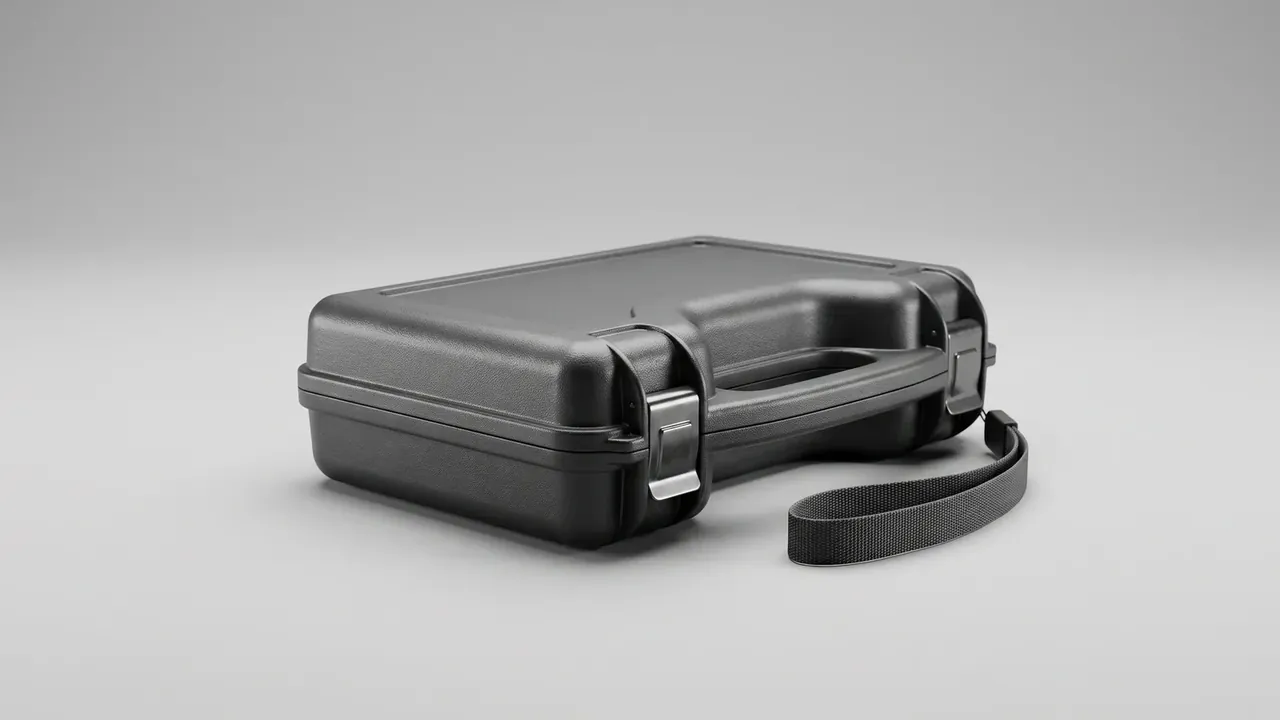
Drop is impact. A 1.2 m fall onto a corner at 40 g peak gives about 18 kN on 1 corner and 2 edges. That is why corners get extra wall and a radius no smaller than the wall beside it.
Strapping on Ammunition and Nuclear Ordnance Boxes is squeeze. A 300 kg preload on 2 narrow bands pushes local side pressure to 0.6 MPa; 2 vertical ribs, 25 mm tall, raise the section modulus about 1.8 times for far less material.
| Load | Source | Magnitude | Where |
|---|---|---|---|
| Static | 5-high stack | 184 kg | Lid |
| Impact | 1.2 m drop | about 18 kN | Corner and edge |
| Squeeze | Band preload | 0.6 MPa | Side band |
3. Cavity First, Outside Dimensions Second
On Ammunition and Nuclear Ordnance Boxes the cavity starts from the largest single item plus padding and hand clearance. Padding is 20 mm a layer, 1 layer a side, clearance 10 mm a side. At 1140 mm item length the cavity is 1200 mm, fixed before anything else is derived.
Outside length is cavity plus 2 walls and 2 radius allowances: at 8 mm wall and 15 mm radius, about 1236 mm. Deep parts need 1.5 degrees of draft; at 300 mm depth the opening differs by 7.8 mm.
Height is where the arithmetic fails: lid foam takes 25 mm, finger space 30 mm, neither enters cavity depth.
| Item | Add | Result |
|---|---|---|
| Cavity | 1140 item, 40 padding, 20 clearance | 1200 mm |
| Outside | Cavity, 2 walls, 2 radii | 1236 mm |
| Height | 200 cavity, 25 foam, 30 finger | 300 mm |
4. Span Sets Wall Thickness
Wall thickness on Ammunition and Nuclear Ordnance Boxes follows span and support. A 1200 mm unsupported base under 46 kg deflects about 3 mm at 8 mm wall; 2 ribs at 40 mm bring that under 1 mm, and the wall can drop to 6 mm, saving about 2.4 kg. Thickness is a result, never an assumption.
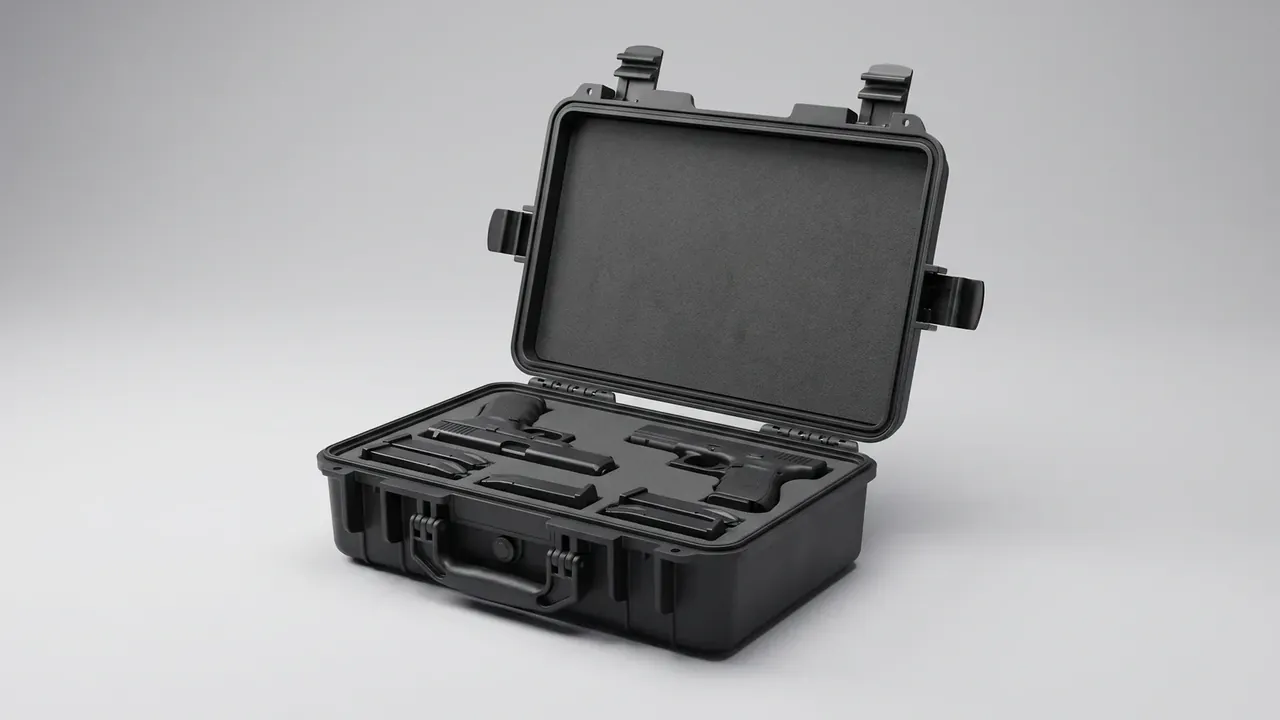
Each face earns its own number: the side takes squeeze at 6 mm, the lid takes stack creep at 8 mm, the base takes impact at 8 mm with ribs, and latch or hinge seats are padded to 12 mm locally.
Rotomoulded wall is a range. A nominal 8 mm shell measures 6.8 to 9.2 mm, because powder piles in inside corners and thins on outside ones. Specify the minimum and the measuring points, never the average.
| Face | Span | Wall | Ribs |
|---|---|---|---|
| Side | 400 mm | 6 mm | none |
| Lid | 1200 mm | 8 mm | 3 cross ribs |
| Base | 1200 mm | 6 to 8 mm | 2 ribs at 40 mm |
5. Hardware and Sealing Follow the Wall
Latches on Ammunition and Nuclear Ordnance Boxes are chosen by lid perimeter and opening frequency, not by volume. Up to 3.2 m of perimeter 2 latches do the job; beyond that, or for one-hand opening, fit 4. The seat is padded to 12 mm and the hole runs 0.2 mm under the pin diameter.
Hinges use a 6 mm pin through 4 bolts at 8 N·m, and bolt holes stay 12 mm from the edge; closer, a drop tears the hole before it bends the pin.
Sealing is decided in the groove. An 8 mm gasket section sits in a 6 mm groove at 25% compression, with the groove 0.5 mm wider to allow swell. The relief valve cracks at 0.3 bar: higher and the lid bulges, lower and it breathes too often.
6. Writing the Numbers as a Testable Sheet
A spec sheet for Ammunition and Nuclear Ordnance Boxes must be testable as written: cavity with a tolerance of plus or minus 2 mm, wall as 6 minimum readings, mass as measured, stacking as layers and duration, drop as height and attitude, sealing as decay, salt spray as 500 hours.
A dimension with no tolerance is not a specification. Write cavity about 1200 mm and both 1195 and 1205 pass while the liner will not go in. Write wall 8 mm and each side measures a different point.
| Parameter | Write it as | Verify by |
|---|---|---|
| Cavity | 1200 x 500 x 200 mm, 2 mm | CMM or caliper |
| Wall | 6 points, min 6.8 mm | Ultrasonic gauge |
| Sealing | Under 2% in 30 minutes | Differential gauge |
Conclusion
Load to wall is an ordered chain: 4 inputs give the load, 3 forces give the span, span gives the wall, wall gives ribs and hardware. Each step leaves a number that can be tested, which separates a specification from a wish list. On Ammunition and Nuclear Ordnance Boxes the thickness argument should end at step two.
This article discusses only the container (case body) side of specifications and design intent, and does not cover any handling, loading or use of the contents.
Related Reading
- How wall thickness and decay are measured at acceptance
- Layer by layer: how the shell carries load
- Spec ranges used on small arms ammunition boxes
- Writing tolerances into an ammunition case spec
- Stacking deformation and base support failures
Related Products
- 8 Series — Gun Cases; Military Equipment Cases; Camera Equipment Cases; Drone Cases; Watch Cases; Knife Cases; First Aid Cases; Electronics Equipment Cases
- WL8-2812 PP Gun Case — model WL8-2812
- All protective cases and toolboxes: 7 series, 158 models