

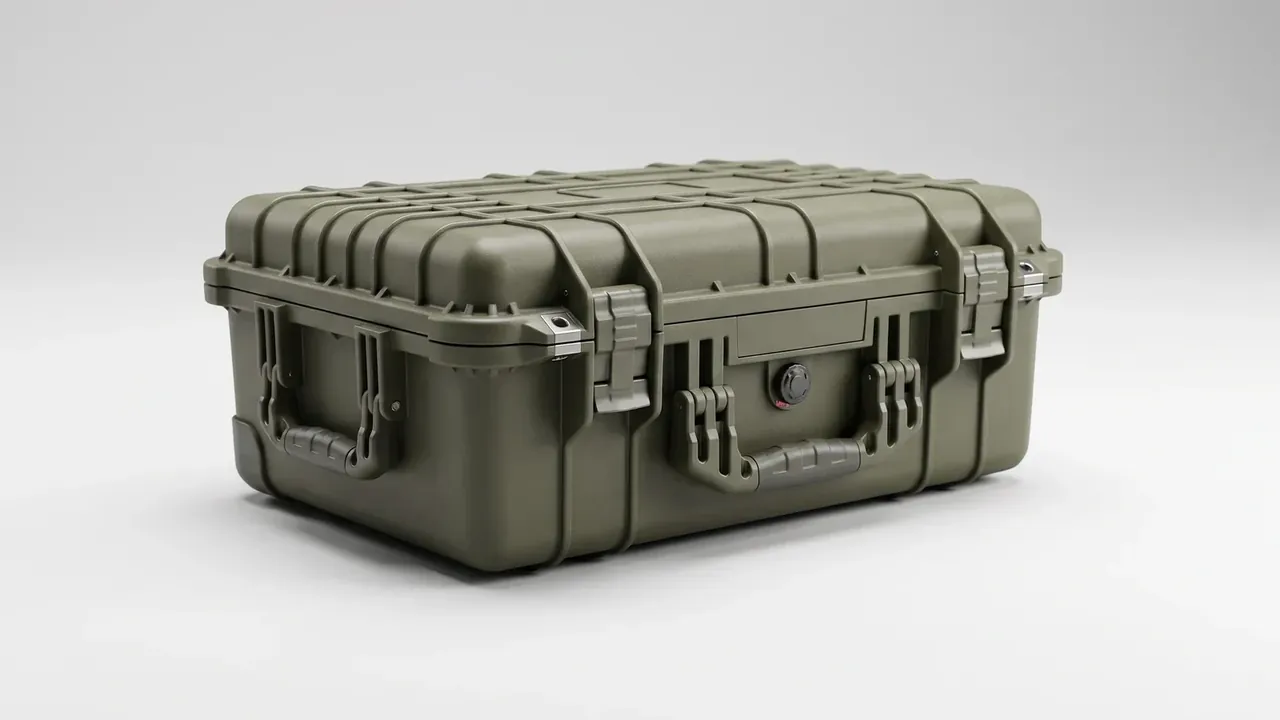
Quick answer: An ammunition transit case is not the answer to every movement task. It earns its place on three figures: six stacked tiers, a loaded weight near 22 kg and an 8 mm wall. Below 30 trips a year, above 40 kg per item, or past six months in the open, three other forms cost less over their life.
Table of contents
- Where an Ammunition Transit Case Stops
- 8 mm Against 4 mm
- Rotomoulded or Riveted: The 22 kg Line
- When Not to Choose One
- Three Substitutes That Beat It
- Three Criteria, One Table
- FAQ
1. Where an Ammunition Transit Case Stops
Five things answer to the same name on site: a rotomoulded ammunition transit case, a welded steel box, an aluminium flight case, a soft bag and a covered crate. What separates them is the failure point. A latch pin loosens, a seam rusts through, rivet holes open, zip teeth shear, cover fabric goes chalky. Same route, and service life differs threefold.
| Form | Empty weight | Stacking | Sealing | First to fail |
|---|---|---|---|---|
| Rotomoulded case | 9 to 13 kg | 6 tiers | continuous solid gasket | latch pin |
| Welded steel box | 15 to 19 kg | 4 tiers | flat gasket, over-centre catches | seam rust |
| Aluminium case | 6 to 8 kg | 3 tiers | hollow gasket in extrusion | rivet holes |
| Soft bag | 2 to 3 kg | 1 tier | zip, water-repellent coating | zip teeth |
| Covered moulded crate | 5 to 7 kg | 5 tiers | single lip compression | cover fabric |
The last column decides more than the first three. Weight and stacking you can compare on a quotation; the failure point only shows in service, and it settles whether year three costs a pin or a replacement.
2. 8 mm Against 4 mm
Rotomoulded walls land between 6 and 10 mm; moulded crates sit at 3 to 4 mm. Tipped from 1.2 m onto concrete, an 8 mm corner only scuffs white. The 4 mm equivalent cracks through to the latch seat.
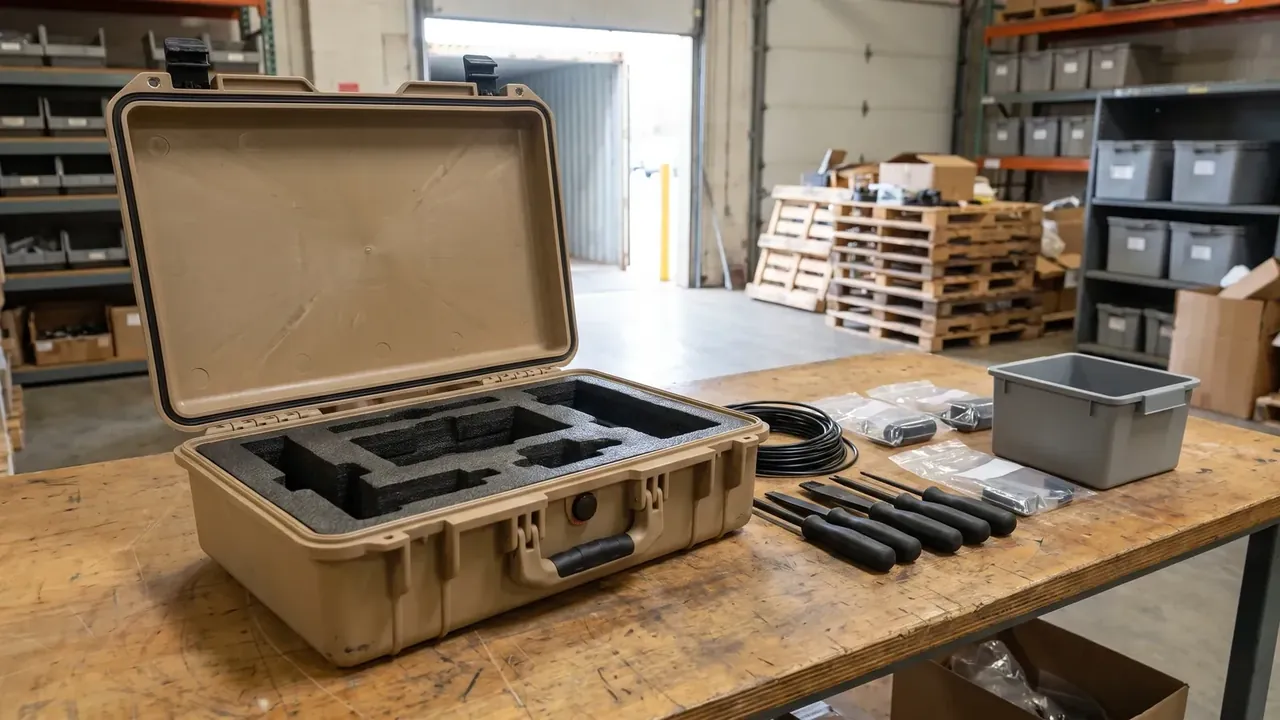
Doubling the wall doubles empty weight too, 6.5 kg to 12 kg, and that bill is paid in handling. Two questions decide it: does any item inside exceed 15 kg, and does loading happen at minus 20 °C? Impact strength falls steeply there, and the extra millimetres are the margin bought for it. Below minus 5 °C, 4 mm with ribs is enough.
Buying 8 mm fleet-wide for two cold tasks a year does not pay back.
3. Rotomoulded or Riveted: The 22 kg Line
A rotomoulded body has no seam, so one continuous gasket is compressed by the whole lid. A riveted panel build relies on four mitred corners staying tight. After thirty minutes of rain, internal humidity rises under five points on the one-piece body and around twelve on the riveted build, almost all at the corners.
The 22 kg line sets the rest. Under it, one person lifts the case off a tailgate unaided; past 28 kg the posture shifts from lifting to hugging and drops climb. That line fights stacking directly: more wall, more ribs, more empty weight. Between six tiers and 22 kg you keep one.
4. When Not to Choose One
Three situations make the money poorly spent. Under 30 trips a year, a case is aged by its environment rather than its use. A single item over 40 kg needs mechanical lifting, so the load runs through eyes rather than the wall. Past six months in the open, ultraviolet light takes colour and toughness together, and the lid ribs craze first.
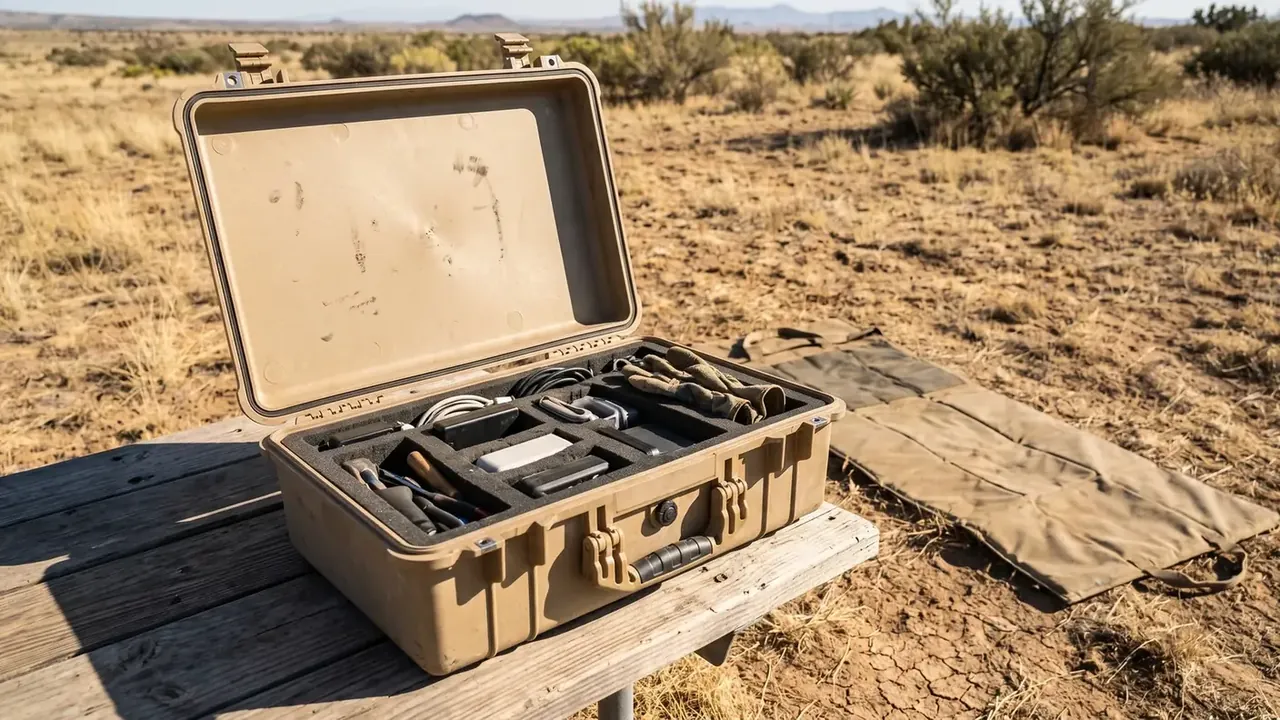
In practice the three arrive together: a temporary site, a dozen trips a year, a few heavy items, half a year outdoors. The cheapest answer is splitting movement from storage.
5. Three Substitutes That Beat It
- Under 30 trips a year: a moulded crate with a removable dust cover, 5 to 7 kg empty, about forty per cent of the price.
- Items over 40 kg: a steel pallet box with four lifting eyes, hoisted without turning the body, on a base cut for forklift tines.
- Over six months outdoors: a pallet, a cover and desiccant, costed by the square metre, at under a third of a rotomoulded case of equal volume.
All three put the money on the leg that carries load rather than into thicker walls. The budget lands on the box; the problem sits on the road outside it.
6. Three Criteria, One Table
| Trips per year | Loaded weight | Exposure | Choice |
|---|---|---|---|
| under 30 | under 25 kg | under 1 month | moulded crate with cover |
| 30 to 200 | 25 to 40 kg | 1 to 6 months | rotomoulded ammunition transit case |
| over 200 | over 40 kg | over 6 months | steel pallet box |
When the criteria fall in different rows, take the most severe: a case making 250 trips with 18 kg still reads as the third row, because the latch pin wears out before the shell does.
Conclusion
A comparison is not there to crown the strongest form but to find the failure point matching your route. Six tiers, 22 kg and an 8 mm wall rarely hold together, and crossing any one is the signal to change form. Put trips, weight and exposure months on the order, and the decision stops being taste: it is whether the route justifies an ammunition transit case.
This article discusses only the container (case body) side of specifications and design intent, and does not cover any handling, loading or use of the contents.
Related Reading
- Metal ammunition box materials compared
- Transit case configurations by scenario
- Transit case problems and fixes
- Case body materials compared
- Carton packing materials compared
Related Products
- 8 Series — Gun Cases; Military Equipment Cases; Camera Equipment Cases; Drone Cases; Watch Cases; Knife Cases; First Aid Cases; Electronics Equipment Cases
- WL8-2812 PP Gun Case — model WL8-2812
- All protective cases and toolboxes: 7 series, 158 models