


Quick answer: An artillery shell box protects through five load paths: shell moulding, wall distribution, sealing face, hardware and liner. This breaks each one down against the real rotomoulding window, with values you can measure.
Table of contents
- Five Load Paths in an Artillery Shell Box
- Shell Material and Wall Thickness
- The Process Window from Powder to Demoulding
- Sealing Face, Hinge and Latch Fit
- Liner and Base Pallet
- FAQ
1. Five Load Paths in an Artillery Shell Box
An artillery shell box of the 640 mm class holds over 45 kg, and that mass does not spread evenly: handles feed the side walls, stacking presses lid and base, drops land on eight corners.
Five paths carry the load: shell, wall, seal, hardware and liner.
| Path | Carried by | Failure sign | Test |
|---|---|---|---|
| Shell | Rotomoulded PE body | Corner cracks, lid dishing | Falling dart |
| Wall | 7 mm main, 9 mm corner | 3 mm dish at four high | Ultrasonic, nine points |
| Seal | Double tongue, EPDM | Condensation inside | 0.3 bar hold |
| Hardware | Stainless pin, four latches | Oval bore, loose latch | 5,000 cycles |
| Liner | EPE and dividers | Item shift, end damage | 1.2 m drop |
2. Shell Material and Wall Thickness
An artillery shell box shell is usually high-density polyethylene, chosen for cold toughness rather than peak strength: it still resists impact at minus 30 °C, the binding requirement for winter rail freight. ABS is stiffer but embrittles at minus 20 °C and splits at the corners.

A 7 mm main wall, 9 mm corners and two 6 mm lid ribs give an 11 kg case. A 10 mm wall without ribs adds 28 percent weight for 12 percent more stiffness; two diagonal ribs add over 30 percent for 5 percent weight.
3. The Process Window from Powder to Demoulding
Oven at 290 °C, 22 minutes of heating, 9 minutes of forced air cooling, then 4 minutes in water. Spindle 6 rpm against arm 2.1 rpm sets corner build.
| Parameter | Setting | Deviation result |
|---|---|---|
| Oven | 290 °C | 10 °C low leaves unmelted powder |
| Heating | 22 minutes | 3 minutes more yellows the wall |
| Cooling | 9 air plus 4 water | Faster warps the lid |
| Rotation | 6 rpm spindle, 2.1 rpm arm | Offset thins the corners |
| Demould | Surface below 60 °C | Hot demould distorts |
Undercooked walls sound dull; overcooked walls yellow and lose 30 percent impact strength. Fast cooling opens a 1 to 2 mm lid gap mid-span. Let the case settle 24 hours before fitting hinges, or bores shift 0.5 mm in a week; trim burrs to 0.3 mm so they cannot lift the gasket.
4. Sealing Face, Hinge and Latch Fit
Sealing is a joint between rim, tongue and compression, not a strip of rubber. The common layout is a double tongue with an 8 × 6 mm EPDM gasket at 25 percent compression: below 15 percent it stops recovering, above 35 percent it takes a set and opening force passes 80 N.
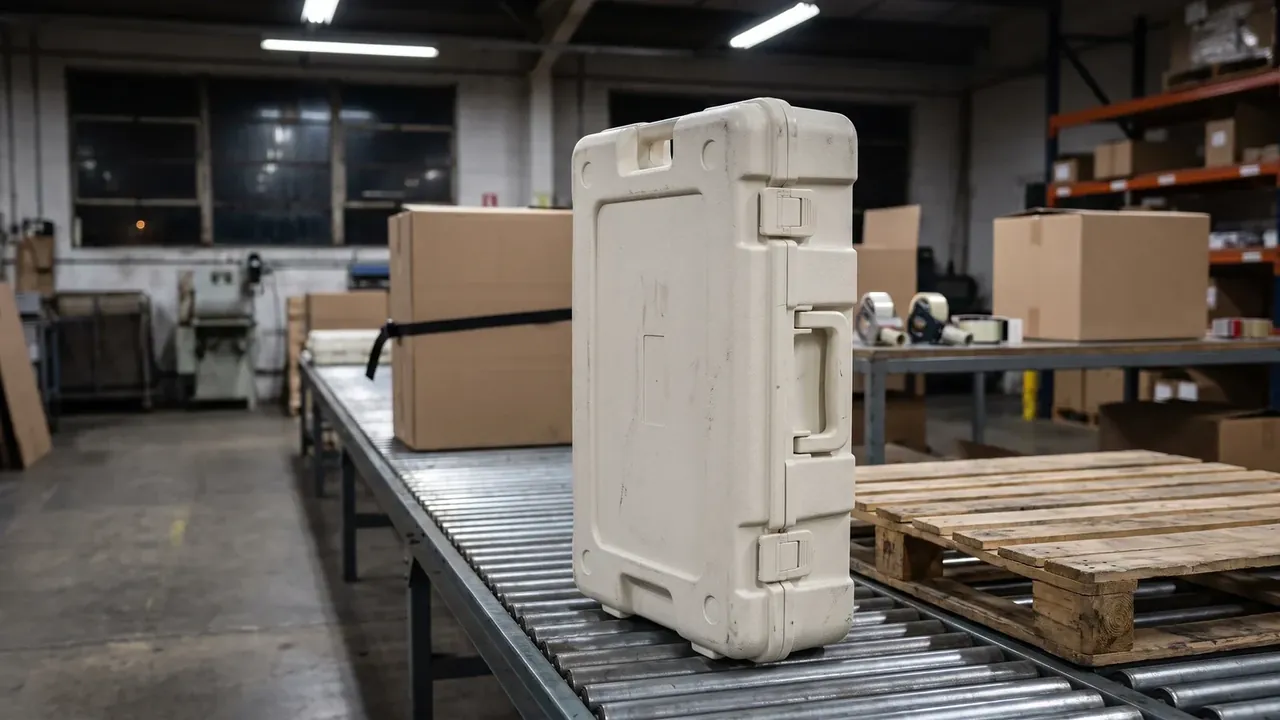
Rim flatness decides even loading, and chalk dust finds the gap: dust the rim, close, open, read where the imprint breaks. A break longer than 30 mm means reworking the mould. A 640 mm case uses a four-section hinge with a 6 mm 316 pin and four latches at 250 to 350 N, bore clearance 0.2 mm.
5. Liner and Base Pallet
An artillery shell box liner has to locate, cushion and still allow removal. The usual build is a 30 kg/m³ EPE clamshell, slot depth at 55 percent of body diameter, the lid liner covering the rest; too shallow and the item lifts in a drop, too deep and fingers cannot grip it.
Dividers hold 8 to 10 mm spacing: 15 mm EPE for two-unit packs, 12 mm EPE on hardboard for four. Under 6 mm, rubbing wears the paint. A 15 mm plywood base pallet spreads 45 kg across the base, and a 3 mm EVA layer stops rib blushing after 2,000 km.
Conclusion
Structure and process add up only when all five paths meet spec: the right resin, a wall that carries the stack, 25 percent gasket compression, hardware rated for the closure count, and a liner that holds the body. Judge one by rim imprint first, corner thickness second, price last. An artillery shell box that passes those three checks rarely fails in the field.
This article discusses only the container (case body) side of specifications and design intent, and does not cover any handling, loading or use of the contents.
Related Reading
- Artillery shell box specifications and load ratings
- Artillery shell box standards and acceptance items
- Structural design points for shell storage containers
- Maintenance and inspection of shell storage containers
Related Products
- 8 Series — Gun Cases; Military Equipment Cases; Camera Equipment Cases; Drone Cases; Watch Cases; Knife Cases; First Aid Cases; Electronics Equipment Cases
- WL8-2812 PP Gun Case — model WL8-2812
- All protective cases and toolboxes: 7 series, 158 models