

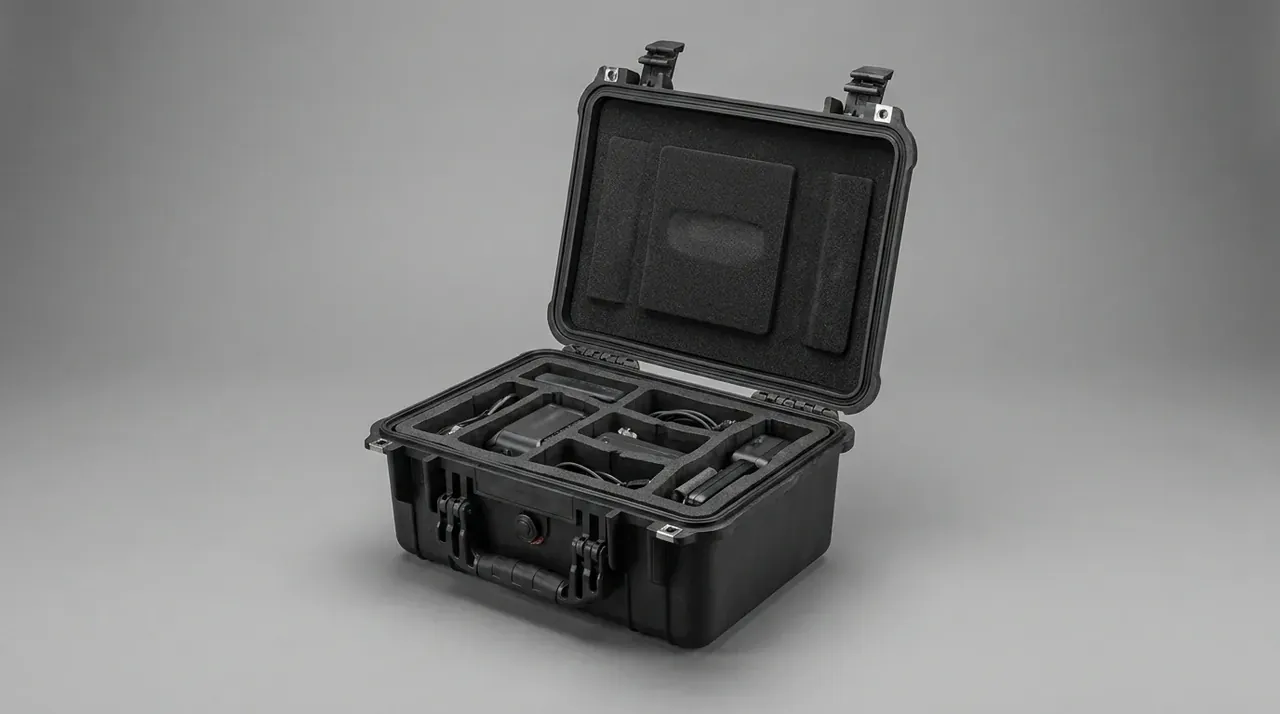
Quick answer: A battery recycling case is judged on two questions: does a 5 L sump pan catch the electrolyte, and does a 300 mm plate identify the box from ten metres?
Table of contents
- Start With the Sump Pan, Not the Walls
- Lining the Shell in 2 mm PP
- What "No Spill at 10 Degrees" Actually Means
- Where the 300 mm Marking Goes
- Vent Holes and the Test Strip Holder
- FAQ
1. Start With the Sump Pan, Not the Walls
Enquiries arrive asking for a wall thickness; the number that decides whether the box works is the pan volume. A 520 × 380 × 220 mm cavity takes a 5 L pan, and 5 L is not a guess: four modules at 200 mL of residual electrolyte each gives 800 mL in the worst case, so the pan carries six times the credible spill. That margin is for movement, not for volume.
Depth matters more than area. A 60 mm pan with a 15 mm flange and R20 corners drains back into itself instead of letting liquid creep under the flange to the base panel. The radius is a cleaning feature: a square corner holds residue that no cloth reaches.
| Pan volume | Fits cavity | Depth | Max gross weight | Stacking |
|---|---|---|---|---|
| 3 L | 420 × 300 mm | 50 mm | 35 kg | 3 high |
| 5 L | 520 × 380 mm | 60 mm | 50 kg | 4 high |
| 8 L | 620 × 450 mm | 70 mm | 65 kg | 4 high |
| 12 L | 720 × 520 mm | 80 mm | 80 kg | 3 high |
| 16 L | 820 × 600 mm | 90 mm | 95 kg | 2 high |
Watch the last two columns. Volume rises, gross weight rises, and stacking height falls, because 80 kg four high puts 240 kg on the bottom flange and PP sags long before it cracks.
2. Lining the Shell in 2 mm PP
The liner is 2 mm PP, thermoformed to walls and base with 20 mm overlaps at every seam. PP survives the solvents found in electrolyte; PE softens and wrinkles within 30 days under the same exposure. That comparison decides the material, and cost has nothing to do with it.
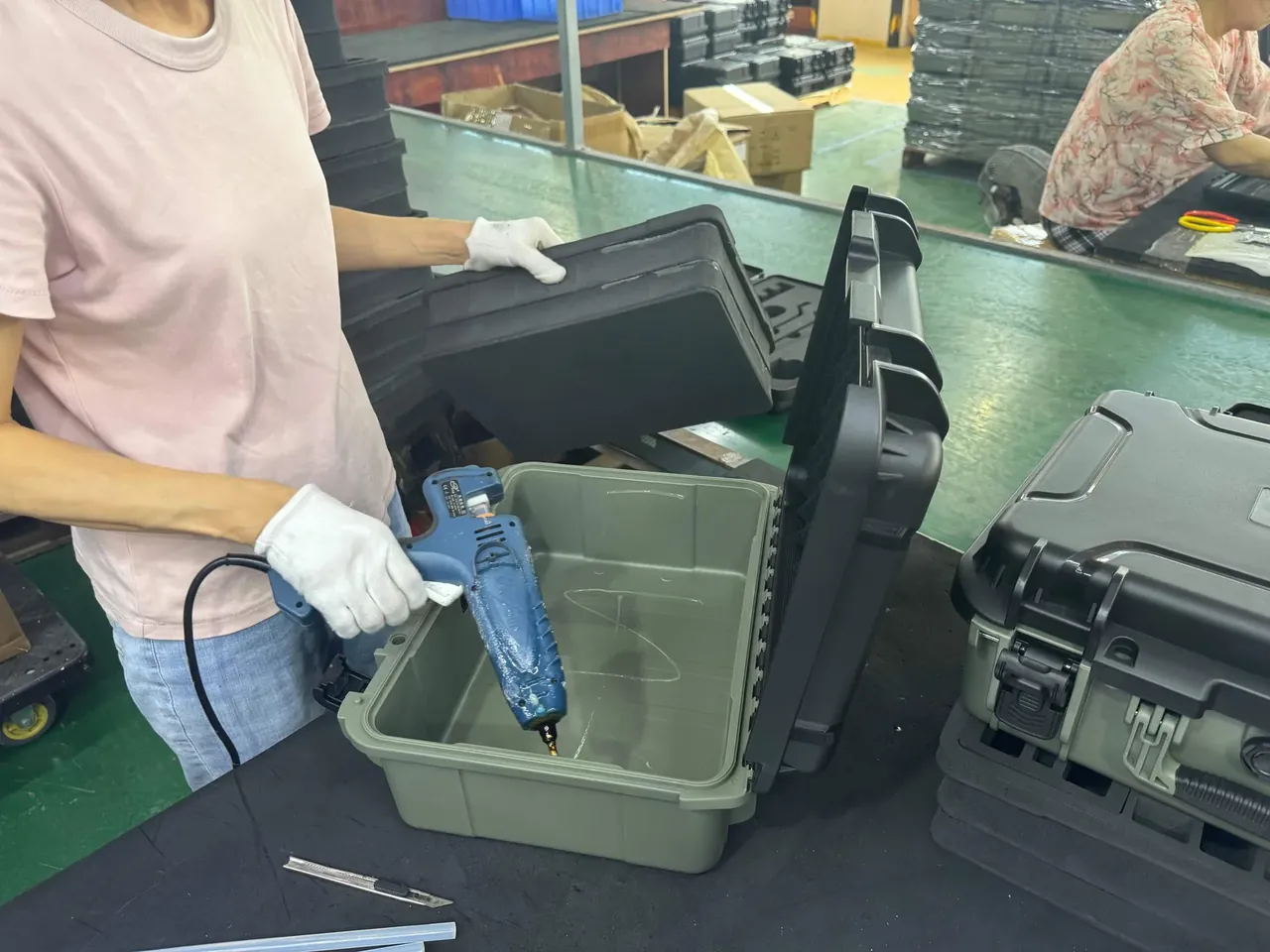
Bonding uses a 6 mm hot-melt bead set 8 mm in from the liner edge and stopped 20 mm short of each corner. A bead that runs into a corner breaks there, and liquid entering the break reaches the space behind the liner, which is the one area no routine cleaning touches. Press within 60 s; below 15 °C the open time halves, so shells are warmed to 20 °C before bonding in winter.
A liner is what makes the inside of the wall washable.
Peel tests run 24 hours later, three points per box, 3 N/cm minimum. Seams are hot-gas welded with an 8 mm bead and sanded flush, because a step in the weld traps liquid the way a square corner does.
3. What "No Spill at 10 Degrees" Actually Means
The claim holds only below a stated fill level, which is where most specifications fall apart. A 5 L pan over a 480 × 340 mm floor holds a rated 12 mm, roughly 2 L. Tilt it 10° and the surface climbs about 30 mm along the pan, leaving 18 mm of freeboard at the low end. Fill the same pan to 5 L and 10° spills every time.
| Tilt | Fill level | Freeboard, low end | Verdict | Fix |
|---|---|---|---|---|
| 0° | 12 mm | 48 mm | holds | standard rim |
| 5° | 12 mm | 33 mm | holds | standard rim |
| 10° | 12 mm | 18 mm | holds | 15 mm flange |
| 10° | 30 mm | 0 mm | marginal | add weir |
| 15° | 12 mm | 3 mm | marginal | lid-side lip |
A 25 mm weir around the rim buys another 5°, provided it is notched: two 8 mm gaps let liquid cross only when the level reaches the crest.
Tilt is unavoidable: ramp angles, forklift pitch and settled yard surfaces each deliver 8° to 12°, which is why rim height is calculated against 10°.
4. Where the 300 mm Marking Goes
The marking is 300 × 300 mm with R20 corners, reverse-printed on 1.5 mm aluminium with a 5 mm white border, set on the front face 150 mm above the base, 80 mm clear of the catch.
Preparation decides whether it stays. Release agent left on the shell lifts an adhesive layer within three months, so the area is wiped twice with isopropanol, flashed off for 10 minutes and checked for 38 mN/m of surface energy. Apply above 15 °C, roll three passes, keep corner lift under 1 mm.
The number and class printed on the plate come from the shipper. The case side owns size, position and adhesion.
Weathering is tested as a cycle: 20 cycles between -20 °C and 60 °C without cracking, 200 hours of UV without fade, and a 24 hour soak with corner lift under 2 mm. The soak is what fails in practice, because one bubble between plate and shell lets water in, and the first frost pushes the decal off.
5. Vent Holes and the Test Strip Holder
Two 10 mm vents sit high on the side walls behind splash guards. A sealed shell develops roughly 3 kPa across a 20 °C swing, and opening it releases suction strong enough to lift liquid off the pan surface.
The guard is a 45° deflector, so splash runs back down. A 0.3 mm hydrophobic membrane on the outside passes air and blocks liquid, and is replaced rather than cleaned.
The strip holder sits on the front wall inside, 80 mm up, holding three strips and a colour chart. The strips confirm a washed liner is free of residue and play no part in process decisions. Replace every 90 days, and every 60 in the wet season.
Gross weight is capped at 50 kg and stacking at four high, 150 kg on the bottom case. None of that load may pass through the pan rim: the four corner posts of the shell carry it, and a 5 mm gap under the pan gives it room to deflect.
Conclusion
Two features do the work: a 5 L pan at 60 mm depth with a 15 mm flange, and a 300 × 300 mm plate set 150 mm above the base. Around them sit the details that keep those two honest, a 2 mm PP liner on a 6 mm bead, a 25 mm notched weir, two 10 mm vents and a strip holder replaced on schedule. Get the positions and volumes right and a battery recycling case stays leak-tight in the yard and legible at a distance, which is the whole brief.
Related Reading
- Compliance and restraint for retired battery transport
- Isolation and fixing inside lithium battery cases
- How to specify a battery safety case
- What the case contributes to an air freight declaration
Related Products
- 8 Series — Gun Cases; Military Equipment Cases; Camera Equipment Cases; Drone Cases; Watch Cases; Knife Cases; First Aid Cases; Electronics Equipment Cases
- WL8-2812 PP Gun Case — model WL8-2812
- All protective cases and toolboxes: 7 series, 158 models