

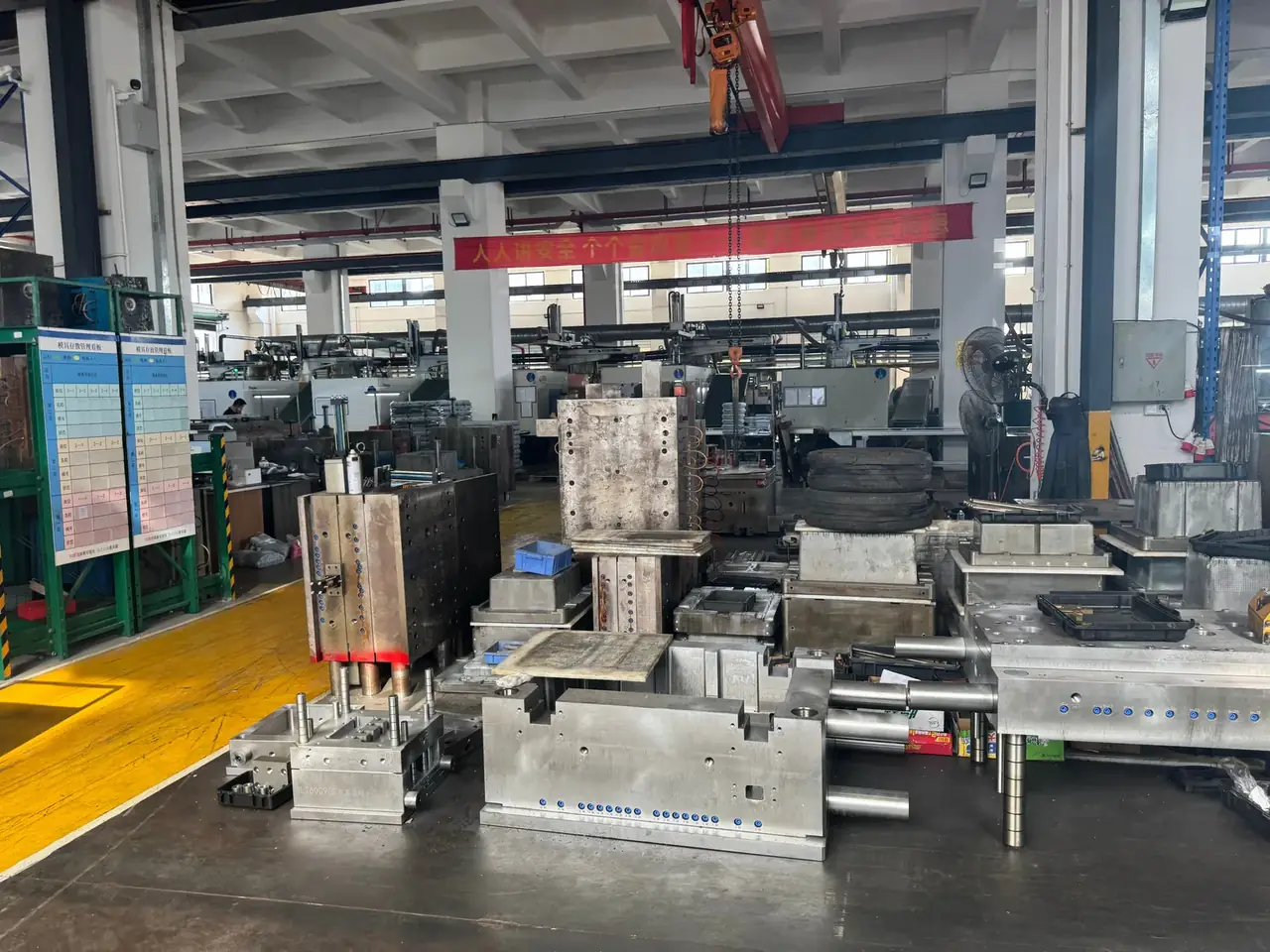
Quick answer: Custom blow-molded cases are drawn backwards from the tool: three machines scanned to 0.5 mm, 2 mm pockets, 3.5 mm double walls and ±1.5 mm on the shell.
Table of contents
- Sampling the Tool Envelope
- Separate Pockets for Battery Pack and Handle
- Where PE Ends and PP Begins
- Silk Screen Colour and Brand Consistency
- Matching the Assembly Line Takt
- FAQ
1. Sampling the Tool Envelope
The hard part of Custom Blow-Molded Cases is not drawing a box; it is getting one gloved hand to push a battery pack home. Work starts at the machine: a drill chuck, a grinder guard and a hammer nose each leave a recess, and one missed bulge turns into a tool change.
Sampling uses 3 machines: a stock unit, one with a charged battery pack, one with the auxiliary handle on. Stacked, the three outlines give the real envelope. Scan tolerance is 0.5 mm even though a metrology scanner reaches 0.02 mm, because 0.5 mm absorbs mesh simplification and tool compensation.
| Machine part | Capture | Clearance | Retention | Note |
|---|---|---|---|---|
| Drill body | Chuck axis against grip | 2 mm | Ribs both sides | 30 mm at the chuck |
| Grinder guard | Largest guard diameter | 2 mm | Cradle plus side stop | Sized on the largest |
| Hammer nose | Nose overhang | 2 mm | Front ring shoulder | Overhang relieved |
| Battery pack | Latch and contacts | 2 mm | Slides in sideways | Finger room counted apart |
The outline then meets shrinkage: HDPE 1.5%-3.0% and PP 1.0%-2.5%, so the cavity is scaled; blow moulding also spreads wall thickness unevenly. Custom Blow-Molded Cases are therefore specified as ranges, with the shell held to ±1.5 mm.
2. Separate Pockets for Battery Pack and Handle
In Custom Blow-Molded Cases the battery pack is the only item with a direction, a latch and contacts, so its pocket cannot follow the outline. One side stays open, the pack slides on a rail until the latch clicks, and the entry leaves room for a gloved thumb: 2 mm of glove, 2 mm more space.
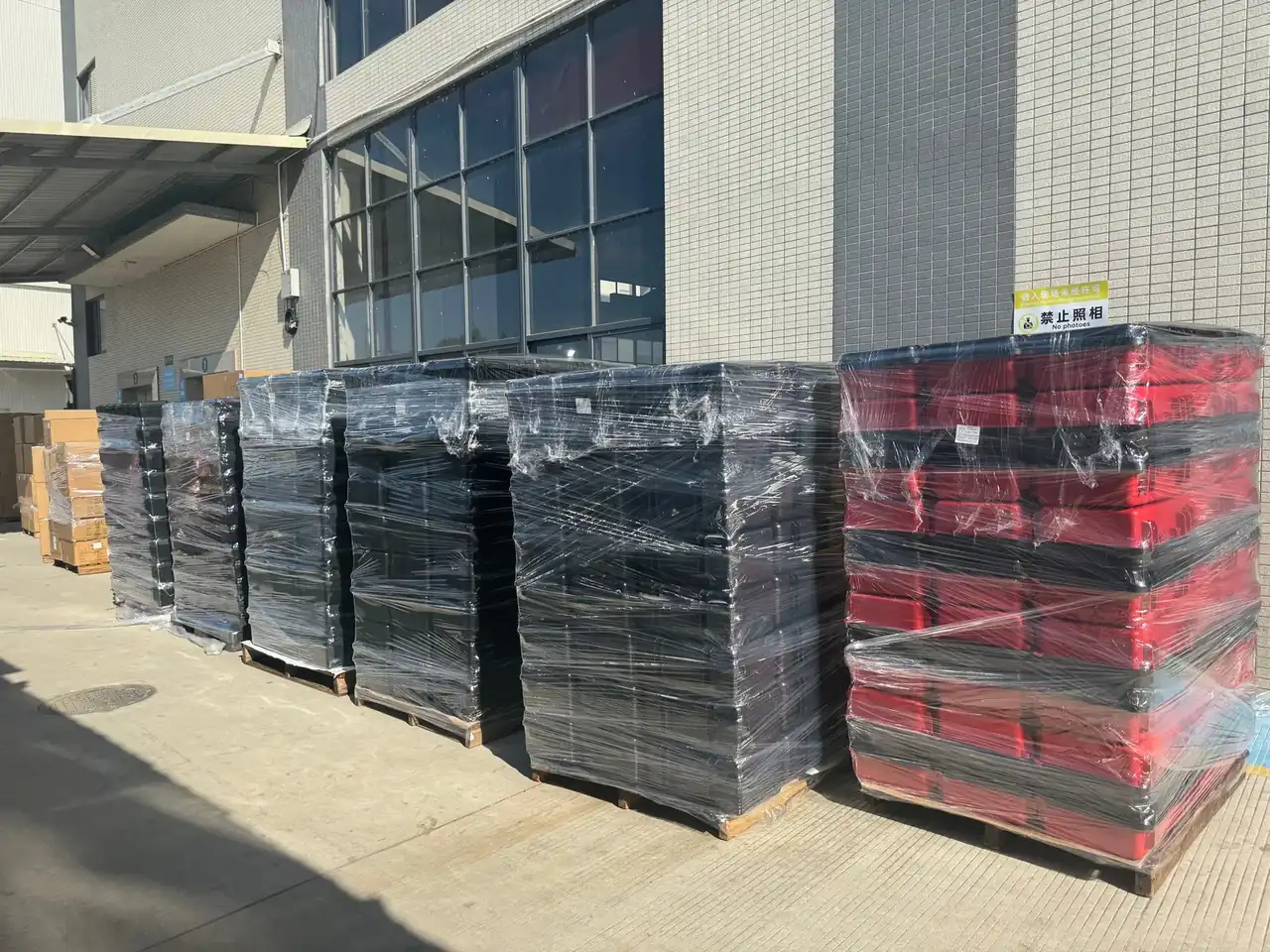
The auxiliary handle needs its own pocket because it detaches, reverses and runs longer than the body; in the main pocket it lets the body shift. A half-open channel takes it crosswise and releases it in one pull. Case verdict: over 2 mm of movement once the tool is seated, or a pack that needs a tool to come out, sends that pocket back to the mould.
| Depth | Relief | Handling | Criterion | |
|---|---|---|---|---|
| Battery bay | Pack thickness plus 2 mm | 15 mm finger gap | Slide until the latch clicks | One hand, no tools |
| Auxiliary handle | Diameter plus 2 mm | 5 mm at each end | Crosswise in, then press | Out in one pull |
| Main cavity | Largest outline plus 2 mm | 30 mm void at the chuck | Drops in vertically | Under 2 mm of play |
| Accessory bay | 30 mm general depth | 3 mm rib to the main cavity | Lay flat | Never presses the tool |
Ribs between pockets are not optional: they hold each item and spread the closing pressure. Without them, Custom Blow-Molded Cases let tool and accessories knock together in transit, and 2 mm of play passes 5 mm.
3. Where PE Ends and PP Begins
Custom Blow-Molded Cases here run a 3.5 mm wall over a 4-8 mm hollow core, and the trapped air absorbs impact. With the wall fixed, PE and PP both blow in the same cavity, but their windows differ.
PE brings low-temperature toughness and chemical resistance, with no cracking at minus twenty and no swelling from coolant; its weakness is stiffness, so it creeps under steady load. PP is stiffer, more heat resistant and about 15% lighter in the same cavity, yet it turns brittle near zero and cracks in a cold drop.
| Material | Density | Shrinkage | Where it fits | Where it fails |
|---|---|---|---|---|
| HDPE | 0.94-0.96 g/cm³ | 1.5%-3.0% | Cold sites, oily workshops | Hold under steady load |
| PP | 0.90-0.91 g/cm³ | 1.0%-2.5% | Room-temperature storage | Drops below zero |
| PE blend | 0.93-0.95 g/cm³ | 1.5%-3.0% | Cost and toughness together | Stiff structural parts |
The line sits on machine weight and shipping temperature: a rotary hammer that travels in all weather goes into HDPE, a drill kit sold at room temperature gains from the lighter PP. Custom Blow-Molded Cases need not use one resin throughout: lid and body can split by strength demand.
4. Silk Screen Colour and Brand Consistency
Silk screen is the only part of Custom Blow-Molded Cases that faces the brand directly. The colour is pinned to the brand swatch, then converted to an ink formula; a new batch is proofed before it runs, with ΔE held at 1.5 or below. Past 1.5 the eye reads two shells as different lots, and past 3 the batch is rejected.
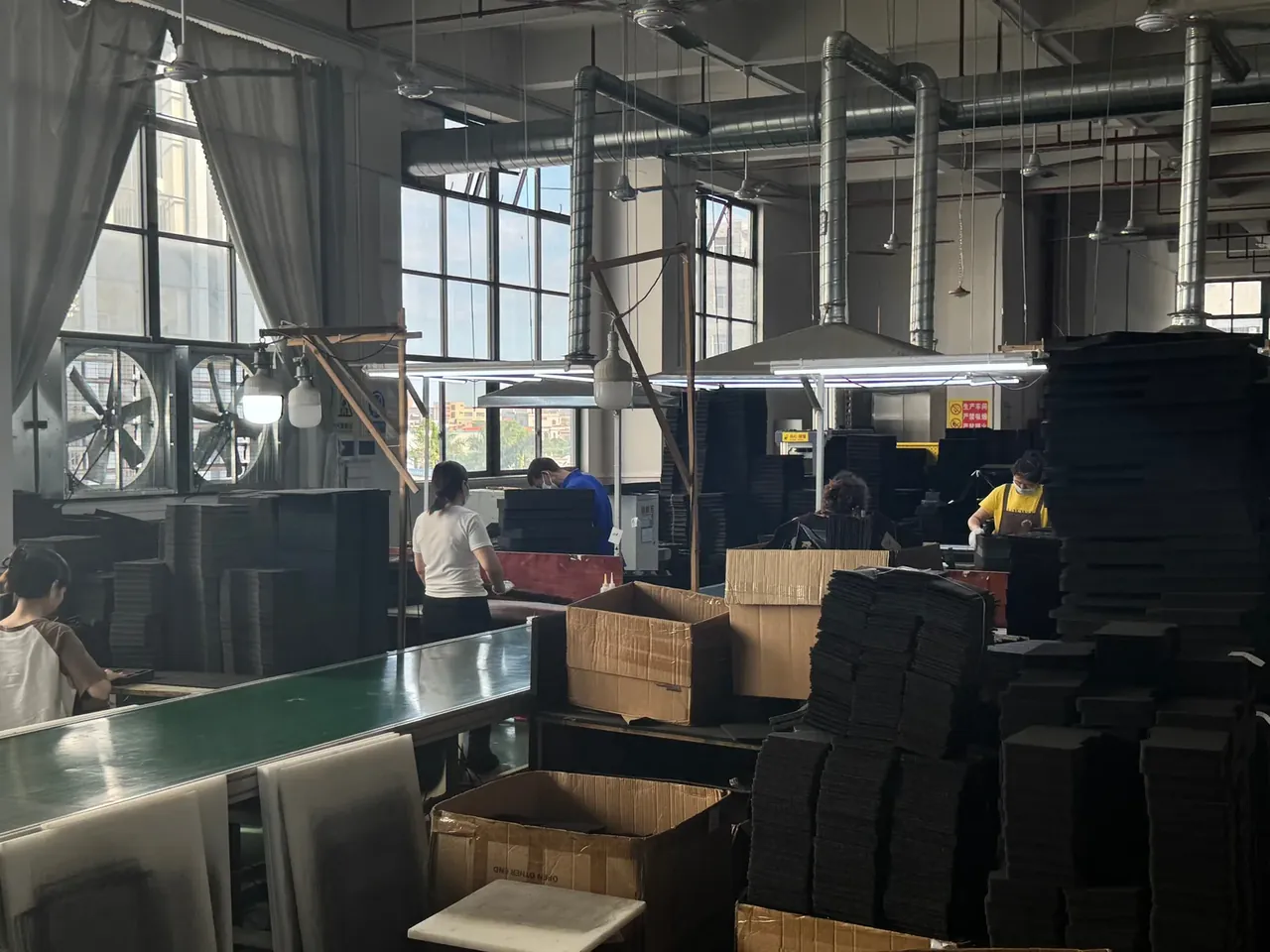
PE and PP are low-surface-energy materials, so adhesion depends on pre-treatment. Flame or corona treatment raises surface tension for the ink to key, and because that energy decays, it is re-measured before printing.
Print placement avoids the back of a pocket, where the wall is stretched thinnest and the ink shows through pale; between ribs, adhesion and appearance both hold. Position is kept to ±1 mm.
5. Matching the Assembly Line Takt
The line runs a 45 second takt, so the box is opened, loaded, closed and set down inside it. A single blow mould cycles in 60-120 seconds and cannot keep up, so Custom Blow-Molded Cases are scheduled across 2 or 3 parallel moulds, or buffered with a day of stock.
Sampling takes 12 days and the run starts at 1,000 pieces. Sampling produces 3 boxes: one for trial fit, one for a drop, one for colour proofing; all three pass before release.
Loading order decides whether the takt holds: tool into the main cavity, pack into the side bay, handle in last, lid closed once. Reverse it and the pack is trapped, the operator lifts the tool out, and 45 seconds is gone. A foam lining in the lid takes up the remaining height: too thick, the lid needs force; too thin, the tool bounces until play passes 2 mm.
Related Reading
- Specifying a custom blow moulded case
- How blow moulding works step by step
- Injection moulded tool box applications
- Custom EVA foam inserts
- Usable internal volume after corners
Related Products
- 8 Series — Gun Cases; Military Equipment Cases; Camera Equipment Cases; Drone Cases; Watch Cases; Knife Cases; First Aid Cases; Electronics Equipment Cases
- WL8-2812 PP Gun Case — model WL8-2812
- All protective cases and toolboxes: 7 series, 158 models