

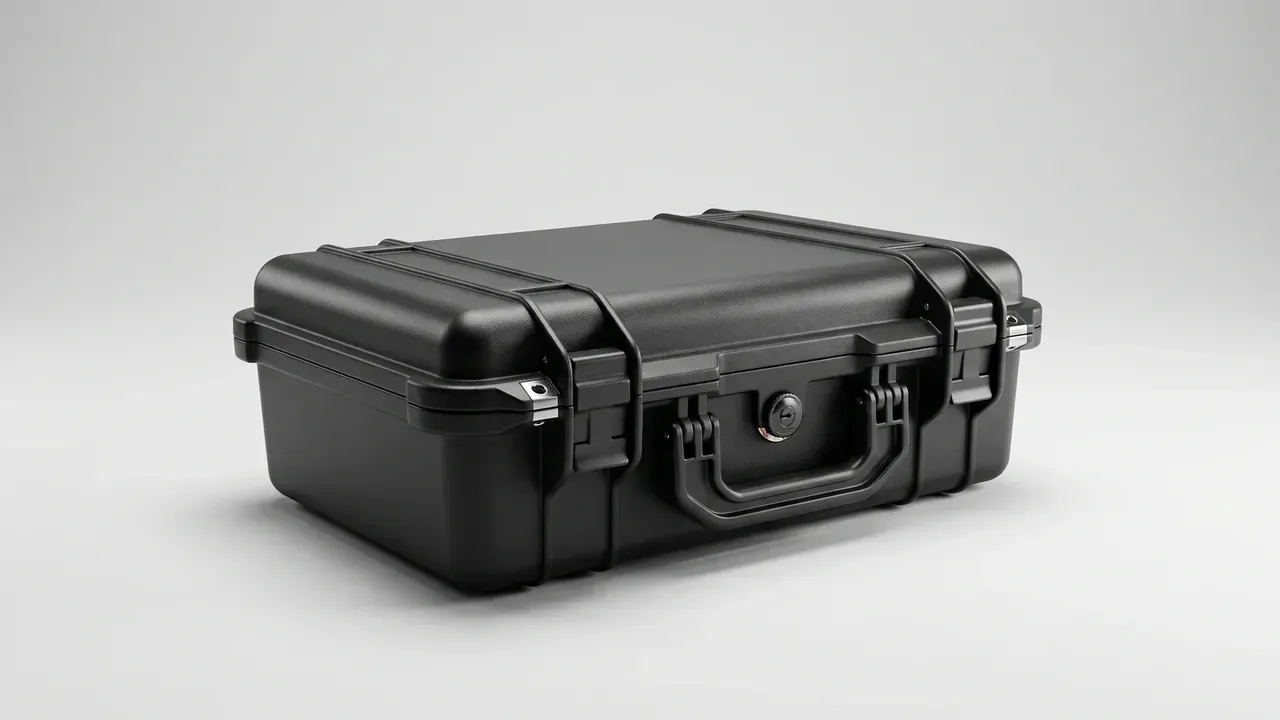
Quick answer: A box, packing, ammunition grade, is three parts in one shell: a moulded body, an insert, and hardware. Performance rests on the heat-and-cool window, on how uneven the wall really is, and on the compression rate of the lid gasket. Those three decide the four dimensions on the drawing.
Table of contents
- Three Parts: Shell, Insert, Hardware
- Six Steps, and Which One Decides the Outcome
- Why Wall Thickness Cannot Be Even
- Sealing: A Gasket Ring or a Groove
- What the Hardware Costs in Service Life
- Four Dimensions to Fix Before Anything Else
- FAQ
1. Three Parts: Shell, Insert, Hardware
Take one apart and there are three parts. The shell is a hollow one-piece moulding with no weld seam and no injection gate. The insert sets compartments and cushioning. The hardware decides whether it opens a few thousand times, stacks and locks.
| Part | Usual build | How it fails |
|---|---|---|
| Shell | Rotomoulded HDPE, one piece, wall 4.2 mm | Thin corners bulge, then split after a drop |
| Insert | Die-cut EPE or EVA, or moulded EPP | Compartments collapse and the load shifts |
| Hardware | Catches, hinges, relief valve, lock | A catch loosens, the lid gap opens, water follows |
The shell carries over 60 percent of the cost and cannot be reworked. Once fixed, the tool and wall stay with the product.
2. Six Steps, and Which One Decides the Outcome
The cycle runs six steps: compound, loading, heating, cooling, demoulding, assembly. Powder goes in at 35 mesh with 2 percent masterbatch. Clamp bolts take 45 N·m; one setting short leaves a thin powder line. Heating runs at 260 degrees Celsius on two axes, eight rpm and six. Cooling is twelve minutes of forced air, below 60 degrees before the mould opens. A full cycle is 26 minutes: fourteen heating, twelve cooling. Heat too briefly and the powder never fuses, leaving pinholes. Heat too long and it flows, piling at corners and thinning vertical walls. Cool too fast and the shrink is uneven, so lid and base no longer meet at the tongue.
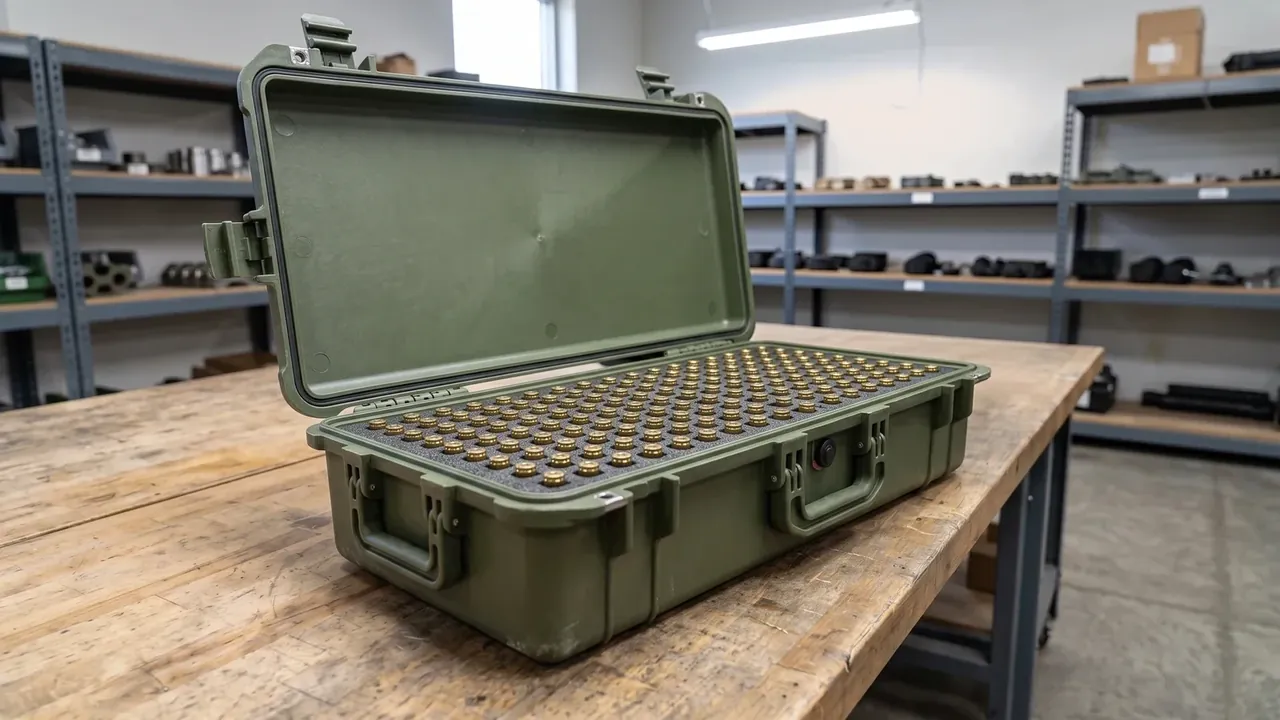
Assembly is the step everyone underestimates. If one of four catch holes sits a millimetre off, the lid needs force and the seal goes.
3. Why Wall Thickness Cannot Be Even
Moulding builds the wall by sticking powder to a hot mould, and gravity pulls powder downhill, so the wall is uneven. Vertical faces run thin, corners and rib roots thick, with 1.5 mm of spread on one case.
| Measuring point | Typical wall | Direction |
|---|---|---|
| Centre of the lid | 4.0 mm | thin |
| Centre of the side | 4.3 mm | close to nominal |
| Centre of the base | 4.6 mm | thick |
| Corner radius | 5.2 mm | clearly thick |
| Rib root | 5.6 mm | thickest |
| Lid tongue | 4.1 mm | thin |
A drawing that says 4.2 mm means the thinnest reading may not fall below 3.6 mm. Put that in the annex and inspection has a criterion.
4. Sealing: A Gasket Ring or a Groove
The seal is not the gasket but the fit between gasket and groove. The lid carries a twin-lip EPDM gasket in a groove 6 mm wide and 5 mm deep, compressed 25 to 30 percent on closing. Too little and water passes; too much and the rubber takes a set.
Hold the groove to plus or minus 0.2 mm. Widen it half a millimetre and compression drops under 15 percent, which 30 minutes of immersion finds.
5. What the Hardware Costs in Service Life
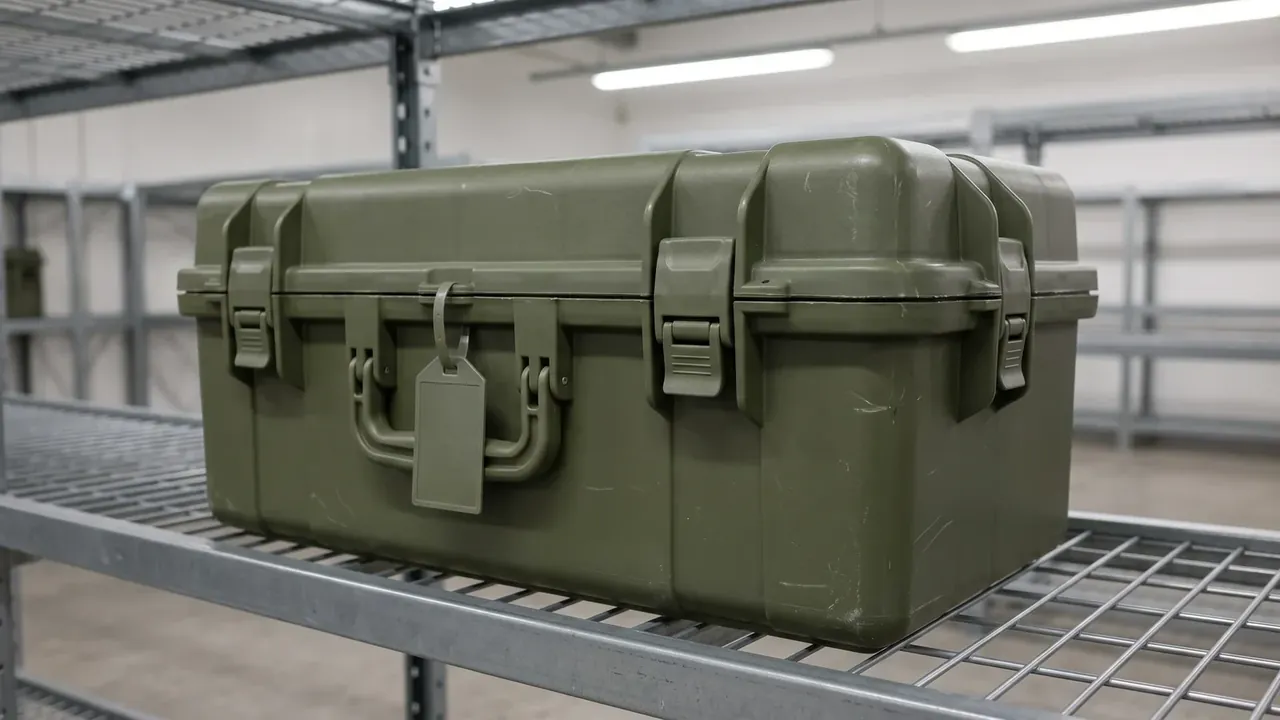
However thick the shell, hardware fails first. Each item has its service figure:
- Catches: glass-filled PA66 or 304 stainless, rated 5,000 cycles. Plastic turns brittle in cold and snaps its hook at minus 20 degrees.
- Hinges: 8 mm pins, two across a 380 mm span. Widen the span and the lid rim warps.
- Relief valve: opens near 0.3 bar to balance pressure from temperature swings. Without it, a lid that flew at altitude will not release.
- Lock: zinc alloy body with a brass cylinder, rated 2,000 key cycles. The padlock tab needs 3 mm of wall or it deforms under a lever.
6. Four Dimensions to Fix Before Anything Else
The first is internal volume, worked back from the load, usually 700 x 380 x 260 mm. The second is tongue depth, where 12 mm balances sealing against release. The third is hardware-to-edge distance, no less than 18 mm, or a drop tears the edge. The fourth is the stacking pad, 25 mm or more, so three-high stacks do not crush a corner.
Draw the envelope first and squeeze the interior later, and the wall pays.
Conclusion
The structure is simple: one moulded shell, one insert, four hardware items. The hard part is holding the window on six process steps, stating wall deviation honestly, and writing gasket compression into the drawing. Get those three right, and a box, packing, ammunition grade, still survives three-high stacking, a 1.2 m drop and 30 minutes under water.
This article discusses only the container (case body) side of specifications and design intent, and does not cover any handling, loading or use of the contents.
Related Reading
- Four generations of ammunition box design
- How CBRN and conventional boxes differ
- Inspection items and pass criteria
- How fibre-reinforced bodies are formed
- Six materials compared side by side
Related Products
- 8 Series — Gun Cases; Military Equipment Cases; Camera Equipment Cases; Drone Cases; Watch Cases; Knife Cases; First Aid Cases; Electronics Equipment Cases
- WL8-2812 PP Gun Case — model WL8-2812
- All protective cases and toolboxes: 7 series, 158 models