

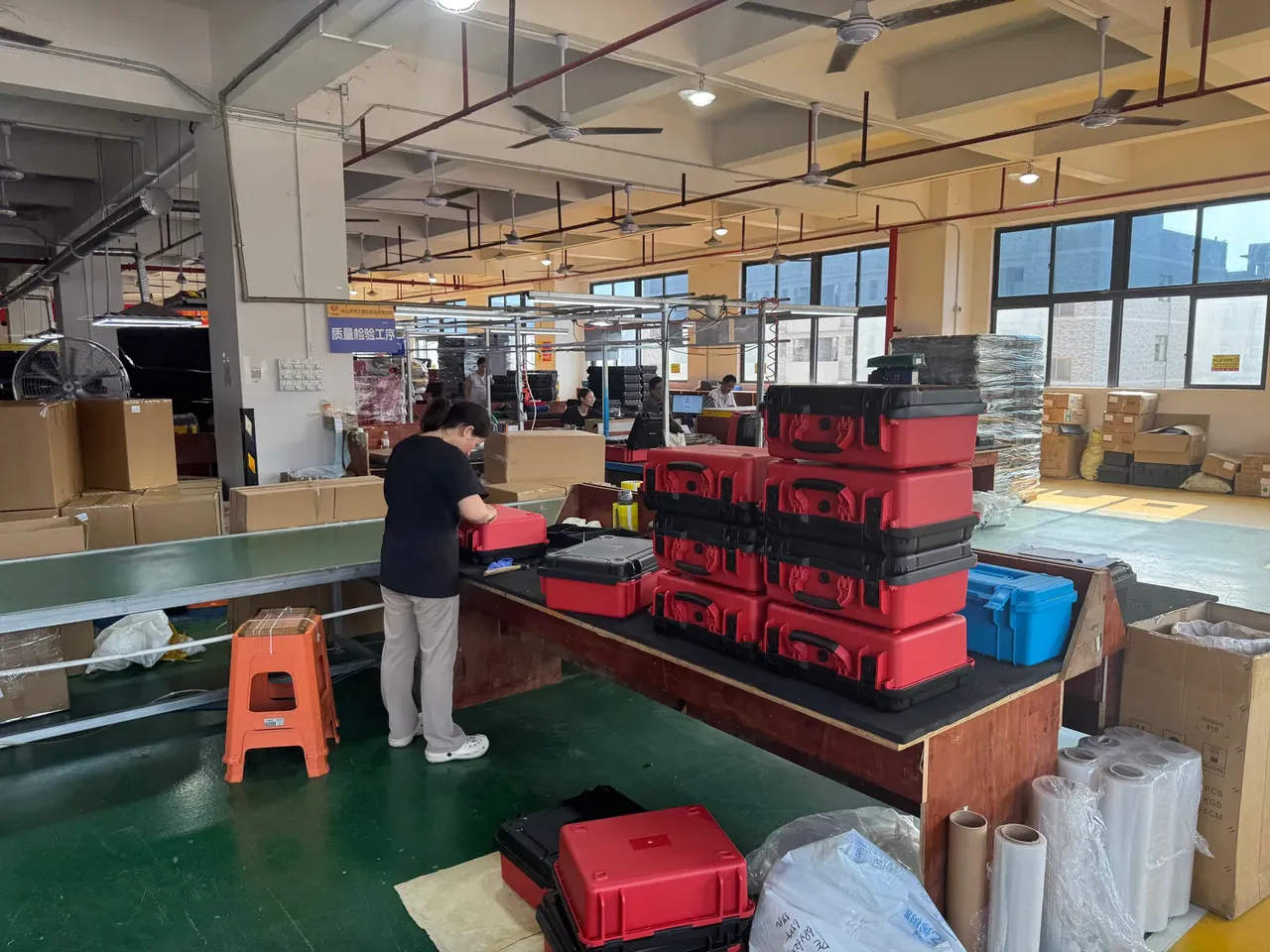
Quick answer: A case opening type is a choice of hand movement: a top lid swings on the rear edge and needs overhead clearance equal to the case depth, a front panel swings on a vertical axis and claims one door width ahead, and a dual case stacks both while its seal grows from 1896 mm to 3172 mm.
Table of contents
- Three Opening Paths and Where the Hand Enters
- Top Opening: Lift Height and Strut Force
- Front and Dual: How Long the Seal Path Is
- Measuring Clearance in Three Places
- FAQ
1. Three Opening Paths and Where the Hand Enters
Top, front and dual are the whole list, and only the hand direction separates them. Take a 520 × 428 × 210 mm case: the top lid puts the rim at 210 mm, so the hand drops in vertically; the front frame is 428 mm wide, so the hand slides in horizontally; a dual case offers both.
The motion then decides the bench: standing inspection costs a 15° wrist tilt with a top lid, while a case strapped into a rack needs a front panel to be reached without undoing the strap.
| Opening type | Motion | Space claimed | Seal perimeter | Hinges |
|---|---|---|---|---|
| Top | Lid swings 90° to 105° on the rear axis | Upward, depth plus height | 1896 mm | 2 |
| Front | Panel swings 90° to 110° on a vertical axis | Forward, one door width | 1276 mm | 2 |
| Dual | Lid lifts and front panel swings | Upward plus forward | 3172 mm | 4 |
Direction sets how much room the station leaves; perimeter sets how much force closure demands. At 1 mm of gasket compression and 0.35 N/mm, 1896 mm needs 664 N and 3172 mm needs 1110 N, so the 446 N gap is what a dual case pays for sealing.
2. Top Opening: Lift Height and Strut Force
A top lid claims volume rather than area. Swinging on the rear axis, its far edge rises to 638 mm above the case bottom at 90°, which is 210 mm of height plus 428 mm of depth, and 30 mm of glove allowance pushes the requirement to 670 mm.
When clearance runs short the angle goes first: at 620 mm the lid stops at 73°, the hand meets the rib on its edge, and the opening narrows from 428 mm to about 300 mm. The strut also works harder, since its arm is the mounting distance times the sine of the angle, and that sine falls from 0.5 to 0.42, so it must deliver 19% more force.
Work it from lid mass. A 1.6 kg lid weighs 15.7 N with its centre 214 mm from the axis, giving 3.36 N·m at 90°. A strut fitted 150 mm from the axis at 30° has a 75 mm arm and must push 44.8 N; a 60 N gas strut covers it, and at -20 ℃ pressure drops 12% to 52.8 N, still enough.
Above 600 mm of lid width a single strut bows the lid by 2 mm and the gasket on the low side never compresses; two struts 300 mm from each edge bring that back to 0.4 mm. On the hinge side only spacing matters: hinges 300 mm apart carry 7.85 N each, and at 200 mm each takes 11.8 N, forcing the boss pad from 2 mm to 3 mm.
3. Front and Dual: How Long the Seal Path Is
A front panel runs a 1276 mm seal, 620 mm shorter than the top lid, so clamping force falls from 664 N to 446 N, a third less effort to close. The cost sits in the corners: below an 8 mm radius the gasket thins by 15%, and a 1 m, 30-minute immersion leaves a trace.
A door is a flat plate, so stiffness comes from thickness: on a 428 × 210 mm panel, 3 mm walls deflect 1.2 mm under a 50 N push and 4 mm walls halve it. Once the panel dishes, the middle of the gasket lifts and the corners carry everything, so a front case adds 1 mm of wall or a 12 mm rib.
A dual case carries two seals on one body: 3172 mm, eight corner joints, four clamping points. Lid and panel run separate clamping paths, and neither covers for the other, which is why dual units stall near 0.6 kPa in a decay test. Longer paths need a stiffer body: 1110 N pushes back on the walls, a 520 mm side bulges 0.8 mm under 555 N and eats a third of the gasket compression, so two vertical ribs pull it back under 0.3 mm.
4. Measuring Clearance in Three Places
Three readings are enough: bench to the underside above, case front edge to the nearest obstacle, and where the operator stands. Measure to the millimetre, because 620 mm and 638 mm are the difference between 73° and 90°.
| Workstation | Overhead | In front | Suggested type | Why |
|---|---|---|---|---|
| Open inspection bench | 1000 mm+ | 600 mm+ | Top | Look down, hand drops in |
| Shelf bay, 620 mm underside | 620 mm | 900 mm+ | Front | A top lid reaches only 73° |
| Vehicle rack, strapped down | 350 mm | 700 mm | Front, drop-down | Reach in without unstrapping |
| Two stations, one seated | 900 mm+ | 800 mm+ | Dual | Each action serves a side |
Read the numbers from the case in its working position: under a 640 mm shelf a 210 mm case opens to 89°, leaving 2 mm that a glove will close, and sliding it 80 mm forward restores the angle. A dual case needs both readings, since 500 mm in front blocks the aisle.
Put both figures on the enquiry: 620 mm overhead and 900 mm in front, and no supplier quotes a top-opening case by default.
Conclusion
Matching a case opening type to a workstation is arithmetic. A top lid needs 638 mm above the bench at 90°, or 670 mm with glove allowance, and 620 mm leaves it at 73° with the opening cut from 428 mm to 300 mm. A front panel needs one door width plus standing room, about 900 mm, and returns a third of the clamping effort. A dual case earns its place only when two sides load at once, and pays with a 3172 mm seal and 1110 N. Measure the bay, then the opening, then the size.
This article discusses container-side specifications and design implications only, and does not cover any handling, loading or use of the contents.
Related Reading
- Lid angle and hinge life
- Choosing a case seal strip and its compression
- How reinforcement ribs are laid out
- Sizing a case from its interior dimensions
Related Products
- 8 Series — Gun Cases; Military Equipment Cases; Camera Equipment Cases; Drone Cases; Watch Cases; Knife Cases; First Aid Cases; Electronics Equipment Cases
- WL8-2812 PP Gun Case — model WL8-2812
- All protective cases and toolboxes: 7 series, 158 models