

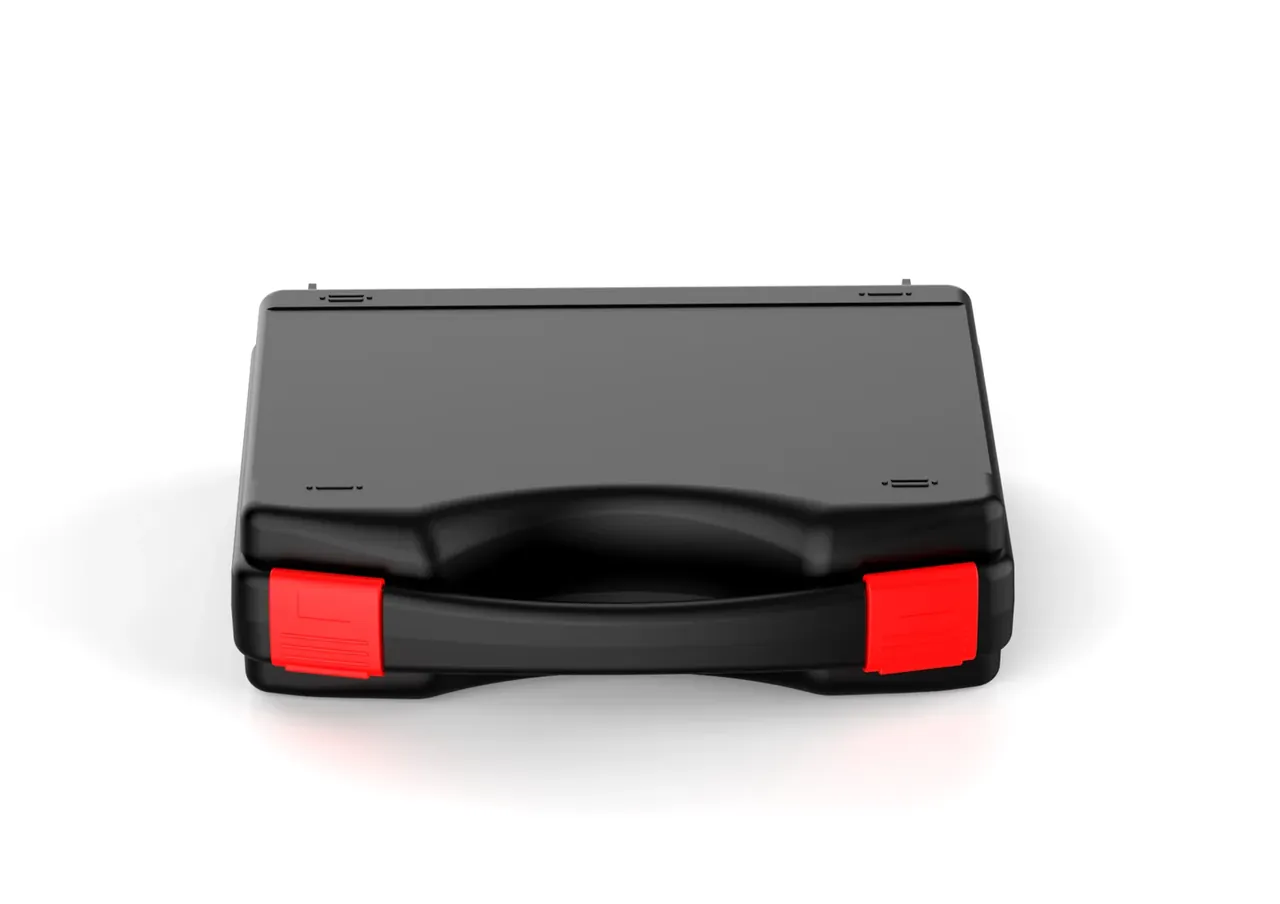
Quick answer: Maintenance in case raw material preparation is not about replacing parts. Hold the store humidity, the dryer air temperature and the regrind count, and a material that ran twice can safely run six times.
Table of contents
- Inspection points and judgement lines
- Storage: stacking height and dew point
- Dryer and hopper checks
- Regrind cycles: limits and the log
- Colour and contamination: purging between colours
- Abnormal handling: re-dry, downgrade, scrap
- FAQ
1. Inspection points and judgement lines
The weak point is not the scale but the bag mouth. A 25 kg sack left open overnight takes on 0.3 percent moisture, and 90 minutes in the dryer will not bring it back to the limit.
Inspection runs at three levels: three points per shift, one measurement per week, one clean-out per month, each with its own limit and action.
| Point | Frequency | Limit | Action when exceeded |
|---|---|---|---|
| Bag mouth and tie | Once a shift | Closed, upright | Tie at once; over 4 hours open, downgrade |
| Hopper level and feed pipe | Once a shift | Above the low mark | Top up and check the pipe for leaks |
| Dryer return air | Once a shift | Within 5℃ of setpoint | Stop, reload, check heater and fan |
| Granule moisture | Weekly | 0.06 percent for regrind | Re-dry 90 minutes, then retest |
| Silo and floor | Monthly | No spillage, no oil | Sweep, run the magnet, relabel |
The sheet hangs at the store door and is signed each shift in case raw material preparation; a signature makes someone walk to the hopper and look.
2. Storage: stacking height and dew point
Three layers of 25 kg sacks is the ceiling. A fourth presses the bottom row into slabs over 3 months, granules fuse, and the granulator runs 20 minutes longer on every batch.
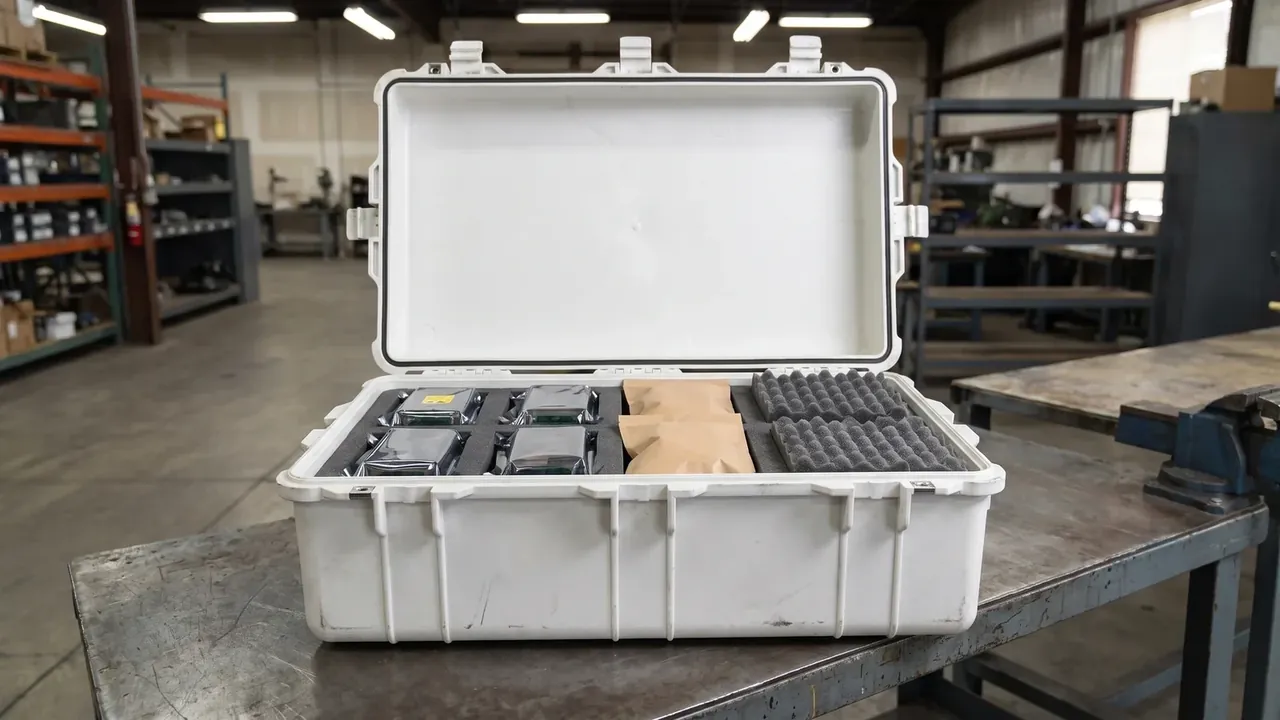
Pallets sit 150 mm off the floor and 300 mm off the wall, so ground moisture has somewhere to go. In a wet season a store can hold 85 percent relative humidity, and sacks closer than 100 mm to a wall condense first.
Opening is decided by dew point. Above -18℃, vapour condenses onto cool granules, and a handheld meter gives that reading in 10 seconds. Use an opened bag within 4 hours, then tie it with a desiccant sachet.
Hold about 3 months of stock, roughly 8 tonnes a delivery; treat 12 months as shelf life, past which colour drifts. Never put two colours in one bay, where a 25-minute purge stretches to 40.
3. Dryer and hopper checks
Dryers rarely fail outright. Return air drifts, airflow falls, dew point climbs, and the defect appears 30 days later.
| Check | Frequency | Pass line | Tool |
|---|---|---|---|
| Return air against setpoint | Per shift | Within 5℃ | Machine display, written log |
| Drying airflow | Weekly | At least 85 percent of nameplate | Anemometer at the outlet |
| Desiccant condition | Every 500 hours | No dust, no colour shift | Sight glass |
| Dew point | Quarterly | Below -20℃ | Calibrated handheld meter |
| Hopper residence time | Per shift | Under 30 minutes | Handover record |
Granules in the hopper beyond 30 minutes go back to the dryer, regrind especially. Regrind has seen one heat history and picks up moisture twice as fast, so 75℃ for 2 hours suits virgin stock while regrind needs 90 minutes more.
Desiccant is a consumable. Powdered desiccant looks present but holds 30 percent of its capacity, and one dew point reading exposes it.
4. Regrind cycles: limits and the log
How far regrind can be pushed depends on records, not feel. Mark the sack once per cycle; the sixth mark sends it to downgrade.
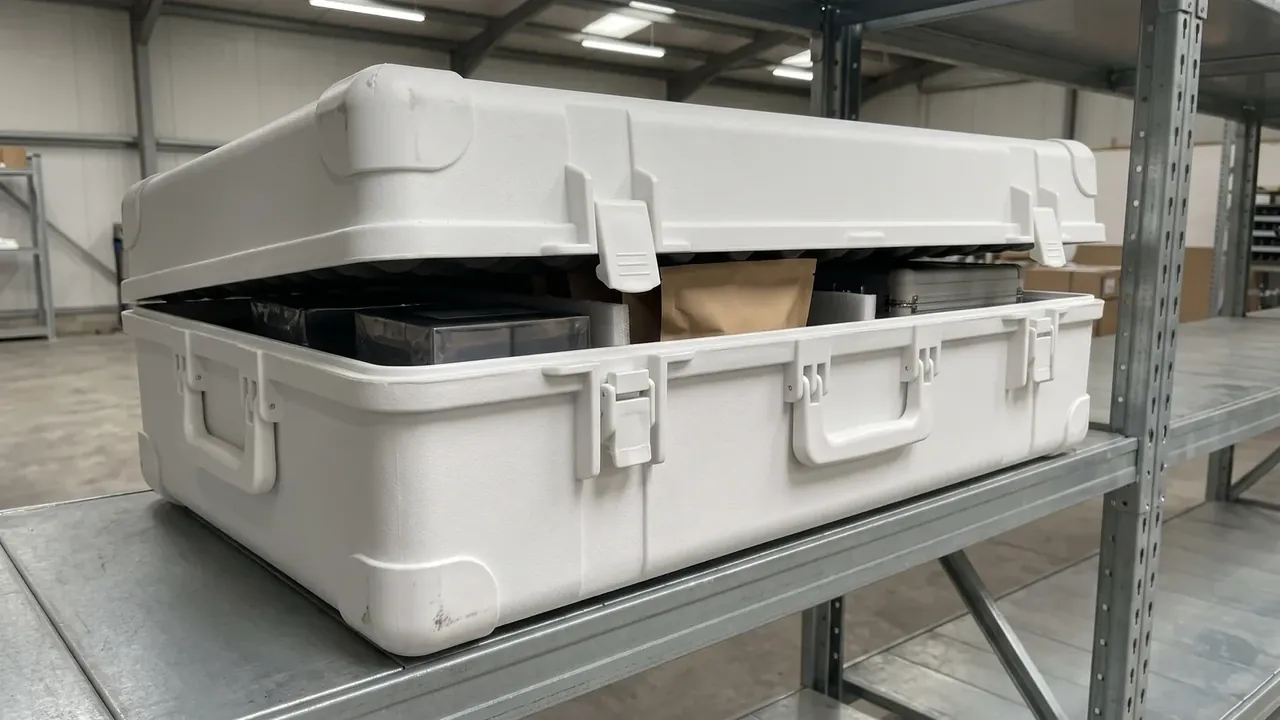
| Part | Cycle limit | Blend limit | Retest each batch |
|---|---|---|---|
| Lid and base faces | 6 | 20 percent | Drop, colour |
| Ribs and dividers | 5 | 25 percent | Dimensions, warp |
| Latch and hinge bosses | 3 | 10 percent | Impact, clearance |
| Gasket groove | 2 | 5 percent | Compression set |
After 6 cycles impact has fallen 12 percent. That is invisible by eye and obvious in a drop test, which is why faces take 6 and load-bearing bosses take 3.
The log holds three fields: batch, cycle, blend. With all three a fault is traced to one sack within an hour.
5. Colour and contamination: purging between colours
Dark to light costs 25 minutes of purging and the first 3 kg of output. Skip it and the next 200 cases carry a grey cast.
| Contamination | Usual source | Detection | Limit |
|---|---|---|---|
| Colour shift | Incomplete purge | Colorimeter, 3 points averaged | Stop the line above ΔE 1.5 |
| Metal chips | Worn granulator blades | Magnet plus 0.5 mm screen | One find scraps the sack |
| Oil | Compressor line carry-over | White paper wipe inside the sack | Any trace, downgrade |
| Mixed resin | Cross-feed between machines | Water float test for layers | Layers mean the sack is isolated |
Colour is the one item argued with data. ΔE 1.5 is the line for light parts and 2.0 for dark ones; a 0.3 spread across 3 points means the blender, not the masterbatch. Mixed resin is harder: PP and HDPE differ by 0.05 g/cm³, so a water bath separates them faster than the eye.
6. Abnormal handling: re-dry, downgrade, scrap
The action goes on the sack, so an operator can read it and act.
Moisture above limit means 90 minutes at 75℃ and a retest; fail twice and it is downgraded to non-visible parts. Lumps are crushed through an 8 mm screen, oversize scrapped, undersize returned at 10 percent. Scrapping a 25 kg sack costs 230 yuan; a case that cracks on an inclusion costs 80 yuan plus a missed date.
One stop rule: 3 or more colour or streak defects in a shift means check the material before the machine.
Conclusion
Seven tenths of the cost in case raw material preparation comes from what was not caught early: a bag left open overnight, airflow down a tenth, an extra mark on a sack. Split inspection into shift, week and month, write limits as numbers, and six passes are no gamble. Case raw material preparation then saves the 42,000 yuan without arguing anyone down on price.
This article discusses only the container (case body) side of specifications and design intent, and does not cover any handling, loading or use of the contents.
Related Reading
- Batch records from goods-in to the machine
- Drying, colour matching and regrind ratio
- A maintenance rhythm for storage boxes
- Steel, aluminium, rotomoulding and composites
Related Products
- 8 Series — Gun Cases; Military Equipment Cases; Camera Equipment Cases; Drone Cases; Watch Cases; Knife Cases; First Aid Cases; Electronics Equipment Cases
- WL8-2812 PP Gun Case — model WL8-2812
- All protective cases and toolboxes: 7 series, 158 models