

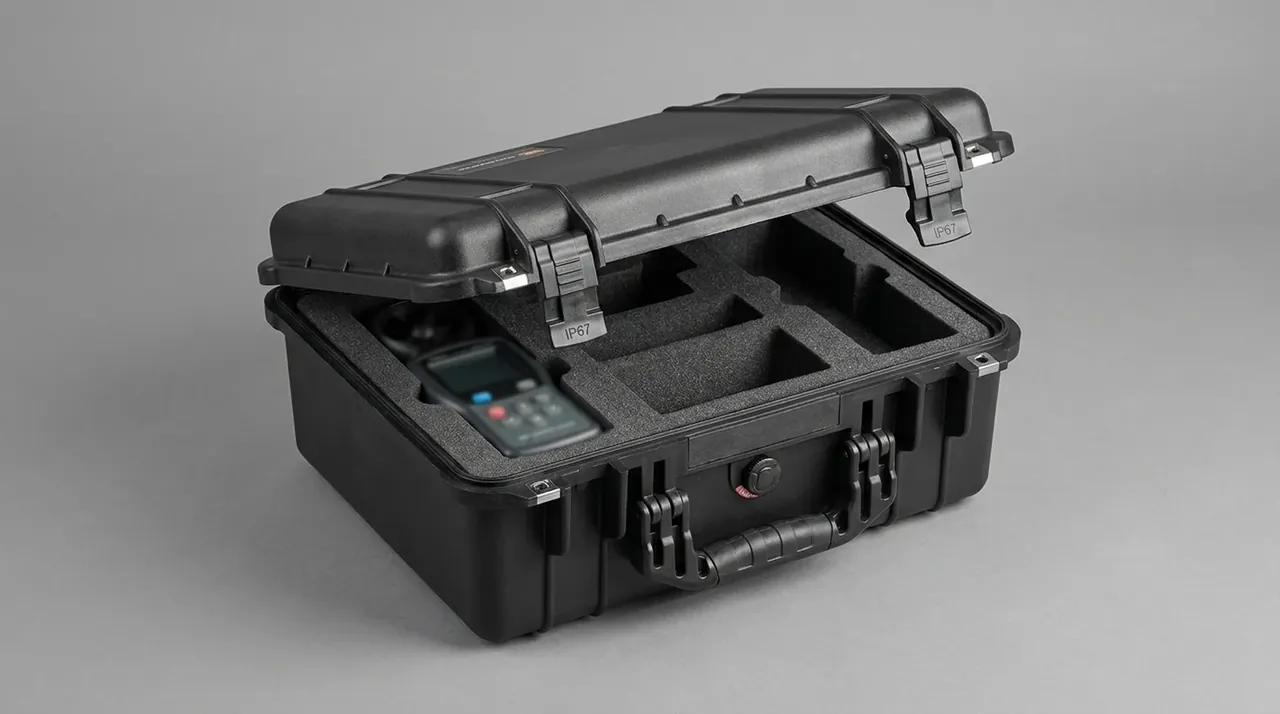
Quick answer: A ce self declaration has no legal hook on a plain plastic case, because no directive covers it until electrical, moving or pressure parts are added.
Table of contents
- The question comes before the paperwork
- Four thresholds, and the ones buyers misread
- The technical file: four volumes, ten years
- Nine declaration fields and a signatory inside the EU
- When a notified body actually appears
- FAQ
1. The question comes before the paperwork
Three questions settle it. Does the shell hold live parts at a rated voltage? Does it carry a powered moving element, such as a lift, tilt or traction drive? Does the wall enclose a chamber above 0.5 bar? A no on all three means it is only a shell, with no directive to declare against.
This is where export paperwork goes wrong. A buyer asks for a CE document, the supplier signs one for a product that never fell inside a directive, and the marking becomes a liability.
Material does not enter the decision: directives are written around function, not around resin.
| Directive | When it reaches a case | What decides it |
|---|---|---|
| 2014/35/EU low voltage | Terminals, switches or a supply inside, rated 50–1000 V AC or 75–1500 V DC | Live parts and rated voltage |
| 2014/30/EU EMC | The case forms part of electrical equipment with circuits that emit or react | Any electronic circuit |
| 2006/42/EC machinery | A powered moving element is built in: lift, tilt, traction | Motor and transmission |
| 2014/68/EU pressure | The wall forms a pressurised chamber above 0.5 bar | A pressure-retaining shell |
2. Four thresholds, and the ones buyers misread
Low voltage is a threshold of volts, not of watts. Between 50 V AC and 1000 V AC, or 75 V DC and 1500 V DC, the directive applies; a 24 V fan sits below it and falls outside 2014/35/EU, though the assembly may still face an EMC assessment.
Machinery turns on the power source and the motion. Castors pushed by hand are not machinery; a motorised lift table is. A gas strut that only assists a lid usually leaves the main action with the operator, which keeps the unit outside 2006/42/EC.
Pressure splits at 0.5 bar of maximum allowable pressure. An ordinary case that sees rain and wash water is not a pressure vessel, and a gauge on the lid does not change that unless the wall actually retains pressure.
EMC is the field where guesses cost the most. A plastic shell with no circuit cannot emit or be disturbed, so there is nothing to test. Add a variable-frequency drive, a radio module or a switching supply and the whole assembly comes into scope, with the shell carried along as part of the equipment.
| Case variant | Directive reached | Evidence usually added | Typical misread |
|---|---|---|---|
| Plain plastic shell | None | Material and dimension records | Packaging law treated as CE |
| Terminals and switches | 2014/35/EU | Temperature rise, dielectric test | IP report issued as proof |
| Motorised lift platform | 2006/42/EC | Risk assessment, guard distances | Control cabinet EMC ignored |
| Sealed pressure chamber | 2014/68/EU | Strength calculation, pressure test | 0.3 bar treated as pressure |
3. The technical file: four volumes, ten years
A technical file is not a manual. The workable shape is four volumes: drawings and BOM, test reports, risk assessment, and the declaration with its authorisation papers. Inspectors ask for the volume that matches the question, and a single 200-page binder wastes the visit.
Retention runs 10 years from the day the last unit is placed on the market, not from the day of signing. Everything must be retrievable within 24 hours, scans are acceptable, and drawings need a revision number and a signature to be worth anything.
The risk assessment follows EN ISO 12100, and a conclusion of no significant hazard still needs its reasoning on file: which hazards were identified, which were excluded by the geometry, and why. Ingress protection is written to the IP code of EN 60529, while mechanical impact is written to the IK scale of EN 62262, where IK08 means 5 J and IK10 means 20 J.
The two codes get swapped. IP66 answers dust and jets; IK10 answers a 20 J strike. One report never substitutes for the other, and an added impact test is cheaper than a new wall.
4. Nine declaration fields and a signatory inside the EU
The declaration is a single page with nine fixed fields: manufacturer name and address, product identification, directives applied, harmonised standards cited, notified body details where relevant, place and date of signing, name and function of the signatory, the declaration statement itself, and the person who holds the technical file.
Two fields go missing most often. An empty standards line leaves the importer unable to see the basis, and an empty custody line leaves the authority with nobody to ask.
The signatory has to be findable inside the EU. A manufacturer with a registered address there signs locally; one without appoints an authorised representative. A company stamp without a named person is refused at the first audit, because nobody can be matched to a business register.
Language follows the member state. German-speaking customers often ask for a German risk assessment, French-speaking ones for a French declaration. Standard titles and directive numbers must use the official translation, which rules out machine output.
5. When a notified body actually appears
With a harmonised standard covering the product, the self-declaration stands alone. A notified body enters only where no suitable standard exists, or where the standard misses a hazard the design presents. That is an exception path, not a default step.
On this product line the exception is rare, because most shells never reach a directive at all.
The order is fixed: directive, standard, body. Run it backwards and the first two become decoration.
Conclusion
The first step in a ce self declaration is applicability, not drafting. Most plain plastic cases fall outside every directive, and marking them creates exposure where none existed; only electrical, moving or pressure functions pull a case into scope with four volumes, nine fields and a ten-year file. Put that check on the pre-quotation sheet and the paperwork stops arriving after the tool is cut.
This article covers case-side specifications only and does not address any handling, loading or use of the contents.
Related Reading
- CE certification route and common directives
- CE and RoHS combined requirements
- Case export compliance for the EU market
- EU packaging rules and case marking
- Certification sets for one export unit
Related Products
- 8 Series — Gun Cases; Military Equipment Cases; Camera Equipment Cases; Drone Cases; Watch Cases; Knife Cases; First Aid Cases; Electronics Equipment Cases
- WL8-2812 PP Gun Case — model WL8-2812
- All protective cases and toolboxes: 7 series, 158 models