

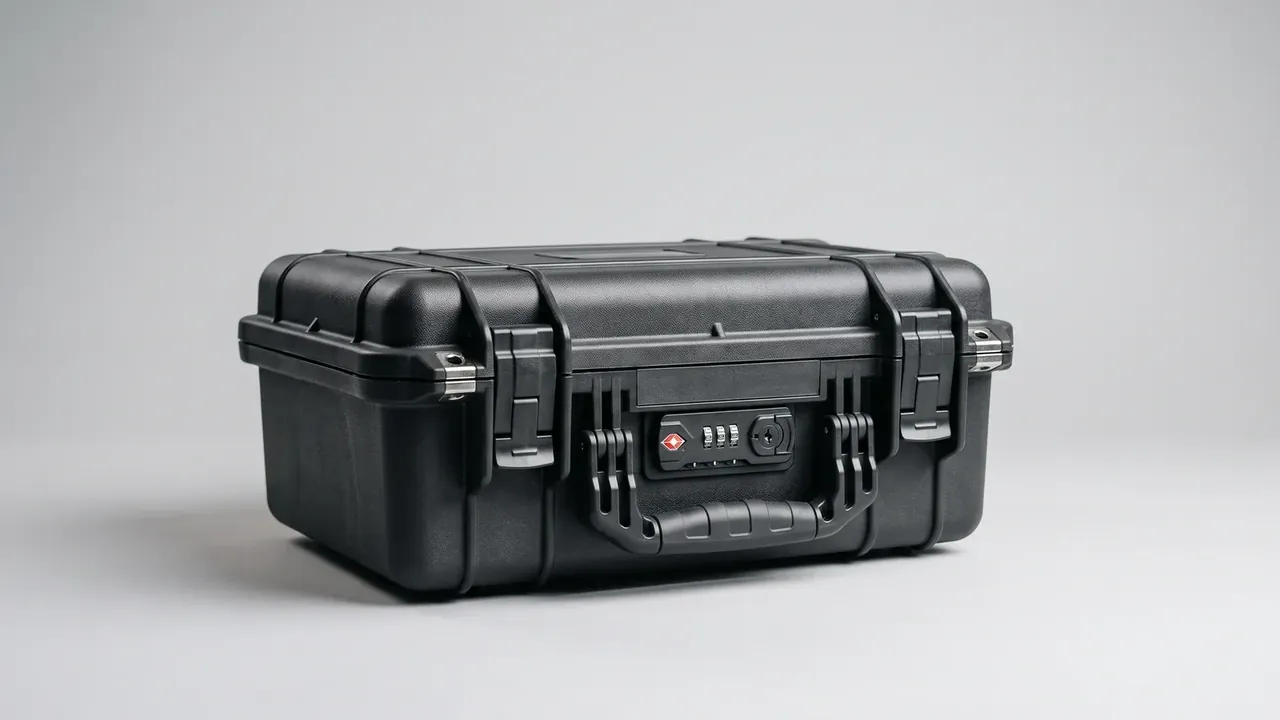
Quick answer: Most failures with a container, ammunition, fiber happen in the handling, not the shell. Vehicle work turns on four tie-down points, racking on tier count and straight fork entry, air freight on pressure equalisation and the order the lid is opened in. Fix those three and six duty cycles get cheaper.
Table of contents
- Six duty cycles and the actions they demand
- Vehicle mounting: four tie-down points and a damping pad
- Warehouse racking: four tiers and a straight fork entry
- Air and sea: pressure, condensation, opening order
- Field staging: blocking up, covering, recovery
- The sixty-second pre-load check
- FAQ
1. Six duty cycles and the actions they demand
One container, ammunition, fiber, six settings, and the load reverses each time. A road leg loads it sideways; a rack loads it downward; air freight loads it from inside; sea freight adds humidity and salt; field staging adds ground moisture and UV; transfer adds forks. The case does not change, only the way it is held down.
| Setting | Dominant load | Correct action | Common mistake |
|---|---|---|---|
| Short road leg | Side impact, vibration | Strap every corner, edge protectors | Two sides only |
| Warehouse rack | Vertical stacking | Level bearers, labels out | Case sitting on the floor |
| Air freight | Pressure differential | Valve up, vent before opening | Foam in the valve |
| Sea freight | Humidity, salt, movement | Desiccant inside, vented wrap | Wrap sealed airtight |
| Field staging | Ground moisture, UV | Blocked off the ground, vented cover | Tarp on the lid |
| Transfer | Fork entry, stacking | Forks aligned with base slots | Fork tips against the wall |
The first three settings take over eighty percent of service hours and most of the damage.
2. Vehicle mounting: four tie-down points and a damping pad
Floor anchors come in two rows, and as the load grows someone starts skipping straps. Four points is the floor, one per corner, crossed diagonally so a loaded container, ammunition, fiber can neither slide under braking nor rotate.
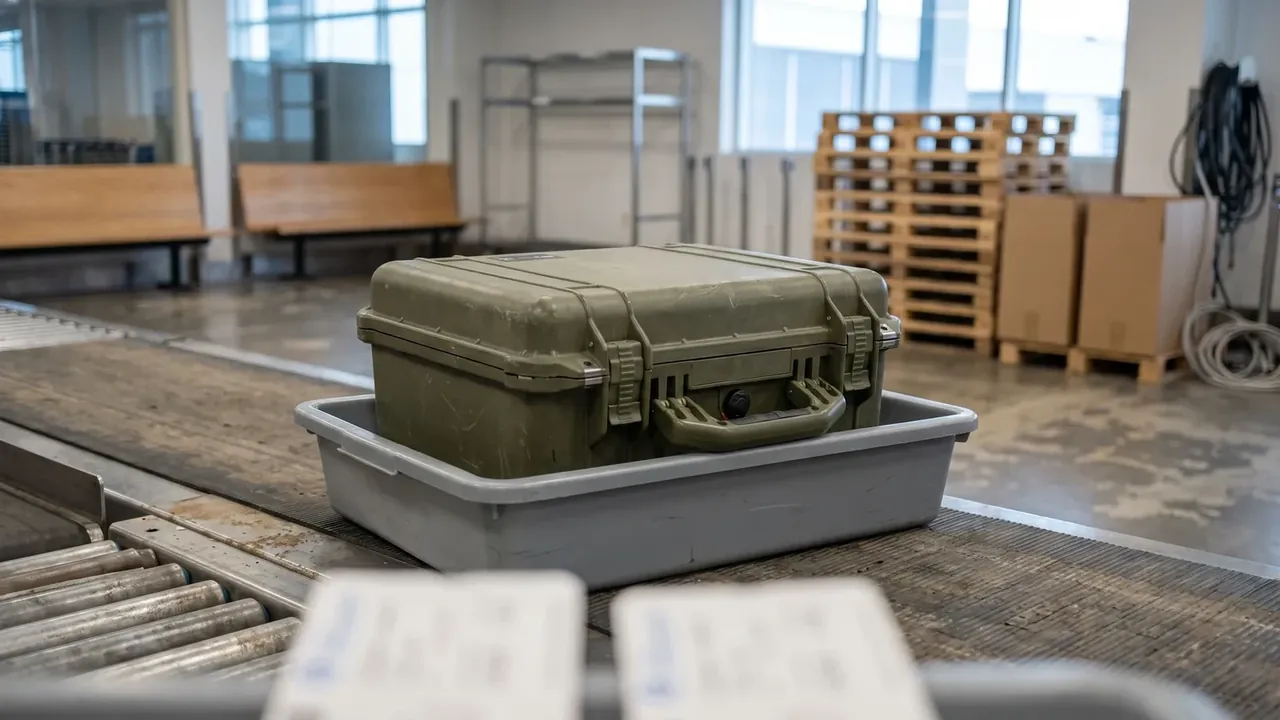
Tension the straps to about 350 N. Tighter and the corners take marks, because a laminate corner is thicker but softer than steel. Edge protectors turn the strap line into a surface load, and a 20 mm EPDM pad absorbs most of the seam vibration.
One pad does more than a fifth strap.
3. Warehouse racking: four tiers and a straight fork entry
Set the bay at 1.8 m, count 0.4 m per closed case, and four units of a container, ammunition, fiber fit on a level with room for hands. Stacking follows four rules.
- Four tiers maximum: higher, the bottom lid carries static load and the laminate creeps.
- Bearers 100 mm thick: they lift the base clear of ground damp.
- Forks in 90 mm: enter fully, or a half-entry lift punches the base.
- Take from the top down: pulling a middle case moves the centre of gravity.
- Labels facing out: counting and first-in-first-out depend on that face.
Fork angle is the item warehouses overlook. Parallel to the long side, the load lands on the base ribs; at an angle it sits on the wall-to-base corner, where a laminate meets a point load.
4. Air and sea: pressure, condensation, opening order
Cruise cabin pressure sits near 75 kPa, the air at roughly 2,400 m. Air sealed in on the ground pushes out at altitude and is drawn back on landing, and the valve on a container, ammunition, fiber exists for that cycle.
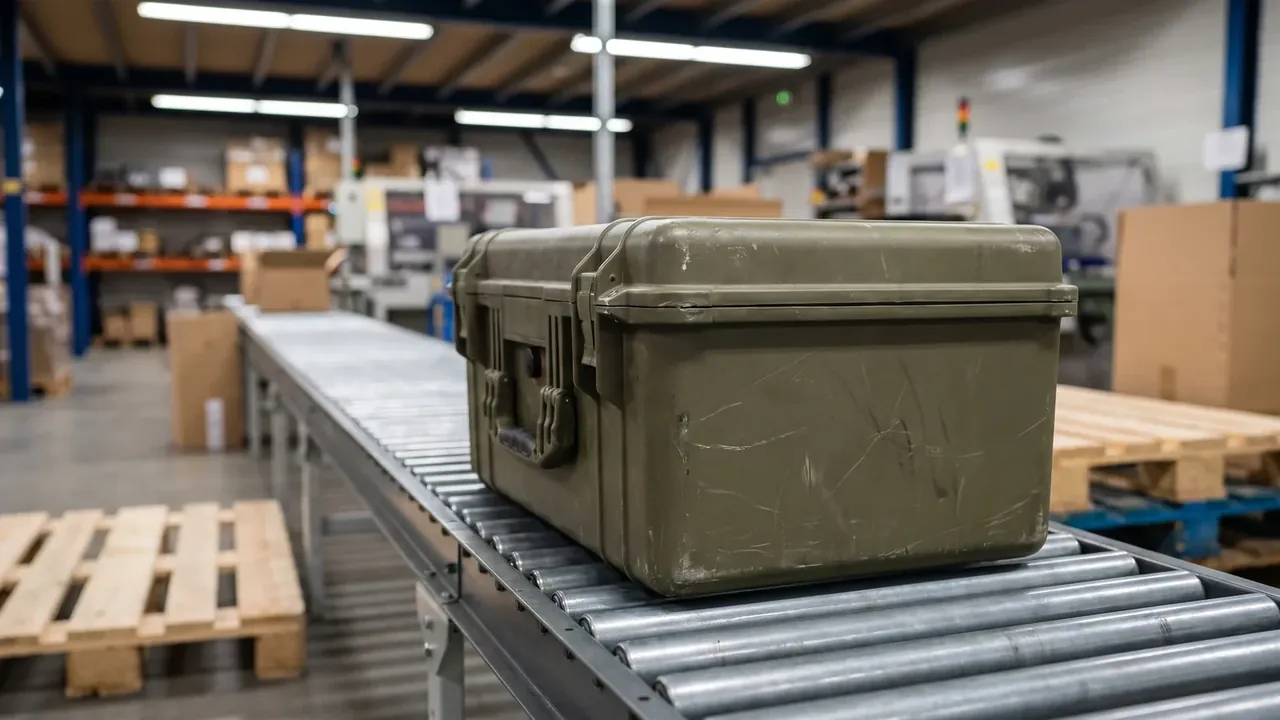
Opening order follows. Vent the valve three seconds, equalise, then release the latches. Done the other way, the keepers take shear: twice is invisible, ten times and they loosen.
Condensation is the other trap. A case packed by day can be 45 K warmer than the destination at night, and moisture lands on the inner wall.
5. Field staging: blocking up, covering, recovery
In the field the ground is the rack. Block the case 150 mm clear at all four corners so air moves under the base. Blocking two ends lets the middle sag, and a laminate held in bending comes back with delamination.
Covers need gaps. A tarp on the lid heats by day and wets by night, trapping moisture against the shell, worse than no cover. Build a low vented lean-to instead.
Check the latch keepers before recovery. A pried keeper is the honest record of a trip: the gasket has taken a set, and that container, ammunition, fiber needs an immersion check before it goes back.
6. The sixty-second pre-load check
Twelve items, sixty seconds, one walk around the case.
| Window | Items | Pass point |
|---|---|---|
| 0–15 s | Lid joint, latches, hinges, gasket | Even gap, crisp click |
| 15–35 s | Handle, boss, inserts, corners | No wobble, no cracks at inserts |
| 35–50 s | Valve, gasket, desiccant | Valve moves, gasket not flattened |
| 50–60 s | Label, outline, base | Label readable, base clean |
The value sits in the fixed order. Once fixed, a skipped item becomes visible; from memory, the last two are always the ones missed.
Conclusion
Six settings reduce to three actions: how the case is tied, how it is stacked, how it is opened. Write them as a fixed sequence and handling errors fall away. What remains is judging which setting dominates this run, and that decides which action gets checked twice on a container, ammunition, fiber.
This article discusses only the container (case body) side of specifications and design intent, and does not cover any handling, loading or use of the contents.
Related Reading
- Four wall layers and the moulding routes behind them
- Fibre cases against metal cases
- Specification system and capacity calculation
- Case layout for warehouse stowage and transfer
- Case use in loading and short-haul legs
Related Products
- 8 Series — Gun Cases; Military Equipment Cases; Camera Equipment Cases; Drone Cases; Watch Cases; Knife Cases; First Aid Cases; Electronics Equipment Cases
- WL8-2812 PP Gun Case — model WL8-2812
- All protective cases and toolboxes: 7 series, 158 models