

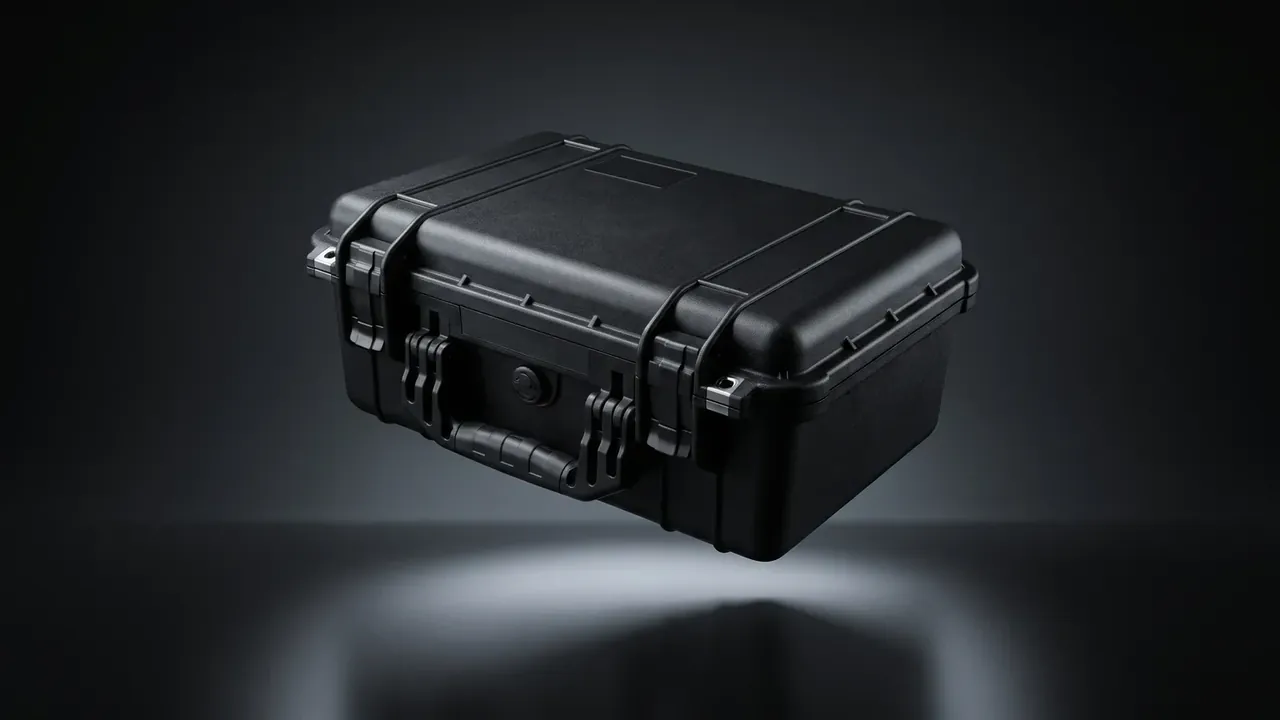
Quick answer: The unit cost of a custom case with compartments is set by partition material, assembly seconds and rework. Between 4 and 24 cells, slotted PP hollow sheet is cheapest; only past 16 cells at 5 kg does a moulded grid pay off.
Table of contents
- Where the Unit Cost of a Custom Case with Compartments Is Locked
- Working Back from Load to Cavity and Cell Count
- Partition Material and Gauge, 4 mm Against 6 mm
- Assembly Time Between Slot-in and Riveted Partitions
- Verifying Load per Compartment
- Pulling the Rework Rate Back Under One Percent
- FAQ
1. Where the Unit Cost of a Custom Case with Compartments Is Locked
A handheld instrument maker moved a 24-cell custom case with compartments from riveted to slotted partitions. Assembly fell from 68 to 32 seconds a unit across 16,000 units a year, and rework dropped from 3.4% to 0.9%.
| Partition scheme | Gauge | Usual cells | Cost per unit | Load per cell |
|---|---|---|---|---|
| Slotted | 4 mm | 4 to 12 | 3.4 CNY | under 2 kg |
| Slotted | 6 mm | 12 to 24 | 5.2 CNY | 3 kg |
| Riveted | 6 mm | 16 to 24 | 7.9 CNY | 5 kg |
| Moulded grid | 2.5 mm rib | 4 to 24 | 6.8 CNY | 4 kg |
The last row hides the real number: 6.8 CNY is material only, the tool costs 42,000 CNY at a 2000 piece minimum, so each carries another 21 CNY. That lands at 27.8 CNY, five times the slotted sheet.
2. Working Back from Load to Cavity and Cell Count
Cell count is arithmetic: total load divided by allowable load per cell, rounded to fit parts. One tool kit custom case with compartments holds 18 items at 0.9 kg, so 16.2 kg. At 3 kg per cell that is six cells, but the longest item is 320 mm, so the cavity takes two rows of three.
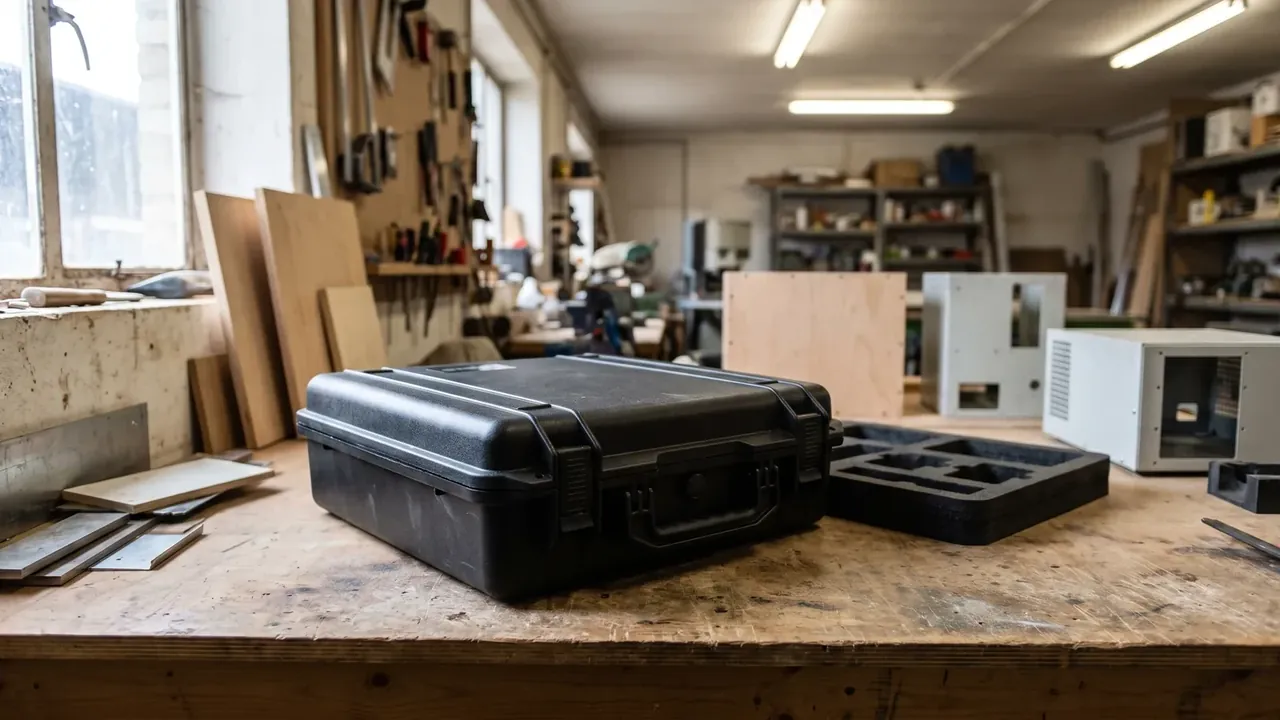
The cavity also gives up space: a 4 mm sheet across three columns eats 8 mm, a 6 mm sheet 12 mm, rivet heads more. None of it shows on a drawing until parts will not drop in.
Cost does not scale linearly: 12 to 24 cells doubles material and adds 60% to assembly, so cost per cell falls.
3. Partition Material and Gauge, 4 mm Against 6 mm
A 4 mm sheet weighs 0.6 kg per metre, a 6 mm sheet 0.95 kg; at equal span the 6 mm is nearly twice as stiff.
- Under 2 kg per cell and 12 cells or fewer: 4 mm slotted sheet
- 2 to 5 kg per cell and 16 cells or more: 6 mm slotted sheet
- Service from -20 °C to 60 °C: copolymer PP, as homopolymer goes brittle
Most material problems come from regrind ratio. Fully reground sheet is 18% cheaper but holds tolerance to ±0.4 mm, so slots fit loose. In a custom case with compartments, a partition that moves 1 mm takes the parts with it.
4. Assembly Time Between Slot-in and Riveted Partitions
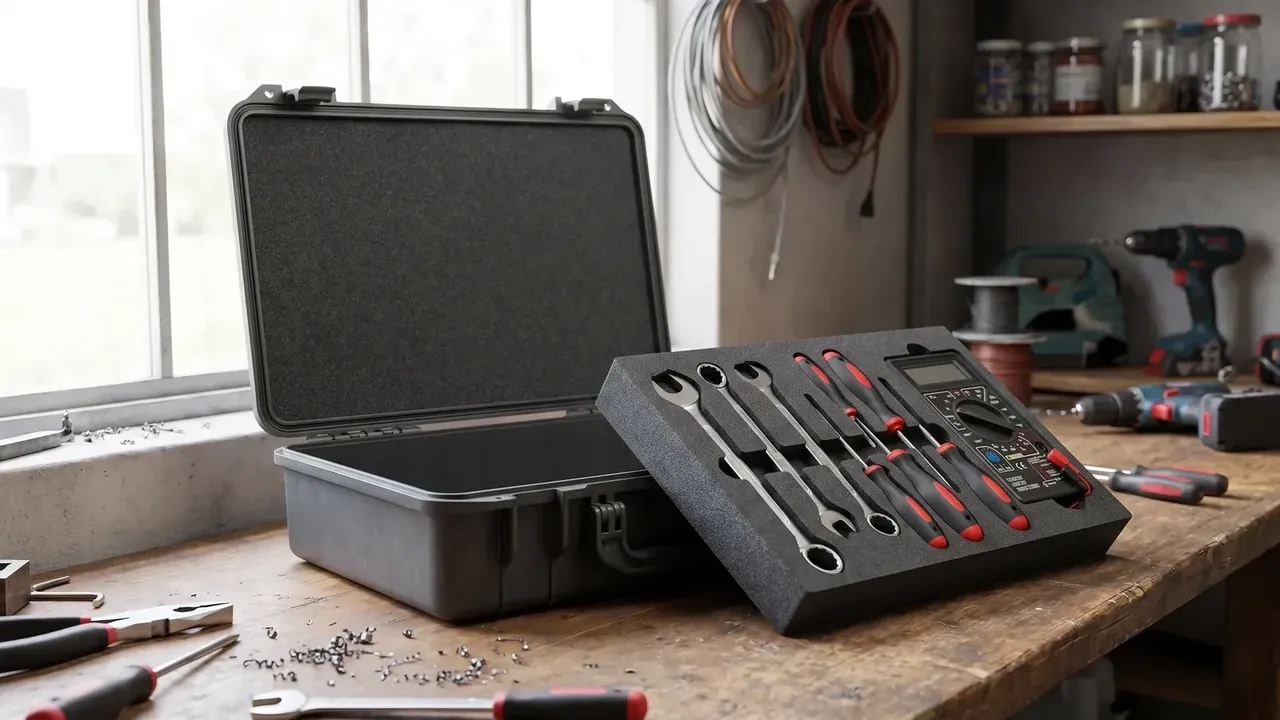
Assembly seconds are the least quoted line. A 16-cell custom case with compartments takes 40 seconds slotted and 68 riveted, which needs drilling and pressing.
| Structure | Assembly per unit | Rework rate | Main cause |
|---|---|---|---|
| Slotted, dry | 32 s | 0.9% | Slots too loose |
| Slotted, glued | 51 s | 2.1% | Glue squeeze-out |
| Riveted | 68 s | 3.4% | Hole offset |
| Moulded grid | 8 s | 0.4% | Flash |
Forty seconds is the benchmark. A 0.2 mm slot assembles fastest and loosens first in transit; at 0.05 mm, assembly gains 12 seconds and rework halves. Rivets pay off only where the grid must not open.
5. Verifying Load per Compartment
Load per cell of 2 to 5 kg is the normal band for PP hollow sheet; past 5 kg the structure changes, not the gauge.
Static load runs at four times the rating for eight hours, with mid-span deflection within 1/200 of span. Drop runs at 1.5 m per face, no partition leaving its slot. Pass both and a custom case with compartments holds parts through normal freight. Span is the usual culprit. A 600 mm cavity with one central partition has no support at the middle, and 5 kg bows it. A rib costs 0.8 CNY and beats 6 mm sheet.
6. Pulling the Rework Rate Back Under One Percent
Rework comes from slot fit, cut length and assembly order. Cut length is the expensive one: 1 mm short is scrap, 1 mm long crushes the flutes.
Three habits get under 1%: leave 0.3 mm on the cut; fit the centre partition first and work outward, frame last; check the first article on diagonals, stopping past 1.2 mm.
Dropping from 3.4% to 0.9% removes 400 piece-events a year at 16,000 units.
Conclusion
Partition scheme sets material cost, assembly seconds set rework, cell count spreads both. Split the three and the quote stops being opaque. Settle the structure of a custom case with compartments first; the unit price follows.
This article discusses only the container (case body) side of specifications and design intent, and does not cover any handling, loading or use of the contents.
Related Reading
- How instrument case specifications are derived
- Shockproof case architecture and specifications
- Bay layout and support inside missile boxes
- Compartment logic in first aid kit cases
- Cavity and sealing specifications for shielded cases
Related Products
- 8 Series — Gun Cases; Military Equipment Cases; Camera Equipment Cases; Drone Cases; Watch Cases; Knife Cases; First Aid Cases; Electronics Equipment Cases
- WL8-2812 PP Gun Case — model WL8-2812
- All protective cases and toolboxes: 7 series, 158 models