

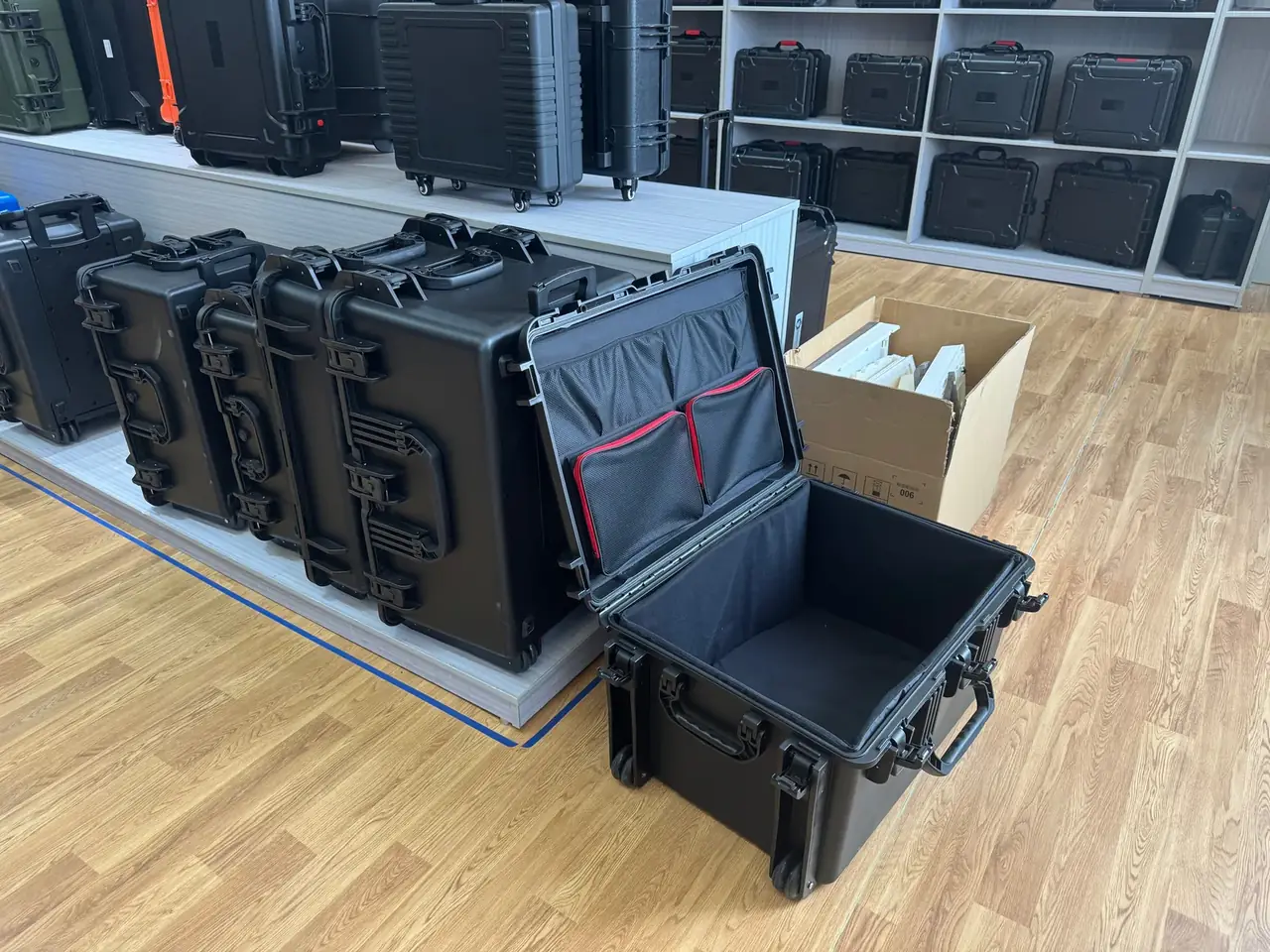
Quick answer: A Custom Communication Case Factory holds gasket compression between 25% and 30% so contact resistance stays under 0.05 Ω while the latches close.
Table of contents
- Shield Gasket Compression at a Custom Communication Case Factory
- Heat Fin Pitch and Natural Convection
- Lid-to-Body Grounding Bond
- Weather Lip for Pole Mounting
- Gasket Values for RF Batches
- FAQ
1. Shield Gasket Compression at a Custom Communication Case Factory
One percentage decides both whether the lid shuts and whether the seam conducts: gasket compression. Groove depth runs 70 to 85 percent of free gasket height, and only the remainder is squeezed. A Custom Communication Case Factory sets 28 percent as the mid value for this tier, where the lip seats and the latches still bite.
Compression and contact resistance are not linear. At 10 percent, resistance sits at 0.3 to 0.5 Ω and shielding is marginal. Between 25 and 30 percent it falls below 0.05 Ω, where the rated 60 to 90 dB lives. At 40 percent it only reaches 0.03 to 0.04 Ω while closing force doubles.
At a Custom Communication Case Factory, corners are where the reading drifts. Below a 3 mm radius the gasket is pushed outward through the bend and reads two to three points above the straight run. Widening the groove 0.3 mm at each corner brings the value back. Groove depth holds a tolerance of plus or minus 0.1 mm; two lids from one tool that differ 0.2 mm differ six points in compression.
| Gasket tier | Compression | Contact resistance | Closing behaviour |
|---|---|---|---|
| Loose | 10% | 0.3 to 0.5 Ω | Closes easily, shielding marginal |
| Baseline | 25% to 30% | Under 0.05 Ω | Even close, rated shielding reached |
| Tight | 40% | 0.03 to 0.04 Ω | No further gain, lid edge lifts |
2. Heat Fin Pitch and Natural Convection
The lid fins run at 12 mm pitch and 8 mm height. Natural convection gives only 2 to 15 W/(m²·K); below 6 mm pitch the boundary layers of neighbouring fins merge halfway up, the air stalls, and the extra area never meets moving air.
Twelve is not a rounded figure. A rig test on vertical rectangular fins 45 mm tall, with pitch swept from 10 to 15 mm, put peak heat transfer at 12 mm; past a height-to-pitch ratio of ten, the outer part of a fin stops contributing. This lid is 8 mm high and still uses 12 mm.
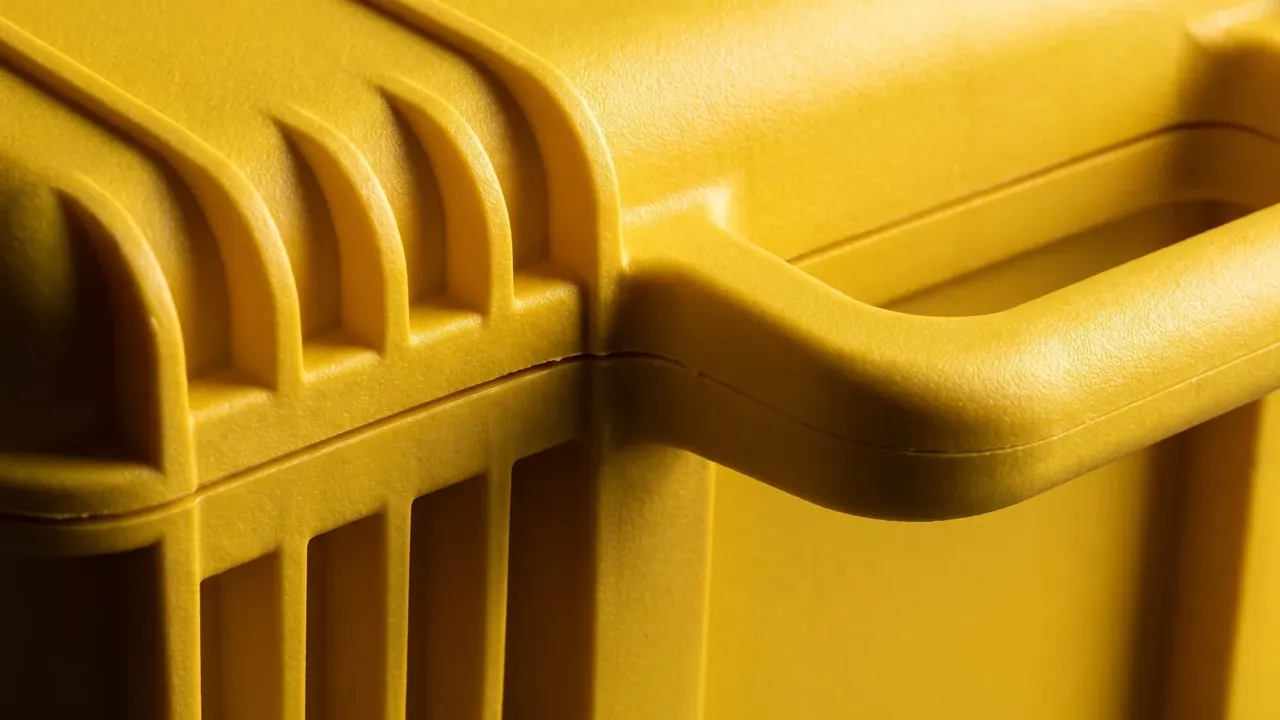
Fin direction is easier to overlook than pitch. Vertical fins let warm air climb the channel; lay the array flat and performance drops about thirty percent, since air turns a corner in every channel. A horizontal mount is safer at 15 mm. A Custom Communication Case Factory reads 18 ℃ on the warm-up rig after a 90 min settling time.
| Warm-up interval | Case state | Recorded |
|---|---|---|
| First 30 minutes | Closed, no load | Root-to-tip gap |
| 30 to 90 minutes | Closed, no load | Slope of the rise |
| Beyond 90 minutes | Settled | Whether it stops at 18 ℃ |
3. Lid-to-Body Grounding Bond
Shielding rides on the gasket, grounding on a bond, and the two paths must not merge. Lid and body need a metal-to-metal route judged at 0.1 Ω or less. Where the gasket is the only path, its relaxation drags the ground with it.
Four unpainted pads on the lid flange are each bitten by a screw or spring finger. At the four corners with at least 30 mm² per pad, one failing pad leaves three to hold the reading under 0.1 Ω.
Powder is the enemy: a coat of 60 to 100 μm is an insulating film, and if the masking fixture misses, all four pads read open while the case looks perfect. A Custom Communication Case Factory measures once after assembly and again after a road trip: the first catches powder, the second a loosened spring.
4. Weather Lip for Pole Mounting
Hanger holes are 4×φ8 mm at the rear corners, 300 mm apart. Each sits inside a 3.0 mm weather lip proud of the back face, so rain runs off the outer edge instead of crawling to the hole.
Higher is not better. At 3.0 mm the lip still moulds in one shot; any higher and the tool needs a slider. Below 2.0 mm, capillary action carries water over the lip. The transition fillet is held at 0.5 mm, since a sharp corner traps water and a soft one costs height.
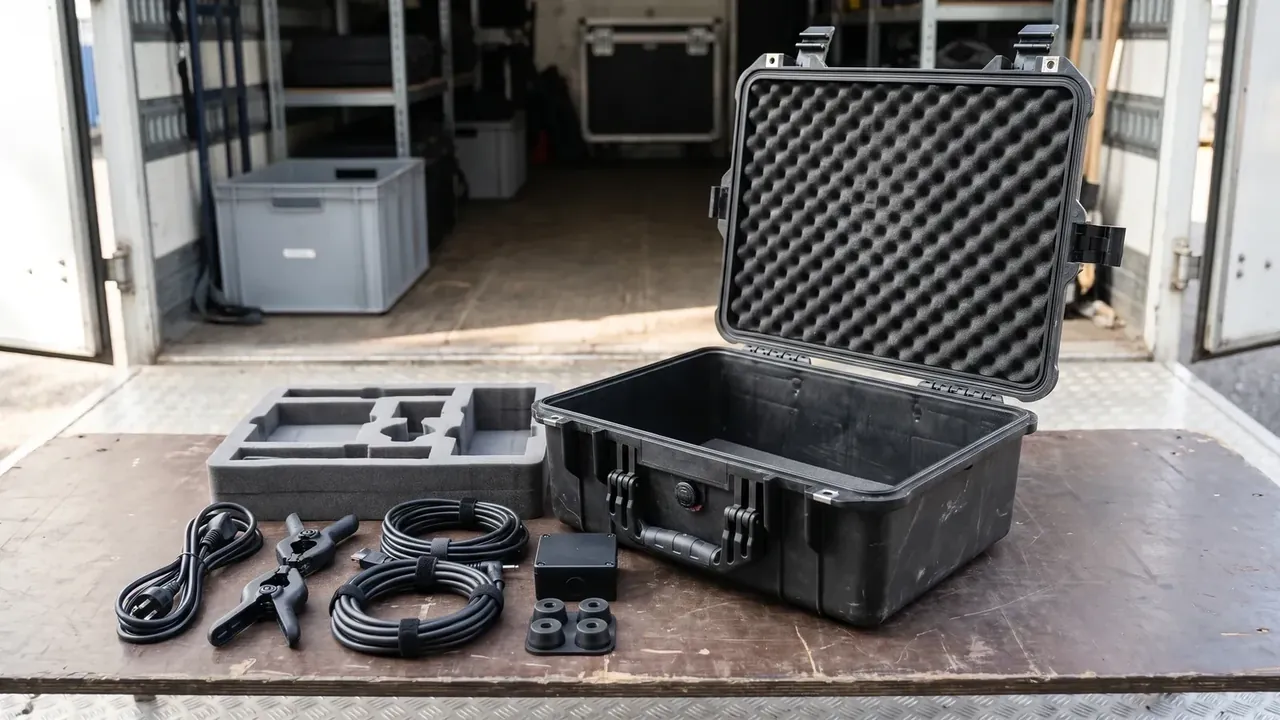
Attitude decides which way the lip faces. Flat against a wall, the upper run becomes a step that stops water and the lower run a drip edge. With all four φ8 mm holes on one level line, the middle two catch water from upstream, so the lip must stay continuous. The jet test follows IP66: 12.5 mm nozzle, 100 L/min, 2.5 to 3 m, at least 3 minutes per face. A water film inside the lip means the fillet traps water, not a low lip.
5. Gasket Values for RF Batches
The gasket tier is the narrowest one whose compression still lands between 25% and 30% after the warm-up settles; a roll outside goes back whole.
Batches also check whether two latches close in one push after 4050 cycles, whether each latch at 350 N pulls open, and whether the 4.2 mm wall whitens at the hanger holes. The 520×370×200 mm body and 455×310×145 mm cavity are dimensioned around that wall and the 12 mm fin pitch. A Custom Communication Case Factory records roll number, groove depth and bond resistance per batch.
Sampling follows the roll: cut a piece from head, middle and tail, hold each at 28 percent for 22 h, release and read recovery. Under ninety percent recovery the roll is rejected whole.
| Compression reading | Where measured | Action |
|---|---|---|
| Under 25% | Four lid corners | Fit one grade thicker, or shallow the groove |
| 25% to 30% | Even all round | Release and log the value |
| Over 30% | Corners and latch seats | Deepen the groove, or fit a softer grade |
Conclusion
A Custom Communication Case Factory holds two numbers on the lid seam: compression between 25 and 30 percent, and bond resistance at or under 0.1 Ω. Fin pitch handles heat, the lip handles water, and each drifts on its own schedule. Let one slide and the case shows it after a year outdoors.
Related Reading
- Calculating Usable Interior Space
- Base Station Case Module Zoning
- Three Trade-offs in Gasket Materials
- Custom Traffic Equipment Case Factory
- Custom Construction Tool Case Factory
Related Products
- 8 Series — Gun Cases; Military Equipment Cases; Camera Equipment Cases; Drone Cases; Watch Cases; Knife Cases; First Aid Cases; Electronics Equipment Cases
- WL8-2812 PP Gun Case — model WL8-2812
- All protective cases and toolboxes: 7 series, 158 models