

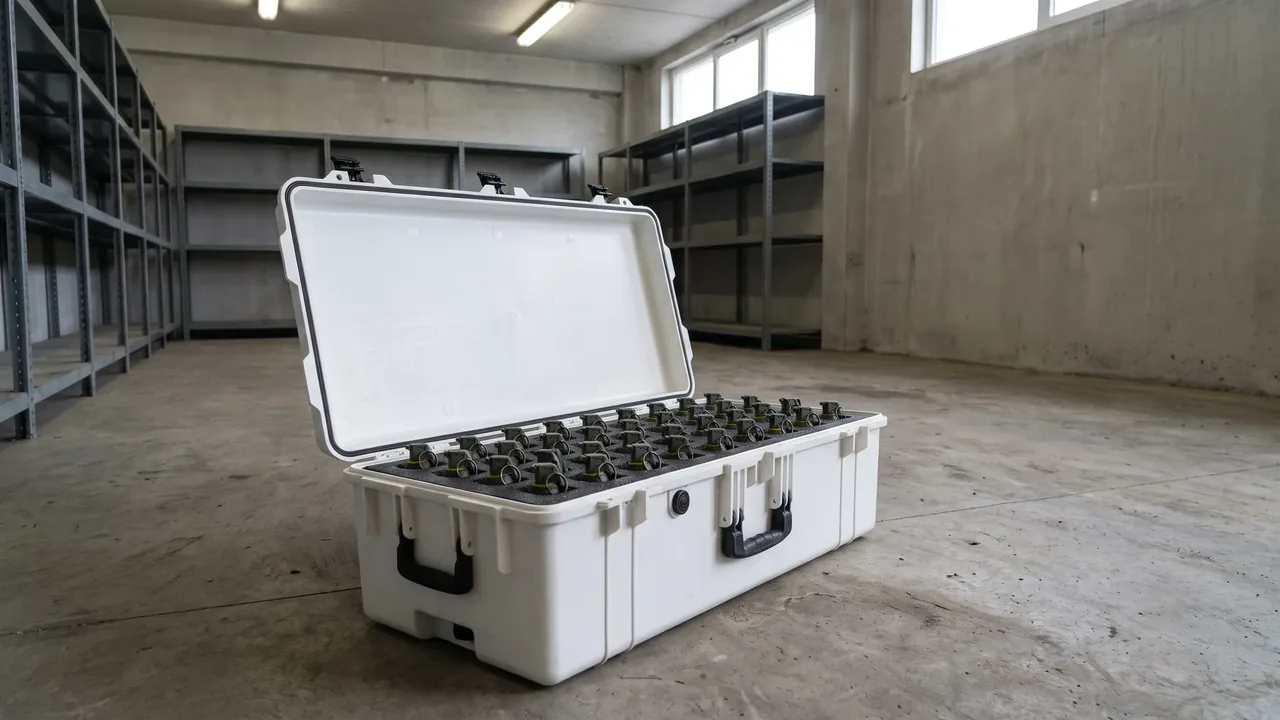
A dangerous goods packaging case is the container that directly holds restricted cargo in chemical export, dangerous goods warehousing, and compliant logistics. It covers fibreboard boxes, steel boxes, steel drums, and the matching structures around them: liners, absorbent materials, closures, and locking hardware. Unlike an ordinary storage case, a dangerous goods packaging case is governed from manufacture through service by the UN Recommendations on the Transport of Dangerous Goods, the European ADR agreement, the IMDG Code for sea transport, the IATA Dangerous Goods Regulations for air transport, and Chinese standards such as GB 19432 and GB 19433. Every UN mark, class label, and orientation arrow on the case corresponds to a traceable certification and a defined responsibility. Experience shows that only a dangerous goods packaging case whose performance level matches the packing group, whose material suits the chemical, and whose marks and documents are completed to the standard can keep leakage and contamination inside a workable envelope in a real transport accident, while shielding the shipper from returns and penalties. This article walks through case structure, UN codes, performance levels, combination packaging, material compatibility, closures, marks and labels, retest and repair, transport documents, procurement, and maintenance, so warehouse, transport, and purchasing teams can build a verifiable compliance framework.
1. Regulatory Position and Scope of the Dangerous Goods Packaging Case
A dangerous goods packaging case is not an ordinary storage container; it is a compliance unit inside a legal system. The UN Recommendations provide the global framework for classification, packaging specifications, and marking. Road transport in Europe follows the ADR agreement, sea transport follows the IMDG Code, and air transport follows the IATA Dangerous Goods Regulations. In China, the domestic framework includes the dangerous goods transport packaging standards GB 19432, GB 19433, and GB 12463, applied together with chemical safety supervision rules. The classification conclusions of these systems largely agree, but packaging specifications, marking details, and document formats differ, so exporters often have to satisfy several rule sets at once.
From the container perspective, the rules bind the outer packaging (drum, box, bag), the inner packagings, the absorbent and cushioning materials in combination packagings, the closures and locks, and every mark and label on the case. Two responsibility parties must be separated: the packaging manufacturer produces packaging to the UN specification, passes the performance tests, and keeps the UN mark truthful; the shipper selects compliant packaging for the class and packing group, assembles inner packagings and absorbents correctly, applies marks and labels, and declares honestly. A failure at either link can cause a whole shipment to be returned or fined at the port.
The scope of dangerous goods packaging cases covers several tiers: single packagings such as steel drums and plastic jerricans hold the goods directly; combination packagings (outer case plus inner packagings) serve medium volumes and mixed loads; intermediate bulk containers and freight containers cover bulk flows. Air transport usually demands stricter packaging levels and fuller documents, while sea transport adds batch and moisture requirements. For a mode-by-mode comparison, see the ADR and IMDG hazmat transport case guide and plan the packaging scheme together with the transport route.

2. UN Packaging Codes Explained
The UN packaging specification is the technical core of a dangerous goods packaging case. It defines the design type, material, manufacturing quality, and mandatory tests, and the UN mark on the case is the compressed expression of that specification. A typical mark reads "UN 4G/Y20/S/24 CN/XXXX": the UN symbol for dangerous goods packaging, the packaging code, the performance level, the test parameter, the year of manufacture, the authorising country code, and the manufacturer code. Reading this string is reading the case's identity document.
The first character of the packaging code gives the type: 1 for drum, 3 for jerrican, 4 for box, 5 for bag, 6 for composite packaging, and 7 for pressure receptacle. The second letter gives the material: A for steel, B for aluminium, C for natural wood, D for plywood, F for reconstituted wood, G for fibreboard, H for plastics, and N for other metals. The third digit, used for drums and jerricans, gives the head form: 1 for non-removable head and 2 for removable head. Common codes decode as follows: 1A1 is a closed-head steel drum, 1A2 an open-head steel drum, 1H1 and 1H2 are closed and open plastics drums, 3H1 is a closed plastics jerrican, 4A is a steel box, 4C and 4D are natural wood and plywood boxes, 4G is a fibreboard box, 4H is a plastics box, and 6HA1 is a composite packaging with a plastics receptacle inside a steel outer drum.
The packaging code itself is not a free pass. Which codes a given substance may use is listed in the applicable packing instruction or packing method (for example the P-series guidance in the IMDG Code or the packing methods in ADR), and the shipper must check entry by entry. Selection is therefore a lookup-and-verify process, not a matter of picking a box that looks similar. For the applicant, test items, and mark management behind UN certification, read the UN packaging certification guide to connect manufacturer-side and user-side duties.
3. Packing Groups, Performance Levels, and Test Thresholds
Dangerous goods are divided into three packing groups by hazard: PG I (high danger), PG II (medium), and PG III (low). The packing group is a property of the goods, fixed by their hazard characteristics and stated on documents and labels. The matching property of the packaging is its performance level: level X packagings may serve PG I, II, and III goods; level Y packagings may serve only PG II and III; level Z packagings only PG III. The ladder is one-directional: a Y-level dangerous goods packaging case must never carry PG I goods, even if its size and shape look right.
Performance levels differ because the test thresholds differ. In the drop test, the UN specification sets graded drop heights for the fully loaded packaging: about 1.8 metres for PG I, about 1.2 metres for PG II, and about 0.8 metres for PG III, with drops onto the bottom face, edges, and corners. Packagings for liquids must also pass a hydraulic internal pressure test, and the mark then states the relative density and the test pressure (for example a density of 1.4 and a pressure of 150 kPa). Box packagings generally must pass a stacking test to prove they keep their shape under a defined load. Fibreboard boxes normally skip the hydraulic test but must clear the drop and stacking combination.
Reading the mark also means reading the test parameter correctly: packagings for liquids or inner receptacles carry density and internal pressure, while packagings for solids or outer boxes and bags carry the maximum gross mass in kilograms, flagged with S for solids. Comparing those fields with the actual density and gross weight tells you whether a packaging is sufficient. A frequent error is to use a packaging whose gross mass is adequate but whose performance level is short, or to forget the added mass of inner packagings and absorbents, so the real gross weight exceeds the marked limit and the packaging fails early in an accident.
4. Limited Quantity and Excepted Quantity Packaging
When a consignment is small, the regulations offer two reliefs: limited quantity (LQ) and excepted quantity (EQ). Both reduce the marking and document burden, but neither waives the requirement that the outer packaging of a dangerous goods packaging case be certified.
Limited quantity applies when the inner packagings and the completed package stay under defined caps. Each inner packaging is filled to a set maximum, the outer packaging carries a limited total mass, and the finished package must still pass the performance tests behind its level. Where the mode allows it, the limited quantity mark replaces the full label set, yet the class diamond and the UN number stay mandatory, and a limited quantity package must never be mixed with fully marked packages in a way that hides its status. The caps differ between ADR, the IMDG Code, and the IATA DGR, so the same goods can qualify as limited quantity by road and fail by air. Always read the table for the mode actually used rather than the one used last time.
Excepted quantity is lighter on marking but stricter in form. The outer packaging carries an excepted quantity code from E0 to E4, where E0 means the goods may not move as excepted quantity at all. Inner packagings must still meet sealing, lining, and compatibility rules, and combination structures keep intermediate packaging with absorbent material when liquids are inside.
Two practical points decide whether a relief is worth taking. First, relief never turns an uncertified case into a compliant one: a plain carton or an ordinary protective case used as the outer packaging of an LQ or EQ package is still a violation at the port. Second, relief is a property of the whole package, not of the case alone. Changing the inner packaging size or the fill volume can push the package back over the cap and void the mark. Buyers should therefore fix the inner packaging drawing, the fill volume, and the case model together and record them as one certified configuration, so the relief survives the next audit.
5. Combination Packaging Structure and the Role of the Protective Case
The typical dangerous goods packaging case is a combination packaging: outer packaging, inner packagings, absorbent material, and cushioning liner. The outer packaging supplies structural strength, stacking capacity, and external protection; the inner packagings touch the goods and decide chemical compatibility; the absorbent material soaks up liquid if an inner packaging breaks and stops spread; the cushioning liner absorbs vibration and shock so the inner packagings survive normal transport. These four parts are one system, and weakening any one of them weakens the whole.
A typical export combination runs: an outer fibreboard or steel box, inner packagings of glass, plastics, or metal by commodity, cardboard honeycomb or EVA partitions between them, absorbent cotton or mineral absorbent in the voids, then sealing, orientation arrows, and class labels. For air freight or multi-leg transfers, an aluminium or plastics protective case is often added as the outermost layer. Here is a critical compliance point: an overpack case must carry the prescribed overpack mark, must preserve or reproduce the UN marks and all labels of the inner packagings, and must bear orientation arrows where liquids are inside; hiding the original marks is never acceptable.
Inside a combination, the protective case does three engineering jobs. First, limiting and cushioning: a custom liner holds each inner packaging firmly and cuts transport vibration and drop shock down to what the inner packagings tolerate. Second, moisture and dust protection: a fibreboard outer box loses edge-crush strength once damp, and an overpack keeps it dry in open storage or sea legs. Third, theft and tamper control: locks and seals decide who may open the case and reduce human opening in transit. The protective case never replaces the legal status of UN-certified packaging; it is a protection layer around compliant packaging. For liner and absorbent-bay layout methods, combine the cushion liner case guide material comparison and separate absorption, cushioning, and limiting into dedicated zones.
6. Chemical Compatibility and Material Selection
The first rule of material selection for a dangerous goods packaging case is chemical compatibility; strength and cost come second. High-density polyethylene (HDPE) drums and boxes resist many acids, alkalis, and salts, are light, and rotomould easily, making them the mainstream choice for liquid corrosives; but HDPE tolerates non-polar solvents such as petrol and aromatics poorly, and long contact brings swelling and environmental stress cracking, so those goods belong in lined steel drums or fluorinated containers. Steel drums are strong and puncture resistant, and internal coatings cover most strongly corrosive goods; aluminium drums are light and resist some oxidising acids but are incompatible with strong alkalis and certain halides. Glass and ceramic inner packagings suit small volumes of high-purity or highly reactive substances only, and must sit inside combination packagings with absorbent and cushioning.
Compatibility judgement should start from the safety data sheet (SDS), not from experience. The transport information section of an SDS usually indicates the suggested packing group and material bias, and the stability and reactivity sections flag contacts to avoid. For mixtures, reclaimed materials, or goods whose concentration fluctuates, run a small-sample compatibility check: keep sample materials in contact with the goods at the maximum storage temperature for a defined period, then observe mass change, swelling, seal aging, and mechanical decay before committing to volume use. Temperature accelerates permeation and reaction, and a summer cargo bay in the south can reach sixty to seventy degrees Celsius, so material choice must be verified against the harshest case.
Seals and inner packagings must be matched as one system. EPDM rubber stands out for acids, alkalis, and weathering but fails on oils and hydrocarbons; NBR resists oil but not strong oxidisers and some solvents; FKM covers wide solvent and temperature ranges at higher cost. Gaskets, washers, and bottle stoppers should be selected together with the body material, so the case never fails first at the seal. For material comparison logic in petrochemical equipment and reagent packaging, see the petrochemical case guide and score body, liner, and seal on one compatibility matrix.
7. Closures and Sealing Requirements
The closure is the most overlooked and most critical part of a dangerous goods packaging case. The UN specification requires closures to stay tight and leak-free in normal transport and to hold their seal after drop and stacking tests. Bungs on closed-head drums and jerricans must work with elastic gaskets and be locked by bolt rings or compression mechanisms; locking torque should follow the manufacturer's stated typical values, because too little torque loosens under vibration while too much crushes the gasket or deforms the head. Open-head drums use removable heads and lever lock rings for solids, pastes, or liquids with liners; after closing, the gasket must be compressed and a lead plug or tamper mark applied.
Under the UN specification, compliant dangerous goods packagings must not carry ordinary vent valves. A pressure-equalization valve is a proven solution on ordinary protective cases, but on a dangerous goods packaging case it breaks the tightness that the certification tests assume, voiding the drop and pressure conclusions. Where pressure relief is genuinely required for a special substance, only a dedicated device recognised by the specification may be used, solved by the packaging manufacturer inside the certification system; the shipper must never fit one on site.
Vibration is the top cause of loose closures. Sustained road and sea vibration slowly degrades threaded connections, so the shipper should check closure condition three times: after filling, before departure, and after any intermediate handling, verifying lock marks and plug integrity. Gaskets and washers are wear parts; once hardened, flattened, cut, or chemically swollen they must be replaced with same-material, same-design spares, never with ordinary industrial rubber. Where a protective case serves as overpack, its locks only handle theft and positioning; the real sealing duty stays with the UN packaging itself, and the work instruction must say so.
8. UN Marks and Dangerous Goods Labels
Marks and labels are the legal skin of a dangerous goods packaging case; their completeness decides whether the goods clear customs and move on. The UN performance mark must be clear, durable, and weather resistant, placed on a prominent face of the drum or box. Fibreboard boxes and other single-trip outer packagings are usually printed or embossed; steel and plastics drums are stamped or moulded. The mark must contain the packaging code, performance level, test parameter, year of manufacture, authorising country, and manufacturer; a missing field makes the packaging invalid.
Dangerous goods labels follow the nine classes: class 1 explosives, class 2 gases, class 3 flammable liquids, class 4 flammable solids, class 5 oxidisers and organic peroxides, class 6 toxic and infectious substances, class 7 radioactive material, class 8 corrosives, and class 9 miscellaneous dangerous goods, where lithium batteries and environmentally hazardous substances usually sit. Labels are standard diamonds, firmly applied and never hidden by straps; where several classes apply they are arranged by primary and subsidiary hazard. Combination packagings containing liquids must also carry orientation arrows on two opposite vertical sides, signalling upright handling in loading and stacking.
Limited quantity and excepted quantity goods use simplified marks, allowing smaller packagings and simpler label sets, but the class and UN number must still appear, and limited-quantity marks must never be mixed with full marks. When reusing a packaging, all old UN marks and labels must be removed or covered completely; repurposing a case for non-dangerous goods also requires de-marking. For label formats and application rules, see the transport marking guide and the packaging labeling compliance guide, keeping marks, labels, and contents in three-way agreement.
9. Retesting and Repair Marks for Existing Packaging
Reusing existing packaging is the most economical part of dangerous goods packaging management and also a hot spot for incidents. The UN specification sets hard conditions for reuse: the same packaging may only hold goods identical or compatible with the original contents, its performance level must not fall below the new packing group, its structure must be undamaged, and it must have passed the periodic retest required for its material and transport mode. Packaging past its retest interval, structurally damaged, or lacking records must not carry dangerous goods again.
The retest items mirror initial certification but can be trimmed by need: metal drums focus on tightness and wall thickness; plastics and composite packagings are rechecked for drop, tightness, and material aging; fibreboard boxes lose strength sharply after moisture pickup and are normally excluded from repeated use. Retests must be run by qualified bodies to the specification, and a new year mark is applied after passing. Repaired packagings carry R-series repair marks stating the month and year of reconditioning and the responsible party; welded repairs to steel drums must be done by qualified reconditioners, and the packaging must pass the relevant performance tests again afterwards, otherwise it counts as downgraded.
Manage every packaging with a ledger: number, UN number, first use date, each inspection and repair record, and current scope of goods. Retire a packaging when corrosion has thinned the wall or punched through, the sealing face is permanently deformed, the closure leaks after repeated seal changes, or the fibreboard has gone soft. Retired packagings must be de-marked, cleaned, and recycled by material; an uncleaned empty packaging is still dangerous goods and may not be discarded casually.
10. Performance Verification: Drop, Stacking, and Tightness
The X, Y, and Z levels printed on a dangerous goods packaging case are conclusions drawn from physical tests, and the same tests, repeated at defined intervals, are what keep a packaging in service. Three of them matter most at case level.
The drop test simulates a handling accident. The fully loaded packaging is dropped from a height graded by packing group, roughly 1.8 metres for PG I, 1.2 metres for PG II, and 0.8 metres for PG III, onto designated faces including the bottom, edges, and corners. Afterwards the case must show no damage that causes leakage, and the closure must still seal. This is why liner design and closure torque are verified together: a sound shell with a loose bung fails the same test as a cracked one.
The stacking test simulates time in a warehouse or a ship hold. A defined load is applied to the top face for a defined period, typically twenty-four hours, and the case must keep its shape well enough to stack and close afterwards. For boxes, this is the test that exposes thin walls, weak corners, and fibreboard that has lost strength to moisture.
The tightness or hydraulic test applies to packagings for liquids. An internal pressure is held and the case is watched for leaks; any bubble or pressure decay fails the sample. Fibreboard boxes normally skip this test but must clear the drop and stacking combination.
For the buyer, verification means documents rather than impressions. Ask the supplier for the test report or certificate behind each mark, the batch traceability record, and the material and closure data sheets. For in-house qualification, add ISTA series transport simulation with random vibration, which exposes liner displacement that certification tests do not. JUNZHIJIA can issue structure and sealing test files for a specified case model so the evidence chain stays traceable. A case that looks solid but cannot produce a report is not verified packaging, and it should not reach the loading dock.
11. Liner Cushioning and Absorbent Design
The interior of a combination packaging is not simply filled; absorption and cushioning have separate jobs. Absorbent material is the backstop after an accident: when an inner packaging breaks, it must soak up the liquid completely so nothing flows freely inside the outer packaging or seeps out. The specification requires enough inert absorbent material to take the whole liquid content when liquid-holding inner packagings are not otherwise protected, and the absorbent must not react with the goods or lose uptake after compression. In practice, polypropylene absorbent cotton, mineral absorbents, and vermiculite are sized from the total inner capacity and placed to surround the inner packagings.
The cushioning liner is the protection in normal transport: its limiting bays hold each inner packaging so vibration and drop shock stay within what the inner packaging tolerates, and so inner packagings do not collide. The design steps mirror ordinary case work: map the weight distribution of the inner packagings, heavy low and light high; mould EVA, honeycomb board, or foam partitions into a dedicated bay for each inner packaging with compression allowance; then run a loaded drop and random vibration check to observe displacement, breakage, and absorbent compaction. Absorbent and cushion layers must never substitute for each other, and cushioning must not squeeze out absorbent space, or a real accident gets worse.
The outer protective case liner should also handle moisture and quick access. A fibreboard outer box loses edge-crush strength fast once damp, so a desiccant bay inside the overpack helps; for frequently inspected sample cases, a moulded liner shaped to the inner packagings gives open-and-see, bottle-by-bottle positioning and cuts fumbling damage. In JUNZHIJIA custom practice, the flow is to split absorbent bays and limiting bays from 3D data of the inner packagings, prototype a loaded drop validation, and only then commit to volume, so absorption, cushioning, and quick access coexist in one liner. For vibration and stacking validation design, see the ISTA transport testing procedure.
12. Transport Documents and Emergency Response Papers
The compliance of a dangerous goods packaging case is ultimately proven by its document chain. The core papers are the shipper's dangerous goods declaration, stating UN number, proper shipping name, class and packing group, quantity, packaging code, and UN mark data; the dangerous goods page of the transport document (sea bill, air waybill, or road consignment note), which must agree with the case marks and labels; the safety data sheet, available with or for the consignment as the rules require; and proof that the packaging was made and tested to the UN specification, evidencing its legal source. Any contradiction between these fields is a direct reason for return at the port.
Emergency response papers are the second layer of protection in an incident. Road transport requires the driver to carry written emergency instructions; sea cargo relies on the IMDG emergency schedules (EmS); air freight passes key information through the transport document and emergency procedure card. The shipper must also provide a twenty-four-hour emergency phone whose holder knows the leakage, fire, and human-contact response for the goods. At the container level, emergency response does three things only: containment (transfer intact packagings into spare compliant containers), absorption (cover spilled liquid with inert material), and isolation (cordon off the area from ignition sources and people). Anything beyond container capability belongs to a professional dangerous goods response team.
Document management should follow the three-match principle: document, mark, and physical goods match; loading records match the document; photos or video match the sealed state. Batch exporters can fix photo points in the loading instruction: before sealing, after labels, and after orientation arrows and overpack marks, building an evidence chain for disputes. For the compliance points of documents and labels, combine the export packaging compliance cases and the packaging labeling compliance guide into a self-check list.
13. Selection Parameters and Procurement
Selection of a dangerous goods packaging case follows a clear order: goods first, packaging second, case last. Step one, confirm from the SDS and the dangerous goods list the UN number, proper shipping name, class, subsidiary hazards, packing group, and marine pollutant status. Step two, consult the packing instruction or method for the transport mode and fix the permitted packaging codes and performance levels. Step three, define the structure (single or combination packaging), inner packaging specification, and absorbent quantity. Only then does case-level selection begin: liner type, external dimensions, gross weight, locks, and whether a protective overpack is added.
Procurement should write supplier capability into the contract. The packaging manufacturer must have the quality assurance the UN specification requires, keep batch test records, and issue conformity proof; the outer case and liner supplier should be able to provide structure, material, and process test documents. In JUNZHIJIA OEM/ODM practice, closure seals and spare kits are matched by case model, test documents covering drop, vibration, stacking, and material flame retardancy are issued for the specified model, and the overall scheme is coordinated with the customer's UN packaging selection. For batch exports, run a pilot shipment first and use one complete transport to verify packaging, marks, and documents as a matched set before typifying and scaling up.
Acceptance checks every case on the key items: UN mark fields complete and consistent with the purchase order; class labels, orientation arrows, and limited-quantity marks present and firm; closure plugs and tamper marks intact; liner and absorbent filled as designed. Beyond price, count total cost of ownership: packaging price, absorbent and liner consumption, retest and maintenance, and the cost of a return. A packaging that costs slightly more but has a long retest cycle and stable spares is usually cheaper than a fragile low-price one, which is the lifecycle view the ADR and IMDG hazmat transport case guide keeps stressing.
14. Maintenance and Lifecycle Management
Maintenance of a dangerous goods packaging case runs on three levels: pre-loading checks, between-batch care, and periodic retest. Pre-loading checks cover all key items: marks clear and unaltered, labels undamaged, body free of corrosion or deformation, closure and seal intact, liner and absorbent effective and dry. Between-batch care is cleaning and storage: empty packagings go to store after cleaning and decontamination, in a dry ventilated space away from sunlight and rain, stacked no higher than the design load, with different goods stored apart to avoid cross-contamination.
Periodic retest follows material. Metal packagings are scheduled by corrosion rate and use frequency, focusing on tightness and wall thickness; plastics and composite packagings go for retest on the prescribed cycle with attention to ultraviolet and solvent aging; fibreboard boxes are single-trip by principle and downgrade once damp. Retests are run by qualified bodies to the specification, and a new year mark is applied after passing; repaired packagings take R-series repair marks and keep records. A repaired packaging must pass the relevant performance tests again; repair-and-use without testing is not allowed.
Retirement criteria must be quantified: through-corrosion or permanent deformation of the sealing face on a steel drum, cracking or thread damage on plastics parts, repeated seal changes that still leak, damp and softened fibreboard, or saturated and compacted liner and absorbent all mean retirement. Retired packagings must be cleaned and stripped of all UN marks and labels before recycling by material; uncleaned empties remain dangerous goods and must follow the dangerous goods or hazardous waste channel. Keep a ledger per packaging: number, applicable goods, commissioning date, inspection and repair records, and retirement destination, so every dangerous goods packaging case stays in a provably compliant state.
FAQ
Q: What information does the UN mark on a dangerous goods packaging case contain?
A: The UN mark is the identity document of a dangerous goods packaging case, stamped, moulded, or printed on a prominent face. It carries the UN symbol, the packaging code such as 4G, 4H1, or 1A1, the performance level X, Y, or Z, the test parameter (relative density and test pressure for liquids, or maximum gross mass flagged S for solids), the month and year of manufacture, the authorising country code, and the manufacturer identification. Repaired or retested packagings add R-series letters with the reconditioning date and the responsible party. Every field must agree with the certificate and the shipping papers; a wrong density or a missing year makes the whole packaging invalid at inspection. Buyers should treat mark completeness as an acceptance item and photograph each case on arrival, so disputes are settled from records rather than memory. Placement follows the packaging form: boxes carry the mark on the top or a long side where it stays visible after stacking, while drums are marked on the head or the body near the closure. The mark must survive the whole service life, so fibreboard boxes are printed or embossed and steel or plastics drums are stamped or moulded. When a mark wears thin, withdraw the case rather than guess at it, because an unreadable mark is treated as a missing one at the port.
Q: How do I choose between a 4G fibreboard box and a 4H1 plastics box?
A: 4G is a fibreboard box: light, cheap, easy to print and form, and commonly certified at Y or Z level. Its weaknesses are moisture and puncture. A damp 4G loses stacking strength quickly, so it needs a reliable inner liner and dry storage, and sharp inner packagings can pierce it during handling. 4H1 is a rigid plastics box: moulded in one piece, with chemistry selectable for corrosion resistance, and naturally water resistant, which suits coastal routes, liquid inner packagings, and repeated handling at higher cost and weight. The selection order is goods first, environment second, price last. Confirm the class and packing group, then the humidity and the number of journeys, then compare quotations. PG I goods normally rule out fibreboard, and where extra rigidity is needed consider 4A steel boxes or drum-based combinations. Whichever code is chosen, the model must hold a valid UN certification with a complete mark. Print quality matters too: fibreboard accepts full-colour handling marks, while moulded plastics cases need applied labels or in-mould decoration. Whichever surface is chosen, the applied marks must stay legible after scuffs, rain, and solvent wiping, since a worn label is read as a missing label during inspection.
Q: How do packing groups and performance levels relate?
A: The packing group describes the goods: PG I for high danger, PG II for medium, PG III for low, fixed by classification and stated on documents and labels. The performance level describes the packaging: X serves PG I, II, and III; Y serves PG II and III; Z serves only PG III. The rule is one-directional: the packaging level must never fall below the goods group, even if size and shape look right. Levels come from test results, not from appearance, so the mark and the certificate are the only valid evidence. Watch the gross mass trap: a case marked for adequate weight can still fail if its level is short, and inner packagings plus absorbent count toward the marked limit. Some classes, such as gases and radioactive material, do not use packing groups and follow their own packaging specifications, so the X/Y/Z logic cannot be stretched to cover them. When a shipment changes mode, recheck the packing instruction for the new mode before reusing the same case, because the permitted packaging list can differ between road, sea, and air. Record the chosen packaging code and level on the purchase order so the warehouse issues the right case without interpreting the rules again.
Q: Can absorbent material be left out of a combination packaging?
A: For liquid inner packagings it normally cannot. When an inner packaging breaks, the absorbent must take up the whole liquid content so nothing flows freely inside the outer case or seeps through the seams. The specification requires enough inert absorbent when the inner packagings are not otherwise protected, placed between and around them, and it must not react with the goods or lose capacity once compressed. Leaving it out means a single broken bottle turns the whole case into a leaking package, which fails inspection and can force a return at the port. Solids, or cases where the regulation confirms protection is unnecessary, may be excluded with the basis recorded in the technical file. In practice, size the absorbent from total inner capacity and fix it in a dedicated bay so vibration cannot compact or shift it during the voyage. Sizing starts from the total inner capacity, not from the largest single bottle, because a simultaneous failure of two or three inner packagings must still be contained. The quantity, type, and placement of absorbent belong in the packing instruction for the case model, together with the inner packaging drawing, so every operator fills the case the same way. During acceptance, open a sample case and confirm the absorbent bays are full and correctly positioned before the batch is released.
Q: Can used UN-certified packaging be reused?
A: Yes, under strict conditions. The packaging may only hold goods identical or compatible with the original contents; its performance level must cover the new packing group; the structure must be undamaged; and it must have passed the retest required for its material and transport mode. Records must trace the original certification and the service history. Plastics and composite packagings usually face a five-year service limit from the date of manufacture, with sampling retests near expiry, while metal packagings are reconditioned and retested after cleaning and repair. Packaging past its interval, structurally damaged, or missing records must not carry dangerous goods again. Fibreboard boxes lose strength after moisture pickup and are normally single-trip. Buying used packaging is a cost lever only when it is managed as an inspected asset with a ledger, not as an ordinary second-hand box. Before a used case re-enters service, strip every old mark and label that does not apply to the new contents; mixed marks are read as false declarations. Retired packagings must be cleaned, de-marked, and recycled by material, because an uncleaned empty is still dangerous goods in the eyes of the regulator. Sellers of used packaging should supply the original certificate, the service record, and the latest retest report as one package.
Q: Why must a repaired packaging be re-marked?
A: Because repair changes the structure that the original certification covered. After cleaning, straightening, welding, or part replacement, the drop and stacking performance of a steel drum or box may no longer match its certified level. A qualified reconditioner must redo the relevant tests and apply the R-series repair mark with the month, year, and responsible party, proving the packaging still meets its original specification. An unmarked repair counts as an uncertified packaging and will be returned or fined at the port. Repair cannot cross the certification boundary: the packaging code, performance level, and closure type must stay as certified, and any structural redesign is a new packaging that must be tested from the start. Keep repair contents, replaced parts, and test results in the ledger so every mark can be traced back to a report. At the port, inspectors compare the repair mark with the repair record, so the paperwork and the stamped letters must tell the same story. A repaired case should also be inspected at every loading: check the repaired area for distortion, re-torque the closure, and confirm the mark is still legible. When in doubt, send the case back for retest rather than risk a shipment on an unverified repair.
Q: Which documents must travel with a dangerous goods packaging case?
A: The core set is the shipper's dangerous goods declaration with UN number, proper shipping name, class, packing group, quantity, packaging code, and mark data; the dangerous goods section of the transport document; the safety data sheet; and proof that the packaging was manufactured and tested to the UN specification. Road moves need written emergency instructions for the driver, sea moves rely on the IMDG emergency schedules, and air moves carry key data on the transport document with an emergency procedure card. A twenty-four-hour emergency phone must be answered by someone who knows the goods. Every field must match the case marks and labels exactly; a mismatch between paper and case is the most common reason for a shipment being stopped. At container level, response means containment, absorption, and isolation only. Keep copies for the retention period the mode requires, and store them where the loading team can reach them during a shift. Electronic copies speed up audits, but the driver or the vessel master still needs the paper set on board. A simple document checklist attached to the loading instruction, signed before the doors close, prevents most of the mismatches that stop a shipment at the gate.
Q: How should a dangerous goods packaging case be managed as an asset?
A: Give every case an individual number and keep a ledger with the certificate number, packaging code and level, manufacture date, commissioning date, goods carried, inspection and repair history, and the next retest date, linked to photographs of the mark. Routine checks look at three things: mark legibility, closure and gasket condition, and body deformation or corrosion, with immediate withdrawal when something fails. Set retest reminders by material, apply a new year mark after passing, and add R-series marks after qualified repair. Retirement criteria should be quantified: through-corrosion, permanent deformation of a sealing face, cracked plastics parts, repeated leaks after seal changes, or softened fibreboard. Retired cases are cleaned, stripped of marks, and recycled by material; an uncleaned empty remains dangerous goods. Managed this way, packaging cost stays visible and compliance stays provable. Link the ledger to the purchasing and warehouse systems so a retest due date blocks issue of the case automatically. Review the ledger monthly with the transport and safety functions, and use the data to negotiate spares, seal kits, and retest services with suppliers. Auditors read the ledger first; a clean record shortens every inspection and turns packaging from a cost surprise into a managed line item.