


Conversations about UN certification for hazardous goods packaging are often compressed into a single sentence: send the case to a lab and collect the certificate. In practice, whether a protective case can enter a compliant transport chain depends on three things meshing cleanly together, namely the physical design of the case, the criteria used to judge it, and the way documentation is managed afterwards. The protective case plays the role of the container. It must absorb the mechanical work of handling, stacking, dropping and long-haul vibration, and it must also leave verifiable traces in its markings, its batch records and its files. This article stays strictly on the container side of the line. It deals with case structure, test methods and the flow of certification paperwork, and it deliberately avoids any attribute of whatever may eventually be packed inside. Think of certification as a gate: the case structure is the gate itself, the test data is the key, and the documentation chain is the lock that keeps the key from rusting. Understanding how those three fit together matters far more than memorising a letter code.
1. Certification Framework: Why a Case Needs Type Testing and a Mark
The underlying logic of hazardous goods packaging certification is best described as trust earned through demonstrated performance. The system does not require every individual case to be pressurized or dropped one by one. Instead it asks the manufacturer to prove that a defined design type reaches a defined performance, and then to reproduce that proof on every production unit through a mark. The object of certification is therefore never a lone case but a frozen, repeatable design type.
For a container maker, the deliverable arrives in three parts: a drawing set that describes the structure precisely, a test record that an independent party can reproduce, and a mark that states the design type and the performance level without ambiguity. Remove any one of the three and the chain snaps at exactly the moment it is most needed.
Type testing is irreplaceable because it converts a vague question, whether the case stays intact under extreme handling, into a repeatable and observable event. Once wall thickness, rib layout, corner radius and closure stiffness are fixed, the test conclusion earns the right to be extrapolated to production units. That extrapolation is precisely what constrains the design freedom of the case shell.
One boundary deserves to be drawn early. Certification does not assess what is actually packed inside, and it does not decide which packaging a given consignment should use. Those judgments belong to the consignor and to the regulator. Container engineering stays inside its own fence and makes the performance within that fence as solid as it can.
The mark then fixes that verified promise onto the surface of the case and lets an inspector decide quickly whether a given unit belongs to a registered design type. For that reason the accuracy of the mark usually attracts more scrutiny than its appearance, and it deserves to be argued over early in the project rather than tidied up at the end.
2. Anatomy of the Mark: Fields the Case Project Controls
A well-formed packaging mark is usually assembled from two blocks of information that behave quite differently. The first block describes the packaging itself: the type code, the body material, the performance level, the maximum gross mass, the year of manufacture, the approving state and the maker code. The second block relates to the nature of the contents and sits firmly within the consignor's declaration duty.
For a protective case project, the first block is almost entirely within reach. Which case format to choose, how thick the wall should be, which hardware set to fit, and how material batches are controlled all end up compressed into those few fields. The second block is not the container factory's business, and this article leaves it alone rather than reaching across the line.
Reading the mark as the identity card of the case is a fair analogy, but an identity card does not prove its own authenticity. Behind every field there should be matching test evidence and production records, otherwise the mark is just a string of characters printed on a panel. Whether the transport marking system is complete and whether its fields agree with reality tends to be interrogated field by field during acceptance.
The safer approach, then, is to treat the mark as a design input from the very beginning rather than a finishing operation bolted on at the end of mass production. When drawings, test plans and mark layout advance together, later reviews run noticeably smoother.
During verification it helps to check the fields one at a time rather than scanning the whole panel. Confirm that the type code matches the drawing, that the material wording matches the material list, that the performance level falls inside what the report covers, and that the manufacturing year and maker code can be traced back into production records. At this stage an incorrect field is more dangerous than a missing one, because a wrong field creates the impression that the evidence is complete and quietly discourages the cross-check that should have happened. Turning that field list into an acceptance form is the cheapest management step with the clearest payoff.
3. Matching Structural Elements to a Performance Level
A performance level is not a slogan. On paper it corresponds to a concrete set of test conditions, since drop height, stacking load and sealing criteria all shift as the level changes. The higher the level, the harsher the conditions the case is expected to survive.
Whether a case can rightfully claim a level depends on how well its structural elements are combined. Wall thickness sets the margin against compression and puncture. Ribs determine local stiffness and how deformation spreads. Latches and hinges decide whether the closure stays engaged under impact, while the gasket decides whether the leak criterion can hold at all. A single weak link drags the whole level down.
A common misjudgment in engineering is to pile on material. Walls are thickened again and again while the stiffness of the closure is ignored. The usual outcome is a case that survives untouched while the lid springs open, simply because the energy found the softest exit available.
Structural freezing should therefore be finished before testing begins, and it should be captured in a drawing set with explicit tolerances. Once the molding route of the case shell changes, say through a new material grade or a modified tool, the design type is normally treated as altered and requires fresh verification.
The density and layout of the foam lining take part in realising the level as well, since they shape the path along which force travels between the contents and the case wall. They are never mere filler. It is also worth stating plainly that a performance level is a floor to be met rather than a target to be chased. Raising the goal without need sets off a chain reaction across material, weight and cost, and it may not buy value that matches the expense. Choosing the band that fits the real duty is usually the wiser engineering decision.
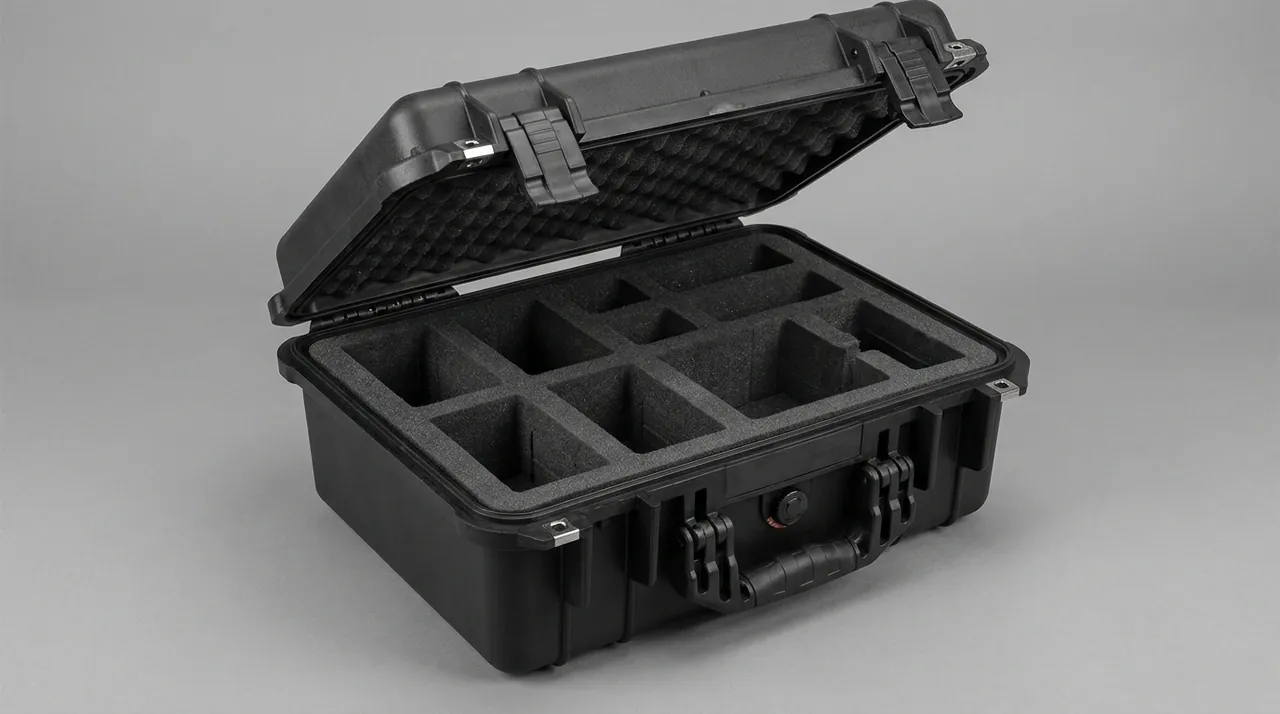
4. Drop: Closure Retention as the Real Test of a Case
A drop test releases the packaging from a specified height and in a stated attitude onto a rigid target. Impact points typically cover corners, edges and flat faces, so that the case is probed in its least favourable orientations.
The test plan prescribes a standardised fill and a defined centre of gravity. That part belongs to the procedure and the testing environment, and this article says nothing about the properties of any fill material. What matters from the container side is how the case itself responds under those conditions.
The criteria cluster around a few critical locations. The case must not suffer a rupture that limits its use. Closures must not come apart. The sealing interface must not shift into failure. The lid and body must not separate or gape.
Those criteria pull design attention toward stress concentrations, meaning the corners, the hinge mounts and the roots of the latches. The value of the drop test lies exactly here: it forces weak points onto the bench in a reproducible way rather than waiting for them to appear during real handling.
A practical rule of thumb follows. If the case emerges intact but the latch has popped, the problem usually sits in insufficient closure stiffness or too little locking travel. Adjusting the hardware match and the locking geometry tends to help far more than adding more wall thickness.
It is also necessary to read the relationship between attitude and height correctly. The height is normally tied to the mass of the case, while the attitude decides which region receives the energy. The same unit can behave very differently between a corner drop and a flat-faced drop, so conclusions are usually drawn only after several orientations and repeated releases. A single landing is not enough to represent the whole. Before the test, it pays to list the weak region expected from each attitude, then check that the corresponding reinforcement is actually present, so nobody has to guess where the problem lies once the case is on the floor.
5. Stacking: Pairing Top Load With Hold Time
During warehousing and intermodal movement, a case carries the accumulated weight of everything stacked above it for long periods. A stacking test simulates that slow, sustained action using a prescribed load held for a prescribed time, measuring how stably the case performs under pressure.
Unlike a drop, stacking damage is usually gradual. Ribs begin to bow slightly, corner posts lose stability, and the whole stack eventually tilts or collapses. Progressive failure is harder to notice than a sudden rupture and depends much more on observation during the test.
Judgment therefore cannot stop at whether the case was crushed. It must also weigh whether residual deformation harms later stacking stability or closure function. A shallow depression that prevents the lid from seating properly is still a failure.
From a design standpoint, the continuity of the corner posts, the flatness of the top bearing surface, and the fit between the base and the pallet or corner fittings all shape stacking behaviour. The load chosen for the stacking test should be tied to a real stacking height rather than picked as a round number out of habit.
Hold time matters because materials creep under sustained load. A structure that looks sound within a short window may settle visibly after several hours or longer. If the storage environment also runs warm, creep is amplified further, which deserves particular attention in summer or in a heated warehouse. Judgment should therefore observe the peak of loading and then measure residual deformation after unloading, confirming that the case still closes properly and still interlocks with the unit beneath it. Recording dimensional change before and after is far more persuasive than a single-line verdict. A case that merely survives the load but no longer stacks squarely has not really passed. Where several case formats share a warehouse, it is worth checking that the test load reflects the heaviest realistic stack rather than an average one, because the worst column in a real installation is what decides whether the stack holds through a season.
6. Sealing and Leakproofness: Turning Criteria Into Case Geometry
Sealing performance has two measurable expressions. One watches whether water or liquid finds its way in. The other watches whether pressure can be held. The two place different demands on the case, and mixing them up produces lopsided conclusions.
Immersion is more sensitive to static sealing, while an air-pressure check is more sensitive to dynamic sealing and to tiny channels. The usual criteria are simple to state: after the prescribed conditions, observe whether continuous bubbles appear, or whether pressure decay stays within the permitted limit.
For a protective case, the weak points in sealing almost always sit at seams: the mating face between lid and rim, the places where hinges and latches pass through the wall, and the openings reserved for pressure-balancing structures. The compression set and rebound of the seal strip determine how long the sealing interface survives repeated opening and closing.
If the case carries a vent or balancing feature, the design stage must settle whether it is permitted to exist as a path at all in the certification context, and it must stay consistent with the test plan rather than being assumed safe. A water immersion test is chiefly about the integrity of static sealing, not about behaviour under dynamic conditions.
One further factor is easily underestimated: the number of open and close cycles during service. Every compression leaves a little permanent set behind, so after enough cycles the rebound weakens and an interface that once passed begins to seep. Where possible, durability of cycling and sealing judgment should be examined together instead of testing only a pristine unit. Assembly discipline matters just as much. Foreign matter on the sealing face, a gasket installed under tension, or a local twist can all produce visible differences between units and make results that ought to be consistent very hard to reproduce. Keeping a simple record of cycle counts and rechecking sealing at intervals gives a far truer picture than a single pass on a new unit, and it also reveals when a gasket material or a latch design has begun to age faster than expected.
7. Vibration and Resonance: Cumulative Damage From the Container's Side
Vibration on a long journey rarely destroys a case in one blow, but it loosens fasteners, compresses liners and lets stress accumulate at weak spots until fatigue finally shows itself.
Random vibration and resonant dwell are the two common loading methods. The first follows the statistical character of a real road spectrum, while the second rapidly exposes resonance points. Used together they cover the transport environment fairly well.
When the natural frequency of the case or liner falls inside the excitation band, amplitude is amplified sharply. Hardware fails first, showing up as loosened screws or a changed latch travel. Liner collapse and internal movement usually follow.
Container design must therefore balance damping against restraint. Contents should neither be left free to rattle nor have shock transmitted straight through to the case body. The outcome of a vibration test should convert into concrete limits on hardware torque, liner density and layout rather than stopping at the word passed.
Remember that the case and its liner form a new mechanical system once they are combined, and its natural frequency is not the same as that of the bare case. Liner density, thickness and fixing method all shift the system response, so the two should be assessed as one assembly instead of being handled in isolation. Recording the resonant bands observed during testing matters too. Those bands can guide the tightening torque chosen for assembly and can quickly reveal whether risk has been reintroduced when a liner or a piece of hardware is later changed. Turning vibration findings into specific assembly parameters is worth far more than keeping a single sheet of paper that merely says the test passed. If a resonant band cannot be moved, the practical alternative is to add damping or restraint so that the amplified motion reaches the contents in a gentler form, and then to confirm that choice with a further run rather than leaving it to assumption.
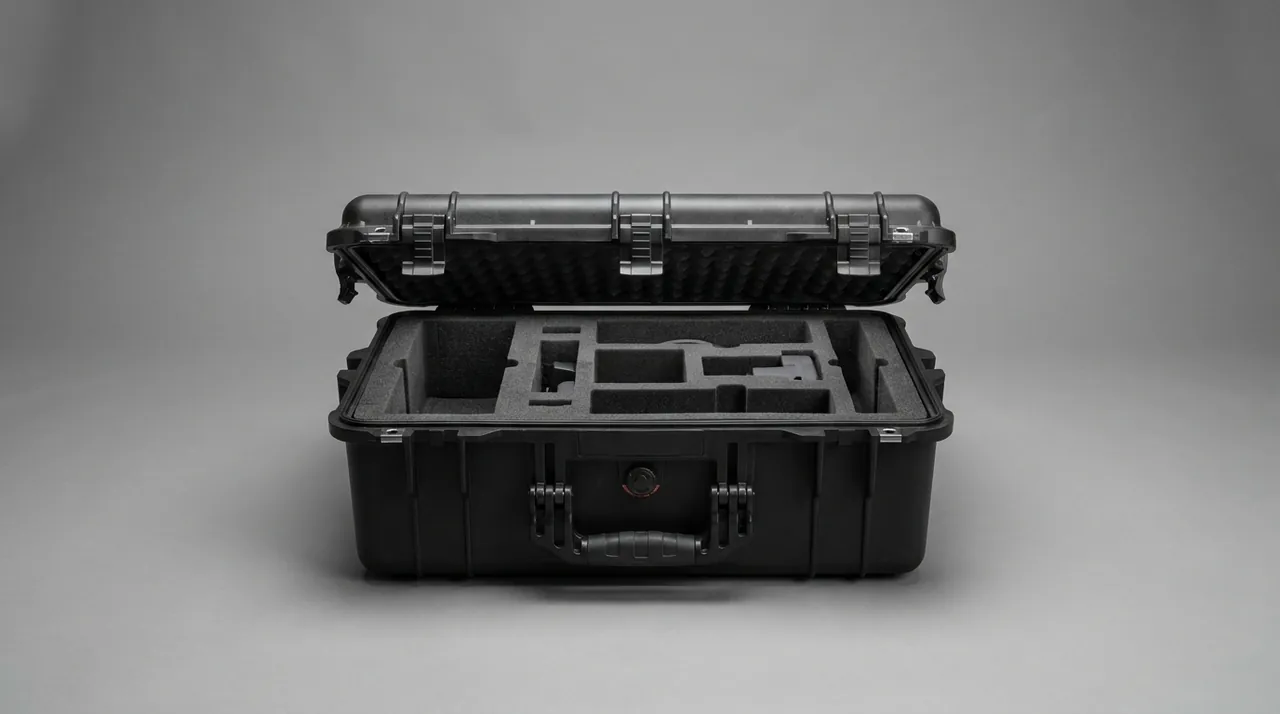
8. Liners and Restraint: Where Case Performance Is Actually Paid Out
However sturdy the case may be, an oversized internal cavity lets impact energy bounce around inside until it reaches small parts that were never meant to carry load.
A liner actually does two jobs. It positions and it cushions. Positioning answers the demand that nothing move, while cushioning answers the demand that controlled deformation be allowed. Only when both are in place can case performance genuinely be paid out.
Foam, dividers and straps each have a suitable range. The choice should rest on weight, fragility and tolerable acceleration rather than on feel or appearance. Too low a density causes collapse, while too high a density passes shock straight into the contents.
It is worth noting that changing the liner can affect an existing type test conclusion, because it rewrites the path along which force travels. The way stacking corners interact with the liner determines whether contents are indirectly squeezed in a stacked condition, and this coupling is often overlooked.
A precision instrument case frequently separates sensitive items from accessories so that their load paths differ, and that idea transfers well to any case that needs to pass certification. A temperature controlled case spends internal volume on insulation, which compresses the cushioning height, so this must be declared as part of the design type.
At the project level, the liner material, density and layout should therefore be written into a controlled list and treated with the same seriousness as the case drawing. Positioning and cushioning often trade off against each other: clamp too tightly and assembly becomes difficult while more force is transmitted during vibration, clamp too loosely and items shift during a drop. The sound approach is to divide the interior by weight and fragility and apply different restraint strategies to heavy and light items, rather than covering the whole cavity with one uniform layout. Reviewing the liner whenever the contents family changes is as important as reviewing it when the case itself changes, because a layout that suits one mix of items may leave another poorly supported.
9. Mark Placement and Durability: Molding, Printing or Labels
The mark is itself an object under test. It has to stay clear, readable and attached through transport, storage and daily use, or the most accurate performance in the world lacks a verifiable entry point.
Three routes are common. Characters can be formed directly during molding, applied later by screen or hot stamping, or delivered on a durable label. Their resistance to abrasion, solvents and weathering differs widely, so the working environment should guide the choice.
Placement needs its own logic. Keep the mark away from surfaces that rub constantly, from stacking contact faces and from areas that are gripped for long periods, while ensuring it is still legible when the lid is open. Putting the mark wherever it is easiest to apply is often the surest way to create a problem.
One easily missed detail is that mark durability should be considered alongside the case tests, because drops and vibration genuinely shake labels loose or scuff them. If poor mark durability is only discovered at acceptance, the cost of rework and re-verification is rarely small.
From a verifiable standpoint, durability involves at least four stresses: mechanical abrasion, attack by solvents, prolonged sunlight and repeated temperature swings. The way they are checked should be equally varied, for instance confirming that characters remain readable after rubbing and solvent wiping, and that labels do not lift or fade after thermal cycling. Rather than waiting until a whole batch has been molded, it is far better to run these checks at the prototype stage, because by then a change of placement or a switch of process costs very little. The mark is a small element, yet it is frequently the first thing an auditor sees and the last thing that shapes their impression. A short written specification for the mark, covering the process, the placement and the checks it must survive, removes much of the guesswork when production shifts to a different line or a different supplier, and it keeps the outcome stable even when the people doing the work change.
10. Sampling and Batch Consistency: One Good Unit Is Not a Batch
A type test certifies a design type. It cannot vouch for every production unit on its own, and this point is misread surprisingly often.
Batch consistency rests on long-running disciplines: a stable mold condition, controlled material batches, traceable process parameters and routine outgoing inspection. Loosen any one of them and production units can drift away from the sample that was verified.
Whenever a mold wears, a material grade changes or a hardware supplier switches, the need for supplementary testing should be reassessed. The guiding question is whether the change is capable of affecting the performance that was verified before.
A sampling plan should match the risk. The more complex the structure, the more closures it carries and the longer its sealing interface, the more attention key dimensions and assembly quality deserve, rather than a fixed percentage pulled out of the air.
Only when both design freezing and production change control are written into the quality system can certification validity survive the mass production stage.
At a finer level, inspection should distinguish between attribute and variable judgments. Features that only have a good-or-bad outcome, such as whether a closure has seated or whether a gasket is present, suit attribute checks that screen quickly. Features that can be measured as numbers, such as wall thickness or the gap at a sealing face, need actual values recorded so that drift in the distribution becomes visible. Identifying the critical characteristics and assigning each its own check method is far more practical than a vague instruction to sample by batch. When a measured indicator starts creeping toward its tolerance limit, a warning should go out early rather than waiting for an outright failure. It is also useful to keep a simple trend chart for the most sensitive dimensions, because a gradual drift is far easier to correct while it is still inside tolerance than after a batch has already been shipped. Reviewing that chart at every production meeting turns inspection data into a decision tool rather than an archive.
11. The Documentation Chain: From Type Test to Batch Release
The credibility of certification ultimately rests on paper. A complete chain should be able to answer who performed the testing, under which plan, which design type the conclusion refers to, and whether a given batch really falls inside that type.
The file set should therefore include drawings and tolerances, a material and hardware list, the test plan and its acceptance criteria, process records and images, equipment calibration information, and confirmation of the mark layout.
The worth of documentation lies in traceability, not in sheer volume. Piling up irrelevant files does not merely fail to help; it buries the decisive evidence and makes it hard for a reviewer to see the point.
It is good practice to build a one-to-one mapping between marks and reports, so that any case can be traced back along its mark code to the relevant type test. Secondary indicators such as an IP rating should be registered in the same way, so that certificates never drift away from the cases actually on sale.
Records should be kept for a reasonable period after the product leaves the market, so that traceability and audit demands can still be met.
There is also a management distinction worth preserving between a test report and a certificate of approval. A report captures the process and result of one specific test, while a certificate expresses confirmation of a design type, and the two do not carry the same scope of validity. If the design changes, the report remains as a historical record, but the certificate it once supported may need to be reissued. Keeping version and change history clear lets a reviewer see at a glance how current the evidence is and how far it applies. When the files are organised well, an audit takes markedly less time and generates noticeably fewer disputes. A short cover sheet listing the current design revision, the applicable report number and the date of the last change saves a reviewer from having to reconstruct the story out of raw files.
12. Dividing Labor With Neighboring Systems: Distribution, Rail and Ingress
More than one rule system touches packaging and containers, and each answers a different question. Mixing them up creates compliance risk.
Distribution test schemes focus on simulating the logistics environment to show that packaging is dependable through typical handling. They do not replace a performance judgment for hazardous goods packaging. A distribution test and a certification test start from different premises and apply different criteria, so neither can stand in for the other.
Rail intermodal work has its own admission requirements, centred on intermodal loading and stability under railway conditions. Rail intermodal certification and packaging performance testing complement each other in the type of evidence they supply rather than substituting for one another.
An ingress rating describes resistance to the entry of foreign matter or water. It neither proves that sealing still holds after a drop nor replaces packaging performance testing. A sealing grade is very often mistaken for a compliance credential, which is a familiar cognitive slip.
The steadier approach is to file the evidence from each system separately and to state plainly which question each report actually answers.
One way to organise the archive is by question. Is the distribution environment reliable? Does packaging performance meet the bar? Is intermodal loading stable? Is the barrier against foreign matter and water sufficient? Each question maps to its own body of evidence. Handled that way, the right documents can be produced quickly for whichever reviewer arrives, without rummaging through unrelated material. What must be avoided is the idea that one report can cover everything. Every single document has questions it cannot answer, and treating it as a universal credential leaves a gap exactly where evidence is genuinely needed. Drawing clear boundaries between systems is, in the end, a way of protecting yourself. It also makes those boundaries visible to colleagues outside the quality team, so that a request from sales or a question from a customer is routed to the right evidence instead of being answered from memory.
13. Common Misconceptions, Corrective Paths and Scope Notes
One frequent misconception is to treat a single impressive indicator as overall compliance. A lone metric, however strong, cannot cover the combined demands of drop, stacking and sealing, and hiding a weak spot only moves the risk downstream.
A second is to mass-produce first and verify afterwards. Changing a tool after the design has been frozen effectively cancels the evidence already gathered, and the work usually has to restart from type testing.
A third is to neglect the mark and the documentation. The case itself may be fine, yet a blurred mark or a report that disagrees with the drawing can stall an audit. It is both the most unjust and the most common kind of failure.
A fourth is to treat the liner and the hardware as accessories open to later optimisation. They are part of the design type from the outset, and every change should pass through change assessment.
When any of these arise, a practical corrective path begins by returning to the design freeze and realigning the drawing, material, hardware and liner, then checking whether the test plan still covers the current structure, and finally confirming that mark and documentation have been updated in step. The order cannot be reversed, because any change made ahead of the evidence forces the later work to be repeated. Keeping a short change log beside the drawing makes that sequence much easier to follow and gives the next reviewer a clear starting point rather than a puzzle.
Finally, a clear statement is needed. This article concerns the container components themselves, namely the case shell, liner, latches and sealing, together with the test methods and documentation practices built around them. It does not discuss the attributes, composition or use of anything that may be packed inside. Cross-border transport, export declarations and the application of control lists should follow the regulations in force at the destination and along the route, and the responsible party must complete that assessment and bear the consequences. Nothing here constitutes a compliance conclusion.
Frequently Asked Questions
Q: Does obtaining UN certification for a protective case mean the case passed some structural strength test? A: Not in that sense. Certification examines the consistency of a whole performance and documentation set, and strength is only one strand within it. A case must pass a group of tests covering drop, stacking and sealing, and it must also ensure the design type is clearly recorded and that marks line up with reports. Fixating on one strength figure easily hides closure fit, sealing durability or mark reliability, all of which will still be questioned. What decides the outcome is usually whether the entire evidence chain is coherent, not how impressive a single number looks. A further point is that the certified object is a design type, so a strong result on one handpicked unit proves less than it appears. The practical advice is to treat certification as a systems exercise, align drawings, tests and marking wording first, and only then work through the details one by one. That habit also avoids the familiar situation in which a test is repeated for the wrong reason, simply because nobody can state with confidence which drawing revision the earlier result actually belonged to.
Q: The case already has a high dust and water ingress rating, so is packaging performance testing still necessary? A: Yes, because the two answer different questions. An ingress rating describes how hard it is for foreign matter or water to enter the case. It does not prove that sealing still holds after a drop, and it says nothing about stacking or vibration. Packaging performance testing examines the overall integrity of the case under transport mechanics, including whether closures stay engaged and whether the body keeps its shape. Confusing the two leads people to assume that a high rating automatically satisfies transport requirements, and that assumption rarely survives a real review. A rating also says nothing about how performance drifts as seals age or as hardware loosens, which are precisely the effects that transport produces. The careful approach is to obtain and file the two kinds of evidence separately, so that one report is never asked to answer two different questions. It also helps to note the specific conditions under which each piece of evidence was obtained, since a rating and a transport test carry meaning only within the limits against which they were measured.
Q: Can the information on a case mark be modified freely after mass production begins? A: It should not be modified freely, and generally should not be modified at all without process. The mark carries design information that has already been verified, and every field should be backed by drawings, material records and test conclusions. Changing it is equivalent to changing the design type the mark points to, which means re-confirming whether existing evidence still applies. If an adjustment is genuinely required, it should follow a formal change assessment: first decide whether performance judgments are affected, then decide between supplementary testing and a fresh type test, and finally keep the revision on record. Treating the mark as a controlled document is the least troublesome way to avoid later disputes. It also helps to state who holds the authority to approve a change, since an uncontrolled edit made to satisfy a customer request can quietly invalidate months of verification work. A simple rule that any mark change must pass through the same review as a drawing change keeps the two in step and prevents a well-intentioned shortcut from turning into a compliance problem later on.
Q: After replacing the liner or the latches, does the original certification conclusion remain valid? A: It usually needs reassessment, and validity should never be assumed. Both the liner and the latches influence how force travels inside the case. The liner decides whether contents are reliably positioned and cushioned, while the latches decide whether the closure stays engaged under impact. Changing either can invalidate earlier measurements. The stable approach is to place the liner and the hardware under the same design type control, run an impact analysis when they change, arrange supplementary drop or sealing tests where necessary, and update the documentation accordingly. It is also wise to record the reason for each change, so that a later reviewer can see why a new test was run or, where it was not, why the existing evidence was judged still adequate. The extra paperwork is a small price compared with discovering, at shipment or during audit, that the evidence chain has a gap. Keeping a short note of what triggered each supplementary test also builds a history that makes later change assessments faster and far less uncertain, because the reasoning behind earlier decisions stays visible instead of having to be reconstructed from memory.
Q: If only one sample case is tested, can it represent the whole production batch? A: A type test represents a design type, not a specific production batch. It can show that the design reaches the required performance on an ideal specimen, but it cannot guarantee every unit that leaves the line. Batch consistency depends on a stable mold, controlled material batches, traceable process parameters and routine outgoing inspection. Beyond the type test, therefore, a sampling and inspection mechanism should be established, concentrating on key dimensions, closure assembly and sealing quality, so that certification validity continues through production. Binding inspection records to batch numbers also makes it possible to identify the exact production window if a problem later surfaces. It is equally important to define in advance what triggers a re-test, so that the decision does not rest on individual judgment alone when a process parameter moves. The type test and the routine batch inspection serve different purposes and should never be confused: one proves what the design can achieve, while the other shows whether production still respects that design. Keeping both threads visible makes it much easier to explain, when a customer or a regulator asks, exactly how consistency is maintained over a long production run.
Q: Among drop, stacking and sealing tests, which one is most likely to cause trouble? A: There is no fixed answer, because the problem usually appears wherever the design weakness sits. A case with insufficient closure stiffness often shows a popped latch during dropping. A structure with an uneven bearing surface or discontinuous corner posts tends to buckle gradually under stacking. A case with an over-long sealing interface or a gasket that rebounds poorly is more likely to fail the sealing criteria. Rather than guessing which is hardest, it is better to check weaknesses item by item at the design stage so that all three criteria rest on one coherent structural logic. The benefit is that when a test must be repeated, it is already clear which other indicators the change will touch. Reviewing past failures in the same product family can also point to which criterion deserves the closest attention this time. The three criteria are rarely equally demanding for a given structure, because the weak point usually announces itself in one category more loudly than in the others. Tracking which criterion failed before on similar designs is a cheap way to bias attention where it is most useful, without ever dropping the rest. Done that way, the test plan stops being a checklist and becomes a genuine risk map.
Q: How long should certification-related documentation be kept? A: It should be retained for a reasonable period after the product leaves the market, to meet traceability and audit needs. Content matters far more than volume and normally covers drawings and tolerances, a material and hardware list, the test plan and acceptance criteria, process records and images, calibration information, and confirmation of mark layout. Mapping mark codes to reports one to one allows any case to be traced back to its evidence. If the file set has gaps, even a perfectly sound case can be questioned during an audit. Appointing a dedicated owner for collection and version control keeps essential evidence from scattering across departments. It also helps to keep the storage format stable, so that older records remain readable when someone needs them years later. A short index page, describing where each category of evidence is kept, spares a great deal of searching at precisely the moment an unannounced audit arrives. It is also worth reviewing the retention arrangement periodically, since transport routes and storage practices change over time and the evidence that matters most can shift with them.
Q: For cross-border transport, is a compliant mark on the case enough to prove compliance? A: Not by itself. The mark describes design information about the packaging, and it must cross-check with test evidence, batch records and the consignor's declaration materials before a complete compliance picture exists. Cross-border transport and export also involve regulations, control requirements and declaration procedures at the destination and along the route, and those are not decided by the container factory alone. This article discusses container structure, test methods and documentation flow throughout, does not address the attributes or use of packed items, and does not constitute a compliance conclusion. Because requirements differ between jurisdictions and change over time, any assumption carried over from a previous shipment should be rechecked rather than reused. The recommendation is to have the responsible party verify each party's requirements before shipment and to confirm container evidence and declaration duties separately. It is worth remembering that a mark is only one link in a longer chain, and treating it as the whole story tends to bury the supporting records that give it meaning. When the mark, the report and the batch file agree with one another, compliance becomes something that can be demonstrated rather than merely asserted.