

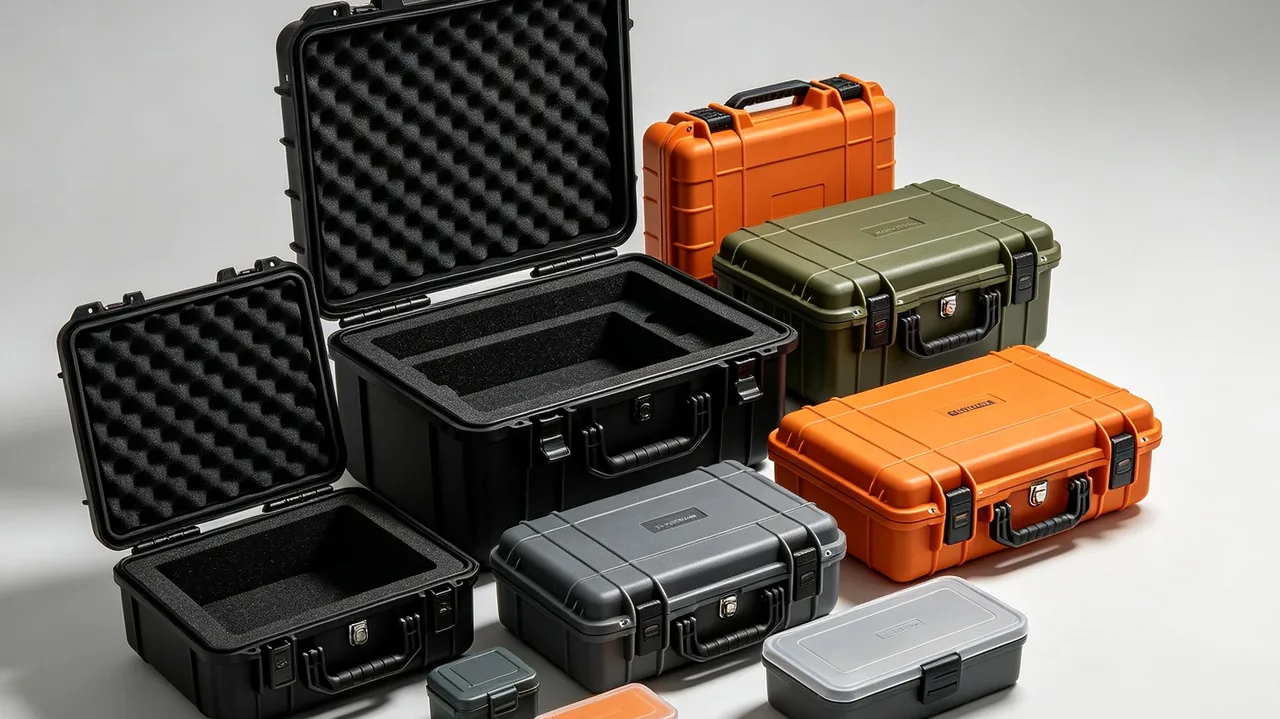
Warehouses rarely have the luxury of spreading protective cases across a single layer of floor. Space is expensive, so cases get stacked, often five, six, or more high, and the units at the bottom of each column spend weeks or months carrying the weight of everything above them. That steady, unglamorous burden is a structural problem in its own right. Plastics creep under sustained compression: give them enough load and enough time and they gradually yield, first as a barely visible change in height, later as a sagging base, a crushed corner, or a sidewall that bows outward. A stacking test is the instrument engineers reach for when they need to know how a container behaves under that kind of long, patient pressure. Rather than simulating a single violent event, the test reproduces the calm, persistent load of a warehouse column and tracks how the case responds as hours turn into days.
This article stays strictly on the container side of the question. It examines how stack load moves through the shell, the ribs, and the stacking corners; how the test is set up and instrumented; how results are judged; and what the numbers mean for storage planning. It says nothing about what a case might hold, and it draws no conclusions about any cargo. Everything here concerns the shell, the reinforcement ribs, the stacking corners, and the load path they create together. The goal is a clear, practical picture of how protective case stacking performance is verified, why the test can take weeks, and where its conclusions stop being valid.
Because stacking failures unfold slowly and quietly, they are easy to overlook until a column finally gives way, which makes disciplined testing far more valuable than intuition. A case that looks perfectly sound on a loading dock may be creeping toward trouble inside a hot, crowded rack. Testing is how that hidden risk is converted into numbers a designer can act on. With that frame in place, we can walk through the engineering step by step, starting from the question the test is actually built to answer, and then move outward to the load path, the arithmetic, the instrumentation, and the operating rules that follow.
1. What Problem the Stacking Test Solves
A stacking test is not about the jolt a case takes when it is dropped or the rattle it endures on a truck. It is about the weight that settles onto a case and then simply stays there. Picture a warehouse aisle lined with pallets, each pallet loaded with the same case shell stacked five tiers high. The bottom case in each column has four or five cases resting on its lid, and that load does not lift for weeks. Under that kind of sustained pressure, a thermoplastic will slowly deform even though nothing has visibly hit it.
The test brings this quiet condition onto the bench. Engineers apply a stable, downward force to a case and hold it for a meaningful period, watching whether the container keeps its shape and function. The distinction from other tests matters. A drop test captures a brief release of momentum; a stacking test captures the slow accumulation of static force. A vibration test comes from road-induced motion in several directions at once, while a stacking load acts almost entirely along the vertical axis.
Understanding that distinction is the first step in deciding whether a given container can safely live at the top of a tall column or must be relegated to a single-layer floor position. The output is not a simple pass or fail stamp, but a recorded curve of deformation against time, together with a description of what recovers once the load comes off. Those details let a designer judge not only whether a case survived, but how much margin remained when the test ended.
There is also a practical dimension that a single moment of impact can never capture. A case may pass a drop test with ease and still lose its shape over a long, hot summer under a permanent load. Speed of loading and duration of loading stress a container in different ways, and only a test that holds force steady for a long time exposes the second kind of weakness. That is why stacking verification sits alongside the more dramatic tests rather than behind them.
2. How Load Travels Through a Stacked Column
The weight in a stack does not vanish; it must travel down a defined path until it reaches the pallet and the floor. For a protective case, that path usually begins at the underside of the case above, passes through the contact between the upper lid rim and the stacking corner, and then drops through the load-bearing zones of the sidewall and the corner post into the base and feet. If any link in that chain is weak, the force simply detours around it and concentrates in neighboring material, creating a local overload.
When the stacking corners of two cases are misaligned, or the lid surface is warped or dented, the contact changes from corner-on-corner to point-on-point. Pressure per unit area can rise several times over, and the edge of the stacking corner is usually the first place to show a dent or a stress whitening mark. A case with aligned corners, a flat top, and a rigid base spreads the concentrated force across a larger bearing area, so the walls carry the weight at a more even stress level.
This is why warehouse guidance about tidy, level stacking is really guidance about protecting the load path. A stack that looks acceptable from a distance can still be routing force through a handful of brittle contact points if the cases are not squared to each other. Designers can help here by giving the lid and the base matching bearing zones, so that force enters and leaves the container as evenly as possible.
The path has a second half that is often forgotten. What arrives at the base must also be handed off cleanly to the pallet, so a soft or uneven underside can redistribute pressure and overload one foot at the expense of the rest. Judging a case only by how its lid bears weight misses this lower link. Both ends of the container need to work together if the whole load is to be carried without a hidden concentration somewhere along the way.
3. Computing Stack Load and Choosing a Safety Factor
Before a stacking test can mean anything, someone has to work out how much force the bottom case actually sees. The common estimate is straightforward: the load on the bottom case roughly equals the number of cases above it, multiplied by the gross weight of one full case, multiplied by the acceleration of gravity. If the load is applied uniformly across the lid, it is then converted into a pressure over the lid area. Real warehouses are messier than the formula, so a safety factor greater than one is normally applied to absorb stack tilt, dimensional tolerances, brief overloads during handling, and the strength loss that long-term creep causes.
A larger factor is not automatically better. Overly cautious values bloat the case, waste material, and raise freight cost. A sound approach is to define the real distribution environment first, in the spirit of an ISTA test, and then choose the factor by combining storage height with the expected storage duration, so the test load reflects genuine conditions without drifting into impractical territory.
Cases of different heights in the same family also need separate calculations, since it is not safe to take data from the tallest variant and assume the shorter ones inherit the same margin. When the arithmetic produces an extreme figure, that is often a signal that the stacking plan itself should change, perhaps with fewer tiers or an added deck, rather than that the wall must grow thicker without limit.
A worked habit helps here: compute the nominal load, apply the chosen factor, and then sanity-check the result against what a similar case achieved in earlier testing. If the number demands a wall far heavier than any comparable product carries, the assumption feeding the calculation is probably too conservative. Adjusting the storage scenario is frequently cheaper and more honest than pushing the material beyond sensible limits.
4. Static Loading and Creep Measurement
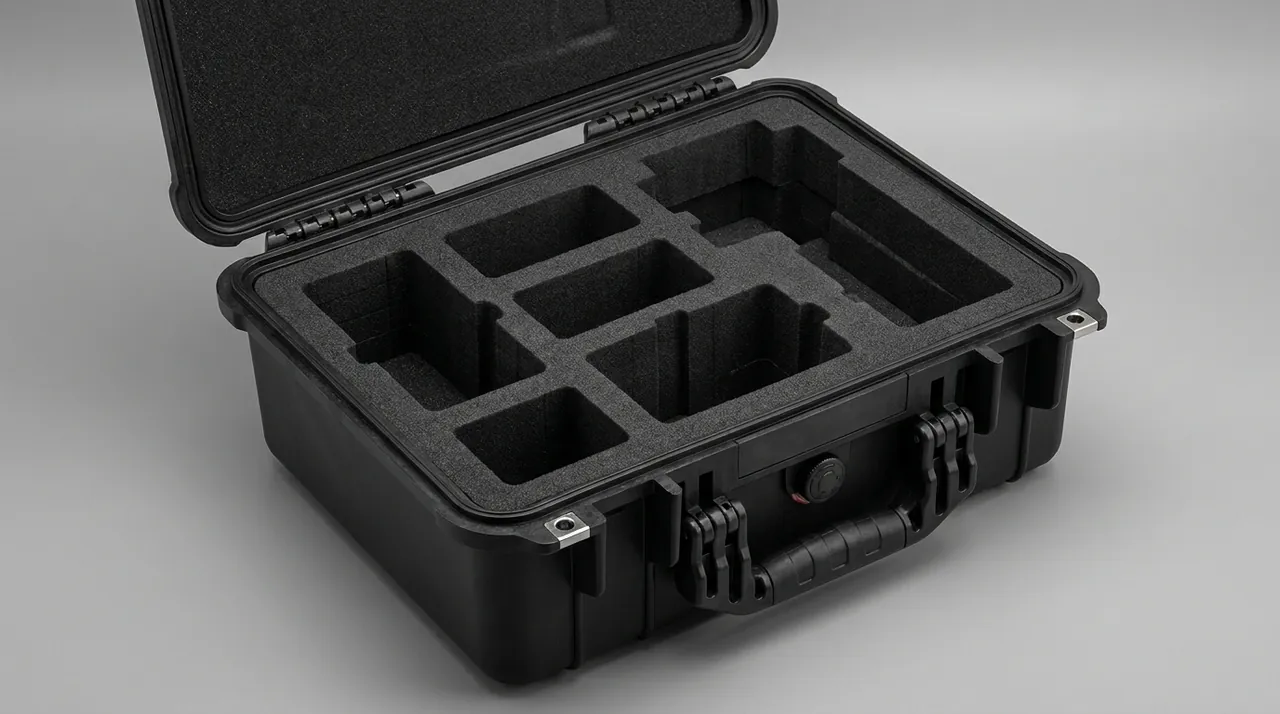
At its heart, a stacking test is about time under a constant load. The case sits on a rigid platform while a platen presses down with a fixed force, and the load can be held for anywhere from several hours to several weeks. As time passes, displacement sensors log the tiny changes in case height and sidewall position, producing a curve of deformation versus time. A classic creep curve has three phases: a faster initial stretch, a slow and nearly linear steady phase, and, if the load is too high, an accelerating phase that races toward instability.
When judging stacking performance, engineers care most about the deformation rate during the steady phase and the residual deformation left after the load is removed. The first reveals the long-term margin; the second decides whether the case can still be used. For a temperature-controlled case kept in storage for a long time, temperature is layered on top of the load, because resistance to creep falls noticeably as material warms. Measurements must be made in a stable environment so that humidity and temperature swings are not mistaken for structural movement.
Creep data also tend to scatter, and curves from the same batch of specimens may not overlap neatly. Reliable conclusions usually require several specimens tested in parallel, with a spread of results reported rather than a single curve standing in for everything. Where a high margin is essential, the worst-performing specimen should set the design basis, so that an average never hides an individual weak unit.
Sometimes a higher temperature is used deliberately to compress the timeline, since creep runs faster in the heat. That shortcut has to be handled with care, because materials differ in how sensitive they are to warmth, and one product's acceleration ratio is not another's. The safest practice is to cross-check any accelerated run against a smaller set of long tests at ordinary temperature, so that the extrapolation rests on measured ground rather than a hopeful guess.
5. Compression Testing Versus Stacking Testing
Compression testing and stacking testing are often lumped together, yet they answer different questions. A compression test raises the load step by step and measures short-term strength and stiffness. Its result is a limit: how much force it takes to crush the case. A stacking test holds the load constant and watches deformation build over a long period. Its result is a trend: whether the case will sag under a load that never leaves.
The first is well suited to quickly screening structures and materials. The second is closer to warehouse reality. In a development program, engineers usually run compression first to map the strength ceiling, then stacking to confirm long-term safety, treating the two as complementary halves of one picture.
For cases that also face repeated handling, another layer can be added by studying how dynamic conditions affect integrity, much as a vibration test does for transport. The loading method differs too: compression rigs often run in displacement control, driving the platen down at a fixed rate, while stacking rigs run in force control and hold a set load steady. That difference shapes how curves look and how they should be read, so it must be stated clearly in any report if data from different sources are to be compared fairly.
A simple rule of thumb is that compression tells you what the case can survive in the worst single moment, while stacking tells you what it can tolerate in the dull, endless everyday. Both matter for a container that is thrown around at the dock and then parked in a rack for a season. Skipping either test leaves a blind spot, and a design team that only measures the dramatic side of the story is likely to be surprised later by the quiet one. Keeping both results in one file, with the loading method noted for each, makes it far easier to explain later why a container behaved the way it did in service.
6. Stacking Corners and Load-Bearing Posts
In most stacking situations the load is not spread evenly across the lid; it lands on a small number of contact points, and the stacking corner is the component that receives them. A well-designed corner reserves a flat bearing surface on top and channels the force through an internal post straight toward the base, instead of letting it bend its way down the middle of a wall.
The cross-section and count of the vertical posts set how efficiently the corner carries weight. A closed cavity resists compression better than a thin single skin, and a post with folded edges resists buckling better than a flat plate. If a case has no dedicated stacking structure, the load must be taken by the lid as a whole, and the lid's flatness and stiffness become the limiting factor. In service, the stacking corners of the cases above and below must line up precisely; once they are offset, even a strong post fails early because the load arrives off-center. Corners are often the thickest molded regions, so shrinkage after cooling deserves attention as well.
Manufacturing method matters here too. A post molded in one piece with the case avoids assembly joints, and those joints are usually where stiffness changes abruptly and failure begins. If a split design is unavoidable, the connection points should be at least as strong as the post itself, so force is never cut off at a seam. The fit between corner and post should also be inspected before a batch ships.
Transitions deserve the same care as the straight sections. Where a post meets the base or the lid, the cross-section changes quickly, and it is there that stress tends to pile up. Rounding and tapering that junction smooths the change in stiffness, which keeps the load path continuous and reduces the chance that a crack will start at the joint long before the post itself is near its limit. Getting that junction right is usually cheaper than adding material elsewhere, and it keeps the load path honest from lid to base.
7. Ribs and Wall Thickness as Load Carriers
There are two direct ways to raise stacking capacity: add wall thickness or add ribs. Thicker walls increase stiffness and strength together, but also weight and material use. Ribs break a large flat panel into smaller spans and raise the section's moment of inertia with far less material, which is usually the better bargain. The design details matter: if ribs are spaced too far apart, the panel can still bulge between them, and if their direction does not follow the dominant stress path, the benefit shrinks.
One caution is that ribs change how plastic flows and cools during molding. They can create local internal stress or sink marks that later become crack origins. Load design therefore has to be planned alongside the whole molding method for the case shell, and finalized after verification testing where needed. Excessively dense rib patterns also complicate the mold and raise the risk of molding defects, so capacity and manufacturability must be balanced rather than optimized in isolation.
A sensible split of duties helps. Near a stacking corner, thick walls paired with short, closely spaced ribs resist crushing best, while the middle of a sidewall favors longer, moderately spaced vertical ribs against overall bending. Handling different zones according to their stress roles usually uses less material than uniform thickening, and it leaves room to trim weight later.
The service life of the case should also guide how generous the structure is. A container that is stacked briefly during a short trip can get by with modest reinforcement, while one destined for months of warehouse storage needs a larger reserve in its most stressed zones. Trading a little weight for a steadier long-term shape is often a sound deal when the container is expected to sit under load for a long time. Weight saved here also makes handling easier and shipping cheaper, so a structural choice made for stacking quietly improves the economics of the whole supply chain, long after the test bench has been switched off.
8. How Temperature Reshapes Long-Term Capacity
Creep speeds up markedly at higher temperatures, and this is the most frequently underestimated variable in stack design. A top-shelf warehouse location with no air conditioning, a spot near a heat source, or a position in direct sunlight can sit well above room temperature, and creep is quite sensitive to warmth. Each step up in temperature can multiply the deformation rate. Cold works the other way: it slows creep but makes some plastics brittle, so a case that meets a handling impact in a cold room is more likely to crack.
The upshot is that the same case can show different stacking safety in a cold zone and a hot zone, which is why test temperature must be defined and recorded. For applications that need both thermal control and load capacity, the thinking used for a temperature-controlled case can be borrowed, folding structural and thermal requirements into one assessment. Storage layout should also keep tall stacks in thermally stable areas, to limit how much long-term heat erodes capacity.
For cases that cross climate zones, the whole route deserves attention rather than a single site. A batch might sit first in a cold northern warehouse and later in a hot, humid one, so the material sees a wider temperature range than any one location suggests. Setting the test condition at the least favorable temperature is the safer habit, since it covers the worst case rather than the comfortable middle.
It also helps to treat temperature as a multiplier that can be estimated and then confirmed. Engineers sometimes translate a short hot run into an equivalent long cool one, but the conversion only holds while the material stays well away from its softening range. Near that range, creep turns sharply non-linear and the tidy multiplier breaks down, so any conversion should lean on measured data rather than a rule of thumb alone. Whenever the conversion is used, it is wise to record the assumption, so that a later reviewer can see exactly how the long-term figure was produced.
9. Specimen Preparation and Conditioning
How representative a specimen is decides whether a test conclusion can be extended to production. A stacking specimen should use the same molding process, wall thickness, and assembly state as real shipments, including the seal strip, latches, and lining. It is not acceptable to test a stripped-down shell and call it a proxy for the finished product. Before loading, the specimen must rest in a controlled temperature and humidity environment long enough for moisture uptake and internal stress to settle, so that the conditioning period is not misread as load deformation.
Initial height, edge lengths, and lid flatness are then measured and recorded as the baseline for later comparison. Loading must also be standardized: if weights are used inside the case to mimic a full load, they should be laid out evenly with a center of gravity below the geometric center, so that an off-center mass does not distort how results are interpreted for programs such as UN certification. Enough specimens should be tested to satisfy the statistical need, rather than letting one lucky unit speak for a whole batch.
Conditioning time varies with material, and plastics that absorb moisture need longer to stabilize. If conditioning is too short, the case may shrink as it dries while it is also creeping, and the two effects blend into a curve that is hard to explain. The conditioning standard should be written into the test plan in advance, not decided on the spot.
Where a case carries a lining, it is worth checking that the lining itself will not slip or compress during loading. If it does, its movement folds into the measured displacement and hides what the shell is really doing. Running one set with the lining and one without can separate the two contributions and make the results easier to interpret. For high-value programs, it can also be worth photographing each specimen before and after loading, since a picture often captures local damage that the numbers alone would miss.
10. Loading Equipment and Displacement Instrumentation
The usual stacking rig is a compression machine paired with a rigid loading platen whose size covers the bearing area of the lid, avoiding edge stress concentrations. The procedure starts with a small preload to close assembly gaps, then rises smoothly to the target load and holds steady. Displacement measurement is typically placed at the four corners and the center of the case, sampled in parallel by displacement gauges or extensometers, so that overall settling can be told apart from local collapse.
To study temperature effects, the whole fixture can be placed inside a climatic chamber so that load and environment act together. Data sampling must be fast enough to capture the brisk early deformation, and the hold time, room fluctuations, and any loosening of the fixture should be logged. Those details are essential when comparing runs, and they echo the environmental control demanded by projects such as a water immersion test.
The stiffness of the platen itself matters as well. If the platen bows, the load spreads unevenly across the lid and presses harder near the supports, so platens are built thick and given enough bending resistance. Their flatness should be checked periodically, especially for long-duration work, so that fixture deformation never leaks into the measurements.
Long runs bring their own practical concerns. A test that is meant to last for days should have travel limits and overload protection, so that nothing is damaged if a specimen gives way unexpectedly. It also pays to give the data system a way to keep recording through a brief power interruption, since losing a week of continuous measurement at the very end would waste both the time and the specimen that produced it. It also helps to keep a written log beside the machine, because a short note about a loose bolt or an unusual noise can explain an odd curve long after the run has finished and the details have faded. A tidy log also makes the final report far quicker to assemble, since the story of the run is already written down.
11. Acceptance Criteria and Common Failure Modes
Judging a stacking test means more than checking whether the case was crushed. Deformation, structural integrity, and function must all be weighed. Typical failure modes include a crushed or split stacking corner, buckling of a wall along a rib line, a base that sags under prolonged load, and the seal strip being squeezed out so that sealing faces misalign.
Acceptance criteria may set a cap on residual deformation, a ceiling on the deformation rate during the hold, or a requirement that the case still opens and closes with latches aligned once the load is released. It is worth stressing that exceeding a deformation limit does not automatically mean scrap, but where a sealing interface is involved, even a small shift can rob the case of the protection implied by its IP rating. The strictness of the criteria must therefore be matched to how the case is actually used, and for a case needing a high margin, results can be cross-checked against compression strength.
It also helps to separate recoverable from permanent deformation. The part that springs back slowly after unloading usually does not affect continued use, while the part that stays behind accumulates into the next stacking cycle and gradually eats away at the safety margin. For cases restacked many times over their life, that buildup deserves a place in the assessment.
When a sealing function is part of the case's job, a check before and after loading can be very revealing. Measuring a leak rate or a pressure change turns a vague impression of fit into a number, and comparing the two numbers shows how much long-term load has quietly narrowed the tolerance at the mating face. This is often more informative than a purely visual inspection of the seam. The same logic applies to latches and hinges, where a slight distortion after long loading can signal that the case will no longer close as intended once it is back in daily use.

12. Pallets, Racking, and Transit Stacking
Stacking in a warehouse rarely happens in isolation. Cases are usually loaded onto a pallet first and then moved by forklift onto a rack or the floor. The pallet's stiffness, board spacing, and tendency to bend all change the support under the case, and a rack beam with too wide a span can let the pallet sag and pass extra bending stress into the container. In transit, stacking is layered with the dynamic load of a vehicle bouncing up and down, so the momentary force can exceed the static figure.
Stacking results should therefore be read alongside vibration test data and drop figures, as part of a complete distribution validation. Treating case, pallet, and rack as one system reflects real risk better than chasing a single container metric. Warehouses should also enforce a maximum stack height and state placement and height limits in the transport marking, so that operators can see at a glance which locations may carry a tall stack.
Not all storage positions are equally supportive, either. Slots against a wall or a column tend to be steadier than those in the middle of a span, so putting the heaviest stacks in the steadier locations lowers overall risk. These choices do not change the case itself, but they decide whether test conclusions hold up once the container reaches a real floor plan.
Handling adds a final twist, because forklift lifts and pallet bumps deliver brief shocks on top of the steady load. A test that leaves almost no spare capacity may look fine on paper yet fail in a busy aisle where the case is jostled daily. Leaving a sensible margin for those routine knocks is part of turning a bench result into a workable storage rule. Reviewing those rules after each busy season, and whenever the container design changes, keeps the guidance aligned with how the cases are really being used out on the floor. A brief annual review of stack heights is a small habit that pays off the first time a storage pattern changes.
13. Scope Boundaries and a Compliance Disclaimer
It is important to be explicit about what this article covers. Everything here deals only with the container itself: its structure, materials, and test methods. It does not address the physical or chemical nature of anything that might be packed inside, and it makes no judgment about classification, hazard level, or applicable regulation. A stacking test verifies whether the case can keep its shape and function under sustained vertical load, and that finding cannot stand in for any assessment of the contents.
In addition, if a case is intended for cross-border movement or export, its compliance must be determined by the responsible party under local law and any applicable export-control requirements. The methods and figures offered here are for technical reference only and do not constitute a compliance conclusion or legal advice. A complete shipping validation of a packed unit may involve separate programs such as AAR certification, which should be treated individually. Users should confirm against the specific product, destination, and currently effective rules, and carry out any necessary verification independently.
It is also worth keeping container engineering and regulatory compliance in separate mental boxes. Test data can show whether a structure is dependable; it cannot show whether a shipment satisfies the legal rules that apply to it. Anyone preparing a real consignment should check the current requirements for the exact route and product, keep the supporting records, and treat this article as one technical input among several rather than a final answer.
In short, the value of a stacking test is that it turns a slow, quiet, easily ignored condition into data that can be measured and compared. Using that data well means respecting its limits: neither reading more into it than it can support, nor stretching it beyond the container it was drawn from. Read in that spirit, a stacking result is a dependable description of one specific behavior, and it becomes genuinely useful precisely because its boundaries are stated as clearly as its findings.
Frequently Asked Questions
Q: How is a stacking test different from an ordinary crush test? A: A stacking test holds the load constant for a long period and focuses on how deformation accumulates under sustained pressure. It answers the question of whether a case will slowly give way when something rests on it for weeks. An ordinary crush test raises the load step by step until the case loses its capacity, which measures short-term strength. The first mirrors a real warehouse; the second is convenient for quickly screening options. The two serve different purposes, so they are usually run together. You use crushing data to map the strength ceiling, then stacking data to confirm long-term safety. Relying on either one alone tends to produce a lopsided view of how much margin a case really has, and it can hide the very slow behavior that long storage actually triggers, which is precisely the risk a warehouse needs to control. Speed of loading and duration of loading are simply different problems, and a well-run program treats them as separate questions, each of which deserves its own line of evidence before a design is signed off.
Q: How many tiers should I assume when calculating stack load? A: Start by counting the greatest number of tiers the warehouse will actually build. Take the number of cases above the bottom one, multiply by the gross weight of a full case, then multiply by the acceleration of gravity to get the static load. Because stack tilt, dimensional tolerance, and long-term creep all reduce real capacity, a safety factor greater than one is applied on top. That factor should reflect storage duration and temperature rather than being pushed ever higher, since an oversized value makes the case needlessly heavy and raises material and freight costs. The final number is best confirmed by test rather than settled on paper alone. If the calculation turns out extreme, it is usually wiser to revisit the stacking plan, perhaps by lowering the tier count, than to keep thickening the wall until the cost becomes unreasonable. A short trial on a representative case can confirm the estimate cheaply, and it often reveals that the true weak point is a corner or a seam rather than the wall thickness the formula quietly assumed.
Q: Why does a stacking test have to run for so long? A: Under a constant load, deformation does not stop quickly. The first stage is faster, then the case enters a slow and nearly linear steady phase. If the test ends too early, it never reveals the continuing trend of accumulation. Some materials only expose an accelerating phase after dozens of hours or even weeks, so a shortened run can produce conclusions that are far too optimistic. The test duration should therefore cover the expected storage period, or a higher temperature can be used to accelerate the process, with results translated back to ambient conditions according to the material's sensitivity to heat. Choosing the duration is itself an engineering decision that balances speed against realism. A run that is too short distorts the picture, while a run that is far longer than the real storage period mainly consumes time without adding much insight. In practice, a report that states the load, the temperature, and the exact duration is far more useful than one that merely says the case passed, because the reader can judge how closely the test matched their own storage condition.
Q: How much does temperature affect stacking results? A: The effect can be considerable. Creep in plastics is quite sensitive to warmth, so a rise in temperature can multiply the deformation rate, meaning the same case can show different stacking safety in a hot top-shelf location and a cool lower one. Cold suppresses creep but can make some materials brittle, so a case struck during handling in a cold room is more likely to crack. This is why a stacking test should record and control temperature, and in some cases set both a high and a low condition rather than testing only at room temperature. Drawing a conclusion from ambient data alone can misrepresent how a case behaves in the seasonal extremes it will actually meet. For containers that travel between climate zones, the least favorable temperature along the route is the safer basis for design. Where a case will spend its life in one fixed place, that site's summer peak is the figure to design around, and where it will move, the designer should follow the route rather than the dock it started from.
Q: If a stacking corner is damaged, is the case ruined? A: It depends on the extent of the damage and the intended use. A slight dent or a stress whitening mark on a corner often reflects nothing more than a local stress concentration, and the case may still work normally. But if the corner has split all the way through, or the base has clearly sagged, there is reason to suspect that load capacity has been weakened. When the case also provides sealing, even a small shift at a mating face can break that seal. Judgment should therefore weigh residual deformation, structural integrity, and opening and closing function together, rather than resting on appearance alone. Where doubt remains, a repeat load or a sealing check can confirm the condition, so that a still-useful case is not retired too early and a weakened one is not returned to a tall stack. In a warehouse that restacks the same containers season after season, it is worth tracking corner condition over time, because small damage that looks harmless today can combine with creep and shorten the working life of the case.
Q: Is a thicker wall always better for stacking? A: Not necessarily. A thicker wall does raise stiffness and strength, but it also adds weight and material, extends the molding cycle, and lifts cost. A more economical route is to place ribs in the critical load-bearing zones, using less material to raise the section's moment of inertia and achieve comparable capacity. Wall thickness and rib layout must be designed in tandem, so that the panel between ribs does not remain the weak point. Whether to thicken a wall is best decided by combining load testing with cost accounting, rather than by intuition or by copying a number from another product. Thickening only the most heavily stressed zones often delivers the same benefit at a small fraction of the weight penalty, and it keeps the container easier to handle and cheaper to ship. The real target is not the thickest possible wall but the lightest wall that still holds its shape for the whole storage period, a balance that only testing and cost data together can settle.
Q: What design points matter most for passing a stacking test? A: First, keep the stacking corners aligned with an adequate bearing surface so that point loads travel cleanly to the base. Second, keep the load path continuous, so force does not bend its way through the middle of a wall. Third, control lid flatness and base rigidity so the contact area does not degrade into isolated high spots. Fourth, choose a creep-resistant material for the service temperature and leave margin for long-term deformation. Once the design is set, verify it by test, adjusting rib layout and wall thickness as needed until both deformation and capacity land inside the acceptable range. It also pays to allow room for manufacturing tolerance and cooling shrinkage, so the production part behaves like the one that passed the test rather than drifting away from it. Because small molding differences can shift performance, a first article that passes should be followed by checks during production, so that the verified design stays the verified design once it reaches the line.
Q: How can stacking test data guide warehouse operations? A: The capacity limit, deformation rate, and residual deformation from testing can be translated into rules a warehouse can follow. Examples include capping the maximum number of tiers, requiring cases to be stacked corner-to-corner, and preventing very tall stacks in hot storage zones. Putting those conclusions into slot planning and handling procedures clearly lowers the risk of bottom cases collapsing. It is worth remembering that such rules should be written for a specific case type and a specific environment, and should not be copied casually onto other sizes or product families. As cases age or a supplier changes, the rules should be reviewed again so they stay matched to the true condition of the containers in service. A rule that was safe for new stock may need tightening once the fleet has seen several years of use. It is also wise to write the rules where operators can actually see them, since a good limit that lives only in an engineering file does little to protect the bottom case in a busy aisle.
Q: Does a stacking test prove a case can be exported? A: No. A stacking test verifies only how the container behaves structurally under sustained vertical load. It says nothing about what is packed inside, and it does not cover the full set of requirements that cross-border shipping and export involve. Whether a case can be exported depends on the law of the destination and any applicable export-control rules, and the responsible party must make that judgment and complete the relevant procedures. The material presented here concerns container engineering alone and is offered for technical reference only. It is not a compliance conclusion, and it should not be treated as legal advice of any kind. Anyone planning a shipment should check the currently effective rules for the specific route and product, and keep the supporting records on hand for inspection. Compliance work and engineering work run on different tracks, and keeping them apart helps ensure that a sound structural result is never mistaken for legal clearance.