

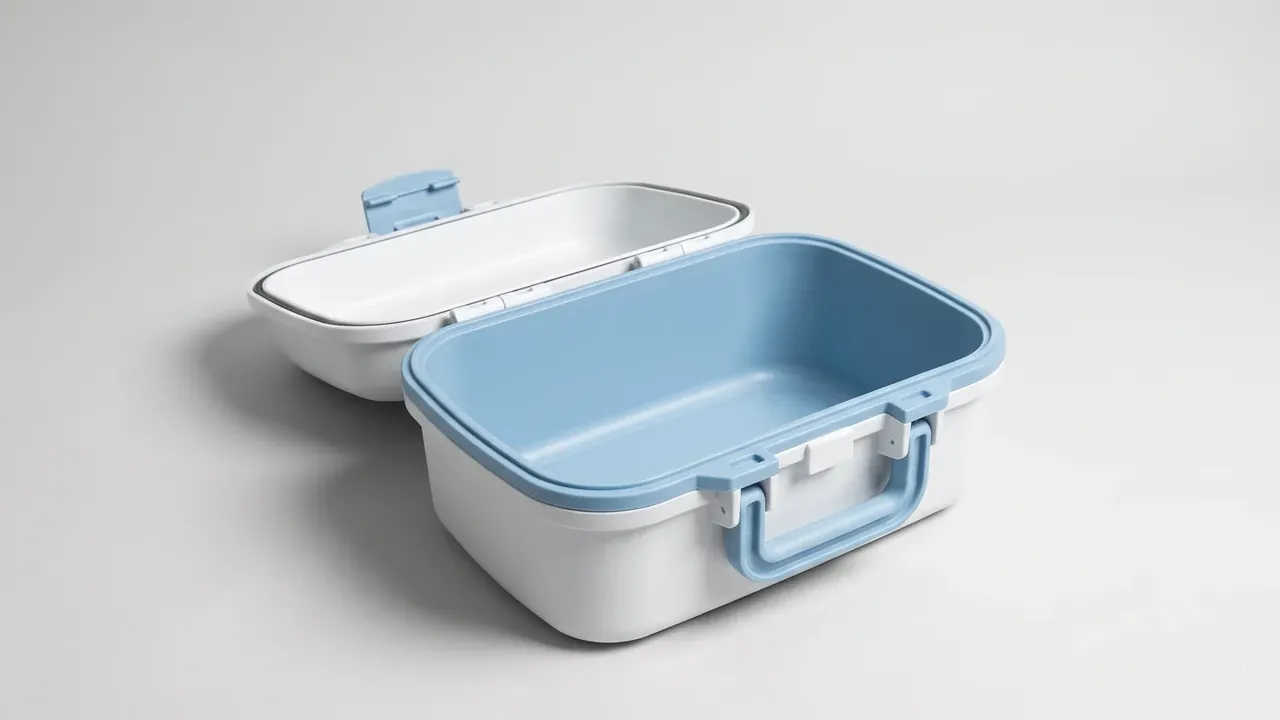
Quick answer: Dry box vs protective case is a question of moisture balance, not shell strength. Drying a 20 L cavity from 60% to 40% RH costs only 24 g of a 100 g silica charge; how long that charge lasts depends on openings and seal permeation, not on volume.
Table of contents
- Target Humidity: Four Bands and Dosing
- Desiccant Dosing: Is 100 g Enough for 20 L
- Sealing and Breathing: IP67 Stops Water, Not Vapour
- Electric vs Passive Drying: Where the Cost Line Falls
- Humidity Indication: Card, Gauge, Logger
- FAQ
1. Target Humidity: Four Bands and Dosing
Set the humidity target first. Both hold below 50% RH; the difference is who absorbs the swings. An integrated dry box carries its own module and gauge, a protective case supplies an IP67 shell and leaves the desiccant to the user.
| Target RH | Typical load | Desiccant | Dose | Check interval |
|---|---|---|---|---|
| 50–60% | Hardware, paper files | Silica gel | 1 g/L | 6 months |
| 40–50% | Boards, connectors | Silica gel | 1.5 g/L | 3 months |
| 20–40% | Optics, gauges | Molecular sieve | 2 g/L | 1 month |
| Below 10% | Coated optics, long storage | Sieve plus foil bag | 3 g/L | 2 weeks |
The bands follow measured thresholds: steel corrosion slows below 60% RH, sulphiding of copper and silver is suppressed below 40%, optics grow mould above 30%. Silica holds 24 g per 100 g at 40% RH but 12 g at 20%, which is why low bands switch to sieve.
2. Desiccant Dosing: Is 100 g Enough for 20 L
Run the water balance. A 20 L cavity at 25 °C and 40% RH holds 0.18 g of vapour; coatings, foam and labels release 3 g as they cool; the seal passes 0.2 g a month. First-year ingress is near 5.6 g; the rest is held for openings.
| Cavity | Silica | Capacity at 40% RH | Openings | Recharge interval |
|---|---|---|---|---|
| 10 L | 50 g | 12 g | 3 per week | 8 months |
| 20 L | 100 g | 24 g | 4 per week | 12 months |
| 50 L | 250 g | 60 g | 5 per week | 15 months |
| 80 L | 400 g | 96 g | 6 per week | 16 months |
One opening is easy to size: a 20 L box held open 30 s exchanges about 6 L of air, which at 25 °C and 60% RH carries 0.08 g. Four a week is 17 g a year, plus 5.6 g of first-year ingress, so 22.6 g of a 24 g charge goes in twelve months. The 50 L box lasts longer because it travels closed.
3. Sealing and Breathing: IP67 Stops Water, Not Vapour
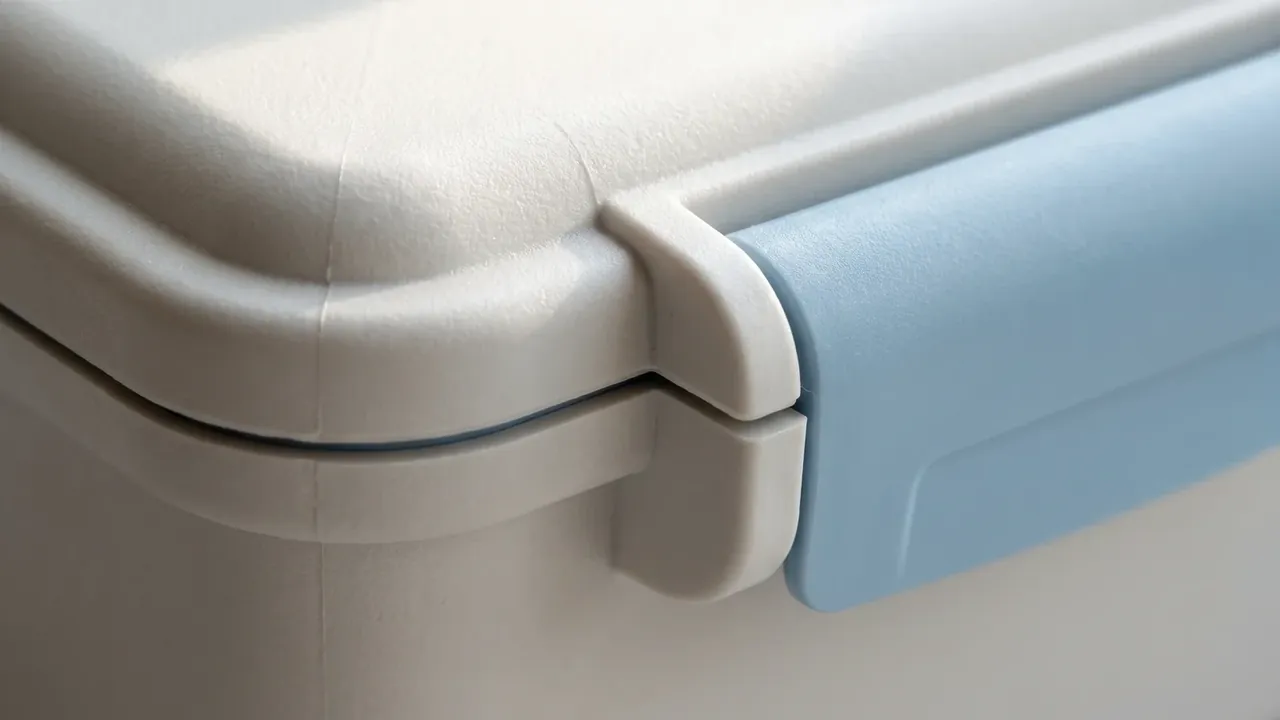
IP67 means no ingress after 30 min at 1 m depth, and it governs liquid water only. A water molecule is 0.28 nm across and an EPDM gasket passes 0.02–0.05 g/(m²·day) at 38 °C and 90% RH; at 0.55 m² that is 0.02 g a day, 7 g a year.
| Seal build | Vapour transmission, g/(m²·d) | Annual ingress, 0.55 m² | Desiccant needed |
|---|---|---|---|
| Single lip, 25% compression | 0.05 | 10 g | Yes |
| Double lip, 30% compression | 0.03 | 6 g | Yes |
| Double lip plus 0.2 bar valve | 0.05 | 10 g | Yes, valve included |
| Silicone plus foil liner | 0.01 | 2 g | Depends on target |
Temperature swings are louder than permeation. Seal a box at -10 °C, carry it to 25 °C: 101 kPa across 35 K implies 13 kPa of differential, so the lid needs over 40 N, or 12 N with a valve. Each cycle admits 0.3 mg.
The real leak is inspection. A 0.5 mm grain in the groove or a 2 mm crease in the lip takes decay from 0.5 kPa to over 3 kPa and triples permeation; both box types need a visual check before closing and a periodic decay test.
4. Electric vs Passive Drying: Where the Cost Line Falls
An integrated dry box sells convenience; a passive setup sells no power draw. Over five years a 20 L box runs about 2120 CNY electric against 165 CNY passive, a twelve-fold gap:
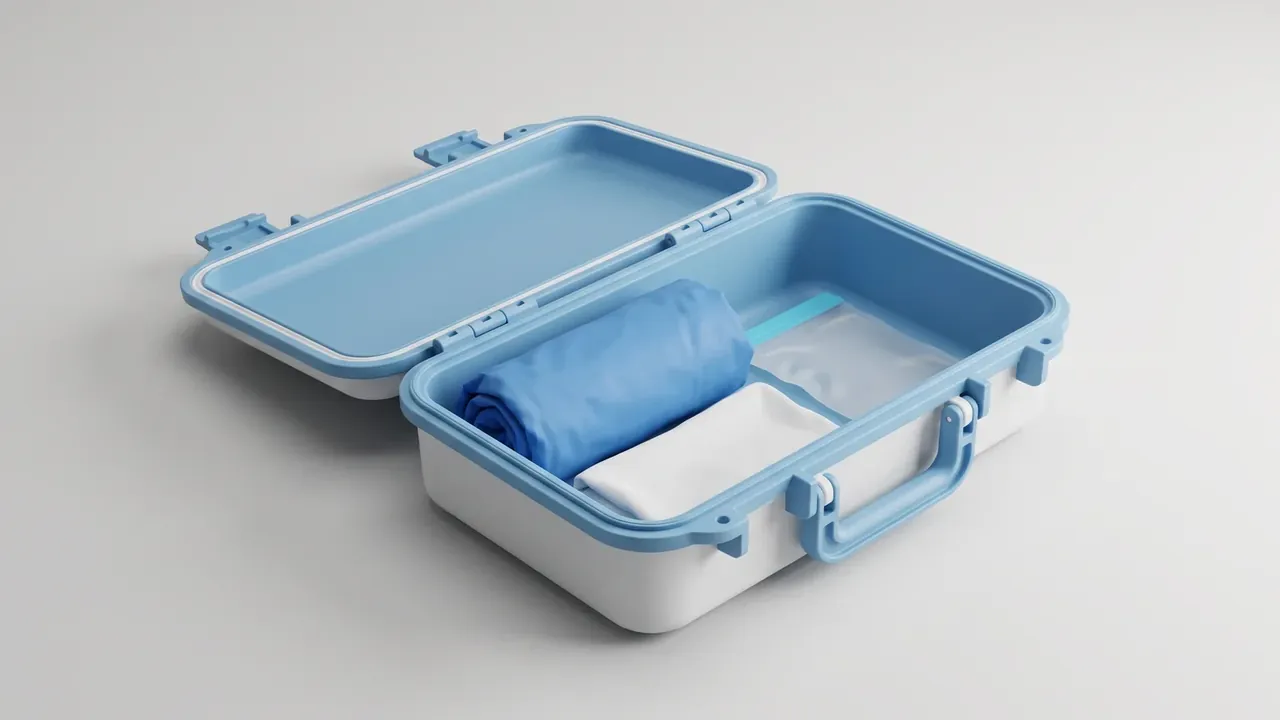
- Peltier module: 35 W, 250 mL per 24 h at 30 °C and 80% RH, 1200 CNY, about 184 CNY of power a year at 0.6 CNY/kWh
- Passive silica: two 100 g charges rotated, 30 CNY, regenerated at 120 °C for 2 h, 30 CNY a year plus 3 CNY of power
- Molecular sieve: below 10% RH only, regenerated at 200 °C, three times the low-humidity uptake of silica
- Hybrid: Peltier plus 50 g of silica as outage buffer, 15 CNY extra
Two lines settle it. Below 35% RH with over 100 L, go electric, or passive media is changed monthly. At 50 L or less with a 35% RH target, go passive: 184 CNY of electricity buys six years of silica.
5. Humidity Indication: Card, Gauge, Logger
A dry box without indication turns desiccant failure into a guess.
| Option | Accuracy | Price | Reading | Use |
|---|---|---|---|---|
| Five-spot card | ±10% RH | 2 CNY | Colour comparison | One-way storage, shipped with goods |
| Dial gauge | ±5% RH | 25 CNY | Direct read | Boxes opened routinely |
| Data logger | ±2% RH | 300 CNY | 10 min sampling, exported curve | Validation and traceability |
The three are not substitutes: a card shows trend, a gauge the present, a logger the path. One trap with dials: on the lid the body runs 3 °C above cavity temperature on a summer afternoon and reads 4% RH low, which looks healthy. Fit it mid-wall, 100 mm from the desiccant.
Conclusion
Dry box vs protective case comes down to four bands (60%, 50%, 40%, 10% RH), 1.5 g/L of silica, and 6–10 g a year of permeation. Passive wins under 50 L and above 35% RH at 30 CNY a year; past 100 L or below 20% RH, 184 CNY of electricity ends the monthly recharge.
This article discusses only the container (case body) side of specifications and design intent, and does not cover any handling, loading or use of the contents.
Related Reading
- What a dry box is: sealing, absorption and indication
- Choosing a dry box: IP rating, uptake and recharge cycle
- Dry bag vs waterproof case: rafting and boat decks
- Moisture packaging for sea freight: three failure points
- Gasket materials compared: EPDM, silicone and NBR
Related Products
- 8 Series — Gun Cases; Military Equipment Cases; Camera Equipment Cases; Drone Cases; Watch Cases; Knife Cases; First Aid Cases; Electronics Equipment Cases
- WL8-2812 PP Gun Case — model WL8-2812
- All protective cases and toolboxes: 7 series, 158 models