

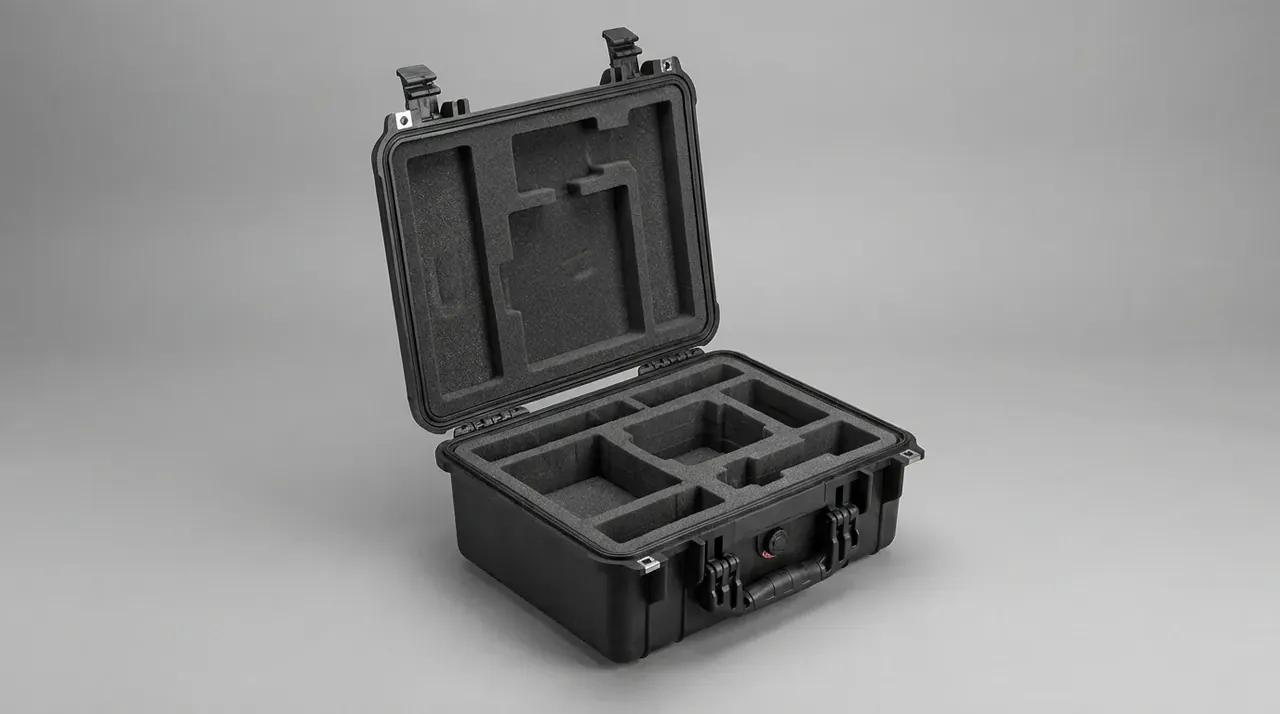
Quick answer: Case end of life work starts with teardown, not with selling the box: five parts, twelve minutes, four streams from one 2.4 kg shell.
Table of contents
- Teardown first: five parts, twelve minutes
- How much of 2.4 kg is PP
- Grinding at 8 mm and the 30% blend
- Resin code 7 and 44 MJ/kg
- Removing labels and data
- FAQ
1. Teardown first: five parts, twelve minutes
A 460 mm × 350 mm × 220 mm hard case weighs 2.4 kg and holds five parts: shell, gasket, latches, wheels and liner. Shipped whole it is priced as mixed plastic, often under half the rate of a single resin; stripped, twelve minutes turn it into four streams.
Three tools are enough: a cross-head screwdriver, pliers and a knife. The order is fixed — pry the gasket, unbolt the latches, pull the wheels, peel the liner.
Reverse that order and the job slows down. The latch screws sit under 3 mm of gasket end and the liner presses on the latch seats, so peeling foam first packs crumbs into the slots and adds four minutes per case.
| Part | Resin | Weight | Destination |
|---|---|---|---|
| Shell | PP | 1.62 kg | Regrind |
| Gasket | Silicone | 0.18 kg | Rubber |
| Latches | PA66, steel pin | 0.22 kg | Pin pulled |
| Wheels | PP, steel axle | 0.26 kg | Axle drawn |
| Liner | EVA | 0.12 kg | Separate |
The five weights add to 2.4 kg, with ±30 g of spread from wall thickness across lots. Weighing is the fastest proof of complete teardown: a shell that comes out at 1.5 kg still carries liner or latches.
2. How much of 2.4 kg is PP
The shell is 1.62 kg of PP, 67.5% of the whole case. Wheel bodies are PP too, which lifts recoverable polypropylene to 1.88 kg, or 78.3%.
That pair decides whether case end of life pays for itself. Under 2 kg of resin comes back per box, so a collection radius beyond 300 km burns the value of the regrind in freight.
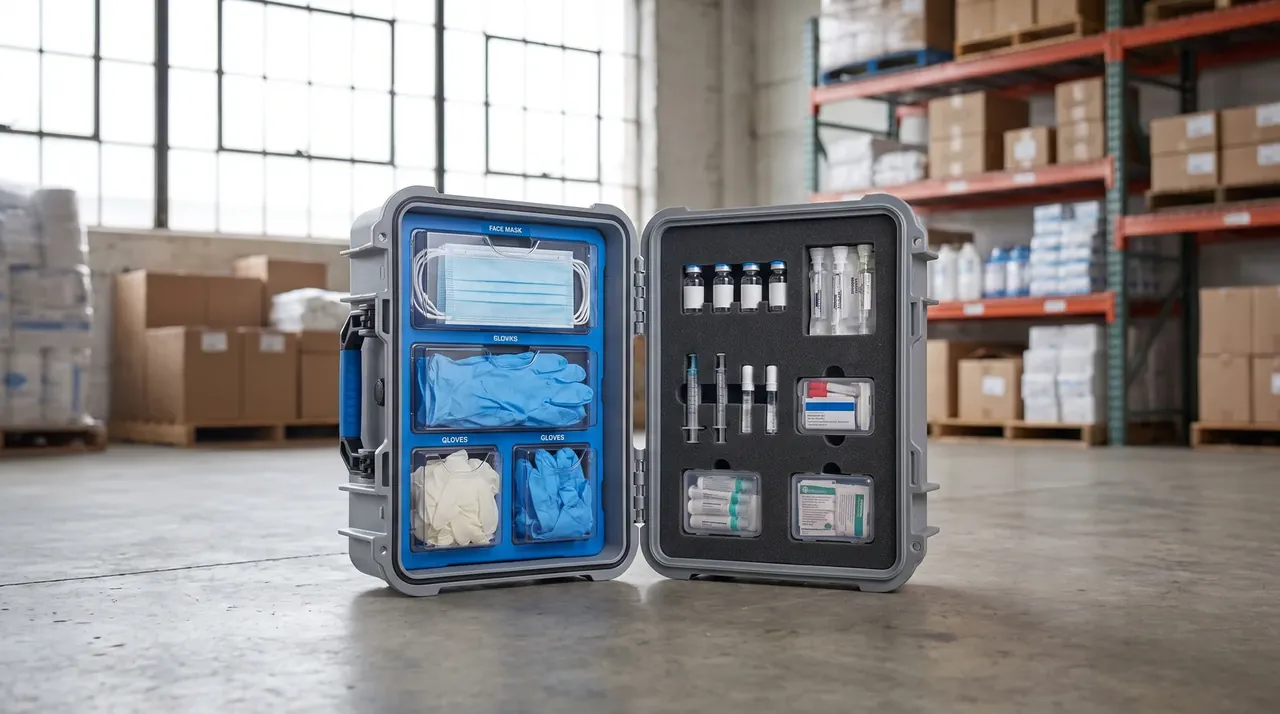
Latches are the main contamination source. At 0.22 kg of PA66 in a tonne of PP the share is 0.022%, yet the melting points differ by 40 ℃, so PP flows while PA66 stays granular and leaves bumps of 1–2 mm. Pull the steel pin and the latch body sells as PA.
Gaskets run 0.18 kg, usually silicone, sometimes EPDM, and the two cannot mix. Silicone takes 200 ℃, EPDM stops at 130 ℃, and a blend turns tacky at 190 ℃. Burning a strip end separates them: white ash is silicone, black smoke is EPDM.
The 0.12 kg EVA liner is the hardest item, often glued to the lid and coming away with an adhesive skin that blinds the grinder screen.
3. Grinding at 8 mm and the 30% blend
Screen size sets the particle range. An 8 mm screen delivers 2–8 mm flakes with about 12% fines below 1 mm; a 12 mm screen cuts fines to 6% but adds 8 s of plasticising time.
Neither extreme works. Below 8% fines the feed screw slips, above 15% the hopper bridges and needs a vibrator.
Two gates stand before the grinder: a magnet for steel pins and axles, and dust extraction for grit. Two kilograms of sand per tonne of flake drops blade life from 600,000 cuts to 350,000, a bigger loss than any blending choice.
| Blend | MFI, g/10min | Impact kept | Suitable part |
|---|---|---|---|
| 0 | 8.0 | 100% | Visible surfaces |
| 15 | 9.2 | 94% | Load-bearing shell |
| 30 | 11.0 | 82% | Non-structural parts |
| 50 | 14.5 | 64% | Cores and blocks |
Thirty percent is the ceiling for most structural parts. Past that line MFI climbs above 14 and packing needs 1.5 s more, otherwise corners sink by 0.2 mm and lids stop seating.
Flake and pellet are different goods. Flake feeds a machine directly at 15% less cost but shows contamination; pellet passes a 120 mesh filter, suits visible parts and carries a conversion charge per tonne.
At a 30% blend the melt temperature rises 10 ℃ to offset MFI while mould temperature stays put, which trims 2 s off plasticising.
4. Resin code 7 and 44 MJ/kg
Code 7 means "other"; PP is 5 and PE-HD is 2. Sorting lines read the code first and downgrade anything marked 7, because a 7 can hide ABS, PC, PA or a blend that no buyer will take at a single-resin rate.
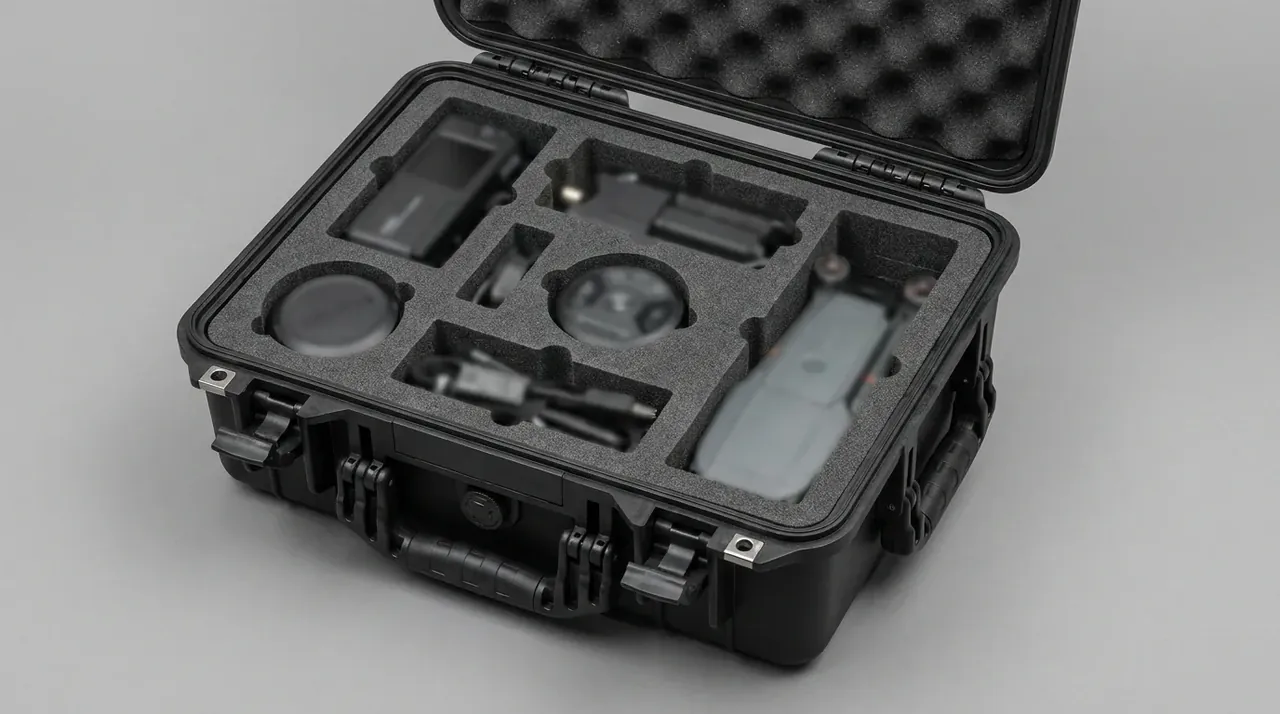
A 5 and a 7 on the same case is the commonest labelling fault. A shell marked 5 beside a latch seat also marked 5 pushes PA into the PP stream and drags the lot down a grade.
Mark shell and wheel bodies as 5, mark latch seats as 7 and bag them apart. With all three marks in place the line splits the streams; miss one and the case returns to 7.
The 44 MJ/kg figure is the energy-recovery basis for PP. A 1.62 kg shell carries 71 MJ, near the heat of 1.7 kg of diesel, which sounds generous until the one-way nature of burning is counted: the resin is gone and the next case needs virgin material.
The order follows: intact, clean shells go to mechanical recycling; glued, insert-laden offcuts go to energy recovery.
"Inseparable" has a number: once non-PP residue passes 5% of teardown weight, sorting costs more than the recovered resin is worth.
5. Removing labels and data
A case leaves the factory with about two identifying marks, an asset label on the lid and a serial plate on the side. Leave them on and case end of life sells the information along with the plastic.
Clear data first and use tools second. Peel the label whole and soften the adhesive with anhydrous ethanol for 60 s; sand the printed logo with 400 grit until no sheen remains; drill the φ3 mm plate rivets and plug the holes in shell colour.
Records need three fields: teardown date, measured weight of each of the five parts, and the document number of the receiving stream. Keep them three years, because regrind is traced over 24 months.
Scrap numbers must also pair one-to-one with asset numbers, or the storekeeper keeps treating a scrapped case as stock.
Conclusion
Case end of life balances only when those twelve minutes are done properly. Five parts split 2.4 kg into 1.88 kg of PP regrind, 0.22 kg of PA66, 0.18 kg of silicone and 0.12 kg of EVA, each with its own buyer; left together, all four become mixed waste. Three checks settle it: weigh the whole case against the 2.4 kg baseline and question any spread beyond ±30 g, weigh the stripped shell and expect 1.62 kg, then read whether the shell carries code 5 or code 7. Pass all three and the shell goes to mechanical recycling with the blend at or under 30%; fail any one and energy recovery at 44 MJ/kg is the honest route. Write the three checks onto the scrap form and the destination stops being a verbal promise.
| Part | Teardown step | Time | Final destination |
|---|---|---|---|
| Shell | Weigh, read code | 2 min | Regrind, blend ≤30% |
| Gasket | Pry, sort | 3 min | Silicone |
| Latches | Pull pin, split | 3 min | PA, separate |
| Wheels | Draw axle | 2 min | PP, steel |
| Liner | Peel, deglue | 2 min | Separate route |
This article discusses container-side specifications and design implications only, and does not cover any handling, loading or use of the contents.
Related Reading
- Judging case material and disposal routes
- How recycling marks are printed on cases
- Gasket materials and how they age
- Using regrind in case production
Related Products
- 8 Series — Gun Cases; Military Equipment Cases; Camera Equipment Cases; Drone Cases; Watch Cases; Knife Cases; First Aid Cases; Electronics Equipment Cases
- WL8-2812 PP Gun Case — model WL8-2812
- All protective cases and toolboxes: 7 series, 158 models