

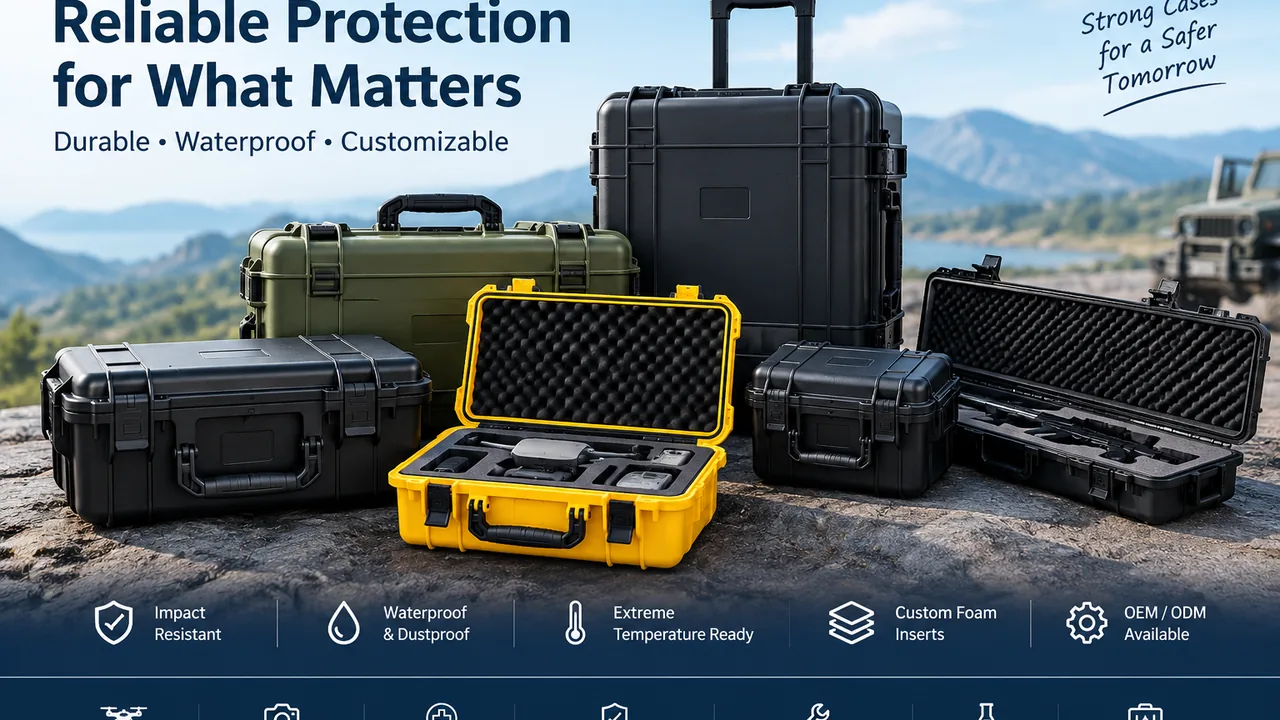
In the storage and transit of industrial equipment, instruments and military supplies, the shell material of protective cases is steadily shifting from virgin resin toward recycled content. A recycled material protective case, when built on graded and cleaned recycled feedstock, controlled blend ratios and compensating structural design, can fully meet routine protection needs such as IP67 water resistance, drop resistance and long-haul circulation, yet its mechanical ceiling and chemical substance compliance boundary must be quantified by the buyer rather than accepted on the strength of an "eco" label alone. This article focuses on recycled polypropylene and recycled polyethylene used in case shells, systematically reviewing their performance decay patterns, molding process trade-offs, sealing and latch adaptation, flame-retardant behavior and restricted-substance compliance, and closes with a practical acceptance checklist so engineering and procurement teams can balance sustainability goals against protection reliability.
1. Definition and Scope of Recycled Material Protective Cases
A recycled material protective case is a rigid protective case whose primary load-bearing shell is made from recycled-source plastic or from virgin resin blended with a defined proportion of recycled content. By source, the industry separates post-consumer recycled material from post-industrial recycled material, and the two differ sharply in cleanliness, impurity control and batch stability. Post-consumer recycled material comes from products that have already circulated and been used, such as recovered packaging, appliance housings and shredded automotive bumper stock. Post-industrial recycled material comes from factory edge trims, trial-mold parts and rejected components, carrying relatively lower contamination risk.
In structural form, recycled material cases are common in rotomolded medium-to-large cases and in injection-molded tool cases, instrument cases and pallet-style transit containers. Typical applications include brand packaging that must declare recycled content for export markets, green circulation systems required by corporate ESG reporting, carbon-footprint-sensitive storage of electronics and medical devices, and in-plant reusable transit containers. Compared with virgin resin cases, recycled cases need tighter incoming-material control on appearance consistency, low-temperature toughness and color uniformity, yet in conventional warehousing, road transport and indoor stacking their performance margin covers most duty cycles.
It must be clear that a recycled material case is not synonymous with a lower protection grade. Through sound material formulation, wall-thickening and seal selection, it can still be rated IP67, pass ISTA transit tests and the relevant vibration and shock procedures of MIL-STD-810H. The decisive factor is not "whether it is recycled" but "whether the recycled feedstock has been graded, washed, modified and verified". For a side-by-side view of material choices, see the protective case plastic materials overview and the virgin versus recycled case material comparison.
2. Source Grading and Impurity Control of Recycled Plastics
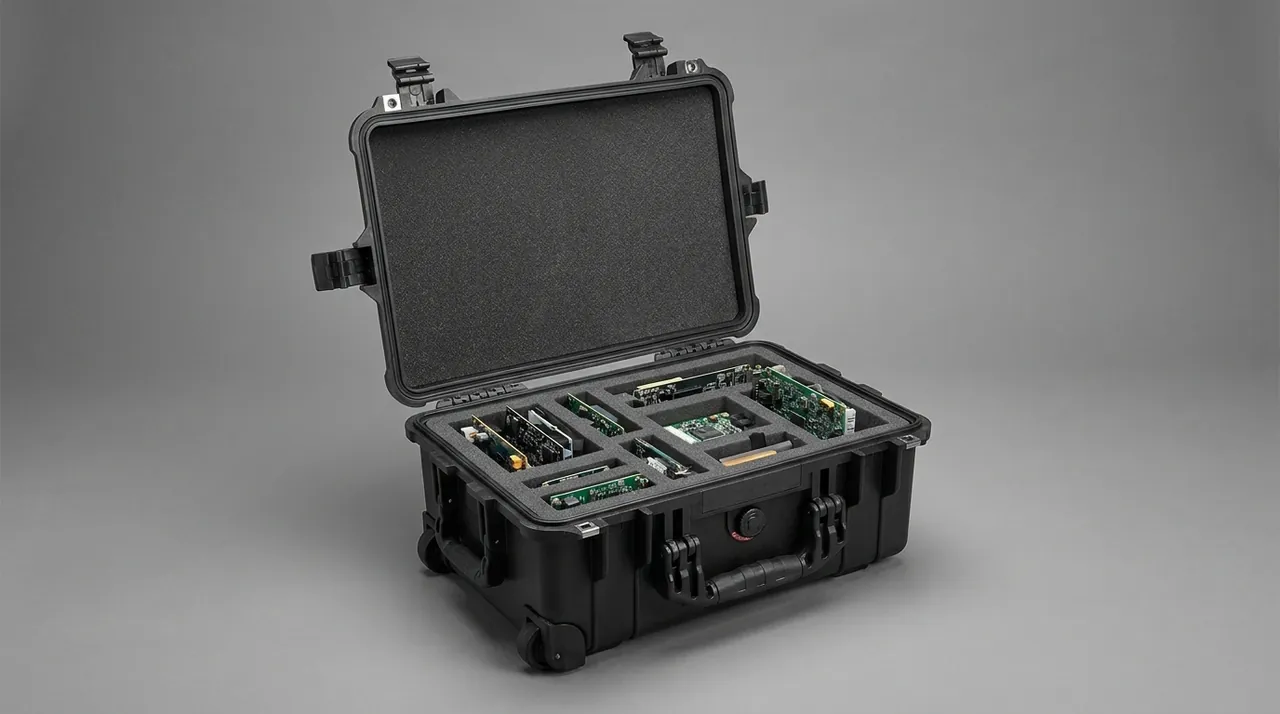
The performance of recycled feedstock is, to a large extent, determined by source grading and pretreatment. Post-industrial scrap usually comes from a single resin grade of injection or rotomolding edge trim, with a narrow melt-index and density spread, so the performance decay after reuse is predictable. Post-consumer scrap is far more heterogeneous, potentially mixing different polymers, pigments, fillers and even metal or rubber contaminants; without manual sorting, float-sink washing and melt filtration, the impact strength and surface quality of the case shell will be materially degraded.
During pretreatment, shredded recycled stock must pass metal detection, magnetic separation and electrostatic sorting to remove iron filings, copper fragments and foreign polymer particles. For rotomolded cases, the powder fineness and bulk density of the recycled stock directly affect uniform melt spreading; overly coarse granules create uneven walls and porosity. For injection-molded cases, the drying moisture of the recycled stock should be kept below 0.3 percent, otherwise vaporized moisture at high temperature forms sliver marks and bubbles on the inner wall and weakens the flatness of the sealing face.
When evaluating a recycled material case, buyers should require the supplier to provide a source declaration, batch test report and impurity-content data for the recycled stock. For cases that contact electronic instruments or medical supplies, it is advisable to prefer formulations with a higher share of traceable post-industrial scrap and avoid the restricted-substance risk that post-consumer scrap may carry. JUNZHIJIA, when taking recycled-shell orders, establishes an independent compounding batch against the customer-specified recycled source and retains traceability records for every powder lot to reduce blend-risk.
3. Performance Traits of Recycled Polypropylene and Recycled Polyethylene
The most common base materials for recycled material cases are recycled polypropylene, often written rPP, and recycled polyethylene, written rPE. rPP offers high rigidity, fatigue resistance and shape retention at elevated temperature, suiting medium-to-large self-supporting cases and latches. rPE provides good toughness and low-temperature crack resistance, often used in components that demand supple lining and impact absorption. Both can be co-blended with virgin resin to balance cost and performance, a point explored further in the virgin versus recycled case material comparison.
Recycled stock shows systematic property shifts relative to virgin resin: tensile strength typically drops about ten to twenty percent, notched impact strength falls more noticeably especially at low temperature, and melt flow rate rises because of chain scission, narrowing the processing window. On color, recycled stock from historically pigmented waste is hard to render as high-purity white or transparent, so deep gray, military green and carbon black with strong hiding power are preferred, which incidentally aligns with the concealment needs of outdoor and military transit.
To suppress decay, recycled stock is commonly modified with compatibilizers, antioxidants and nucleating agents. Compatibilizers improve interfacial bonding between recycled and virgin resin, antioxidants slow thermo-oxidative degradation from repeated processing, and nucleating agents refine crystallinity to lift stiffness and surface gloss. Modified rPP can recover flexural modulus to above about eighty-five percent of virgin resin at room temperature, enough to support the load and stacking duty of conventional protective cases.
4. Mechanical Comparison Between Recycled and Virgin Stock
Quantitative comparison is the core basis for selecting a recycled material case. The table below gives typical room-temperature ranges for virgin polypropylene, labeled VIRGIN PP, against polypropylene blended with thirty percent recycled content, labeled rPP30. Actual values must come from the supplier batch report; the figures here are trend references only.
| Property | Virgin PP (typical) | 30% Recycled Blend (typical) | Change |
|---|---|---|---|
| --- | --- | --- | --- |
| Tensile strength | 28-35 MPa | 23-30 MPa | about -15% |
| Flexural modulus | 1200-1600 MPa | 1000-1400 MPa | about -12% |
| Notched impact | 5-8 kJ/m2 | 3-6 kJ/m2 | about -25% |
| Heat deflection | 55-65 C | 50-60 C | slight drop |
| Melt flow index | 8-12 g/10min | 10-16 g/10min | rises |
The table shows that recycled stock's main weaknesses concentrate in impact toughness and long-term fatigue rather than static stiffness. This means a recycled case is nearly indistinguishable from a virgin case in static stacking and flat support, but under dynamic duty such as edge drops, repeated latch cycling and transit vibration, structural design and wall thickening must carry the load. The common engineering practice is to use recycled stock for non-load-bearing sidewalls and the base shell, while keeping hinge seats and other stress-concentrated zones at a higher virgin or glass-fiber-reinforced ratio, consistent with the protective case plastic materials overview.
5. Recycled Content Ratios in Rotomolding and Injection Molding
The molding process sets the safe upper limit for recycled inclusion. Rotomolding slowly rotates powder inside a mold to fuse it, tolerating wider variation in feedstock particle size and flow, so recycled blend ratios of thirty to fifty percent can stay visually uniform, fitting large one-piece cases; but rotomold powder must be milled from flake, raising pretreatment cost. Injection molding runs fast with strong shear and demands tight melt consistency, so recycled blend is generally held at fifteen to thirty percent; too high invites sliver marks, sink marks and dimensional drift.
On ratio setting, follow the principle of "low blend in load parts, high blend in non-load parts". For example, the main sidewall may use forty percent recycled stock, while latch pivots, caster brackets and reinforcing ribs should drop below ten percent or use virgin and glass-fiber-reinforced stock. Where food or medical contact is involved, the recycled ratio and contact-face treatment must meet the relevant regulation; avoid direct contact between recycled stock and sensitive items by using a recyclable virgin liner or a washable removable insert.
JUNZHIJIA supports OEM/ODM customization by model, and can set different recycled and virgin ratios on separate mold inserts of the same tool to achieve a "green outside, stable inside" composite structure. This satisfies the customer's recycled-content commitment while securing the reliability of critical load zones, and a zoned material declaration can be supplied at delivery. The approach mirrors the modular thinking described in the reusable transit case program guide.
6. Wall Thickness, Ribs and Structural Compensation
Because recycled stock is lower in stiffness and toughness than virgin resin, the most direct structural compensation is extra wall thickness and reinforcing ribs. Conventional virgin cases run wall thickness of 2.5 to 4 mm; recycled cases should thicken the main load-bearing wall by 0.5 to 1.5 mm to offset the increased deflection from lower modulus. Ribs should run along the load direction, forming continuous support at long sides, bottom corners and latch seats to avoid local stress concentration and cracking. Detailed sizing is covered in the case wall thickness and strength guide.
Corner radius is another key. Recycled stock is more prone to weld lines and stress concentration at sharp corners, so all internal corners should use a root radius of at least one wall thickness, and external corners should be slightly filleted to disperse drop impact. For rotomolded shells, wall uniformity matters more than absolute thickness; control rotation-speed ratio and heating curve to keep wall-thickness variation from recycled powder flow differences within plus or minus fifteen percent.
On stacking strength, align stacking locator ribs and limit bosses on lid and base so the stacked load travels vertically to the floor rather than onto the weak lid face. Per the GB/T 4857 transport packaging test family, a fully loaded recycled case under three-high stacking at room temperature should keep long-term creep deformation within one percent of case height; beyond that, re-check wall thickness or reduce stacking layers. Spare and wear parts for such structures are listed in the case repair and spare parts guide.
7. Sealing System: Water and Dust Proofing and IP Rating
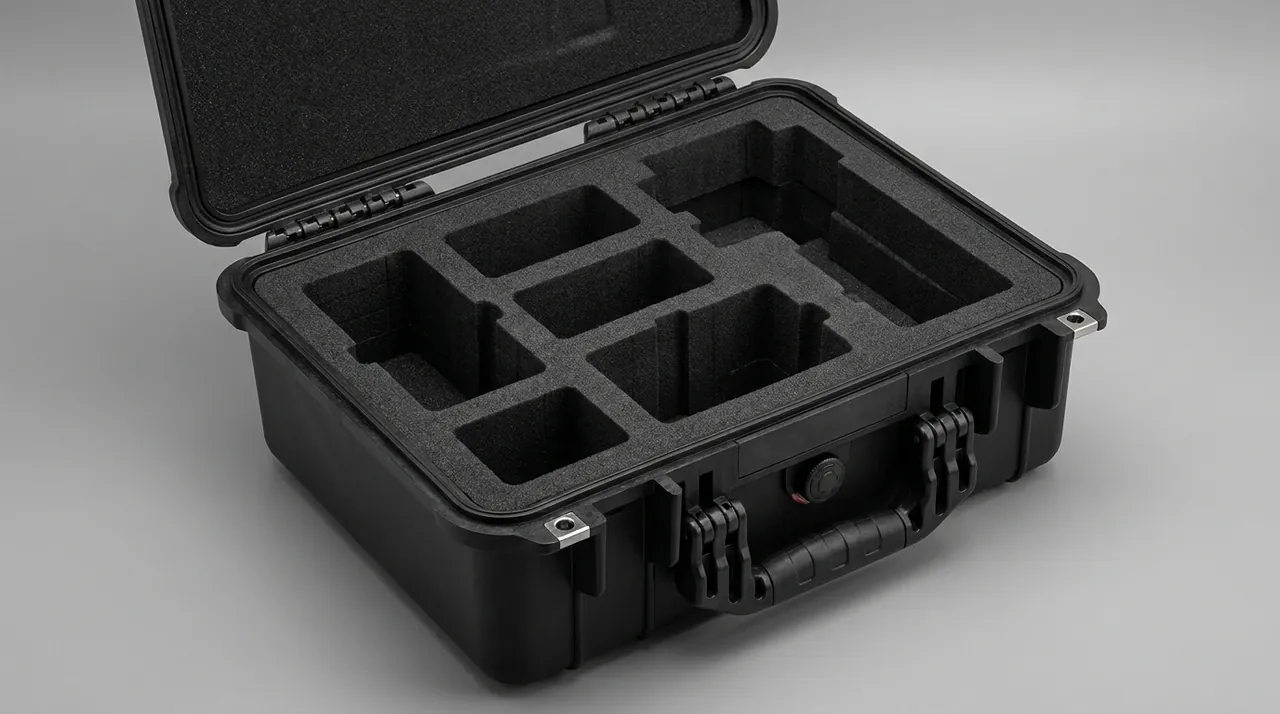
The water and dust resistance of a protective case depends on the sealing structure, not the shell material, so a recycled case can reach a high protection grade too. Under IEC 60529 and the counterpart GB/T 4208, IP67 requires the enclosure to exclude water after immersion at 1.5 m for 30 minutes, while IP68 holds the seal at a negotiated depth and time. The key to IP67 in a recycled case lies in seal-groove accuracy, gasket material and the compression achieved when the lid closes. Related practice is detailed in the outdoor case waterproof design guide.
The seal-groove flatness of a recycled shell is slightly more affected by material shrinkage variance than virgin stock, so it is advised to form the seal groove with an independent insert or machine it flat, keeping compression at twenty to thirty percent. Gaskets are mostly EPDM or TPE; EPDM resists weather and ozone better, while TPE is more recyclable and fits the green positioning. For wet and salt-spray environments, pair with a pressure-equalization valve to stop water mist being drawn in by temperature and pressure differences, a practice consistent with outdoor-case waterproof-sealing design thinking.
Note that the IP grade is a "as-delivered" indicator. Under long-term ultraviolet and thermal cycling, a recycled case whose seal-groove material ages and embrittles will lose compression rebound. It is advised to inspect the gasket and groove every twelve to twenty-four months and follow the case seal aging guidance for maintenance, so the protection grade does not slide with service age.
8. Latches and Hinges: Fatigue Life and Durability Testing
Latches, hinges and handles are the most failure-prone moving parts of a recycled case because they bear repeated bending and impact. To offset weaker recycled fatigue, moving parts usually carry the main load in virgin stock, glass-fiber-reinforced stock or metal, with recycled stock limited to decorative covers or non-load brackets. Latch cycle life should follow the mechanical-endurance logic of MIL-STD-810H methods and the open-close vibration simulation of ISTA procedures; a typical engineering target is five thousand to ten thousand open-close cycles with no fracture or permanent deformation.
On hinge design, a composite of metal pin with plastic bushing is recommended; the metal takes the pivot load while the shell lugs disperse stress through thickening and filleting. Handles and caster brackets are the first load points in a drop, so recycled cases should locally raise virgin ratio there or embed metal inserts. For field and vehicle-mounted cases, assess lug wall thickness and reinforcement against high-quality case-structure judgment criteria.
Beyond cycle life, run a low-temperature latch test: place the case at minus twenty degrees Celsius for four hours, then immediately open-close and drop it, observing whether the recycled lugs crack. Such boundary duty is exactly where recycled stock lags virgin stock most, and it must be written into the acceptance specification. The case repair and spare parts guide helps plan hinge and latch replacements over the service life.
9. Lining and Cushioning: Low-Emission Eco Foam Selection
The internal cushioning of a recycled case can also follow an eco route. For electronic instruments, optics and medical supplies, prefer low-odor, low-outgassing EPE, EVA or IXPE foam to avoid volatile release from the recycled shell and lining together polluting sensitive devices. Selection principles are reviewed in the eco-friendly lining material guide, which compares foam density, rebound and chemical outgassing.
Lining fixation comes in pre-cut, pick-and-pluck and custom die-cut forms. Because recycled-shell inner walls are slightly less flat, a full-wrap or adhesive-backed lining is advised to reduce resonance from suspended voids. For multi-item kits, use divider frames to keep heavy items near the bottom-center of gravity and lower overturning moment. If devices are static-sensitive, composite an anti-static cloth layer or adopt the lining approach of an ESD anti-static protective case.
On lining life, recycled shells carry no special disadvantage; the key is the foam's own compression set. Experience suggests closed-cell IXPE should lose less than ten percent thickness after one hundred thousand compressions, beyond which it should be replaced. JUNZHIJIA can supply CNC die-cut liners from the device's 3D data so the recycled shell and eco foam form an integrated protection, balancing green goals with shock reliability.
10. Flame Retardancy and UL 94 Grade in Recycled Stock
When a recycled case stores electrical equipment, battery modules or vehicle gear, flame retardancy becomes mandatory. UL 94 grades plastics as HB, V-2, V-1 and V-0; V-0 requires the flame to self-extinguish within ten seconds with no glowing drip. Virgin polypropylene is inherently flammable, and recycled stock, with its complex historical additives, is even less predictable, so it must be verified by adding halogen-free or brominated retardants and running vertical-burn tests.
A special caution: if recycled stock mixes halogen-bearing historical products, it may conflict with newly added retardant systems and even introduce restricted brominated substances, crossing RoHS and REACH red lines. Therefore flame-retardant recycled cases should run a "single source, single formulation" closed recycling loop to avoid composition loss from open recycling. For electronic exports to the EU, retardant type and content must enter chemical-substance compliance review, as discussed in the RoHS and REACH case compliance guide.
In verification, beyond UL 94 vertical burn, also check glow-wire ignition temperature, GWIT, and needle-flame tests to simulate in-case electrical fault ignition. A recycled case meeting V-0 must also confirm the retardant does not sharply lower low-temperature toughness, or it will crack in winter drops. Record the flame-retardant grade, test standard and sample number into the chemical-compliance declaration file for downstream traceability, following the structure in RoHS and REACH compliance cases.
11. Chemical Compliance: RoHS and REACH Limits on Recycled Stock
The biggest compliance risk of recycled stock is restricted substances. The RoHS directive limits lead, cadmium, mercury, hexavalent chromium and certain brominated retardants in electronics-related products; REACH sets duties and notification thresholds for substances of very high concern, SVHC. Unlike virgin stock with transparent composition, recycled stock's incomplete source transparency may let historical restricted substances "hitchhike" into the case, which is exactly why RoHS and REACH compliance cases is repeatedly stressed.
For compliance management of a recycled case, take four steps. First, require the recycled supplier's RoHS and REACH declaration of conformity, DoC. Second, send batches to third-party testing, focusing on lead, cadmium and polybrominated biphenyls. Third, mark recycled content and material code on the case or nameplate, paired with recycling mark case guidance to build sorting information. Fourth, for EU exports, watch EPR producer-responsibility registration duties under the EPR compliance case guide.
On CE marking, if the case is shipped as an equipment enclosure with the machine, it should meet the relevant directive with the host; a standalone case is often not directly CE-marked, yet its materials and flame grade may still be referenced by the host certification. Under green supply chains, more buyers list restricted-substance test reports as mandatory, and recycled cases need more transparent data support than virgin cases on this front.
12. Recycled Content Declaration, Traceability and Green Supply Chain
Recycled content is not a slogan but a quantified commitment backed by documents and marks. The common method calculates the recycled share by mass against total plastic mass of the case, stating details such as "thirty percent post-consumer, twenty percent post-industrial" in the technical file. To strengthen credibility, introduce third-party mass-balance or mass-conservation verification to avoid "greenwashing" doubt.
On traceability, batch management is the baseline. Each recycled lot should record source, pretreatment, blend ratio and mold number so any shipped case traces back to a specific compounding record. This aligns with the supplier-audit emphasis in the green supply chain case guide: the audit focuses not on whether the supplier "claims green" but on whether it can produce stable batch data and a test closed loop.
At the circular level, recycled cases can combine with the circular packaging protective case system and reusable transit case programs to form a "recover after use, remake into cases" loop. Such programs demand higher case disassemblability and material simplification at design stage, avoiding structures where metal inserts or multi-materials cannot be separated, so end-of-life recyclability holds.
13. Procurement Practice: Acceptance Checklist and Test Files
Facing a supplier's recycled case proposal, buyers can verify item by item against the following checklist rather than decide on appearance or low price alone. First, obtain the recycled source declaration and batch test report, confirming blend ratio and impurity ceiling. Second, check the case's marked IP grade against an IEC 60529 or GB/T 4208 third-party or in-house report. Third, require open-close life and low-temperature drop records for key moving parts, comparing base performance against the protective case plastic materials overview.
Fourth, confirm the UL 94 test specimen and sample number for flame grade where applicable, referencing the RoHS and REACH case compliance guide. Fifth, review the RoHS and REACH declaration and restricted-substance testing, arranging in-plant sampling if needed. Sixth, inspect seal-groove flatness, wall uniformity and rib layout, re-checking structure against the case wall thickness and strength guide. Seventh, define warranty and spare-parts supply, especially gaskets and latches; build stock per the case repair and spare parts list.
Finally, attach recycled content, carbon footprint and compliance files to the contract so the green commitment is enforceable. To quantify emissions, apply the packaging carbon footprint guide method to list the reduction from replacing virgin with recycled stock as first-hand ESG disclosure data, and benchmark the result against the virgin versus recycled case material comparison.
FAQ
Q: Is the water-resistance grade of a recycled case worse than a virgin case? A: At the as-delivered state, there is usually no essential difference, because water and dust resistance come from the sealing structure rather than the shell material. A recycled case, provided its seal-groove accuracy, gasket material and compression are controlled, can be rated IP67 and even pass negotiated-condition IP68 verification under IEC 60529 and GB/T 4208. There are three key control points to watch. First, seal-groove flatness: recycled shrinkage variance is slightly larger, so an independent insert or machining flat is advised. Second, the gasket should be EPDM or TPE with a twenty to thirty percent compression ratio that holds over temperature cycles. Third, a pressure-equalization valve should be fitted to stop water mist being drawn in by temperature and pressure differences across the wall. Remember that the IP grade is a delivered indicator; after years of ultraviolet and thermal cycling, a recycled case whose seal-groove material ages and embrittles will lose compression rebound, so the seal system should be re-checked every twelve to twenty-four months rather than treated as permanently valid after one pass.
Q: Should I choose recycled polypropylene or recycled polyethylene for the shell? A: It depends on the case's load and duty cycle, and the two materials are complementary rather than competing. Recycled polypropylene has high rigidity, fatigue resistance and shape retention at higher temperature, suiting self-supporting medium-to-large cases, latches and reinforcing ribs where stiffness matters most. Recycled polyethylene is tougher and resists low-temperature cracking, suiting lining-flexibility and impact-absorber components, and often the drop-buffer sidewalls that take the first hit in transit. In practice both are co-blended with virgin resin to balance cost and performance across the same case. If the case will store long term outdoors below zero, lean toward recycled polyethylene or raise the modified ratio of recycled polypropylene; if high stiffness stacking and load are needed, lead with recycled polypropylene for the structure. Either way, modify the recycled stock with compatibilizer and antioxidant to suppress thermo-oxidative degradation and impact drop from repeated processing passes through the extruder. For the case body, a recycled-polypropylene-dominant shell keeps the lid and base flat for the seal groove, while a polyethylene-rich sidewall better absorbs corner drops in handling. Matching the shell resin to the foam liner also limits creak and cold-flow at the cushion interface.
Q: What recycled blend ratio is safe, and will it crack on the first drop? A: The safe ratio depends on the molding process and the load zone, and cannot be one-size-fits-all across a single case. Rotomolding is tolerant, so non-load sidewalls can reach thirty to fifty percent and stay visually uniform; injection molding runs fast with strong shear, so recycled blend is generally held at fifteen to thirty percent, beyond which sliver marks and dimensional drift appear on thin features. Load parts such as latch pivots, caster brackets and ribs should drop below ten percent or use virgin or glass-fiber-reinforced stock entirely. Whether it "cracks on first drop" mainly depends on structural design: put recycled stock in non-load sidewalls and base shell, keep high virgin ratio in load and stress-concentrated zones, and add wall thickness with root fillets, and it will pass conventional drop tests. The boundary case is the minus twenty degree Celsius low-temperature drop, exactly where recycled lags virgin most, and it must be written into the acceptance spec and actually tested with production samples.
Q: What special chemical-compliance risks does recycled stock carry? A: The largest risk is restricted substances hitchhiking in from an opaque supply chain. RoHS limits lead, cadmium, mercury, hexavalent chromium and certain brominated retardants; REACH sets duties and notification thresholds for substances of very high concern. Virgin composition is transparent and controllable, while recycled source may be opaque, so if it mixes halogen-bearing historical products or heavy-metal pigments, it can cross the red line without the molder's knowledge. Manage it in four steps: require the supplier's RoHS and REACH declaration of conformity; send batches to third-party testing focused on lead, cadmium and polybrominated biphenyls; mark recycled content and material code on case or nameplate for sorting; for EU exports watch EPR registration duties. Flame-retardant recycled cases especially need a single-source, single-formulation closed loop to avoid composition loss from open recycling, and the flame grade and sample number should enter the compliance declaration file for downstream traceability and audit. On the case body itself, keep recycled stock away from surfaces that touch sensitive contents, and rely on a virgin liner or coated insert as a barrier layer. Molded-in nameplate fields on the shell keep the material code and recycled share visible at inspection without peeling labels.
Q: Can a recycled case be flame retardant, and does that conflict with its eco positioning? A: It can be flame retardant, but the design must be careful so it does not clash with the eco positioning that motivated the recycled shell in the first place. UL 94 grades from HB up to V-0, where V-0 requires the flame to self-extinguish within ten seconds with no glowing drip and no flaming particles. Virgin polypropylene is inherently flammable, and recycled stock with its complex historical additives is even less predictable, so halogen-free or brominated retardants must be added and vertical-burn verified on production parts. The conflict point is real: if recycled stock mixes halogen-bearing historical products, the newly added retardant may react with them and even introduce restricted brominated substances, violating RoHS and REACH at the same time. Therefore flame-retardant recycled cases should run a closed recycling loop and also run glow-wire and needle-flame tests to simulate electrical ignition risk inside the case during service. Structurally, keep the flame-retardant recycled wall in the base and side shell where heat builds up, and protect the gasket channel so the retardant package does not stiffen the seal lip. A labeled flame-grade zone on the case body lets handlers see the rating without opening the enclosure.
Q: How do I prove to a customer that the case truly contains recycled material rather than false claims? A: The core is to replace verbal claims with quantified documents and traceable marks that an auditor can check independently. First, calculate the recycled share by mass against total plastic mass and state the post-consumer and post-industrial percentages explicitly in the technical file, not as a vague "contains recycled content" line. Second, introduce third-party mass-balance or mass-conservation verification to build credibility and avoid greenwashing doubt from stakeholders and regulators. Third, mark recycled content and material code on the case or nameplate, pairing with recycling marks to give end users clear sorting information at end of life. Fourth, run batch management recording source, pretreatment, blend ratio and mold number so any case traces back to a specific lot. When auditing a supplier, buyers should focus on whether the supplier can produce stable batch data and a test closed loop, not merely display eco slogans, which is exactly the logic of green supply chain audit procedures used by large procurement organizations.
Q: Does the stacking load of a recycled case drop versus a virgin case? A: Under static stacking the difference is usually minor; the real gap opens in long-term creep and dynamic impact rather than in a single static load measurement. Recycled flexural modulus drops about twelve percent versus virgin, meaning slightly larger deflection at equal wall, so engineering thickens the main load wall by 0.5 to 1.5 mm to compensate and restores the margin. Per transport packaging test experience aligned with GB/T 4857, a fully loaded recycled case under three-high room-temperature stacking should keep long-term creep within one percent of case height; beyond that, re-check wall thickness or cut stacking layers to protect the bottom case. Stacked load should travel vertically through locator ribs and limit bosses to the floor, avoiding the weak lid face that would otherwise carry the column. With proper compensation, for conventional up-to-three-layer warehouse stacking a recycled case is nearly indistinguishable from a virgin case in load behavior and service life.
Q: At acceptance of a recycled case, which documents are mandatory to check? A: At least seven document and physical items are advised before sign-off. One, the recycled source declaration and batch test report confirming blend ratio and impurity ceiling for every lot used. Two, the IP-grade report under IEC 60529 or GB/T 4208, with the test sample identified. Three, open-close life and low-temperature drop records for key moving parts, benchmarked to the declared duty. Four, the UL 94 test specimen and number where flame grade applies to the contents. Five, the RoHS and REACH declaration and restricted-substance testing, with laboratory accreditation stated. Six, a structural re-check of seal-groove flatness, wall uniformity and rib layout against the design drawing. Seven, warranty period and spare-parts plan for gaskets and latches over the expected service life. Attach recycled content, carbon footprint and compliance files to the contract so the green commitment is enforceable, and use the packaging carbon footprint method to list the reduction from replacing virgin with recycled stock as ESG disclosure evidence.