

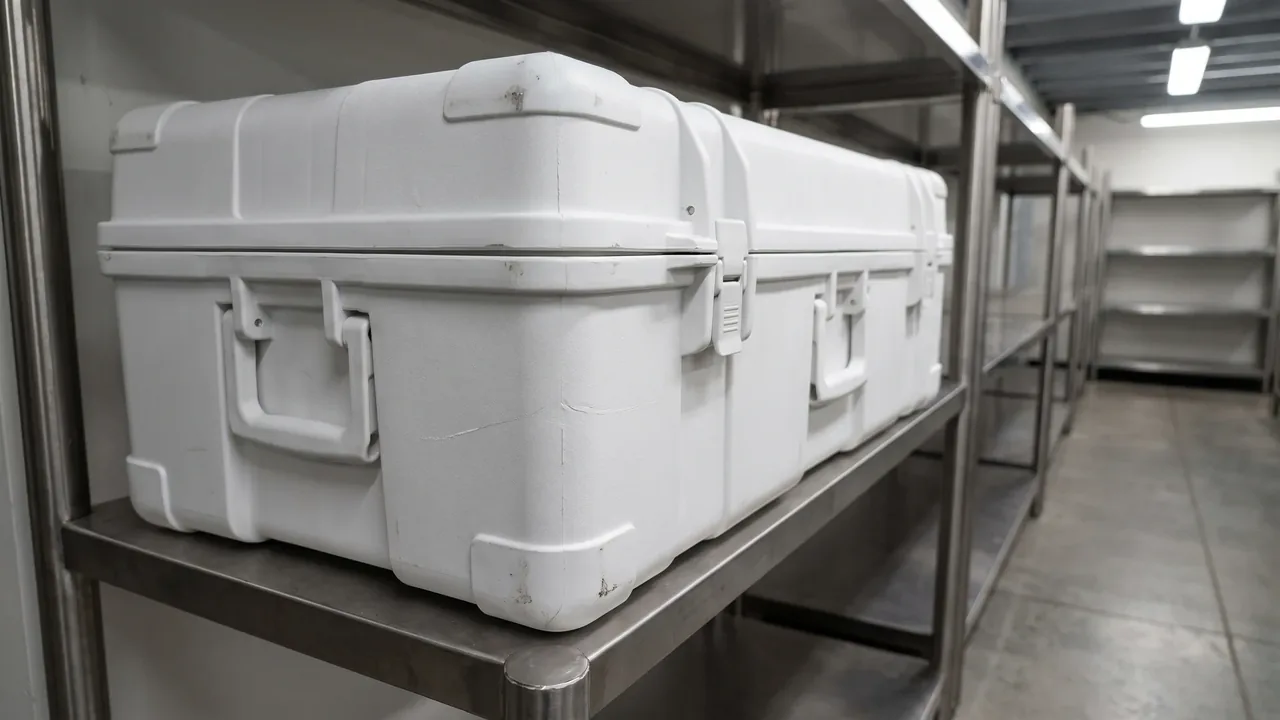
Green supply chain cases are the containers a brand depends on for incoming material rotation, in-plant distribution, spare parts logistics and trade show storage. Each unit costs little, but brands operate them in tens of thousands of pieces, so their material composition, chemical compliance and end-of-life routing shape corporate environmental statements and downstream customer audit outcomes. Experience shows that writing environmental clauses into the technical specification and managing case suppliers through qualification audits, on-site audits and a documentary evidence chain delivers verifiable gains in recycled content, low-migration compliance and carbon data at a controlled total cost. A single turnover case without a material declaration can undermine an entire product line green claim. This article walks through the policy frame, specification clauses, material evidence, chemical compliance, supplier qualification and on-site audits, the evidence chain, carbon data, graded management and customer audit interfaces, with clause wording and audit steps that procurement and sustainability teams can apply directly.
1. Policy Frame and Where Cases Sit in Green Procurement
Green case management starts with positioning cases inside the corporate green supply chain. The reference frameworks are ISO 14001 for environmental management systems and ISO 20400 for sustainable procurement guidance. ISO 14001 requires an organization to identify purchased items with environmental impact and to influence suppliers; ISO 20400 provides the method for embedding environmental, social and ethical requirements into the purchasing process. Cases fall squarely into scope because they are high-frequency, low-value and material-intensive: they are consumed in bulk, replaced often, and made mainly of plastics and metals.
A workable policy has four layers. The commitment layer is the public green procurement statement. The standard layer translates the statement into case specifications and an approved supplier list. The process layer defines qualification, annual audits, corrective actions and exit rules. The record layer retains test reports, declarations and batch traceability files. All four layers are needed: commitments without clauses leave auditors with nothing to check, and audits without records leave the brand unable to evidence anything. For the overall strategy behind this structure, the green procurement case guide shows how portfolio-level policy connects to item-level case requirements.
Cases also play at least four roles in a brand logistics network: standardized containers for incoming and in-plant rotation, a component of outbound packaging, carriers for after-sales parts, and flexible storage for trade shows and temporary warehousing. Each role faces a different exposure profile. Outbound packaging cases see transport stacking and recycling marks, rotation cases see repeated washing and forklift impact, and spare parts cases see long storage and traceability demands. Environmental clauses should therefore be tiered by role instead of applied uniformly across the catalogue.
One more point: green case management is not a solo act by procurement. The sustainability team owns compliance interpretation, quality owns report review, logistics owns rotation and scrap data, and supplier management owns audits and corrective actions. All four inputs converge on one specification and one supplier file. That convergence is what makes the graded management and customer audit interfaces described later in this article work in practice.

2. Environmental Clauses in the Technical Specification
The technical specification is where green procurement becomes enforceable, and clause wording decides whether a clause can be audited. A common mistake is vague language such as "use eco-friendly material", which can be neither tested nor evidenced. A verifiable clause carries four elements: the metric, the standard basis, the required document or test, and the acceptance method. For example, "recycled content in the main shell resin shall be at least thirty percent by total case mass, evidenced by a material certificate and a recycled content declaration delivered with each batch, verified by annual sampling" is enforceable, while "prefer recycled material" is not.
A complete environmental clause package for cases usually covers six areas. First, material declaration: resin or alloy types for the shell, liner and seals, plus recycled content. Second, recyclable design: mono-material preference, adhesive-free assembly and removable structures, with defined recycling marks. Third, low migration: limits on substances that may transfer from the case to its contents. Fourth, chemical compliance: RoHS and REACH requirements. Fifth, carbon data: accounting boundary and delivery format. Sixth, document delivery: the list of files supplied with goods and archived annually. Together these six areas form a clause set that survives an audit.
Clauses must not contradict each other. Demanding maximum recycled content and maximum low-temperature impact resistance at the same time can exceed what the material process allows; a more workable combination is high recycled content in non-structural parts and virgin or modified resin in functional parts. Requiring adhesive-free assembly for recyclability while demanding very high sealing retention forces a trade-off between snap-fit design and gasket compression. Specification reviews should be countersigned by materials, quality and logistics so no single function writes a clause nobody can accept.
Clauses should also be tiered. Core models with high volume and outbound packaging exposure follow the full clause set; tail models can start with chemical compliance and document requirements, with recycled content and carbon data given a transition period. Tiering controls cost and prevents suppliers from over-claiming to win business. The case procurement pitfall checklist lists common clause wording traps and acceptance gaps worth checking before release.
3. Recycled Content and Material Evidence
Recycled content is the most quantified and most challenged environmental clause for cases. Among common resins, PP and PE have mature recycling streams, while ABS and engineering alloys see recycled use limited by impact performance. A specification that states a percentage should also define three things: the calculation basis (whole case mass or single part), the verification method (material certificate, melt flow index test or spectroscopy), and the tolerance band. A percentage without a defined basis is close to meaningless in an audit.
From a materials engineering view, more recycled content is not automatically better. Recycled resin has passed through multiple heat histories, and chain degradation can show up as lower impact strength and wider scatter. As a rule of thumb, unmodified high-content recycled PP can show increased scatter in low-temperature falling-dart impact, so load-bearing parts and cold storage scenarios need content limits or toughening compensation. If liner foam uses recycled feed, rebound retention deserves extra verification, because foam cushioning decay is harder to detect visually than shell defects.
On the evidence side, suppliers should provide four document types: a material certificate stating resin type and grade, a batch-level recycled content declaration, an upstream traceability note distinguishing post-consumer recycled from industrial regrind, and third-party test reports where required. Post-consumer and industrial regrind carry different environmental meaning and should be declared separately. For a deeper comparison of virgin and recycled performance, the virgin vs recycled case material article and the recycled material case guide pair performance verification with content requirements.
During on-site audits, recycled material authenticity is a priority check. Auditors verify segregation between recycled and virgin storage areas, batch card completeness, first-in-first-out execution, and whether unlabeled incoming bags exist. Recycled feed addition records are cross-checked against actual dosing ratios, and current-batch raw material is sampled and sealed. Cases where claimed recycled feed was actually mixed unlabeled regrind have introduced both performance loss and chemical risk, so content clauses must be bound to batch traceability and sealed-sample retention.
4. Recyclable Design and Recycling Marks
Recyclable design addresses what happens after a case is retired. The principles compress into four rules: keep materials as single as possible, make connections demountable, minimize coatings, and standardize information. Mono-material design means the shell, lid and main structural parts share one resin to cut sorting effort. Demountable connections use snap-fits or screws instead of large-area adhesive bonding so a retired case can be separated quickly. Minimal coating avoids plating and multi-layer painting that block recycling. Standardized information means molding or screen-printing the recycling mark and resin code where wear is least likely.
On marks, plastic parts typically carry resin identification codes, with PP coded 5, PE coded 2 and 4, and ABS coded 7. Marks should sit on flat, low-wear surfaces and agree with the material declaration. For cases shipped into markets such as the EU, packaging rules on recyclability and labeling should be tracked, and disposal guidance added to the case or accompanying documents where needed. The recycling mark case guide covers mark position, size and durability requirements in detail.
A simple design review test: can a retired case be separated into three streams or fewer (shell, metal parts, seals and foam) within fifteen minutes using basic tools? Cases that pass this test have markedly better end-of-life economics than composite structures. For rotation cases, average trip count matters too: a case designed for fifty trips and one rated for twenty carry very different environmental cost per trip even at the same purchase price. The trip-cycle management ideas in the case recycling and reuse article help connect design intent with real rotation data.
5. Low Migration and Chemical Compliance
Low migration and chemical compliance form the safety floor of the environmental clause set. The logic is to control what case materials may release toward contents or the environment. The two most cited regulations are RoHS and REACH. RoHS restricts lead, cadmium, mercury, hexavalent chromium and certain phthalate plasticizers in electrical and electronic products. REACH requires declaration and notification of substances of very high concern and keeps updating the candidate list. Cases are rarely finished electronics, but when they carry electronic products or enter the EU as accessory packaging, downstream customers pass RoHS and REACH obligations down the supply chain as a matter of course.
The highest-risk parts are usually not the shell but three auxiliary groups: gaskets, foam liners and surface printing. Gaskets may rely on phthalate plasticizers for elasticity. Some foam systems involve restricted blowing or flame-retardant chemistry. Heavy metals and solvent residues in inks and coatings can migrate slowly during long storage. The specification should therefore list restricted substances and test requirements separately for the shell, seals, liner and inks, rather than a blanket statement of RoHS conformity.
On test methods, heavy metals are typically quantified with dedicated chemical analysis, and phthalates and polycyclic aromatic hydrocarbons with extraction plus chromatography. The specification need not dictate laboratory procedures, but it should state two principles: the detection limit must sit below the regulatory limit, and sampling is on homogeneous materials. Sampling positions should be explicit, for example seals and ink layers tested separately. Where cases sit near food, pharmaceutical or children's product applications, migration testing with simulants should be added to assess release under realistic contact conditions.
On documents, suppliers submit RoHS and REACH declarations covering all homogeneous materials with referenced test report numbers, and they need a mechanism to notify the brand when the REACH candidate list updates. The RoHS and REACH compliance cases article and the environmental certification guide for cases translate regulatory text into specification language. A declaration is not evidence by itself: audits should cross-check at least one third-party report against the declared data.
6. Supplier Qualification Audits
Qualification is the first gate of green supplier management. Its purpose is to confirm before contract signature that a supplier can keep meeting environmental clauses, not merely produce one acceptable sample. A three-layer structure works well: document pre-review, self-assessment questionnaire and initial on-site review. Document pre-review checks qualification boundaries, including business scope, ISO 14001 certificates where held, laboratory equipment lists and third-party reports from the past year. The questionnaire probes management systems: chemical purchase and issue control, recycled feed sourcing policy, nonconforming product control and traceability records. The initial on-site review tests whether written systems and floor behavior agree.
Scoring should use weighted dimensions rather than pass or fail. Common dimensions and indicative weights are environmental system and certification at twenty percent, material and chemical control at twenty-five, testing capability and report quality at twenty, process records and traceability at twenty, and capacity and delivery stability at fifteen. Scores above threshold enter the approved list, scores below with improvement intent join a watch list, and falsification records or refusal to provide basic declarations lead to outright rejection. For high-frequency, low-value cases, batch-to-batch consistency deserves special weight, because green clauses usually fail at volume production, not at the sample stage.
Qualification is also where exit rules are fixed. Contracts should state that false environmental documents constitute material breach, that suspension follows two consecutive nonconforming batches on key clauses, and that concealment found in a customer audit triggers the exit process. Front-loading exit costs into the contract works better than remediation after the fact. For a fuller scoring method, see the case supplier evaluation system and the supplier sample evaluation cases article, which separate sample validation from volume consistency.

7. On-Site Audit Essentials
The on-site audit is how real capability gets verified. An effective case factory audit takes one to two days and should cover five areas. First, raw material storage: segregation of recycled and virgin resin, batch card completeness, first-in-first-out execution and any unlabeled incoming packaging. Second, the molding floor: temperature control records for injection or rotomolding, dosing control records for regrind addition, purge procedures at material changeover, and the collection and re-use path for offcuts. Third, the laboratory: equipment list, calibration certificates and original records, confirming coverage of every specification clause. Fourth, finished goods storage: marks, first-in-first-out and quarantine of pending inspection. Fifth, environmental facilities: dust collection, waste gas treatment and wastewater discharge in operation.
Sampling re-test is the decisive audit action. Auditors seal current-batch raw material and finished samples on site and send them to a third-party or brand laboratory for re-testing recycled content, restricted substances and key physical properties. Sealed samples are signed by both parties with batch and sealing date recorded to prevent later disputes. Auditors also pull historical reports at random and reconcile them against original records to confirm data traceability rather than after-the-fact reconstruction.
Findings should be graded. Major findings are regulatory violations or falsification, such as restricted substances above limits, unreliable report data or unverifiable recycled feed, and typically trigger supply suspension plus exit evaluation. Minor findings are system or record defects, such as incomplete batch cards or expired calibration certificates, and carry a correction deadline. Observations are risks without a finding yet, such as faint marking in the regrind area, and roll into the next audit. Grading directs correction effort at real risk instead of formalities. For a complete route map, see the case factory audit guide.
8. The Evidence Chain: Reports and Declarations
The evidence chain turns green procurement from promise into proof and is the first material pulled during a customer audit. A complete case evidence chain has five file types. The first is product test reports covering all performance and environmental items cited in the specification, for example enclosure protection tests under IEC 60529 and GB/T 4208, transport testing under the ISTA series, and material flame and restricted-substance tests. The second is material and recycled content declarations stating resin type, ratio and source batch by batch. The third is chemical compliance declarations covering RoHS and REACH with referenced report numbers. The fourth is carbon data files giving emission factors and results under the agreed method. The fifth is batch traceability records linking all files above to specific production batches, so any single case can be traced back to evidence.
Report validity is judged on three points. Check accreditation: the issuing body should hold CNAS or CMA or equivalent recognition, and its scope must cover the tested items, verifiable by certificate number on the accreditor website. Check sample correspondence: the model, batch and specification in the report must match delivered goods, and series coverage claims need technical justification, because borrowing a report for similar products is a serious defect. Check currency and signature: the report should be within validity, with issuer signature and institutional seal on the conclusion page. For series models, confirm the coverage statement has been technically confirmed rather than listed casually.
Recurring problems fall into three groups: reports detached from delivered batches, declarations with incomplete coverage such as shell only without seals, and inconsistent carbon accounting boundaries. The countermeasure is an archive mapping table that links every specification clause to file type, issuing body and update cycle, reviewed quarterly against expiry. For fast-rotation cases, run a full document review annually and refresh the supplier file. Certification and document requirements are detailed in the sustainable packaging certification guide, which separates certification documents from test documents.
9. Carbon Data and Life Cycle Assessment
Carbon data is the fastest-growing environmental clause for cases. The driver is scope three accounting and product carbon footprint disclosure: cases serve as packaging and logistics carriers, so the emissions from their material production and transport are counted in downstream customer or product footprints. If a brand cannot obtain case carbon data from suppliers, it must rely on rough estimates in disclosure, which customer audits routinely flag as an improvement item.
The accounting boundary should be fixed in the specification. A common boundary is cradle-to-gate, covering resin or metal raw material production, case molding, and transport from factory to brand warehouse. Some brands extend the boundary to use and disposal in a cradle-to-grave view. Relevant references include ISO 14067 for product carbon footprint, ISO 14040 and ISO 14044 for life cycle assessment principles and requirements, and domestic accounting standards such as GB/T 32151. The clause should state the boundary, the functional unit (per piece or per cubic meter of volume), the data year and the delivery format, because data from different suppliers cannot be compared without these.
Data collection runs on three levels. The first is supplier-specific measurement based on actual energy and material consumption per case, most accurate but most costly, suited to high-volume core models. The second is industry factors adjusted with plant energy data, suited to mid and small volume models. The third is brand-side estimation by material type when the supplier cannot provide data, flagged as estimated in disclosure. The practical route is measured data for core models, industry factors for the tail, with an upgrade path written into the supplier development plan.
Case carbon data has an underused benefit: it turns light-weighting from slogan into metric. Reducing wall thickness or switching to lighter material at equal volume shows up directly in the numbers. But light-weighting cannot sacrifice stacking or drop performance, so carbon clauses and performance clauses must be reviewed together. For accounting method detail see the packaging carbon footprint guide, and for disclosure and label wording see the packaging carbon label guide, keeping internal and external boundaries aligned.
10. Graded Management and Corrective Action Loops
Graded management focuses audit resources on high-risk suppliers. A common scheme sorts case suppliers into four levels. Level A is strategic: two consecutive years without major findings, complete files and measured carbon data, rewarded with reduced incoming inspection and payment priority. Level B is qualified: main clauses met, minor findings corrected on time, normal audit frequency. Level C is watch: repeated findings or late documents, higher audit frequency and restrictions on new model supply. Level D is exit: major findings or falsification. Grades are reviewed annually, and an unannounced check can trigger a temporary downgrade.
The corrective action loop is the engine of graded management and runs in five steps. First, the finding report is issued within five working days after the audit, stating the fact, the clause basis, the grade and the correction requirement. Second, root cause analysis is submitted within ten working days, separating people capability, system gaps and execution drift. Third, corrective actions state specific actions, owners and deadlines, with typical windows of thirty days for major findings and sixty days for minor findings. Fourth, the supplier submits evidence such as updated records, photos or re-test reports rather than a statement that correction is done. Fifth, the auditor verifies the evidence and closes the finding, sending back anything unconvincing.
Two failure modes need guarding. Correction fatigue appears when suppliers pay lip service to recurring formal issues; the answer is to escalate repeat findings and reflect them in grading. Paper correction happens when records are edited instead of processes fixed; the answer is a higher on-site verification ratio at closure, and mandatory on-site confirmation for major findings. For continuously supplied cases, aggregate finding trends quarterly and feed frequent issues back into specification revision, so audits find problems and specifications remove their root cause.
11. Interfacing with Customer Audits
A brand buying cases is itself a link in its customers supply chain. When a retail customer or end brand runs a green audit on the brand, case supplier records move up level by level and become supporting evidence for the brand green claims. Case supplier audits must therefore satisfy internal needs and pre-position interfaces for downstream audits.
The first step is a clause mapping table. Map every environmental clause in the customer audit questionnaire or code of conduct to a clause in the brand case specification, and then to the document the supplier must provide. A customer requirement for recyclable packaging maps to mono-material and recycling mark clauses, then to material declarations and design notes. A customer requirement for chemical compliance maps to RoHS and REACH clauses, then to declarations and test reports. The mapping table locates evidence in minutes instead of a document hunt.
The second step is bilingual and standardized archiving. Multinational customers usually require files in both Chinese and English, so key declarations and reports should have English versions prepared in advance, with model codes, batch rules and document numbers kept consistent across languages to avoid boundary drift in translation. The third step is rehearsal-style internal audit: once a year pick one or two core case models and run a full-chain trace drill on the customer audit basis, starting from one case in stock and working back to material declaration, test report, carbon data and production batch. Any broken link found in the drill becomes next year improvement priority. For translating customer green requirements into quantified indicators, the parameter mapping method in the protective case selection guide also applies.
12. Cost, Benefit and the Procurement Checklist
Green clauses change cost, and the procurement job is to keep the arithmetic honest. Green premium usually comes from four places: price gaps for recycled or modified resin, third-party testing and certification fees, audit travel and labor, and the document management added by clause compliance. As a typical observation for mid and high volume cases, testing and certification fees amortize to a very low per-unit level once volume is large enough, leaving material price gap as the main variable.
The accounting lens should switch to total cost of ownership. A case that costs slightly more but lasts more trips, can be refurbished and has clear scrap value may beat a cheaper fragile model on cost per trip, while purchase-price-only procurement tends to face concentrated replacement in year two. The evaluation table should list purchase price, expected trip count, repair rate and cost, scrap recovery value and compliance document cost, converting a five-year total into cost per trip for comparison.
At the operating level, a nine-point decision checklist makes the call repeatable: is the recycled content ratio and basis explicit, is recyclable design verifiable by disassembly, are restricted substances declared part by part, is the carbon data boundary agreed, do test reports cover the model and batch, is supplier grading evidence-based, does the corrective loop have deadline teeth, is the customer audit mapping in place, and is the end-of-life recycling path clear. Any missing point should be closed before order placement or written into a transition plan. For balancing customization against standard shells, the modular thinking in the custom foam inserts guide lets differentiated liners satisfy green clauses without redesigning the whole case family.
13. Maintenance, Refurbishment and End-of-Life Recycling
The second half of green procurement sits at the end of the case life cycle. Maintenance is the first lever for longer life: rotation cases should be cleaned on schedule, with checks on gasket hardening or trapped debris, latch and hinge smoothness, and cracks at stacking corners and ribs. Gaskets are wear parts and should be replaced by use frequency, preferring spares of identical section and material. In the engineering practice of JUNZHIJIA, seals are matched to specific case models with common spares kept in stock, and protection and material test documents are issued against designated models, which helps brands connect maintenance records with the evidence chain and avoid the audit gap where the case survives but its certificate is lost.
Refurbishment is the middle state between maintenance and scrap, and its criteria should be quantified: no through-cracks in the shell, functional latches, immersion test passed after gasket replacement, and liner retention restored. Cases meeting these conditions return to service. Refurbishment is both economic and environmental behavior: every extra trip defers one round of new material consumption and one disposal event. For batch rotation cases, build a health file by serial number, keeping cleaning, part replacement and test records in one place so refurbishment decisions are evidenced.
End-of-life recycling closes the loop. Sorting should be as fine as practical: PP and PE shells enter plastics recycling and pelletizing, aluminum alloy parts enter metal recycling, gaskets and foam are routed by material, and parts contaminated with oil or chemicals are characterized as hazardous or general industrial waste before disposal. Recycler qualification belongs in supplier management, and recycling flow records are kept for audit. Brands may specify in purchasing documents that the supplier provides scrap sorting guidance or a recycling service option, moving end-of-life responsibility into the procurement stage. With that, the chain from policy frame to recycling closes, and every link of procurement standards and supplier audits has a verifiable anchor.
FAQ
Q: What is the essential difference between green supply chain cases and ordinary purchased cases?
A: The difference lies in the management objective. Ordinary case purchasing solves whether goods can be held, moved and bought cheaply. Green supply chain cases add verifiable environmental attributes on top: material composition must be traceable, chemical compliance must be evidenced, and end-of-life routing must be accounted for. Ordinary purchasing watches unit price, lead time and appearance, while green purchasing also checks the recycled content basis, part-level restricted substance declarations, the carbon accounting boundary and the completeness of the evidence file set. The responsibility span differs as well. Ordinary purchasing ends at goods receipt, whereas green procurement extends through maintenance, refurbishment decisions and scrap recycling. For a brand, this extension is not an extra burden but a shift from treating cases as consumables to managing them as auditable environmental assets, so that external green claims survive sampling and traceability in a customer audit. In practice this means the same case model is judged on documents as well as on drop and stack performance, and the evaluation file follows the case from first delivery to final disposal.
Q: How detailed should environmental clauses in a technical specification be?
A: Clauses should reach a level that is testable, verifiable and acceptable at goods receipt, which means every clause carries four elements: metric, standard basis, required document or test, and acceptance method. For recycled content, a workable clause states that recycled content in the main shell resin shall be at least thirty percent by total case mass, evidenced by a material certificate and a content declaration with each batch, verified by annual sampling. An unworkable clause simply says to prefer recycled material. For restricted substances, requirements should sit at part level, with limits and sampling positions defined separately for shell, gaskets, foam and inks. Carbon clauses must fix the accounting boundary, functional unit and delivery format. Clauses that are too coarse invite acceptance disputes, while overly fine clauses may exceed supplier capability, so the practical route is precision on core clauses and explicit transition timetables for the rest. A useful drafting habit is to read each clause as an auditor would and ask which document would settle the question; if no document can settle it, the clause needs rewriting before release.
Q: Is a higher recycled content ratio always greener?
A: Not necessarily. The value of recycled feed depends on source type, processing history and end use, not on the percentage alone. Unmodified high-content recycled resin can bring lower impact strength and wider scatter, which in load-bearing parts or cold storage shortens case life and drives more frequent replacement, increasing cumulative environmental burden. Seen across the full cycle, the sound ratio is the highest level performance allows: raise content in non-structural, room-temperature parts, and control it in structural and low-temperature parts with toughening compensation. Post-consumer recycled and industrial regrind should be declared separately because their environmental meaning differs. The honest metric is material consumption per unit of rotation life, not a single number in a specification. Verification should follow the same logic: test impact performance at the service temperature rather than at room temperature alone, and track rebound retention for foam liners across an aging period before approving a recycled formulation for volume use.
Q: How often should case supplier audits be conducted?
A: A practical combination is one full annual audit plus quarterly unannounced checks. The annual audit covers system documents, all floor areas and sampling re-test for every registered supplier. Quarterly unannounced checks focus on high-risk items such as batch consistency in the recycled material store and original records for key tests. Grading sets the frequency: level A suppliers keep the annual cycle, while level C and D face higher frequency and restrictions on new models. Temporary audits are triggered by three situations: three months before a customer audit, a change of key raw material or production site, and two consecutive failing batches or an environmental incident. Audit frequency should also be tied to contract terms, with refusal to admit auditors listed as breach, so audits cannot be stalled. Frequency should scale with volume and criticality as well: a case carrying export packaging into a regulated market justifies more audit attention than an internal rotation tote with limited exposure.
Q: Can a brand pass a customer audit if a supplier cannot provide carbon data yet?
A: It depends on the customer requirement and how the brand responds. Most customer audits do not demand measured carbon data for every item, but they do expect a prioritization route and a credible plan. A three-tier response works: for high-volume core case models, commit to a measurement plan with dates; for mid and small volume models, use industry emission factors adjusted with plant energy data and flag the estimates; for tail items that cannot be covered, state the estimation assumptions in disclosure. The key is to write these three tiers into the supplier file and customer communication so auditors see boundaries, a path and owners. Last-minute collection of scattered data usually fails because inconsistent boundaries cannot be cross-verified, and it leaves an improvement item instead. Brands that treat carbon data as a graded capability rather than a pass-fail gate usually find suppliers cooperate more readily, because the requirement looks achievable and the upgrade path is visible.
Q: What should be done when audit findings stay open past their deadline?
A: First separate inability from unwillingness. Where capability is short, break the correction into smaller steps, provide templates or coaching, and consider stationing a brand quality engineer at the plant. Where willingness is short, apply commercial levers. Institutionally, a stepped approach works: unclosed minor findings pause new model supply from that supplier; unclosed major findings trigger downgrade and exit evaluation; repeated findings escalate regardless of grade. Another effective step is to tie correction timeliness to payment terms and volume allocation, so correction performance carries direct commercial weight. It is also worth revisiting the specification itself: recurring findings of the same type usually signal an unreasonable clause or a supplier base that lacks the capability, which calls for specification revision or structural change in the supplier portfolio rather than repeated chasing. Whichever lever is used, the closure record matters: keep the finding, the root cause, the action, the evidence and the closure date together, since this file is exactly what a customer audit asks to see.
Q: Do small-batch, high-variety case purchases also need the full document set?
A: Yes, but the depth can be tiered. Documents exist to provide traceability, which does not depend on batch size: a case used as export packaging needs a material declaration and chemical compliance declaration just as much as a high-volume one. What can flex is depth and frequency. Small-batch models may accept extended reports based on the same material series, carbon data at the industry factor level, and audits limited to document pre-review plus questionnaire. Prioritize by annual usage and export exposure: models with high volume or entry into strongly regulated markets such as the EU follow the full set, others follow a basic set. The basic set should always include the material declaration, the RoHS and REACH declarations and the recyclable design note, since these three are cheap, quick and carry high audit value. Where volume is genuinely tiny, a group-level declaration covering a material family can replace per-model reports, provided the group definition and its technical justification are documented and accepted by the brand quality function.
Q: How can the authenticity of a supplier test report be judged?
A: Check three points. First, accreditation: the issuing body should hold CNAS, CMA or equivalent recognition, its scope must cover the tested items, and the certificate number can be verified on the accreditor website. Second, correspondence: the model, batch and specification in the report must match delivered goods, and series coverage claims need technical justification, because borrowing a report for similar products is a serious defect. Third, traceability: report data should reconcile with original records, and during on-site audits historical reports can be pulled and checked item by item against raw records, equipment logs and report dates. Cross-validation adds confidence: send the same material to two laboratories, or re-test key indicators at goods receipt. As a rule of thumb, data that look suspiciously clean with abnormally low scatter deserve priority sampling.
Conclusion and Related Reading
Managing green supply chain cases means turning environmental commitment into verifiable engineering and procurement language, from specification clauses and audits to carbon data, corrective loops and end-of-life recycling. The lasting value is compliance that becomes routine, with cost amortized by scale and experience compounding each cycle.
Related reading: green procurement case guide, case supplier evaluation system, how to audit a case factory, recycled material case guide.