

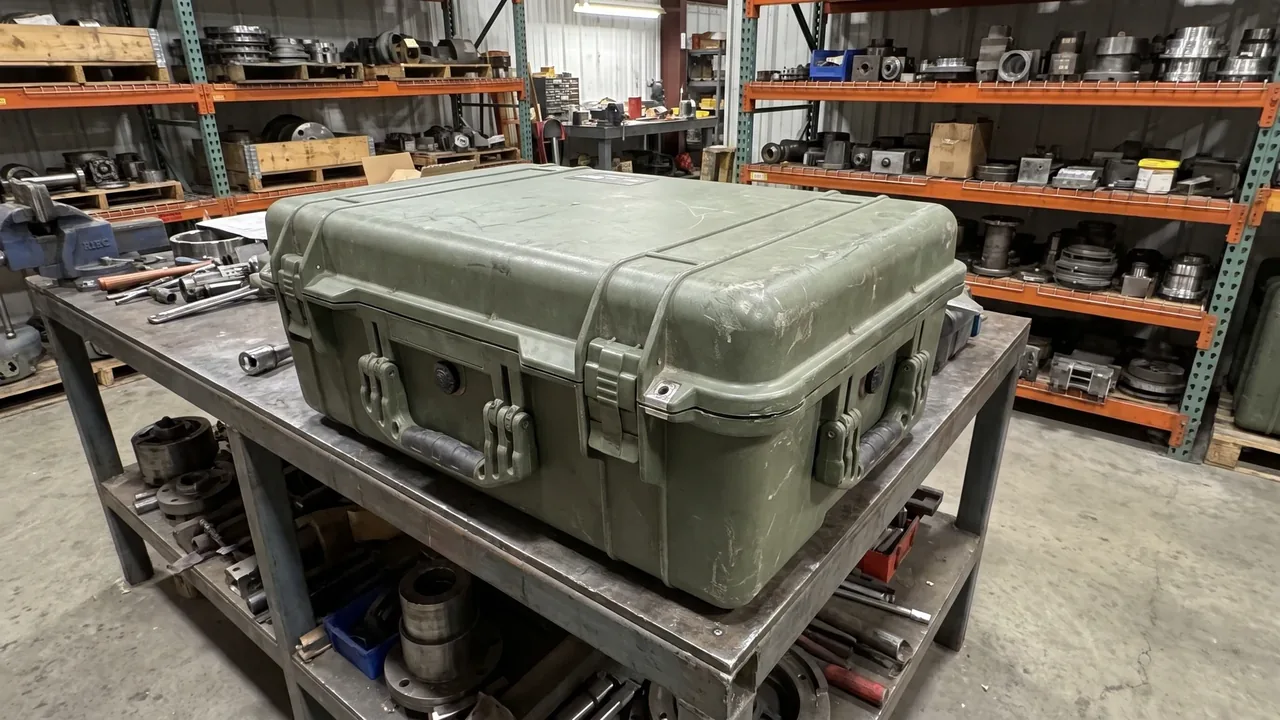
As supply chains accelerate environmental disclosure, the carbon emissions of protective cases, the containers that carry industrial equipment, medical devices and precision instruments, are entering the accounting lists of buyers, and the carbon label has become a new member of the case documentation set. For case manufacturers and accessory suppliers, a carbon label is not an environmental slogan but a marking that writes case carbon data down clearly, verifiably and comparably. Experience shows that a well-marked carbon label on a protective case should carry three core items at once: a declared carbon value per unit, an accounting boundary, and a verification method; missing any one of them reduces the number to marketing copy rather than a procurement basis. Focusing on the case itself, this guide explains what the label carries, the standards behind the accounting, the relationship between PCR and EPD, how buyers read and compare labels, common misuse, and how suppliers should mark, so procurement, engineering and ESG teams can turn the carbon label into a real management tool.
1. What a Carbon Label Carries
A packaging carbon label compresses case carbon data into a sticker or mark that can be applied, scanned and audited. For an industrial container such as a protective case, a qualified label carries at least three core items: the declared carbon value per unit, the accounting boundary, and the verification method. The declared value answers how much this case emits, usually expressed in kilograms of carbon dioxide equivalent (kg CO2e) with an explicit functional unit. The boundary answers how the number was calculated, that is, which life-cycle stages from raw material extraction to end-of-life are covered and which unit processes are included. The verification method answers who stands behind the number, whether it is a supplier self-declaration or an independent third-party verification against a named standard.
None of the three can be omitted. A value without a boundary is like reporting a score without the exam syllabus. A boundary without a verification method leaves the number untraceable. A verification statement that does not bind to a specific model or batch leaves the paperwork disconnected from the physical goods, and the label remains decorative. As a rule, buyers should treat boundary and functional unit as the first checkpoint when reviewing a label and rank the value itself second, because a value without a boundary is not comparable and can mislead the purchase decision. The accounting conventions should follow the functional-unit method described in the packaging carbon footprint guide, and both documents should share one boundary definition.
The carrier format also deserves attention. Case carbon information can be molded into the inside of the shell, printed on a weather-resistant label on the back, or linked through a QR code to an online declaration file. Because cases see sunlight, rain and repeated handling, molded marks and outdoor-grade labels clearly outlast ordinary paper tags. A QR code should point to a durable page, and a static file backup should be kept, so the evidence survives supplier website redesigns during customer audits.
2. Declared Value and Functional Unit
The functional unit is the denominator of the carbon value on a label, and different denominators produce very different conclusions for the same case. Three conventions are common: per case, covering the whole life cycle of one unit; per standard transport cycle, covering one load, transport and return; and per year of service, folding in spare parts and maintenance energy. None is absolutely superior, but the label must state the denominator, otherwise the value cannot be interpreted at all.
For reusable protective cases, the per-cycle convention is the fairest. If a rotomolded case completes fifty cycles, its manufacturing emissions are spread across those cycles, while a one-way wooden box is scrapped after a single shipment and sinks its full footprint into that one trip. If a label uses a per-case unit without stating the cycle count, the advantage of reusable cases is systematically underestimated, and buyers can wrongly conclude that a plastic case emits more than a wooden box. Cycle assumptions should rest on evidence such as life testing or actual rotation records rather than a round number pulled from the air.
When reviewing a label, confirm the denominator first: per case or per cycle, how many cycles are assumed, and whether maintenance spares are included. Suppliers should state the functional unit and cycle assumption proactively, for example, one standard round trip per case assuming fifty cycles. For cases that carry high-value goods such as ammunition accessories or medical supplies, the case itself is usually a small share of the footprint relative to contents, so the per-cycle convention should be highlighted rather than a gross total, which would exaggerate the environmental weight of the box.
3. Accounting Boundary and Scopes 1, 2, 3
The accounting boundary decides how much of the case footprint the label covers. By life-cycle stage, case emissions split into five blocks: raw material acquisition, covering resin pellets, metal profiles and additives; case manufacturing, covering rotomolding or injection heating, mold preheating, cooling and finishing; distribution transport, covering finished and empty-case logistics; use and maintenance, covering cleaning and replacing seals and latches; and end-of-life treatment, covering shredding, recycling or disposal. A cradle-to-gate boundary covers the first three blocks, while cradle-to-grave covers all five.
Under the GHG Protocol Product Standard, emissions can also be grouped by scope. Scope 1 covers the factory's own combustion and process emissions. Scope 2 covers purchased electricity and heat. Scope 3 covers upstream and downstream indirect emissions, including material production, outsourced processing, outbound transport, and even customer use and disposal. Rotomolding is electricity-intensive, so scope 2 usually dominates the manufacturing stage, while resin pellet production sits upstream in scope 3. A buyer who compares a scope 1 figure against a full-scope figure will badly underestimate the emissions of an electricity-driven plant.
Inside the boundary, cut-off rules and allocation methods must be explicit. Auxiliary inputs contributing below an empirical threshold, for example one percent, may be declared and omitted, but key items such as shell resin, metal hinges and seal strips must stay in. Shared-line energy should be allocated by output, and multi-purpose cases by cycle count or mass. Once fixed, the boundary and allocation method should stay constant in the supporting files so results remain comparable across years and models, which is exactly what a third-party verifier checks first.
4. Standards: ISO 14067, PAS 2050 and GHG Protocol
Three standards dominate case carbon accounting. ISO 14067, Greenhouse Gases, Carbon Footprint of Products, Requirements and Guidelines for Quantification and Communication, is the mainstream product carbon footprint standard today, specifying functional unit, system boundary, data quality, allocation and communication; its Chinese equivalent GB/T 24067 has also been published, letting exporters maintain bilingual accounting files. PAS 2050, Specification for the Assessment of the Life Cycle Greenhouse Gas Emissions of Goods and Services, came earlier for packaging and fast-moving goods and separates additional emissions from carbon storage carefully. The GHG Protocol Product Standard emphasizes the scope 1, 2 and 3 logic so product footprints reconcile with corporate inventories and feed ESG disclosure.
The three do not conflict and are often combined: ISO 14067 or GB/T 24067 as the quantification and labeling basis, the GHG Protocol logic for reconciliation with corporate accounting, and PAS 2050 methods where packaging-specific issues arise. For durable packaging such as protective cases, the ISO 14067 structure of functional unit, boundary and data-quality rating maps exactly onto the three core items a carbon label must disclose, which is why this guide keeps ISO 14067 as the main thread.
It also helps to separate the carbon label from the wider family of environmental claims. The ISO 14020 series sets the general principles: self-declared claims such as this case contains recycled content rest on supplier evidence, Type I ecolabels are third-party certified, and Type III declarations (EPD) provide quantified data from a life-cycle assessment. A carbon label sits between a self-declaration and a full EPD, more concrete than a green slogan and narrower than a full declaration. Buyers should know which level of evidence their procurement chain actually demands, and avoid letting a self-declared number carry the heaviest compliance burden.
5. PCR and EPD: Category Rules and Environmental Product Declarations
PCR, or Product Category Rules, are the measurement rulebook of the environmental declaration system. For a given product category they fix the boundary, functional unit, data quality and cut-off rules of the life-cycle assessment, making footprints comparable across products. For cases, the category rules for reusable transport packaging, wood packaging or plastic packaging decide how far a case footprint reaches, whether spare-part replacement is counted, and how cycle counts are assumed. Without a PCR, even a correctly calculated number may become incomparable because of boundary choices alone.
An EPD, or Environmental Product Declaration, is a Type III declaration compiled under ISO 14025. It goes far beyond a carbon label: besides global warming potential it usually reports acidification, ozone depletion and eutrophication, and it must be verified by an independent third party. An EPD must follow the applicable PCR, and its data usually trace to a verified life-cycle assessment report. For protective cases, EPDs appear mainly in EU export chains, green building and large infrastructure supply chains, representing the upgraded evidence tier behind a carbon label, so buyers should check its PCR reference and verifier.
The relationship can be summarized as: PCR sets the rules, the assessment produces the data, the EPD is the report, and the carbon label is the summary. Buyers receiving a label can request the PCR reference and a data summary to confirm the convention; suppliers can build the accounting model to a PCR first and evolve toward an EPD later on a controlled budget. JUNZHIJIA, when supporting export customers, typically issues model-level carbon data tables first and only introduces third-party assessment if the customer requires a full EPD, avoiding an oversized one-off investment.
6. Data Quality and Third-Party Verification
The credibility of a carbon label rests on data quality and the verification tier. On data, primary sources come first: in-house meter readings, material purchase records and measured transport distances; secondary sources such as industry-average emission factor databases only fill gaps. ISO 14067 requires data quality to be rated by time, technology and geography, with uncertainty stated in the report. For rotomolded cases the manufacturing stage is electricity-heavy, so if metered data is missing and only industry averages are used, the error can grow large enough to distort the label, and buyers should prefer values backed by measured records.
On verification, environmental declarations come in two tiers. A self-declaration leaves data and convention under supplier responsibility and suits internal management and early disclosure. Third-party verification has an independent body check the calculation process, data sources and conclusion consistency against ISO 14067 or ISO 14025 and issue a verification statement, which is markedly more credible. For cases entering public procurement, EU supply chains or corporate ESG reporting, buyers usually require a third-party verified label or EPD within its stated validity period.
Buyers can apply three checks. First, confirm the verification statement covers this model and this batch rather than a generic product family. Second, confirm the report states functional unit, boundary, data sources and emission factor provenance. Third, check the date and update cycle: carbon data is best refreshed every one to two years, with immediate revision when material structure, process or grid factors change materially. Writing these three checks into the technical specification filters out most paper labels and lets environmental data serve the review practice of the green procurement case guide.

7. How Buyers Read and Compare Labels
When a supplier presents a carbon label, read it in a fixed order. Step one is the boundary: cradle-to-gate or cradle-to-grave. Step two is the functional unit: per case, per cycle or per year, with the cycle assumption checked. Step three is the value itself, compared against references of the same convention. Step four is the verification method: self-declared or third-party verified. Step five is the date and covered models. The order cannot be shuffled, because a value stripped of boundary and functional unit means nothing in comparison.
When comparing two suppliers, align conventions before comparing numbers. If one side gives cradle-to-grave per cycle and the other cradle-to-gate per case, ask the latter to fill the use, maintenance and end-of-life data, or restate the former into the same boundary. Once aligned, weigh mass and service life: a heavier case lasting twice as long may carry a lower per-cycle footprint than a lighter rival. Carbon should also be assessed together with protection performance, because a lightweighting move that breaks the drop or sealing performance can impose hidden emissions from damaged goods far above the savings; the supporting evidence should reference MIL-STD-810H, ISTA and IP rating test files.
For volume procurement, add an environmental information section to the technical specification: a unit carbon value calculated under ISO 14067 or GB/T 24067, the boundary and functional unit stated, data quality and verification method described, and an update commitment given. This turns the carbon label from marketing material into a contract annex with remedies if breached. For a systematic view of supplier competence, combine the case supplier evaluation system and score the completeness of environmental files alongside protection, life and warranty.
8. Common Comparison Traps
Even when both sides present labels, several typical traps remain. The first is boundary mismatch: one counts only factory output while the other runs to end-of-life, and a direct comparison flatters the narrow boundary. The second is functional unit mismatch: per case against per cycle compares a total with an allocation, so the conclusion is necessarily distorted. The third is divergent cycle assumptions: one case amortized over ten cycles and another over one hundred cannot be compared until each side states the basis, such as life testing or actual rotation records.
The fourth is allocation difference: shared lines and shared molds allocated differently can move a single case footprint appreciably. The fifth is stale emission factors: grid and fuel factors are updated annually, and an old database introduces systematic bias, especially since grid factors vary strongly by region, so the same model built in different locations can differ in manufacturing-stage emissions. The sixth is ignoring use and maintenance: replacing seals, latches and wheels belongs to the use stage, and a label that omits it underestimates the true cost of long-life cases and hides the value of repairable design.
The remedy is to require the three convention items to travel with the label: boundary description, functional unit definition, and data and factor provenance. Buyers can issue a template that all bidders complete in the same format, then restate differences into one convention before scoring. This practice mirrors the functional-unit method in the packaging carbon footprint guide, and the two tools reinforce each other when applied together.
9. Misuse and Improper Marking
Several common misuses appear in case-related environmental marking, and buyers should recognize them. The most frequent is a value without a boundary: the label reads low carbon and thirty percent lower emissions without stating the baseline or the boundary, an unverifiable percentage typical of selective disclosure. The second is a corporate inventory masquerading as a product footprint: dividing annual factory emissions by output yields a per-case number that is neither a product footprint nor comparable with peers.
The third is abuse of the term carbon neutral: product-level neutrality must state the covered scope, the offset approach and the offset quantity, and a bare carbon neutral claim without offset evidence should be treated as exaggerated marketing. The fourth is the false comparison between one-way cartons and reusable cases, setting a carton single-trip footprint against a plastic case total manufacturing footprint to create the illusion that paper is greener. The fifth is badge grafting, printing unrelated system-certification logos beside the carbon label to imply that the carbon data is certified too, a visual splice that misleads buyers.
For suppliers, improper marking is not only an integrity issue but also advertising compliance and contract liability. The correct approach is that every value must trace to an accounting file, conventions must be fully disclosed, and marks must match the actual certification scope. Where label content compliance is concerned, follow the packaging labeling compliance guide on element, language and durability requirements, so the carbon label neither collides with transport marks nor wears out before the case does.
10. How Suppliers Should Mark the Label
Case suppliers should build a marking convention in four steps: carrier, elements, timeliness and traceability. For the carrier, prefer molded marks on the inside or base of the shell plus outdoor-grade weather-resistant labels, with a QR code as the online entry; carbon information should avoid transport marks, stacking load faces and wear-prone edges so it stays legible for the case life. For elements, each label should include at least the unit carbon value and unit, the boundary type, the functional unit and cycle assumption, the reference standard, the data year, and the verification method and body; a label missing any of these is non-compliant.
For timeliness, the label should state the data year and recommended update cycle, with a full review every one to two years; when the material structure changes, for example a shift in recycled content, when the process route, energy mix or transport distance changes materially, the revision should be immediate and the label version replaced. For traceability, each label should map to an accounting file including model version, data tables, emission factor sources and the verification statement, retained for no less than the case life plus two years to survive customer audits and compliance reviews.
For multi-model series, build the accounting model on a shell platform: where one shell is combined with different liners and hardware, use a differential-parts incremental method so each model is costed without a full re-calculation. JUNZHIJIA applies exactly this in engineering practice: a base shell model acts as the master, with liner, latch and seal treated as variable parts, so a new combination can be estimated within days under a convention identical to the master, letting customers compare series products side by side.
11. Carbon Files with Test and Certification Documents
Carbon files and performance test files are two parallel systems: manage them separately but let them corroborate each other. Performance files answer whether the case is qualified: IP ratings under IEC 60529 and GB/T 4208, environmental tests under MIL-STD-810H, transport package tests under the ISTA series, material flammability under UL 94, and CE, RoHS and REACH compliance for EU export, following the case chemical compliance guide. Carbon files answer how much the case emits: the life-cycle assessment report, the emission factor tables and the verification statement. Together they form the complete delivery archive.
The synergy lies in shared data. Mass data used in carbon accounting should come from controlled drawings and measured weighing, consistent with the samples used in drop and vibration tests. A declared recycled-content ratio should match the material test report. If a supplier claims lower emissions from recycled content, proof of the ratio and the accounting note should accompany it. Filing both systems under one bill of materials and one model-batch number prevents the embarrassment of contradictory performance and carbon disclosures and strengthens the evidence chain needed for the sustainable packaging certification guide.
For suppliers facing the EU market, also separate the carbon label from packaging regulation: the EU Packaging and Packaging Waste Regulation sets mandatory requirements on minimization, recyclability and recycled content, while the carbon label is a voluntary environmental information tool beyond it, though both can share one life-cycle model as their data base. The relevant requirements can be followed through the EU packaging directive case guide, archiving compliance and carbon documents together to cut repeated certification costs.

12. Carbon Labels in Procurement and Supply Chain
The value of a carbon label ultimately lands in procurement decisions and supply-chain management. For buyers, build environmental information completeness into supplier evaluation: whether a clearly bounded label is provided, whether unified conventions are accepted, and whether an update cycle is committed can all serve as indicators of supplier professionalism. In multi-supplier bidding, set a unit per-cycle carbon indicator in the technical score alongside protection grade, service life and warranty, so price is not the only lever and low-carbon design earns a real commercial return.
For supply chains, the carbon label is a data pass-through tool. When a brand or integrator asks case suppliers for carbon data, it is extending scope 3 accounting into the packaging layer; the supplier then requests emission factors upstream from resin producers, and data moves down the chain link by link. In practice, core companies should agree a data template and update frequency with case suppliers, fold label maintenance into the annual supplier audit, and run it together with the checklist in the green supply chain case guide to reduce duplicate reporting.
For case manufacturers themselves, labels also serve ESG disclosure and tendering: submitting series carbon data tables with bids is becoming routine for export and large project procurement. If the company also runs a reusable transit case program, the cycle-count ledger can be used directly as activity data for the use stage of carbon accounting, and end-of-life disposal records can be merged with the recycling ledger of the packaging waste management guide, forming a complete data chain from factory gate to regeneration.
13. Engineering Practice for Case Carbon Labels
Moving the carbon label from file to product requires a supplier with coordinated material, process and data capability. JUNZHIJIA has built three supports around the label in protective case engineering. First, model-level carbon data tables covering shell, liner and hardware seal mass and process energy, output in either cradle-to-gate or cradle-to-grave convention as the customer requires. Second, recycled-content schemes with the recycled ratio marked on the product so reduction claims are verifiable, with material boundaries referenced against the validation conclusions of the recycled material case guide. Third, the working papers needed for third-party verification on request, including data tables, factor sources and model notes, supporting customer ESG disclosure or export compliance.
For export-oriented customers, JUNZHIJIA also archives carbon label files together with CE, RoHS and REACH compliance documents, both data sets sharing one bill of materials and one set of measured records, which cuts repeated testing and repeated certification in energy and cost. On liner selection, the low-odour and recyclable foam options in the eco-friendly lining material guide can lower unit emissions without compromising cushioning, keeping the label value consistent with the real product; the end-of-life route of the shell can be aligned with the closed-loop design of the circular packaging case guide, extending the data chain into regeneration.
To restate, the bottom line of a carbon label is truthful data, clear convention and auditability. Any low-carbon claim detached from accounting papers has no procurement value, and only an emissions reduction achieved at equal or better protection performance is a sustainable environmental gain. Buyers and suppliers alike should manage the label as an engineering document: with a boundary, a unit, a standard, a date and a verification method, all five in place, the label truly serves green procurement and supply-chain decarbonization and can withstand scrutiny in export compliance and ESG audits.
Conclusion and Related Reading
A packaging carbon label turns the environmental performance of a protective case from a vague impression into a checkable number, but all of its value rests on a clear convention and traceable data. For buyers, the reading order is always boundary first, unit second, value third, with verification method and date as credibility filters. For suppliers, the marking essentials are a durable carrier, complete elements, timely updates and auditable papers. As EU packaging rules and scope 3 accounting extend into the packaging layer, documented case carbon information will shift from bonus to routine, and those who build the model early benefit earliest.
This guide and the packaging carbon footprint guide are companion pieces: one covers measurement, this one covers marking, and they are best read together. Readers who want to go deeper into packaging environmental compliance can also consult the packaging reduction case guide, the recycling mark case guide and the degradable case material guide to place the carbon label inside the wider green packaging system.
FAQ
Q: What is the relationship between a carbon label and carbon footprint accounting? A: The two are a result and a process. Carbon footprint accounting quantifies life-cycle greenhouse gases under ISO 14067 or GB/T 24067 and produces the assessment report and data tables; the carbon label compresses the core results, namely the unit carbon value, boundary, functional unit and verification method, into a marking for external display, acting as the summary page of the accounting. A label without accounting papers is water without a source, while accounting without a label makes data slow to move through procurement and supply chains. The correct sequence is to complete the accounting and any third-party verification first, then generate the label from a controlled template with values strictly consistent with the papers and version traceability. When checking, buyers can ask for both the report number and the label version, and question any mismatch, adjusting how much they trust that supplier's environmental data. In audits, the pairing of report number and label version is the fastest way to expose data that has drifted out of sync, and a supplier who cannot produce the pairing on request should be treated as having no usable label at all.
Q: Two suppliers show different carbon label values. How should they be compared? A: Comparing values directly is meaningless; conventions must be aligned first. Step one checks the boundary, confirming cradle-to-gate or cradle-to-grave and asking for the missing blocks. Step two checks the functional unit, whether per case, per cycle or per year, and whether cycle assumptions agree. Step three checks the data year and emission factor sources so old database values are not set against fresh ones. Step four compares the values themselves together with mass, service life and protection grade. In practice a unified template can require all bidders to submit boundary, unit, value, verification method and date in one format, with differences restated before scoring. Where a bidder cannot offer third-party verification, stricter acceptance clauses and liability terms can hedge the data risk instead of paying a premium for incomparable numbers. Where restatement is impossible, ask both parties to recalculate under one agreed convention, even if the recalculation is approximate, because an approximate common basis beats a precise but incomparable one. Scoring should then weight boundary completeness and verification tier alongside the raw value, so a fully bounded, verified figure outranks a lower but narrower claim.
Q: Can a label with only factory-gate emissions be used? A: Yes, but its applicable range must be clear. A cradle-to-gate boundary covers material acquisition, case manufacturing and part of distribution, data that is relatively easy to obtain and cheap to produce, making it a good tool for passing upstream data through the supply chain and comparing manufacturing stages between similar cases. Its limits are equally clear: it excludes use-stage spares and end-of-life treatment, so for long-life reusable cases it underestimates the full-cycle impact and can make one-way packaging look greener than it is. For packaging selection decisions, buyers should ask for use and end-of-life data, or at least the cycle assumption, so the factory-gate value can be amortized into a per-cycle footprint and set against a one-way carton single-trip figure. As a starting point for internal carbon management the factory-gate convention is entirely reasonable, provided it is stated clearly, used within its limits, and its constraints are documented. Suppliers who can only offer the factory-gate figure should be asked which scope 3 categories they have estimated and which they have omitted, since silence usually means the use and end-of-life stages were never modelled. A pragmatic middle path is to combine the factory-gate value with buyer-side estimates for transport, spares and disposal, clearly flagged as a hybrid, until the supplier can deliver a fuller boundary.
Q: What is a PCR and why should buyers care? A: A PCR, or Product Category Rules, is the measurement rulebook for a product category, fixing the boundary, functional unit, data quality and cut-off rules of the life-cycle assessment. Buyers care because of comparability: without a PCR, footprint numbers for similar products can diverge through boundary choices, cycle assumptions and allocation methods alone, however precisely each is calculated. When two labels follow the same PCR, consistency of convention is guaranteed by rule, and comparison reduces to values and data quality. Procurement documents can require suppliers to state the PCR or category rule their accounting follows, and third-party verifiers check that compliance too. For the reusable transport packaging category that covers protective cases, where a PCR exists its functional unit and boundary should be adopted in preference, trimming needless disputes over conventions. PCR documents are developed by program operators and revised periodically, so buyers should check which version a supplier applied and whether a newer version changes the boundary. In public tenders, requiring a named PCR version in the bid documents removes an entire class of disputes, because every bidder is then forced to compute on the same rules, and the evaluation committee can compare numbers without re-deriving each one.
Q: What is the difference between an EPD and a carbon label? A: An EPD, or Environmental Product Declaration, is a Type III declaration compiled under ISO 14025. Beyond global warming potential it usually reports acidification, eutrophication and ozone depletion, and it must rest on a third-party verified life-cycle assessment. A carbon label focuses on the single greenhouse gas indicator, is light in form, and may be self-declared or third-party verified. The analogy is a full medical report against a single temperature reading. In procurement, routine comparison and screening can rely on the label; entry into EU supply chains, green building or projects demanding deep disclosure usually calls for an EPD. Both can share one life-cycle model, so suppliers typically build the model and issue the label first, then upgrade to an EPD on customer demand, avoiding duplicate investment. When checking an EPD, confirm the PCR it follows, the verifier's competence and the report validity period. EPDs are commonly registered in national or sector program databases and carry a validity period, often around five years, after which revalidation is required. They cost more to produce because of the verified assessment behind them, so buyers should request an EPD only where the procurement genuinely needs that depth, and otherwise accept a well-bounded carbon label to avoid loading suppliers with unnecessary cost.
Q: Is a third-party verified carbon label automatically trustworthy? A: Third-party verification raises credibility substantially but is not a free pass. Its trustworthiness depends on three conditions: whether the verification scope covers the actual data of this model and batch; whether the verifier holds the right competence and independence; and whether the report is within its validity period. Buyers should still run basic checks. First, read the verification statement scope: if only the method was checked and raw data were not sampled, the conclusion is weaker. Second, check the date, since carbon data is best refreshed every one to two years and old conclusions can be distorted by material, process or grid factor changes. Third, test internal consistency between the value and the supporting files, such as mass and electricity ledgers. For major projects, data-truthfulness liability can be written into the contract and incoming quality testing reserved. Verification is a filter, not a substitute for buyer judgment. Accredited verifiers typically review the model, sample source data and may conduct site visits, and their statement should say what was checked and what was not. Keeping a verification log per model, with dates, scope and statements filed together, lets a buyer see at a glance whether the label in hand is still inside its verified window.
Q: A supplier claims the product is carbon neutral. How should that be verified? A: A carbon neutral claim must be verifiable or it should be treated as exaggerated marketing. Verification runs in three steps. Step one checks the covered scope, clarifying product-level or activity-level neutrality and whether the boundary matches the footprint accounting convention. Step two checks the split between reduction and offset: how much was reduced by the product itself, how the remainder is offset, and whether the carbon credit type, project and retirement record are traceable. Step three checks registration and verification: retirement records should be searchable in a public registry, and a third-party statement is better still. If the supplier offers none of these, the claim has no procurement value. The practical move is to return to the three label items and use checkable data instead of slogans, treating carbon neutrality as a bonus rather than a threshold, so no premium is paid for vague promises. Sound practice follows the hierarchy of reduce first and offset only the residual, with offsets retired in a credible registry rather than traded informally. Contract language can require the supplier to maintain the retirement evidence for the product life and to notify the buyer if the claim is withdrawn, so the buyer's own downstream disclosures are not built on a claim that later evaporates.
Q: How often should carbon label data be updated? A: A one to two year cycle is the baseline, supplemented by trigger-based revision. Periodic updates matter because emission factors change annually, with grid, fuel and transport factors all affecting values, and because material structures shift, for example a change in recycled content that directly alters the material-stage footprint; keeping a stale label misleads external disclosure. Trigger revision applies to major changes: a new process route, a change of primary material supplier, significant shifts in transport distance or mode, and structural redesign should prompt immediate revision and a new label version. Buyers can contract the update cycle and the duty to notify major changes, and record the label version in acceptance documents for batch traceability. For product series, an annual full-series review keeps conventions consistent across models and preserves the long-term credibility of the data. Version control matters as much as the interval: each label should carry a version identifier so an old sticker on a returned case is not mistaken for current data. Where the supplier feeds customer ESG reports, the update calendar should be aligned with the customer's reporting cycle, so refreshed values arrive before the disclosure deadline rather than after it.