

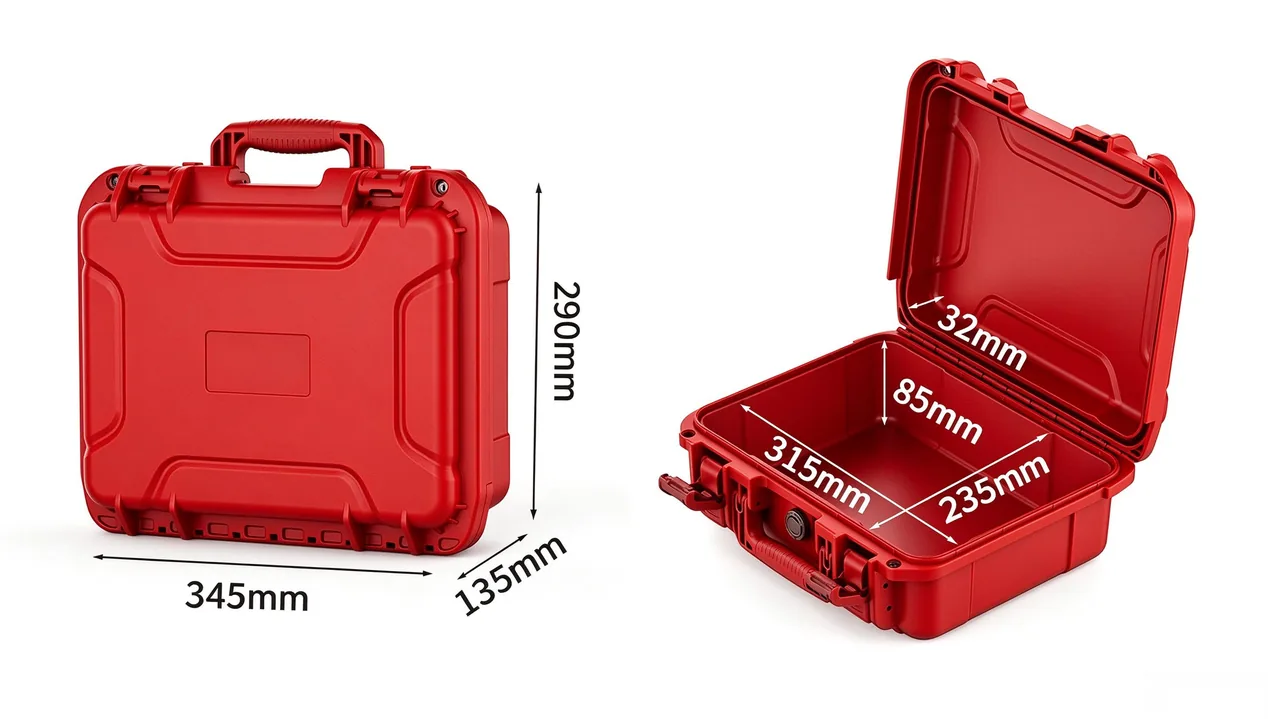
Degradable case materials appear constantly in single-use packaging replacement programs, food and medical consumable packaging, and green procurement lists. The term covers boxes, lids, liners, and fittings molded, thermoformed, or pressed from compostable resins such as polylactic acid (PLA), PBAT, and starch-based compounds, with the design goal of completing one or a few storage and transport cycles before entering an industrial composting or organic recovery stream instead of persisting in the environment. Experience shows that degradable case materials are not simply greener versions of ordinary plastic cases; they are dedicated containers with a hard boundary: stiffness is adequate, but heat resistance, impact toughness, water resistance, and shelf life all fall below polyolefin cases, so they only work when the cycle is short, temperature and humidity are controlled, and a real composting outlet exists downstream. This article walks through material systems, mechanical and thermal behavior, certification schemes, the mismatch between degradation conditions and real logistics, water resistance, mold control, structural design, compliance links, cost accounting, and a selection decision tree, giving procurement and engineering teams a verifiable framework.
1. Application Scope and Material Boundaries
A degradable case is built from five parts: the shell, the lid, the liner, the seal structure, and the markings, and all five must be selected together rather than swapping the shell material alone. By origin, PLA is bio-based, polymerized from lactic acid fermented out of corn or sugarcane; starch-based compounds come from corn or cassava starch; PBAT is fossil-based yet compostable. The most common confusion in procurement is treating bio-based as equal to degradable and degradable as equal to bio-based: PBAT is fossil-based but compostable, while PLA is bio-based yet degrades extremely slowly in ambient soil. Specifications should therefore describe degradation performance, not feedstock origin.
By use case, degradable cases cluster in fresh e-commerce turnover, in-plant food handling, single-use medical consumable packaging, trade-show sample transport, and government green procurement lists. These scenarios share three traits: single or limited use cycles, broadly controlled temperature and humidity, and a downstream composting or organic recovery outlet. Long-term outdoor rotation, summer sun-baked truck cabins, high-impact drop handling, and applications needing sustained submerged sealing all fall outside the boundary. The boundary is a material property, not a manufacturing defect.
Putting the boundary before the material choice is what keeps a project out of trouble. Most complaints that a degradable case does not hold up trace back to using a short-cycle container as a rotating tote: impact strength fades after the intended life, corners mold, latch retention decays, and the material gets blamed. The correct method is to draw the task profile first, covering number of uses, load, temperature and humidity ceilings, food or drug contact, and the disposal outlet, then work backward to material and structure so the case operates inside its window.
2. Three Material Systems: PLA, PBAT, and Starch-Based Resins
PLA is the main structural material for degradable cases. It is stiff and hard, takes print and hot-foil decoration close to PP or PS, and runs on mature injection-molding lines. Its weaknesses are equally clear: brittleness and low notched-impact strength, worse at low temperature, with an unmodified heat-deflection temperature typically in the 55 to 60 degrees Celsius range. PLA suits shell sheets, dividers, clips, and structural inserts, but it should not carry drop and impact duty alone; blending with PBAT for toughening or adding fiber reinforcement are standard engineering moves.
PBAT, a copolyester of adipic, terephthalic, and butanediol units, is the flexible partner. It offers high elongation at break, good impact and film performance, and insufficient stiffness and dimensional stability on its own, so it is mostly used as a toughening masterbatch blended with PLA or as a soft liner bag. Its heat ceiling is lower still and it creeps under sustained load. A useful mental model treats PLA as the bone material and PBAT as the joint material, with the ratio set by load and toughness requirements.
Starch-based compounds, including thermoplastic starch and its blends with PBAT or PLA, are the cheapest option with a friendly feedstock story, but they lose strength and dimensional accuracy sharply after moisture pickup, and their sugars feed mold, so they serve shallow trays and single-use light boxes rather than load-bearing totes. Common modifications include bamboo or hemp fiber reinforcement, nucleation, and chain extension, which partly close the toughness gap at higher cost and a narrower degradation window. The selection order should be load and climate first, disposal outlet second, cost third; reversing it produces cases with perfect certificates that crack on first drop.
3. Mechanical Performance: Strength, Toughness, and Wall Design
Four indicators govern mechanical performance: tensile strength, flexural modulus, notched-impact strength, and long-term creep. The family pattern is enough stiffness, not enough toughness. PLA flexural modulus approaches polypropylene, but typical notched-impact values sit well below it, and drops tend to open cracks at corners instead of producing recoverable dents. PBAT blending raises impact while giving up stiffness and heat resistance. A specification that only states a load limit in kilograms is incomplete; it must also state the crack criterion after drop testing.
Structural design is the main compensation for weak materials. Standard moves include wall thickness one to two tenths above comparable polyolefin cases, large-radius fillets at all four corners with a radius around three times the wall thickness, full-length ribs along side walls and base, base support posts that spread point loads, and thickened or metal-insert bosses at latch and hinge positions to prevent stress concentration. Drop and stacking verification can follow the ISTA series or the GB/T 4857 transport packaging test methods, with drop height graded by loaded mass, checking for through-cracks, lid operation, and liner retention after the test.
Creep under sustained load is an underrated risk. Under constant load, PLA and starch-based shells deform slowly, and the bulging side walls and warped lids of bottom-layer cases in long-term warehouse stacking usually originate here. Keep stacking layers one to two layers below comparable PP cases and run a stacking-load verification before typification. For a systematic comparison of materials and molding routes, see the case plastic material guide and the injection-molded case process, and pay back the material deficit with structure and process.
4. Temperature and Humidity Limits vs Logistics Reality
Temperature is the hardest constraint. Unmodified PLA shows a typical heat-deflection temperature of 55 to 60 degrees Celsius, reinforced grades can raise it at the cost of brittleness and price, and PBAT blends sit lower still. A sealed truck cabin in summer, an open loading dock, or a position near a boiler or drying tunnel can all exceed the safe window, producing softening, warping, and dimensional instability that never fully recovers. Any scenario involving sun-baked vehicles or hot in-plant transfer should rule out degradable options outright rather than hope that ribs will rescue the design.
Humidity behaves in two ways. PLA picks up little water but hydrolyzes, and combined heat and humidity accelerate chain scission; starch-based systems lose strength and dimensions quickly after moisture pickup and are extremely sensitive to warehouse humidity; long exposure above roughly 75 percent relative humidity shortens shelf life noticeably. The control logic for condensation inside the case matches conventional protective cases, and the humidity management and ventilation practices in the case condensation control guide apply directly.
Degradation from mismatch is gradual. A case may look slightly warped yet already have lost impact strength, which is exactly how bad batches pass incoming inspection. Add an aging-plus-retest step to batch acceptance: a typical empirical practice is accelerated aging around 60 degrees Celsius and 80 percent relative humidity followed by retest of impact and stacking performance, rather than judging on as-molded appearance and static stack load alone. Writing the retest into the acceptance procedure catches the batches that only fail after two months in the warehouse.
5. Degradation Certification: Industrial, Home, and Marine Composting
The industrial composting benchmark is EN 13432, which requires four things at once: disintegration, with more than 90 percent of material breaking into fragments below 2 by 2 millimetres within twelve weeks under controlled composting; biodegradation, with more than 90 percent of carbon converted to carbon dioxide within 180 days at around 58 degrees Celsius plus or minus 2; ecotoxicity, with the compost not inhibiting plant growth; and limits on heavy metals and fluorine. ASTM D6400 in the United States follows a similar line, ASTM D6868 covers coated and multilayer articles, and the domestic counterparts include GB/T 38082 and GB/T 19277; export jobs must also follow destination labeling rules.
Home composting is a different world. A home-composting mark such as the TUV Austria OK compost HOME label is designed for ambient conditions around 20 to 25 degrees Celsius with a period of up to one year, because a home pile is small, cool, and microbiologically weaker. Marine degradation marks such as OK biodegradable MARINE, and methods like ASTM D7081, address biodegradation and disintegration in seawater. The three families test fundamentally different conditions, none substitutes for another, and none of them means the item rots wherever it is dropped.
The classic procurement error is treating an industrial composting certificate as a license for any disposal route. The correct method is to confirm the facility type first and then demand the matching certificate: industrial composting plants accept EN 13432 or ASTM D6400 claims, community composting or green-waste lines need home-composting claims, and marine operations are the only place for marine claims. Verify every certificate number in the issuer database, including TUV Austria, DIN CERTCO, BPI, and domestic CNAS-accredited laboratories. For the full verification workflow, see the sustainable packaging certification guide.
6. The Gap Between Degradation Conditions and Real Logistics
Industrial composting is a controlled process: pile temperatures near 58 degrees Celsius, ample oxygen and moisture, active microbial communities, and a timescale of weeks to months. The real logistics chain is warehouses, trucks, sorting centers, container ships, landfills, and incinerators. Under ambient storage and line-haul conditions, where heat and microbes are absent, a degradable case barely degrades at all. That is both its performance advantage, since strength and dimensions stay stable through the storage cycle, and the weak point of its green story, since the disposal phase may never deliver. Selection must accept both halves at once.
The landfill case needs particular clarity. Modern sanitary landfills are largely anaerobic, where compostable materials degrade far more slowly and may generate methane, which is a long way from the image of returning to nature. Before a project starts, verify that genuine industrial composting capacity exists within a practical radius; an empirical approach is to request the incoming-materials acceptance list from the supplier or the local sanitation authority, turning a marketing claim into a checkable address and contact. A degradable case without a disposal outlet simply moves environmental cost from a visible place to an invisible one.
The way to manage the gap is matching certification to disposal: industrial-compost-marked cases go to composting lines, marine-certified cases to marine operations, and cases without any outlet claim are sorted into local plastic or paper recovery streams, with the disposal route printed on the box. For path design methods, see the circular packaging case guide and the packaging waste management guide, and design the disposal route into the product instead of improvising at retirement.

7. Water Resistance and Seal Degradation
Water resistance of a degradable shell depends on material tightness and joint treatment. PLA picks up little water itself, but hinge holes, latch bores, and the lid seam are natural weak points; molded pulp and starch-based materials are hardly water resistant at all and need a film or coating, and most films and coatings are not compostable, so applying them voids the whole-case certification. This is a first-principles conflict between full degradability and water resistance that no process promise can talk away, so waterproofing needs and certification needs belong in the same evaluation table.
If short-term splash and wading protection is genuinely required, a gasket with latch compression can be used, but accept two compromises. First, degradable cases rarely reach the IP67 of conventional protective cases, and the performance holds for a shorter period. Second, gaskets are usually silicone or EPDM and are not degradable, so they should be designed as separable components and declared separately in the certification file. For grade meaning and material comparison, see the IP rating guide and the case seal material guide.
The decay pattern deserves a place in the maintenance procedure: after long immersion or damp storage, fuzzing surfaces, reduced latch retention, and compression set in the gasket are typical signs. The empirical rule is to drain and shade-dry after brief water exposure and to check latch and hinge retention after more than a few hours immersed, never treating a degradable case like a waterproof case. Where repeated immersion is unavoidable, switch to a recyclable conventional waterproof case rather than pushing the degradable case to its failure edge.
8. Mold Control, Humidity, and Stock Management
Mold is the recurring failure of starch-based and some PBAT-blend systems. The sugars and additives in the material feed fungi, and in hot humid warehouses the corners and stacking contact surfaces show mildew first; once mold appears, mechanical performance has already suffered real damage, so wiping and continuing is not acceptable. The three-part defense is humidity, temperature, and airflow: warehouse relative humidity below 65 percent, temperature below 25 degrees Celsius, and stock kept off the floor and away from walls with ventilation gaps. Missing any one of the three undermines the other two.
Degradable cases carry an explicit shelf life, typically six to twelve months as an empirical range that moves with formulation and storage conditions, far less stable than conventional plastic cases. Stock control should run first-in-first-out, record production dates and batch numbers, include desiccant in the packaging, and wrap pallets against moisture while avoiding condensate pooling. For general warehouse humidity and stacking practice, see the warehouse stacking moisture guide.
Incoming and in-store inspection should build a paper trail: record production date, batch number, and storage conditions for every delivery; retest impact and stacking performance before releasing any batch that is overdue or has lost storage-condition control, rather than judging by appearance. For food and medical projects, also check consistency between the shelf-life statement and third-party test documents, because a certificate that is still valid while the goods are past shelf life is routinely treated as a quality-system defect in audits.
9. Structural Design: Ribs, Stacking, and Cushioning Liners
Structure should start from the premise of high stiffness and low toughness. The three workhorses are wall thickness with full-length ribs for global rigidity, stacking posts and anti-slip top ribs for stack stability, and a base support grid that spreads point loads. In detail, corner radii around three times the wall thickness, thickened or metal-insert bosses at latch and hinge positions, and a secondary mid-latch on long boxes keep lid force even. These moves mirror conventional protective cases, except that degradable cases need larger wall margins and earlier structural compensation.
Stacking capacity is a hard warehouse metric. Creep under sustained static load is stronger in degradable materials, so keep stacking one to two layers below comparable PP cases, store empty and loaded boxes separately, and use stretch wrap for pallet-level stability. Drop and impact verification can follow mass-graded height and method selection, with references to the drop test guide and the IK rating case guide, writing test conditions into the specification as acceptance criteria.
The liner is where a degradable case most easily becomes fake green. The fully degradable route uses molded pulp trays and same-material dividers; molded pulp approaches foamed materials in local cushioning and is recyclable, making it the mainstream direction today, while irregular items can use PLA-printed dividers or custom molded inserts. Hybrid solutions must design the liner as separable so non-degradable foam never contaminates the compost stream. For material comparison, see the eco-friendly lining material guide and the case foam material comparison. In JUNZHIJIA engineering practice, molded pulp or same-material dividers can be customized to the case model and delivered with stacking and drop test documents so the liner scheme and the case certification ship together.
10. Compliance: RoHS, REACH, and Food-Contact Materials
A degradable shell itself is mostly outside RoHS scope, since that directive targets electrical and electronic equipment; but once the case carries electronic components or enters the EU supply chain as equipment packaging, procurement specifications routinely pull RoHS and REACH into the same clause. The real risk sits in auxiliaries: masterbatch, plasticizers, slip agents, flame retardants, and inks, with phthalate plasticizers historically used in PBAT blends checked item by item against the substances of very high concern list. For a systematic view of the compliance perimeter, see the RoHS and REACH case compliance guide and the CE and RoHS certification guide.
Food-contact scenarios are stricter still. Regulation (EU) 10/2011 sets an overall migration limit of 10 milligrams per square decimeter for plastic food-contact materials and manages monomers and additives through a positive list; the domestic counterpart is the GB 4806 series, with plastics under GB 4806.7, and the US market follows 21 CFR. In degradable formulations, lactic acid oligomers, chain extenders, and slip agents must all be covered by the declaration of compliance, and the declaration must bind to the actual grade and color in use; a generic statement covering this type of material is not accepted in audits.
Export and distribution add labeling and packaging law. The EU imposes marking, recycled-content, and extended producer responsibility requirements on packaging and packaging waste, while domestic e-commerce and express jobs engage the green-governance standards for express packaging. Procurement should bind certificate, grade, color, and supplier into one acceptance set and check them batch by batch. For the legal interfaces, see the EU packaging directive case guide and the packaging labeling compliance guide.
11. Cost Comparison and Lifecycle Accounting
On material cost, PLA and PBAT resin prices swing with capacity and oil, and the typical range is 1.5 to 3 times conventional polyolefin prices as an empirical figure, with starch-based compounds lower but performance-discounted. Tooling and equipment largely reuse injection and thermoforming lines, so capital differences are small; what really moves yield is moisture sensitivity and drying discipline, and regrind must be tightly limited because degradable regrind loses molecular weight quickly under repeated heating, a very different logic from polypropylene recycling.
Lifecycle accounting covers five items: purchase price, storage cost (climate-controlled warehouses cost more), shelf-life loss (expiry write-offs), disposal cost (compost haulage can be a paid service while plastic recovery may retain value), and compliance cost (testing and certificate upkeep). Reverse gains include extended producer responsibility fee reductions, green procurement scoring, and carbon-footprint advantages. For the breakdown method, see the case cost structure breakdown and the EPR compliance case guide.
The decision rule fits one sentence: when single or limited use, a composting outlet, and controlled climate all hold at once, the total cost of a degradable case is often close to or below that of a premium durable case used for only a short life; when the scenario demands repeated rotation, high impact, or outdoor heat, a conventional recyclable case wins instead, as discussed in the recycled material case guide and the virgin versus recycled material guide. The question is not which is greener, but whether turnover count and disposal outlet match.
12. Selection Decision Tree and Procurement Acceptance
Selection can be narrowed with five questions. First, how many uses: single or limited use opens the degradable option, repeated rotation returns to conventional recyclable cases. Second, temperature and humidity ceilings: sun-baked cabins or hot workshops exclude the option. Third, load and drop requirements: heavy loads and high drops demand careful review of pure-PLA brittleness risk. Fourth, food or drug contact: this triggers food-contact compliance and hygiene requirements. Fifth, the disposal outlet: without composting capacity or a recovery path, degradability is only added cost. After five answers, the material and structure options are largely settled.
Procurement documents should state material grade and supplier, certificate number and issuer, test conditions (composting type, temperature, period), food-contact compliance, shelf life and storage conditions, and batch consistency requirements. Acceptance should extend beyond incoming appearance to third-party sampling: commission disintegration and biodegradation-rate tests under the EN 13432 or GB/T 19277 framework and confirm that certificate scope matches the delivered grade and color. For pitfall avoidance, see the case procurement pitfall checklist and the green procurement case guide.
Customization and supply coordination matter equally. Box type, liner, markings, and latches can all be tailored to the project, and makers with OEM/ODM capability can also supply model-matched seals plus stacking, drop, and compostability test documents, turning environmental metrics into acceptance clauses. For supplier evaluation methods, see how to choose a case OEM factory, and write lead time and minimum order quantity into the contract to avoid stock-out ahead of a project milestone.
13. Maintenance, Recycling, and End-of-Life Paths
Maintenance during use stays simple: wash with clean water or a neutral detergent, dry in shade, and avoid high-temperature drying that deforms the shell; check latch and hinge retention periodically; and make liners replaceable modules to extend the usable life of the whole box. For cleaning limits and cycle planning, see the protective case maintenance guide and the protective case cleaning guide.
End-of-life paths run in three tracks. Where an industrial composting facility will accept them, strip non-degradable latches and metal inserts and send the whole box to composting; without a composting outlet, sort into the local plastic or paper recovery system and never mix into the conventional plastic recycling stream, where a small share of degradable bags can spoil a batch of recyclate; boxes contaminated by oil or reagents are judged as general or hazardous waste accordingly. For circular program design, see the reusable transit case program guide.
The key to closing the loop is the ledger: record purchase, use, and disposal evidence by batch so the green procurement chain extends to end-of-life. In green audits and carbon accounting, disposal records are often more persuasive than purchase contracts, because the first proves the material truly went where it should and the second only proves what was bought. Archiving disposal evidence is the line between procurement compliance and environmental compliance for any degradable packaging project.
FAQ
Q: Will degradable case materials slowly degrade during normal use? A: No. The degradation verified by industrial composting certification happens at around 58 degrees Celsius in an active microbial environment over weeks or months, while at ambient warehouse, truck, and shelf conditions the strength and dimensions of a degradable case are designed to stay stable, and that stability is exactly what lets it replace cartons through the storage and transport cycle. If a case turns brittle or warps in the warehouse, that is a shelf-life or storage-condition failure, not degradation working as intended. Overdue storage and hot humid conditions do accelerate hydrolytic aging, so first-in-first-out discipline and batch control are essential, with production dates and batch numbers logged at receiving. The correct expectation is stable performance within shelf life and degradation at the certified end-of-life condition; anything that rots in use should be traced as a quality problem. A useful purchase clause is to require the supplier to state the shelf life and the recommended storage window on the packing list, so warehouse teams can enforce the same conditions the certificate assumed.
Q: What is the difference between industrial and home composting certification, and can one replace the other? A: They cannot replace each other, because the test conditions differ fundamentally. Industrial composting marks such as EN 13432 and ASTM D6400 require more than 90 percent of carbon to convert to carbon dioxide within 180 days at 58 degrees Celsius plus or minus 2, with disintegration complete within twelve weeks. Home composting marks such as the TUV Austria OK compost HOME label are designed for ambient conditions around 20 to 25 degrees Celsius with a period of up to one year, because a home pile is small, cool, and microbiologically weaker. Marine degradation marks address biodegradation and disintegration in seawater and form a third family. Procurement should work backward from the actual facility: industrial plants accept industrial claims, community composting or green-waste lines need home claims, and marine scenarios are the only place for marine claims. In practice, write the required certificate family and the test conditions into the technical specification, and verify the certificate number in the issuer database before award, so the claim on the box matches the facility that will receive it.
Q: Can a PLA case enter a hot workshop or a sun-baked vehicle cabin? A: No, and this is the hardest boundary of the material family. Unmodified PLA shows a typical heat-deflection temperature of 55 to 60 degrees Celsius, reinforced grades raise it at the cost of brittleness and price, and PBAT blends sit lower. A sealed truck cabin in summer easily exceeds those values, and the shell softens, warps, and loses dimensional stability without fully recovering. Any scenario involving sun-baked vehicles, prolonged open-dock parking, or positions near boilers and drying tunnels should rule out degradable options and return to conventional PP rotomolded or metal cases. When data is needed, request the heat-deflection report for the specific grade plus impact retest data after heat aging rather than accepting a verbal claim that heat is not a problem. If the application is mostly indoor but includes a short outdoor leg, shade the boxes during staging and cap the staging time, and treat any case that has seen excessive heat as a reject rather than returning it to service.
Q: Why do starch-based cases mold and deform so easily, and how is this prevented? A: Starch-based materials contain sugars and hydrophilic groups that feed fungi, and they lose strength and dimensions sharply after moisture pickup; both traits are intrinsic and cannot be engineered away entirely. Prevention rests on the storage trio of humidity below 65 percent, temperature below 25 degrees Celsius, and stock kept off the floor and away from walls with ventilation gaps, supported by desiccant in the packaging, pallet moisture wrap, and first-in-first-out rotation. Formulation adjustment and fiber reinforcement can mitigate the problem at higher cost and a narrower degradation window, so they suit dry indoor lines rather than humid warehouses. Procedurally, write the storage conditions into the receiving rules and retest impact and stacking performance before releasing overdue or damp batches, so mildewed boxes never reach food or medical production lines. Where a project cannot guarantee climate control, the honest answer is to choose PLA or a conventional case instead of fighting the material on every delivery.
Q: Can degradable cases be built with a waterproof sealed structure, and to what level? A: They can handle brief splash and wading, but reaching and holding the IP67 of conventional protective cases is very difficult. PLA itself picks up little water, but hinge holes, latch bores, and the lid seam are weak points; molded pulp and starch-based materials need a film or coating, and most such layers are not compostable and void the whole-case certification. Where sealing is truly needed, a gasket with latch compression works, provided the gasket is designed as a separable component and declared separately in the certification file. Accept that performance retention is shorter: drain and shade-dry after brief exposure, and inspect latch and hinge retention after more than a few hours immersed. For repeated immersion, switch to a recyclable conventional waterproof case. Keep in mind that the IP code describes a test condition rather than a field guarantee, so sampling after delivery matters more than the printed rating on the datasheet.
Q: Which compliance documents are required for food and medical consumable packaging? A: At least four families, and none can be skipped. First, food-contact compliance: the EU checks overall migration at 10 milligrams per square decimeter plus monomer and additive lists under Regulation (EU) 10/2011, the domestic route follows the GB 4806 series, and the supplier must issue a declaration of compliance covering the actual grade and color. Second, degradation certification such as EN 13432 or ASTM D6400 with domestic counterparts, with certificate numbers verifiable in the issuer database. Third, substance screening under RoHS and REACH for heavy metals, phthalate plasticizers, and substances of very high concern, focusing on masterbatch and additives. Fourth, batch consistency files proving certificate scope matches the delivered grade and color. All four families should be bound to batch numbers and retained for at least one sales cycle. In audits, the most common finding is not a missing certificate but a certificate whose scope does not cover the color or grade actually received, so the receiving check is as important as the purchase check.
Q: How much more do degradable cases cost than ordinary plastic cases, and when do they pay off? A: Resin cost typically runs 1.5 to 3 times conventional polyolefin prices as an empirical range that moves with capacity and oil, with starch-based compounds lower but performance-discounted, while tooling and equipment differences are small. Whether they pay off depends on five lifecycle items: purchase price, storage cost, shelf-life loss, disposal cost, and compliance cost, offset by reverse gains such as extended producer responsibility fee reductions and green procurement scoring. The conclusion: when single or limited use, a composting outlet, and controlled climate all hold at once, total cost is often close to or below a premium durable case used for only a short life; where repeated rotation, high impact, or outdoor heat dominate, conventional recyclable cases win. Pilot with real turnover and disposal data before typification. In practice, run one full cycle with two or three candidate grades, log damage and write-off rates, and only then fix the specification, because estimates from brochures rarely survive contact with a real warehouse.
Q: How should end-of-life degradable cases be handled, and can they simply be discarded? A: They must not be discarded casually; manage them by outlet. Where an industrial composting facility accepts them, strip non-degradable latches and metal inserts and send the whole box to composting. Without a composting outlet, sort into the local plastic or paper recovery system, and never mix into the conventional plastic recycling stream, where a small share of degradable material can spoil a batch of recyclate. Boxes contaminated by oil or reagents are judged as general or hazardous waste accordingly. Uncertified pseudo-degradable boxes fit no stream at all, which is why certificate verification at purchase is the real fix. Projects should keep a disposal evidence ledger by batch, because green audits and carbon accounting accept disposal records far more readily than purchase contracts. Training the warehouse team on the three sorting tracks costs little and prevents the most damaging error of all, sending a whole pallet of compostable boxes into the wrong recovery stream.
Q: How can procurement verify that a degradation certificate is genuine and valid? A: Three actions. Check the number: certificates from TUV Austria, DIN CERTCO, BPI, and domestic CNAS-accredited laboratories can be verified in the issuer database, confirming holder name, product description, and validity period to prevent borrowed certificates. Match the conditions: the test conditions on the certificate, meaning composting type, temperature, and period, must match your disposal facility, and an industrial certificate never covers a home composting scenario. Verify the delivery: commission third-party disintegration and biodegradation-rate sampling by batch and confirm certificate scope against the grade and color received. Only accept a batch when all three pass, because any gap leaves room for the certificate to be valid while the goods do not match it. Archive verification records and test reports as joint evidence for quality traceability and environmental audit. Where the budget allows, add an annual re-verification to the supplier agreement so a lapsed certificate is caught before the next delivery rather than during an audit.
Conclusion
Degradable case selection is boundary management: fix use count, climate, load, and disposal outlet first, then let material, structure, and certification each take their place.