

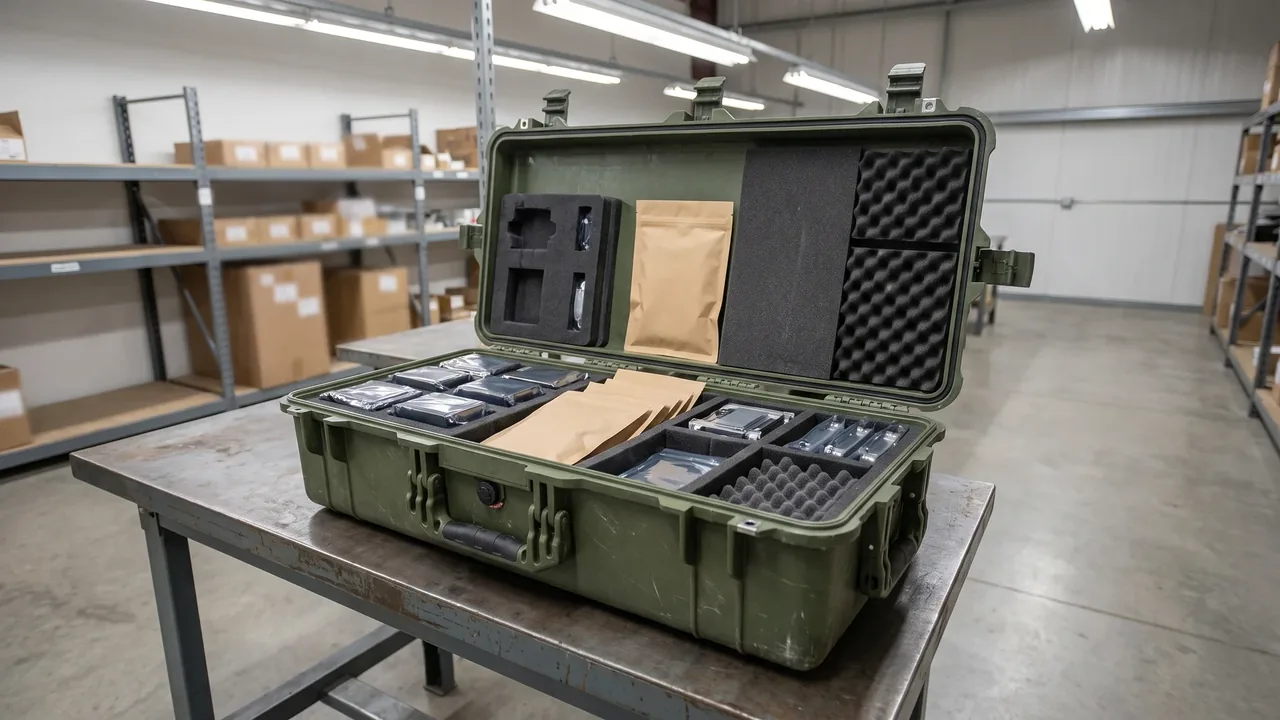
Eco-friendly lining material is the functional layer inside a protective case, instrument case or transit case that sits in direct contact with the stored equipment, carrying out cushioning, positioning, moisture control and cleanliness retention at the same time. For precision instrument manufacturers, medical and food case builders, and export compliance projects, a lining is no longer a simple sheet of foam: low odor, low emission, traceability and testability have become mandatory selection conditions. Experience shows that once the case geometry is fixed, the odor and emission behavior of the lining material is often the decisive variable determining whether a case passes a customer factory audit and an export sampling inspection; locking in a closed-cell foam system backed by VOC emission data and RoHS/REACH documentation first can significantly reduce the risk of late rework, return shipments and claims. This article works through odor testing, emission control, material comparison, cell structure selection, density matching, compression set retention, conversion processes, cleanroom compliance, test documentation and maintenance replacement, laying out an executable selection path for engineering and procurement teams.
1. Definition and Application Boundaries of Eco-Friendly Lining Material
Eco-friendly lining material broadly refers to foams and fiber-based materials used inside a case to cushion and protect equipment, whose environmental impact is controllable across raw material sourcing, production, use and disposal. Its "eco" quality is not a single metric but a combination of requirements: low odor emission, few migratable substances, freedom from restricted chemicals, recyclability or recycled content, and supporting test documentation for every claim. For precision instruments, volatile substances emitted by the lining can form a contaminating film on optical lenses, sensor contacts and circuit board surfaces. For medical and food cases, odor and migration directly affect the sensory and hygiene assessment of the contents. For export projects, REACH and RoHS compliance files are indispensable.
Viewed through application boundaries, an eco-friendly lining does not pursue absolute environmental virtue but verifiable low impact in a specified scenario. A lining used for ordinary tool storage and a lining used for sterile medical device transfer have completely different acceptance criteria. The first step in selection is therefore to define the scenario: equipment type, contact mode (direct contact or bag-separated contact), operating temperature and humidity, turnover frequency, and the regulations of the target market. Write these five items into a requirements table before moving on to material comparison; doing so avoids two classic mistakes, namely using ordinary foam to satisfy a medical factory audit, or budgeting food-grade material for a tool box. For a broader comparison method, see the foam material comparison guide, which aligns material parameters with scenario requirements item by item.
2. Low-Odor Requirements: VOC Emission and Odor Grade Testing
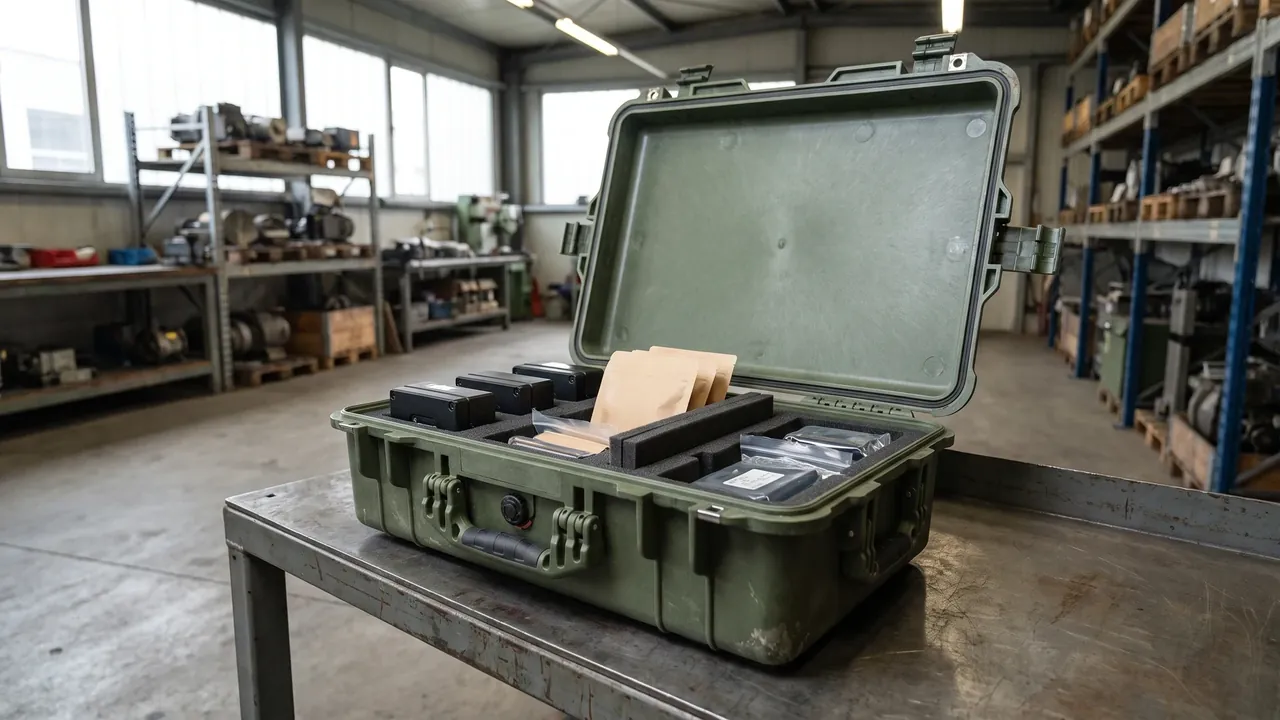
Odor is the most intuitive threshold for eco-friendly lining material. Residual monomers, plasticizers, crosslinking agents and processing aids in foam all volatilize slowly when heated or confined, producing a pungent smell. Industry generally uses two families of methods: odor grade assessment and VOC emission concentration testing. Odor grade assessment is most commonly performed with the German Automotive Industry Association VDA 270 method: a sample is sealed in a container and heated at a specified temperature, then a trained odor panel scores it on a six-level scale where level 1 is no odor and level 6 is unbearable. As a rule of thumb, foam used for case linings is usually required to stay at level 3 or better. The bottle method and the bag method suit incoming material screening; results are reproducible but depend on the skill of the assessors.
Concentration testing comes closer to the real operating environment. The ISO 12219 series provides a sampling and determination framework for the interior air of road vehicles, while GB/T 18883 sets limits for formaldehyde, benzene and total volatile organic compounds in indoor air, with explicit ceilings for the eight-hour average of each. A protective case is a small confined space with a concentrated foam load, so actual concentrations can be markedly higher than in an open room. It is therefore advisable to convert the foam load against the case volume and to require climate chamber or micro-chamber emission data from the supplier, rather than accepting a one-page odor compliance letter. For precision instrument cases, attention should also go to low-molecular-weight siloxanes, which form an insulating film on contact surfaces; such projects need a separate clause in the technical agreement.
3. Low-Emission Requirements: Plasticizers, Halogens and Volatiles Control
Emission refers to the migration of components from a material to its surface or to the contents under the influence of temperature, pressure or a contacting medium. For case linings, the greatest concern is phthalate plasticizers. Annex II of the EU RoHS Directive restricts six phthalates (DEHP, DBP, BBP, DINP, DIDP, DNOP) in homogeneous materials, and the REACH candidate list also includes several plasticizers, so cases exported to the EU must carry a declaration of conformity. If EVA foam uses a plasticizer-containing formulation, it may migrate into the contents during prolonged compression or high-temperature storage; in medical, food and precision electronics scenarios, a phthalate-free requirement should therefore be stated explicitly, supported by third-party migration testing or a material declaration.
Halogen control is another common hard requirement. The halogen-free requirement customary in the cable and electronics industries typically uses experience-based limits of no more than 900 ppm each for bromine and chlorine and no more than 1500 ppm combined. Flame retardants and foaming aids in a foam formulation can introduce halogens, so the purchase document should state halogen-free and specify the test method. Low emission also covers extractables and fogging values: the former is weighed or analyzed chromatographically after solvent extraction, the latter measures volatile condensate under heating. These items can be bundled into a single test commission to obtain data in one pass, avoiding repeated prototypes that drag out the development cycle. For a systematic treatment of the regulatory boundary, see the RoHS and REACH compliance guide.
4. Material Options Compared: EVA, PE, XPE and IXPE
Eco-friendly foam linings on the market are dominated by EVA, PE and their crosslinked variants XPE and IXPE. EVA (ethylene-vinyl acetate copolymer) foam is soft to the touch, easy to thermoform and available in many colors; it is the classic material for molded inserts, with a wide density range that allows layer-by-layer configuration according to equipment weight. PE foam, also known as pearl cotton, has a closed-cell structure that delivers good water and chemical resistance at lower cost, suiting medium-impact scenarios. XPE is chemically crosslinked polyethylene foam with finer and more uniform cells, giving better surface flatness and rebound consistency than ordinary PE foam sheet. IXPE is crosslinked by electron irradiation, with fine cells, tight thickness tolerance and no chemical crosslinking agent residue, making it a common choice for precision instruments and medical cases at a correspondingly higher cost.
Unit price alone should not drive selection. The strength of EVA lies in formability and appearance, which suits molded inserts that must follow equipment contours; the strength of IXPE lies in dimensional stability and low emission, which suits scenarios with high cleanliness and compliance demands; the strength of PE foam lies in cost and ease of processing, which suits consumable transit cases. If a project requires both low odor and complex geometry, an XPE or IXPE substrate with a surface lamination can be used, but the laminating adhesive layer must also be included in the emission assessment. The differences in density, rebound, temperature resistance and processability across foams can be cross-checked against the internal foam types guide and the foam material comparison guide, then configured into compartments by weight class.
5. Bio-Based Foam and Molded Pulp Options
Bio-based foam refers to a foam system in which renewable feedstock (such as bio-based ethylene produced via the sugarcane ethanol route) replaces part of the fossil feedstock. Its decarbonization value lies at the raw material stage; service performance is close to ordinary foam, but it still needs verification through the same odor and emission process, since bio-based does not automatically mean low odor. In practice, procurement should require the supplier to state the bio-based content and the accounting basis (such as mass balance), and should write an acceptance clause into the technical agreement stipulating that bio-based content is not lower than an agreed value, preventing conceptual marketing from going unchecked.
Molded pulp is a distinctly different route: made from recycled paper pulp shaped by vacuum filtration in a mold, it can be formed into trays that fit equipment contours, at low cost, recyclable or compostable, suiting one-way transport packaging and a gift-like unboxing experience. Its limitations are poor moisture resistance, limited rebound and weak drop protection, making it better for fixing and dividing than for absorbing energy. For medical and instrument cases that need long-term turnover, molded pulp is best used as an auxiliary locating part alongside a foam cushioning layer. When a full life-cycle assessment is required, the comparison framework in the degradable case material guide helps weigh degradation conditions, recovery routes and actual turnover counts on a single sheet.
6. Recycled Foam and Circular Design
Recycled foam (such as recycled EVA or recycled PE) is produced by blending reclaimed material into virgin resin at a given ratio, a direct way to cut virgin material consumption. Blend ratio, reclaimed source and purification process jointly determine finished performance: at a high ratio, color darkens and mechanical consistency drops, and compression set and odor behavior are often worse than a virgin system. For medical and food cases, recycled material should be confined to non-contact layers or positions explicitly not touching the contents, with emission behavior verified separately; for ordinary equipment cases, a higher recycled ratio can be used in exchange for cost and carbon footprint advantages.
Circular design also includes the structural idea of separating case and lining: the lining is made as a module that can be removed as a whole, so that when equipment is updated only the lining is replaced and not the case. At end of life, foam and shell are sorted and recycled by material, avoiding the difficulty of separating composite assemblies. Where a supplier has a mature reclaimed material traceability system, it should be asked to provide a blend ratio declaration and batch traceability records. There is no standard answer to the virgin-versus-recycled trade-off; the cost and performance data in the virgin versus recycled case material comparison can support tiered decisions by project regulation and budget.
7. Selection Logic for Closed-Cell and Open-Cell Structures
The cell structure of foam directly determines water resistance, dust uptake and cleanability. In closed-cell foam the cells are mutually independent, so water and dust cannot penetrate and the surface can be wiped with a damp cloth; this is the mainstream choice for medical, food and precision instrument linings. Open-cell foam (such as ordinary polyurethane sponge) has interconnected cells and delivers better damping and sound absorption, but it absorbs water, traps dust and harbors dirt, tends to mildew in humid conditions and releases odor, which makes it risky for food and medical cases.
A common misconception in selection is to assign the main cushioning duty to an open-cell material. When open-cell foam is compressed, air is expelled and it feels soft at first, but after repeated compression water and particulate matter enter the cells, so performance decays quickly and cleaning becomes difficult. If a project needs both sound insulation and water resistance, a composite of a closed-cell substrate with a surface open-cell layer can be used, or a material with a graded cell structure can be chosen directly. Medical cases should also consider disinfectant wipe compatibility: chlorine-based disinfectants, alcohol and peroxide wipes may yellow or embrittle some foams, so a disinfection resistance test should be stipulated in the purchase document. For general methods of lining configuration and compartment division, see the case foam lining guide.
8. Matching Density to Cushioning Performance
Density is the first parameter in foam selection, but higher is not automatically better. The core of cushioning design is to keep the acceleration response of the equipment during a drop impact within its allowable fragility range: precision instruments with lower fragility (as a rule of thumb, permitted shock for optical and metrology equipment can be as low as a few tens of G) need a softer cushioning curve, meaning a lower stress level, while heavy equipment needs higher density to provide sufficient static support and prevent the lining from being crushed through during warehouse stacking. In engineering practice, the maximum acceleration versus static stress cushioning curve is consulted to back-calculate the required density and thickness from drop height and equipment mass.
A workable practice is to layer by mass: for light and small precision parts of a few kilograms or less, choose a fine-celled medium-to-low density IXPE or XPE with a thicker cushioning layer; for heavy equipment above ten kilograms, choose a medium-to-high density EVA placed close to the case bottom; use PE foam for the intermediate band. On thickness, a thicker cushioning layer markedly reduces shock transmission but consumes internal space, so it must be balanced against the internal net dimensions of the case. Drop verification methods can follow the tiered approach in the drop test guide, rechecking the lining design with a fully loaded drop. For precision instrument projects, the configuration examples in the precision instrument protective case article also clarify how density and geometry work together.
9. Compression Set and Rebound Retention
Compression set determines the long-term reliability of a lining. If foam cannot recover its original thickness after prolonged compression or thermal cycling, its positioning and cushioning capability decline in step. Industry practice measures permanent deformation using methods such as ISO 1856: a specimen is compressed to a specified ratio and held at a set temperature for a specified time, then residual deformation after recovery is measured. For case lining foam, the deformation rate is typically required to stay at a low level (a typical requirement is no higher than ten percent), with a lower bound on rebound rate (typical values in the thirty to forty-five percent band).
Thermal cycling is a harsher test than constant-temperature compression. After a lining experiences warehouse heat, cold-chain low temperatures and transport vibration along with the case, the degree of cross-sectional stress relaxation directly determines the replacement interval. During selection, request accelerated aging data from the supplier, or run an in-house comparison test: hold identical specimens at low and high temperature for specified durations, then measure thickness change and rebound before deciding whether to accept the material. For high-turnover projects, an acceptance metric for thickness retention after a number of cycles should be written into the technical agreement, turning abstract material properties into sampled numbers; this is also the key step in moving eco-friendly lining material from selection into controlled use.
10. Conversion Processes: Thermoforming Die Cutting and Waterjet Cutting
Low-odor, low-emission material also needs a conversion process that does not introduce contamination. Three routes are common. Die cutting suits flat pads and simple outlines, is efficient, but leaves compression marks on the edge. Thermoforming die cutting heats the foam and presses curved surfaces and steps into it in a mold, giving good contour fidelity and suiting molded inserts; it is the classic EVA process. Waterjet cutting uses a high-pressure water jet with no heat-affected zone and no dust, suiting clean scenarios with high cross-section requirements, but machine-hour cost is higher. Process choice directly affects cross-section quality and cleanliness: excessive thermoforming can lightly skin or even scorch the surface, which paradoxically adds an odor source, so bonding temperature and dwell time must be controlled.
Process detail should also cover deburring and cleaning. Foam edges after die cutting often carry debris, so medical and precision instrument linings benefit from an added cleanroom treatment step and particulate sampling before packing. If in-situ pour foaming is used for irregular encapsulation, the VOC behavior of the catalyst and the polyol blend must be confirmed, so that an eco-friendly shell is not undermined by the lining. The complete flow and typical defects of EVA thermoformed inserts are covered in the EVA thermoformed liner process guide, which can be written into the supplier technical agreement as process parameters.
11. Cleanliness Requirements in Medical and Food Contact Scenarios
Medical and food cases impose cleanliness requirements on the lining that exceed those of ordinary equipment cases. On the food contact side, if the lining may contact food directly or indirectly, the material must comply with the food contact regulations of the target market, for example the US FDA 21 CFR 177 series on indirect food contact components (EVA-type copolymers correspond to entry 177.1360); exports to the EU must additionally satisfy the framework regulation and national migration limits. Procurement should require a supplier declaration of conformity that matches the actual in-case conditions of temperature, contact time and food type, rather than a generic food-grade statement.
In medical scenarios, if the lining does not contact the patient directly, a biological evaluation is usually not mandatory, but factory audits commonly check low odor, low emission and cleanability. If contact with broken skin or mucous membranes is possible, a biological assessment should be added following the ISO 10993 series. On cleanliness, the focus is particulate control and disinfection resistance: the lining should not shed debris during wiping or vibration, and its surface should be dense with no fiber release. If a transit case also serves as a cold-chain case, the hardness change at low temperature and the effect of condensation should also be evaluated. Relevant case configurations are described in the medical device transport case and food packaging machine case articles, which translate cleanliness requirements into both material and process decisions.
12. Test Documentation and Procurement Acceptance
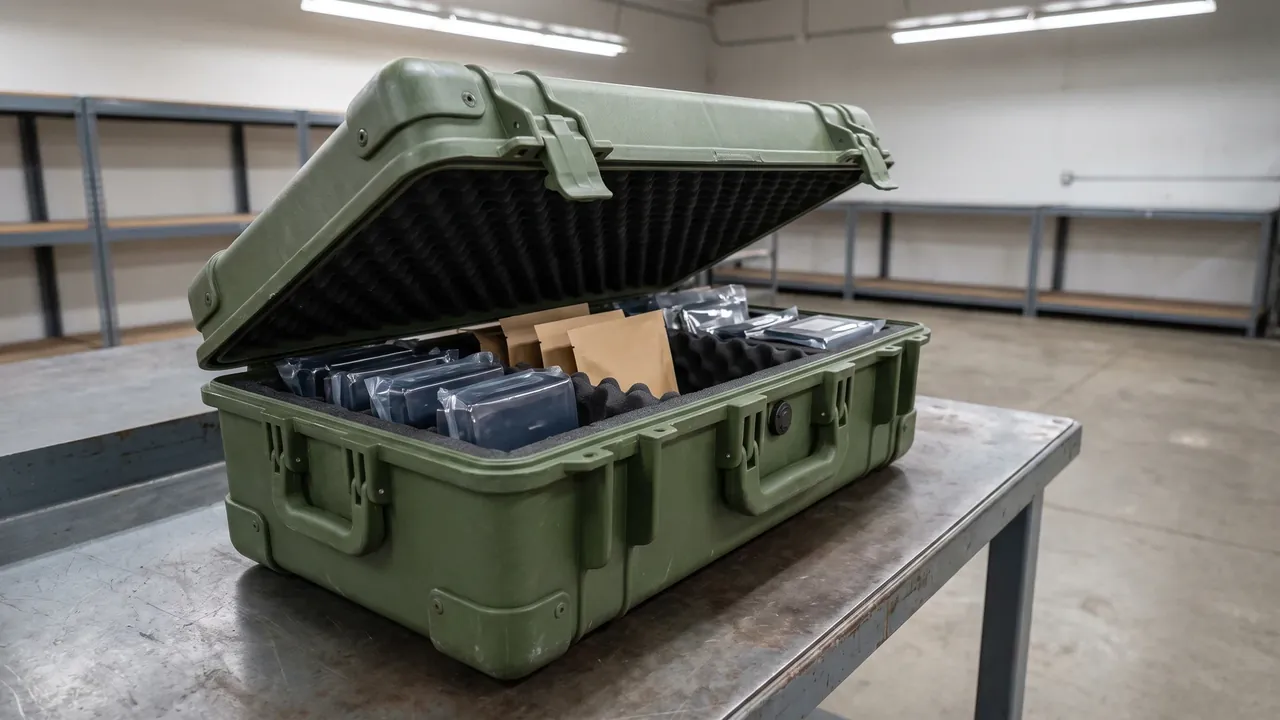
The selection conclusion for eco-friendly lining material must land on paper. The procurement technical agreement should stipulate four classes of documents: material and formulation declarations (including whether phthalate plasticizers, halogens, heavy metals and recycled content are present), environmental conformity declarations or test reports (RoHS and REACH candidate list screening), odor and emission data (VDA 270 grade, ISO 12219 or climate chamber concentration, fogging value), and performance data (density, compression set, rebound rate, tensile strength). Reports should be issued by bodies holding CMA or CNAS accreditation and should state sample condition and test conditions; for identifying report authenticity, see the CMA and CNAS test report guide.
Acceptance is best executed in tiers: full item verification on the first batch, batch-level sampling of odor and appearance after mass production begins, and an annual recheck of key items. For export projects, also confirm that declarations cover the regulation versions currently in force in the target market, avoiding the use of superseded standards to answer new rules. Bringing environmental indicators into the annual supplier review, combined with the assessment framework in the green procurement case guide, turns low odor and low emission from a one-off acceptance into an ongoing controlled process; this is the key practice by which export compliance projects avoid batch risk.
13. Maintenance, Replacement and Service Life Management
A lining is a consumable with a finite life. Routine maintenance is mainly cleaning: after the case returns to the warehouse, wipe the lining surface with a dry or slightly damp cloth to remove dust and spill residue, and avoid prolonged contact between organic solvents and the foam; general cleaning and care practice is covered in the protective case cleaning guide. Three replacement signals should be recognized: visible compression dents that will not rebound, foam powdering and debris shedding, and residual emission marks that persist after wiping. When any one appears, replace the affected compartment rather than scrapping the whole case.
For cases with high turnover, rotating linings on a schedule is advisable: ordinary equipment cases are typically inspected and replaced every two to three years, while medical and food cases are managed in step with the shelf life of their contents. At replacement, prefer stock of the same specification as the original, re-cut or re-formed to match the compartments; where a mature refurbishment route exists, the economics of the foam relining and recutting service can be assessed. Scrapped foam should enter the recycling channel sorted by material, avoiding mixed materials that lower reclaimed value; this is the final link in closing the circular design loop.
FAQ
Q: What is eco-friendly lining material, and what exactly do low odor and low emission mean?
A: Eco-friendly lining material is foam-based material used inside a case to cushion and position equipment while keeping environmental impact controllable across raw material, production, use and disposal; its eco quality is expressed as a set of verifiable requirements. Low odor means the material releases few volatile substances at ambient confinement or under heat, with odor intensity and concentration controlled within specified limits, typically graded by methods such as VDA 270 and measured by climate chamber methods or standards of the GB/T 18883 type. Low emission means plasticizers, halogens, heavy metals and extractables migrate to the surface or the contents only in extremely small amounts, and that RoHS- and REACH-restricted phthalates are absent. Together, the two aims protect precision equipment from contaminating films and corrosion while meeting the hygiene and regulatory requirements of medical, food and export scenarios. Verifiable documentation is the core basis for judgment, so a supplier claim without test reports and a formulation declaration should not be accepted as evidence.
Q: How is foam odor tested, and what level counts as compliant?
A: Two routes are common. The first is odor grade assessment, exemplified by VDA 270: the sample is sealed and heated at a set temperature, then a trained panel scores it on a six-level scale where level 1 is no odor and level 6 is unbearable; foam for case linings is usually required to stay at level 3 or better, and the method suits fast incoming material screening. The second is VOC emission concentration testing, using a climate chamber or micro-chamber to simulate the confined case environment and measuring total volatile organic compounds, formaldehyde and benzene, following the ISO 12219 and GB/T 18883 frameworks, with results convertible directly against case volume. The compliant level should be written into the technical agreement: both an upper odor grade limit and concentration limits with chamber conditions. Note in particular that a protective case is a small confined space with a concentrated foam load, so actual concentrations may be significantly higher than in an open room. A verbal supplier promise is therefore insufficient; insist on a report that states test conditions and sample condition, and keep the report version aligned with the current regulation version of the target market.
Q: How is the absence of plasticizer emission verified, and how do RoHS and REACH differ?
A: Verification has two steps: first check the formulation declaration to confirm whether phthalate plasticizers are used, then run migration testing as needed, using a simulated contact liquid or solvent extraction followed by quantitative analysis of the six restricted phthalates (DEHP, DBP, BBP, DINP, DIDP, DNOP). RoHS is the EU directive restricting hazardous substances in electrical and electronic equipment; it sets content ceilings for homogeneous materials and applies to electronic products entering the EU along with their packaging accessories. REACH is the regulation on registration, evaluation, authorization and restriction of chemicals; its scope is broader, its candidate list updates dynamically, and it covers plasticizers, flame retardants and many other substance families. For a case project, RoHS addresses limit conformity while REACH addresses substance disclosure and communication obligations. Two documents are therefore normally required, a declaration of conformity and a candidate list screening report, and their versions should correspond to the regulations currently in force in the target market, so that superseded standards are not used to answer new rules.
Q: How should EVA, PE, XPE and IXPE foam be chosen among the four?
A: The four occupy clearly different positions. EVA foam is soft, easy to thermoform and available in many colors, suiting molded inserts that follow equipment contours, and is the classic mid-range workhorse. PE foam is closed-cell, water resistant and low cost, suiting medium impact and consumable turnover. XPE is chemically crosslinked polyethylene with finer cells and better flatness and consistency, suiting scenarios with appearance and dimensional stability requirements. IXPE is crosslinked by electron irradiation, with fine cells, tight thickness tolerance and no chemical crosslinking agent residue, making it a common choice for precision instruments and medical cases at the highest cost. Selection should begin from scenario requirements: choose EVA for contour fidelity, PE foam for cost effectiveness, and IXPE for consistency and low emission. If low odor and complex geometry are required together, an IXPE or XPE substrate with surface lamination can be used, but the lamination layer must also be included in the emission assessment, since adhesive layers are a frequently overlooked migration source.
Q: Can bio-based foam and molded pulp replace conventional foam?
A: They can replace it partially, but the scenario must be distinguished. Bio-based foam substitutes renewable feedstock for part of the fossil feedstock, so its decarbonization value is at the raw material stage; service performance is close to ordinary foam, but it still requires verification through the same odor and emission process, because bio-based does not mean low odor by default. Procurement should require a statement of bio-based content and the accounting basis, and should set a content floor in the agreement. Molded pulp is formed by vacuum filtration of recycled paper pulp; it is low cost and recyclable or compostable, and suits fixing and partitioning, but its poor moisture resistance and limited rebound make it hard for it to carry drop cushioning alone. For long-turnover medical and instrument cases, a combination in which molded pulp acts as the locating part and foam as the cushioning layer is advisable. For one-way transport packaging, molded pulp offers clear cost and environmental advantages. A replacement decision should weigh turnover count, recovery route and degradation conditions together rather than judging from a single selling point, and should record the assumed turnover count in the project file.
Q: Can recycled foam be used in medical and food cases?
A: Yes, but the position must be restricted and verification performed separately. Recycled foam is produced by blending reclaimed material, and blend ratio, source and purification process determine finished performance: at a high ratio the color darkens and consistency drops, and odor and compression set are often worse than with virgin material. In medical and food scenarios, recycled material should be confined to positions that do not directly contact the contents, such as a base pad or an isolation layer between the shell and the cushioning layer, with emission and odor re-tested for that batch. Ordinary equipment cases can use a higher recycled ratio in exchange for cost advantage, but still require declarations and traceability records. In every scenario, the supplier should be asked for a blend ratio declaration, a statement of reclaimed material source and batch traceability, turning recycling from a marketing phrase into verifiable data. Otherwise, when a downstream factory audit asks for evidence, the inability to provide it creates a compliance risk that outweighs the original cost saving.
Q: Is closed-cell foam always better than open-cell foam?
A: Not necessarily; the key is the operating environment. Closed-cell foam has independent cells, does not absorb water, does not trap dust and can be wiped on the surface; its water and chemical resistance is good, making it the mainstream choice for medical, food and precision instrument linings. Open-cell foam, such as ordinary polyurethane sponge, has interconnected cells and offers better damping and sound absorption with a softer initial feel, but it absorbs water, traps dust and harbors dirt, tends to mildew and produce odor in humid conditions, and is difficult to clean. Which is better therefore depends on the requirement: choose closed-cell when water resistance, cleanliness and easy maintenance are needed; open-cell can be used when sound and vibration damping is needed in a dry environment. If a project wants both, a composite of a closed-cell substrate with a functional surface layer works. Medical cases should additionally assess disinfectant wipe performance, since chlorine-based disinfectants and alcohol may yellow or embrittle some foams, which requires test conditions to be written into the purchase document rather than assumed.
Q: What test documents should be requested from a supplier when buying eco-friendly lining material?
A: At least four classes. The first is the material and formulation declaration, stating whether phthalate plasticizers, halogens, heavy metals and recycled content are present, with the applicable standard named. The second is environmental conformity documentation, including a RoHS declaration of conformity and a REACH candidate list screening report, with versions covering the regulations currently in force in the target market. The third is odor and emission data, such as the VDA 270 odor grade, climate chamber or micro-chamber VOC concentration, and fogging value, with chamber conditions and sample condition stated. The fourth is performance data, including density, compression set, rebound rate and tensile strength, supplemented where necessary with thickness retention data after disinfection and thermal cycling. Reports should be issued by bodies with CMA or CNAS accreditation and should correspond to the specific model and batch. At acceptance, verify all items on the first batch, sample odor and appearance per batch in mass production, and recheck key items annually, forming a continuously controlled quality loop that can be presented at any time during a customer audit or export inspection.
Conclusion and Further Reading
Define the scenario first, choose the material second, and close the loop with test data last. For precision instruments, medical food applications and export projects, the lining is often the weakest compliance link in the whole case.