

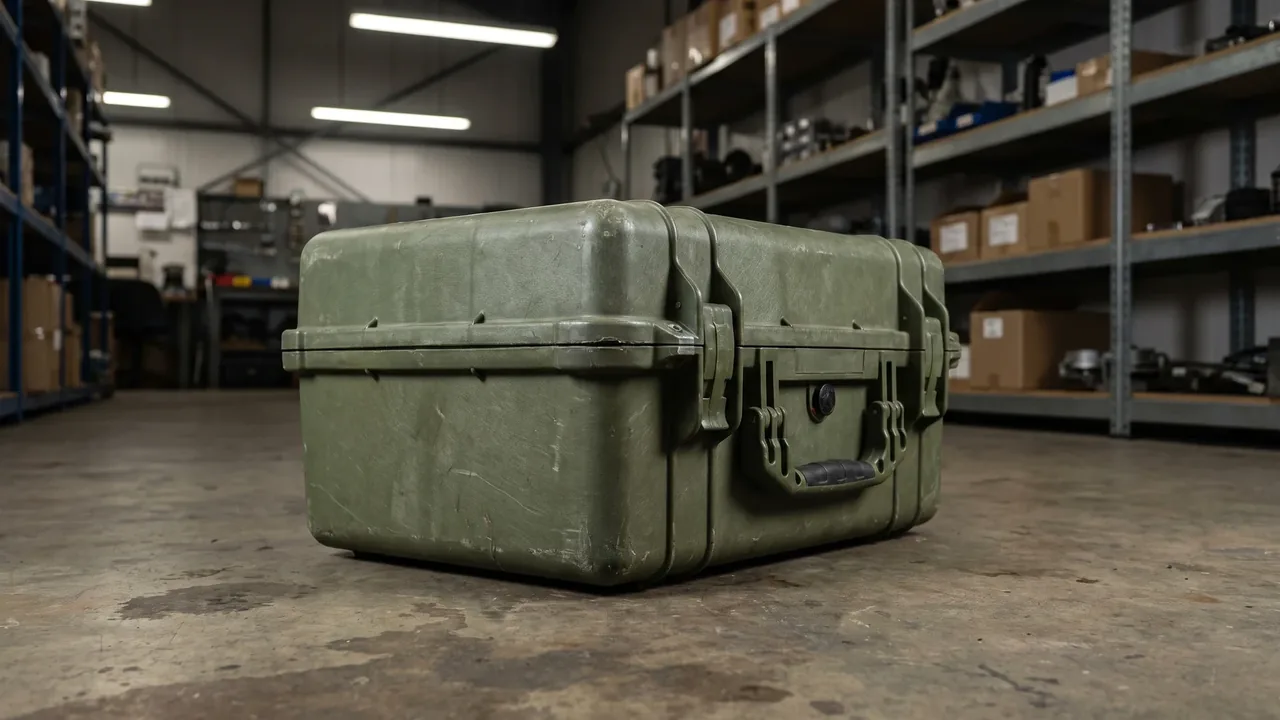
Packaging reduction design is a systematic method in packaging engineering that achieves equal protective performance with less material. For cases and boxes, reduction does not simply mean thinning the wall or deleting the liner; it means balancing wall-thickness optimization, rib topology, lightweight material substitution, precise liner cutting, packaging layer simplification, and size matching against the product outline, and then verifying reliability after reduction with drop, stacking, and vibration tests. Experience shows that a case optimized in wall thickness and rib layout can reduce nominal wall thickness and per-case material use while maintaining stiffness; combined with size matching and layer simplification, case mass and consumable cost usually fall together, while logistics loading efficiency improves. This article covers wall-thickness optimization, material selection, liner reduction, layer simplification, size optimization, performance verification, material accounting, and balance boundaries, with actionable parameters, methods, and acceptance requirements for packaging engineers, cost-control projects, and sustainable design teams.
1. Engineering Content and Boundaries of Packaging Reduction Design
The objective of packaging reduction design is not only to use less material. It is to minimize material consumption per unit, case mass, packaging volume, and packaging layers under the constraints of protection, storage and transport, compliance, and cost. Evaluation indicators usually include material mass per case, material consumption per packed unit, case volume, number of packaging layers, packaging cost per unit, and the corresponding carbon footprint. Only when these indicators sit in the same table does packaging reduction turn from a slogan into a measurable engineering improvement.
The first boundary to draw is the performance boundary: packaging reduction must not sacrifice protective performance. The basic functions of packaging are to protect the product, facilitate storage and transport, and enable identification, so any reduction plan must return to drop, stacking, and vibration simulation tests to confirm that the product suffers no damage in the intended distribution environment before the reduction counts as valid. The second boundary is compliance: national standards limiting excessive packaging constrain void ratio, layer count, and cost proportion, and export packaging must also meet the rules of the destination country and transport mode, so crossing these lines brings returns, claims, and brand risk.
The third boundary is economic. Reduction usually comes with one-time investments such as mold modification, test verification, and supplier switching, and if the gains cannot cover these investments the plan is not sustainable. The engineering rule is to calculate first and reduce second: establish the current baseline of material, mass, and cost, then evaluate the incremental gain and investment of each measure and prioritize accordingly. For a breakdown method, see the cost-structure analysis in the case cost structure breakdown, separating material, tooling, labor, and logistics so that reduction is not judged by unit price alone.

2. Wall-Thickness Optimization and Rib Topology Design
Wall-thickness optimization is the most direct lever for case lightweighting. The bending stiffness of a flat plate scales with the cube of wall thickness, so thinning the wall by twenty percent reduces stiffness by roughly forty-nine percent; but if rib height and rib density increase at the same time, the second moment of area of the ribs can compensate for the loss of the wall, and overall stiffness can be maintained or even improved. The standard engineering approach is to identify load paths through mechanical simulation, place ribs along those paths, and concentrate material where loads are actually carried instead of spreading it evenly across the whole wall.
For concrete parameters, the nominal wall thickness of injection-molded cases commonly falls in an empirical range of 1.8 to 3.5 millimeters, depending on case size, material, and load. Rib thickness is usually fifty to seventy percent of the parent wall; higher values create sink marks at the rib root. Rib height can be two to three times the wall thickness, with a draft angle of about one and a half degrees, and rib ends should transition gradually to avoid stress concentration. For large cases that must stack, the compression face of lid and body, latch mounting positions, and hinge inserts should be locally thickened, producing a pattern of thin main walls with local reinforcement rather than uniform thickening.
Rib topology must also match the molding process. Over-dense or poorly arranged ribs cause filling difficulty, weld lines, and warpage, which raise scrap rates. Thermoplastic injection cases can be validated with mold-flow analysis, while rotomolded cases are limited by powder flow and heating uniformity, so their ribs take gentler transitions. For systematic methods of wall and rib design, see the parameter comparison in the case wall thickness and strength and case reinforcement ribs guides, and translate the thinning plan into manufacturable drawings.
3. Lightweight Material Selection and Substitution Paths
Material substitution is the second main line of reduction. The core idea is to use a lower-density or higher-specific-strength material so the same structure weighs less. Polypropylene has a density of about 0.90 to 0.91 grams per cubic centimeter, roughly thirteen percent below ABS, which delivers about a ten percent mass reduction at identical shape and wall thickness. With mineral or glass-fiber modified grades, heat-deflection temperature and rigidity approach ABS levels, which suits most tool and equipment cases. For higher-load cases, high-density polyethylene blends or microcellular foam structures can cut solid material further at the same overall size.
Raising the recycled-content ratio is another direction, but it must proceed in layers. Structural and non-appearance parts can gradually increase post-consumer recycled content, while load-bearing walls, sealing faces, and appearance surfaces should keep the ratio controlled and verify impact and weathering performance. The practical route is small-ratio blending trials first, batch impact and drop verification next, and staged increases afterwards. For selection data, compare the PP versus ABS toolbox and the virgin versus recycled case material guides, placing density, strength, weathering, and cost in one matrix.
Material substitution cannot be judged from a density table alone. Shrinkage, draft requirements, weldability, and chemical resistance differ, so changing material usually means mold modification and a new process window. A safe sequence is same-family first: adjust grade and filler within the PP family, then move to PP replacing ABS, and finally evaluate molded pulp for specific locations. For the environmental and recycling angle, read the recycled material case guide together with this section.
4. Three Technical Routes for Liner Reduction
The liner is often the invisible waste inside a case: for convenience the whole box is stuffed with foam while the equipment occupies only a small fraction of the volume. The first route of liner reduction is contour cutting, trimming foam to the true outline of the equipment and removing the non-functional zones around it so that only the minimum thickness needed for limiting and cushioning remains. The second route is precise cavity formation in pick-and-pluck foam, tearing cavities that match each item so that adjacent items can share cavity walls and further compress dead volume.
The third route is material substitution, replacing part of the plastic foam with molded pulp. Molded pulp uses plant fiber, typically at two to five millimeters thick, and relies on fiber resilience plus structural design for cushioning. It suits regularly shaped, medium-mass items that need positioning, with degradable raw material and a unit price usually below molded EVA; its weaknesses are poorer moisture resistance and limited resilience, so it should not carry the main cushioning duty in high-impact scenarios. For moisture-sensitive or repeated-impact positions, a composite structure of pulp trays for positioning plus local foam for cushioning places each material where it performs best.
Liner reduction must be based on cushioning calculation, not on carving by feel. Estimate the required cushioning area and foam density from case mass and planned drop height, then work back to liner thickness and cavity dimensions; for irregular items or offset centers of gravity, add local thickening and limiting ribs. For material and process comparisons, see the custom foam lining guide and the eco-friendly lining material guide, writing both the cushioning requirement and the reduction target into the liner drawing. In the JUNZHIJIA engineering practice, liner drawings carry cushioning thickness, cavity dimensions, and limiting-rib height on the same sheet, and model-matched seals and spare kits ship with the case, so the reduced liner can be reproduced exactly at the next batch instead of being re-guessed by hand.
5. Packaging Layer Simplification and Structure Consolidation
Layer simplification is one of the highest-yield reduction steps. Common moves include removing the outer carton, merging inner and outer packaging, and positioning accessories in the same case as the main unit. Removing the outer carton is valid only if the case itself provides enough transport protection and identification and adapts to warehouse stacking and vehicle fixation; otherwise the saved carton returns in the form of freight damage. Merging packaging requires re-working the item list: group items that must be used together into one set, position them with a shared liner, and cut case count, layer count, and unpacking steps.
Choosing between single-use and returnable packaging is another decision point in layer simplification. For one-way transport, corrugated cartons have a low per-piece cost. For round-trip rotation, the marginal cost of a returnable case falls with the number of cycles, so over the long run it is cheaper and more sustainable. Selection can use a cycle break-even estimate: when the expected number of cycles exceeds the critical value, the returnable option wins. For related comparisons, see the corrugated packaging case and reusable transit case program guides.
Layer simplification must also respect the end-user experience. Fewer layers simplify unpacking, but handling becomes more concentrated and single-case mass may rise. At that point, check manual handling limits and the fitment of labor-saving parts such as rollers and trolley handles, so that layer reduction does not become a heavy physical burden. The balance test is that total handling steps, total mass, and total time from intake to unpacking all fall together, not one indicator improving alone.
6. Size Optimization and Void Control
Size optimization means letting the internal space follow the product outline. Build a three-dimensional envelope of the product first, then set the internal cavity from the maximum outline plus cushioning allowance, instead of dropping the product into a standard case size. Void ratio is a direct indicator of size optimization; empirically the void ratio of a single-item package should stay within fifteen percent. For mixed loads, use a trial-packing approach that fills the height direction first and then adjusts the layout, reducing the dead space reserved for round numbers.
The gains from size optimization go beyond material. A smaller outer case means lower volumetric weight and higher vehicle and container loading efficiency, and for volume-rated air and express business this saving often exceeds the material itself. Also unify the dimensional chain: plan case outlines on pallet and vehicle moduli so stacked cases exactly fill the pallet or bay and no odd corner space remains. For methods, see the how to size a protective case and case stackability and pallet planning guides.
Size optimization must also reserve tolerance and deformation allowance. After wall thinning, dimensional stability under locking, drop, and temperature-humidity change will fall, so internal cavity dimensions should be checked for the worst case and tight fit must not become interference that makes liner loading difficult or presses on the equipment. The safe practice is to measure the dimensional chain on a sample case and overlay wall thickness, liner compression, and equipment tolerance to confirm assembly allowance under extreme conditions.

7. Post-Reduction Performance Verification System
A reduction plan must pass verification before mass production; this engineering floor cannot be skipped. Drop testing is the most basic item and can follow the drop methods in the GB/T 4857 series and procedures such as ISTA 1A, 2A, 3A, and 3E. For cases, drop height is usually selected by loaded mass, with specified faces, edges, and corners tested in sequence; after testing the case should show no through-crack, latches should work normally, liner limiting should hold, and the equipment should have no functional damage. Test conditions should match the real distribution environment rather than always taking the most severe value.
Stacking and vibration tests cannot be skipped either. Stacking tests address the static load in warehouse and transport stacks, confirming that thinned walls and lids do not creep under long-term compression. Vibration tests address sustained excitation from vehicles and conveyors, confirming that liner limiting does not loosen at resonance frequencies and that items do not shift. For cases with moisture or sealing requirements, reduction also demands a re-check of gasket compression and locking uniformity, because thinner walls change interface rigidity and therefore sealing retention.
Verification should be organized point-first, then whole-case: run comparison tests on individual changes such as wall thickness, ribs, and material to confirm the gain and risk of each, then run a combined whole-case test so that stacked reductions do not mix problems beyond attribution. Sample quantity and pass criteria should be agreed in advance and recorded for traceability. For systematic test methods, see the drop test guide, stacking test guide, vibration test guide, and ISTA transport testing guide, and write the conditions into the specification as acceptance criteria.
8. Quantified Accounting for Material Savings
Reduction results must be proven with data. The first step of accounting is to establish a baseline: record the current material mass per case, allocated material cost per unit, external volume, and packaging layer count as the reference for later improvement. The second step is item-by-item accounting: wall-thickness reduction is priced by the removed wall volume times material density and unit price; material substitution by the density and unit-price difference between old and new; liner reduction by the saved foam volume and labor; layer simplification by the eliminated carton cost and handling labor.
The third step is the indirect benefit on the logistics side. A smaller case improves volume-rated freight, warehouse space, and vehicle loading efficiency; a lighter case benefits weight-rated steps at the same time. Use a single-piece packaging comprehensive cost that merges material, processing, logistics, and warehousing into one indicator so that departments stop keeping separate books. For a broader cost view, see the total cost of ownership for cases, placing one-time investment and rotation gains in one model.
The fourth step is to fold in carbon and other compliance indicators. Material savings usually bring a parallel drop in carbon emissions, which can be estimated with packaging carbon-footprint methodology for customer communication and green procurement scoring. Note that the accounting basis must be fixed: same scope, same boundary, same period, or the saving figure distorts whenever the basis changes. Archive the accounting sheet with the reduction project as the benchmark for later batches and supplier price comparisons, so every round of improvement stays evidence-based.
9. Balance Boundaries Between Reduction and Protective Performance
Reduction is not limitless. In engineering terms, protective requirements should be converted into minimum performance thresholds: failed drop, unstable stacking, lost sealing, or loosened liner each vetoes the reduction plan on its own. For high-value, fragile, or non-interchangeable products, keep extra safety margin, because the distribution environment is uncertain and test conditions cover typical rather than extreme scenarios. The rule of thumb is to retain at least ten percent margin on post-reduction performance indicators before entering mass production.
The typical failure modes of over-reduction deserve attention: overly thin walls cause weld-line cracks and corner stress concentration; over-dense ribs cause sink marks and warpage; overly thin liners leave insufficient cushioning stroke so drop acceleration peaks exceed limits; insufficient sealing-face rigidity makes gasket compression uneven after locking. These failures are rarely a single indicator exceeding limits but a systemic risk from stacked reductions. The control method is therefore per-item limits plus combined verification: cap each reduction measure and re-verify the whole case after combination.
Boundaries should also match product value. Low-value consumables can accept more aggressive reduction because freight-damage cost is lower than packaging savings; high-value equipment should stay conservative. The quantitative test compares reduction gain against expected freight-damage cost, and reduction is justified only when the former clearly exceeds the latter with controllable risk. This trade-off logic matches the case weight and strength balance approach and the two can be used together.
10. Selection and Supplier Evaluation for Lightweight Cases
When procuring lightweight cases, the technical specification should state performance requirements and reduction requirements together: the former covers drop grade, stacking load, sealing level, and test standards; the latter covers material mass per case, wall-thickness range, recycled-content ratio, and volume ceiling. Performance without reduction leads suppliers to over-thicken for safety; reduction without performance yields cases that are light but unprotected. Only the two together steer design toward least material under equal protection.
Supplier evaluation should focus on reduction engineering capability: whether the supplier has mechanical simulation and mold-flow analysis and can document the wall and rib optimization process; whether it can self-test or commission drop, stacking, and vibration tests; and whether it can issue test documents by model. For OEM/ODM providers, also assess their experience in balancing standardized shells with differentiated liners so customization does not inflate tooling cost and lead time. Makers such as JUNZHIJIA with OEM/ODM experience can issue drop, stacking, and vibration documents for a specified model and match seals by case type, which helps users complete acceptance filing and keeps wear-part supply stable across batches. For evaluation dimensions, see the protective case selection guide and OEM/ODM custom protective cases.
Commercially, mold modification, testing, and first-batch trial production should enter the total-price comparison and be amortized over lifecycle volume. In price negotiation, ask suppliers to price by material consumption so that material price volatility and usage optimization are linked and the supplier participates in reduction. For negotiation methods and contract points, see the how to negotiate case price and custom case cost reduction points guides, and fix reduction results into long-term supply terms so indicators do not rebound after the pilot.
11. Maintenance, Refurbishment, and Lifecycle Management
The benefits of lightweight cases are kept by lifecycle management. After wall thinning, scratch and bump resistance is usually lower than for thick-wall designs, so use depends more on discipline: no throwing, no sharp impacts on walls, and no stacking beyond design load. Maintenance should fix case inspection into periodic actions, including wall cracks, rib fractures, loose latches and hinges, and gasket aging, with prompt repair or replacement so that running damaged does not amplify freight damage.
For returnable cases, refurbishment is the key means to extend life and amortize the reduction investment. Common work includes local wall repair, latch and seal replacement, liner re-cutting, and label renewal. Refurbishment usually costs far less than new purchase and keeps the dimensional chain stable so cases still match existing racks and stacking moduli. For spare parts, wear items such as gaskets, latches, and hinges should be listed by model so maintenance is never interrupted by shortages. For systematic practice, see the protective case maintenance guide and case repair and spare parts guides.
Retirement and recycling close the lifecycle. The more material-uniform a lightweight case is, the better its recycling value tends to be; avoid firm multi-material composites at the design stage to reduce disassembly difficulty. Cases that meet retirement criteria should be recycled by material class in line with environmental and asset rules. Only by connecting maintenance, refurbishment, and retirement does the long-term economics of a reduction plan hold, which matches the circular logic of the case recycling and reuse approach.

12. Common Implementation Pitfalls and Improvement Process
The most common pitfall is treating reduction as de-specification: seeing a thick wall, judging it waste, and thinning by ratio, so stiffness and protection fall together. The correct order is structure first, wall second, material downgrade last. The second pitfall is counting material only, where saved material cost is offset by new freight damage, repair, and rework, turning a gain into a loss. The third pitfall is skipping verification into mass production, so problems surface at the customer and the loss far exceeds the test cost.
A disciplined improvement process can be fixed in seven steps: one, establish the baseline and describe the distribution environment; two, define performance thresholds from that environment; three, optimize structure; four, compare material and liner options; five, optimize size and layers; six, build sample cases and run combined verification; seven, pilot, collect data, and roll out. Each step needs records and pass criteria, and no step starts before the previous one passes, so stacked changes stay attributable.
The process also needs organizational support. A packaging engineer should lead, with cost control and quality participating, folding reduction projects into the annual cost plan with a target for material consumption per packed unit and periodic review. For multi-product companies, pilot one or two representative case models first, then copy the proven flow. For the broader sustainable framework, plan together with the circular packaging case guide and packaging carbon footprint guide so reduction serves both cost goals and green supply-chain requirements.
FAQ
Q: Will packaging reduction design weaken the protective capability of a case? A: Packaging reduction design does not inevitably weaken protection; the outcome depends on method and verification. A sound sequence is structure first, wall second, material last, concentrating material on load paths through rib topology so less material maintains equal stiffness. Thinning by ratio without verification is what erodes protection. The criterion is not how much lighter the case became but whether drop, stacking, vibration, and sealing indicators after reduction still exceed the requirements of the distribution environment. Engineering practice keeps at least ten percent margin on post-reduction indicators and confirms by combined whole-case verification that stacked changes cause no systemic failure. It also helps to define the circulation environment before touching the design, because a case that only sees gentle last-mile delivery can accept more aggressive reduction than one that faces repeated cross-docking and air freight. Followed properly, reduction can lower material use while preserving or even improving reliability, keeping cases lighter without making them more fragile in daily distribution service.
Q: How much wall-thickness reduction is considered safe? Is there an empirical range? A: There is no universal number; the safe range depends on case size, material, load, and rib design. Empirically, within the nominal range of 1.8 to 3.5 millimeters for injection-molded cases, a local reduction of ten to twenty percent is usually achievable with simulation and test support, and if rib height and density increase in parallel most of the stiffness loss can be recovered. Three safety criteria apply: side-wall deflection under full load stays within five thousandths of case height, no through-crack appears after drop testing with latches still working, and no cracks appear at weld lines or corners. Near the molding limit, risk rises non-linearly, so weight should be taken out through structure and material instead of further thinning. Simulation should run before the first mold cut, because stiffness predicted by hand calculation often misses the contribution of lid geometry, latch columns, and corner radii. Where budget allows, build one prototype and instrument it under stacking load before committing to the full reduction, since the measured deflection curve is the only reliable evidence that the thinner wall still behaves as designed.
Q: What benefits and cautions come with replacing ABS with PP for lightweighting? A: PP density is about 0.90 grams per cubic centimeter, roughly thirteen percent below ABS, so at identical shape and wall thickness the mass drops about ten percent, one of the easiest gains to quantify. Three cautions apply. First, PP heat-deflection temperature is usually lower than ABS, so enhanced modified grades are needed in hot or load-bearing positions. Second, shrinkage and draft differ, which usually requires mold and process-window changes. Third, chemical resistance and impact toughness differ and must be verified for the actual use case. A safe path is same-family first: adjust grade and filler within PP, then move to cross-material substitution, confirming with small-batch production plus drop testing. Comparing density, strength, weathering, and cost in one matrix prevents misjudgment from density tables alone. It is also worth checking how the new material behaves at low temperature, since some standard PP grades stiffen and lose impact strength in cold storage or winter transport, which can turn a successful mass saving into a winter cracking complaint if the distribution chain crosses cold regions.
Q: Does liner reduction compromise cushioning protection? A: Liner reduction removes dead volume, not effective cushioning, provided it follows cushioning calculation rather than carving by feel. The sound method estimates required cushioning area and foam density from case mass and drop height, then works back to liner thickness and cavity size before trimming foam outside the equipment outline. Contour cutting, pick-and-pluck cavity formation, and molded-pulp substitution all obey this premise. The dangerous method is thinning everything or shrinking cavities, which cuts cushioning stroke and pushes drop acceleration peaks beyond limits. Verification uses drop and vibration tests after liner loading, watching for item displacement, surface marks, and loosened limiting. Keeping the calculated cushion thickness and limiting strength lets liner reduction improve compactness and transport stability by eliminating voids and reducing secondary collisions. When several items share one case, also check that shared cavity walls still hold position under vibration, because a wall that flexes can let two heavy items touch and damage each other even when each individual cavity looks correctly sized on the drawing.
Q: Under what conditions is packaging layer simplification cost-effective? A: Three tests decide whether layer simplification pays. First, the case itself must carry enough transport protection and identification so freight-damage rates do not rise after the outer carton is removed; otherwise the saved carton returns as damage cost. Second, total handling steps, time, and mass from intake to unpacking must all fall, not just one layer disappearing while mass concentrates beyond manual handling comfort. Third, the rotation pattern must match: for round-trip business, the marginal cost of returnable cases falls with cycle count, and past a break-even number of cycles the returnable option is cheaper. Added cost for fixtures, labor-saving parts, and end-user unpacking experience must also be counted. When all three hold, layer simplification has long-term economics instead of moving cost from the packaging shop to transport and warehousing. Retail and e-commerce channels add one more condition: the case must still carry the labeling, barcode, and tamper evidence that the carton used to provide, so the simplification project should include the labeling team from the start rather than treating it as a pure packaging-cost exercise.
Q: Which tests must a reduced case pass before mass production? A: A reduced case should complete at least three verifications. The first is drop testing: select height by loaded mass, drop specified faces, edges, and corners the required number of times, and require no through-crack, normal latch function, effective liner limiting, and no functional damage to contents. The second is stacking testing, confirming that thinned walls and lids show no creep or permanent deformation under long-term static load calculated from the maximum warehouse stack height. The third is vibration testing, confirming that liner limiting does not loosen at resonance frequencies and items do not shift. Cases with sealing requirements also need a re-check of gasket compression and locking uniformity. Run comparison tests on individual changes first and combined whole-case verification afterwards, and write conditions into the specification as mass-production acceptance criteria. Where the case serves cold or humid chains, add a temperature-humidity conditioning step before drop testing, because material stiffness and gasket elasticity change with temperature and a room-temperature pass can hide a cold-chain failure that appears in real service.
Q: How can the real benefits of packaging reduction be accounted for? A: Real benefits span four layers. The first is direct material saving, priced from wall-thickness volume differences, density and unit-price differences after substitution, and saved foam volume in the liner. The second is processing and labor saving, including molding-cycle changes, liner labor, packing labor, and the handling drop from fewer layers. The third is logistics and warehousing gain from higher loading efficiency, lower volume-rated freight, and lower weight-rated steps. The fourth is indirect gain such as carbon-footprint reduction supporting green procurement scores and brand value. Accounting must fix scope and boundary and amortize mold modification and testing over lifecycle volume, using a single-piece comprehensive cost so gains are not overstated when each department keeps its own books. A practical discipline is to review the baseline again after three months of production, because scrap rates, cycle times, and damage claims settle into steady values only after the learning curve flattens, and that measured view is what should decide whether the reduction is kept, tuned, or rolled back.
Q: How should reduction targets be written into the specification when procuring lightweight cases? A: The specification should state performance and reduction requirements side by side, creating an orientation of least material under equal protection. The performance side lists drop grade and test standard, stacking load, sealing level, operating temperature range, and pass criteria. The reduction side lists material mass ceiling per case, wall-thickness range, rib form, recycled-content ratio, external volume, void-ratio ceiling, and layer count. Every indicator must be quantifiable and re-testable with stated methods and criteria, so lightweighting does not remain a slogan. Commercial clauses can require pricing by material consumption, linking price volatility with usage optimization, and assign the cost of mold modification, testing, and first-batch trials. At acceptance, verify item by item against the specification and keep test documents as the benchmark for future price comparison and repurchase.
Conclusion and Further Reading
Packaging reduction design is a systems task: wall-thickness optimization, material substitution, liner trimming, layer simplification, and size matching each contribute part of the gain, but no single item stands without verification. Sustainable reduction holds the protection floor with test data, the economic floor with accounting discipline, and the quality floor with lifecycle management. For further reading, see the lightweight protective case guide, the circular packaging case guide, and the packaging carbon footprint guide.