

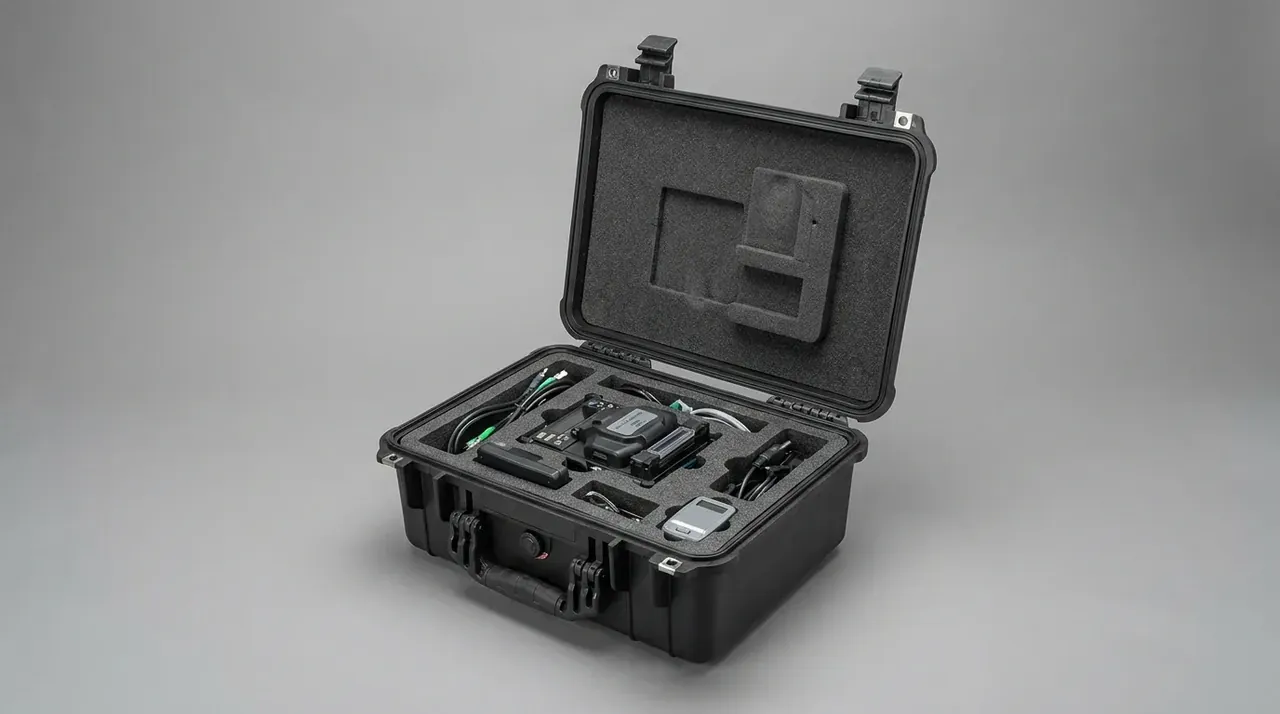
Quick answer: A storage fire case in a battery cabin fights pressure, not water: 50 Pa of cabin pressure plus a -20 ℃ to 60 ℃ cycle loads a sealed lid past 80 N.
Table of contents
- Pressure, not rain, is what this case fights
- IP54 and IP67 differ in breathing, not protection
- Sizing the 5 kPa valve against 1200 mm² of vent
- Seal hardness and the 80 N door force
- 150 mm lettering and the door swing
- FAQ
1. Pressure, not rain, is what this case fights
A 100 MWh battery site hangs one storage fire case on the partition wall of each cabin. Inside sit two 9 kg dry-powder extinguishers and a 25 m hose reel. The crew opens it quarterly, and twice found a film of water on the inner wall and a tacky hose jacket.
The leak was not a leak. The cabin runs at 50 Pa positive pressure from constant air handling, and the case had been built to IP67, cutting the air inside off from everything. As the cabin swung from -20 ℃ to 60 ℃, the trapped air pushed gauge pressure towards 32 kPa. Across a 0.41 m² door that is 13 kN, which nobody opens by hand.
The fix belongs on the case: drop the body to IP54, keep a 3 mm silicone gasket as a splash barrier, and open 1200 mm² of vent area so the inside breathes with the cabin. A 5 kPa relief valve sits behind that, so a blocked vent cannot let the wall deform.
| Cabin condition | Cabin | Case differential | Door load |
|---|---|---|---|
| Air handling at full load | +50 Pa | Under 40 Pa | Inward |
| Cabin door just opened | 0 Pa | Under 15 Pa | Near zero |
| Extract fans wide open | -30 Pa | Under 45 Pa | Outward |
| Hot afternoon, plant idle | +12 Pa | 150 Pa peak | Inward |
2. IP54 and IP67 differ in breathing, not protection
IP67 means 30 minutes at 1 m of water, and the price is an airtight box. A battery cabin has no flooding case: it is dry and positively pressurised, and what attacks the contents is dust and splash, both covered by IP54.
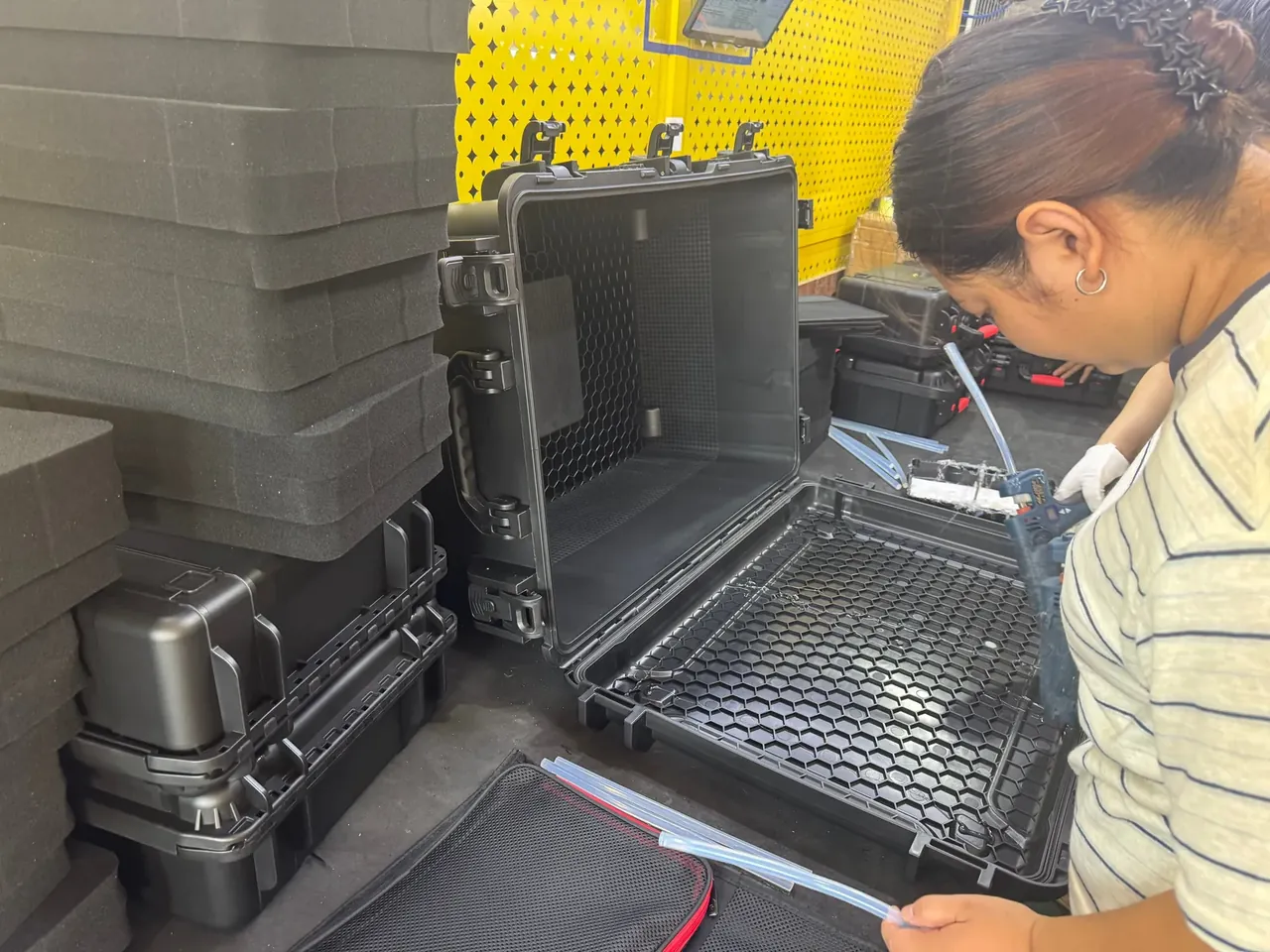
So the sealing is layered. The 3 mm gasket handles splash only, at 30% compression, since squeezing harder costs rebound. The lid joint uses a two-step labyrinth, so dust turns two 90° corners. The real vent sits on the roof, facing down.
| Rating | Dust | Water | Equalisation | Decision |
|---|---|---|---|---|
| IP54 | Level 5 | Splash | Free breathing | Adopted |
| IP65 | Level 6 | Jet | Needs a breather | Fallback |
| IP67 | Level 6 | 1 m, 30 min | Sealed | Rejected |
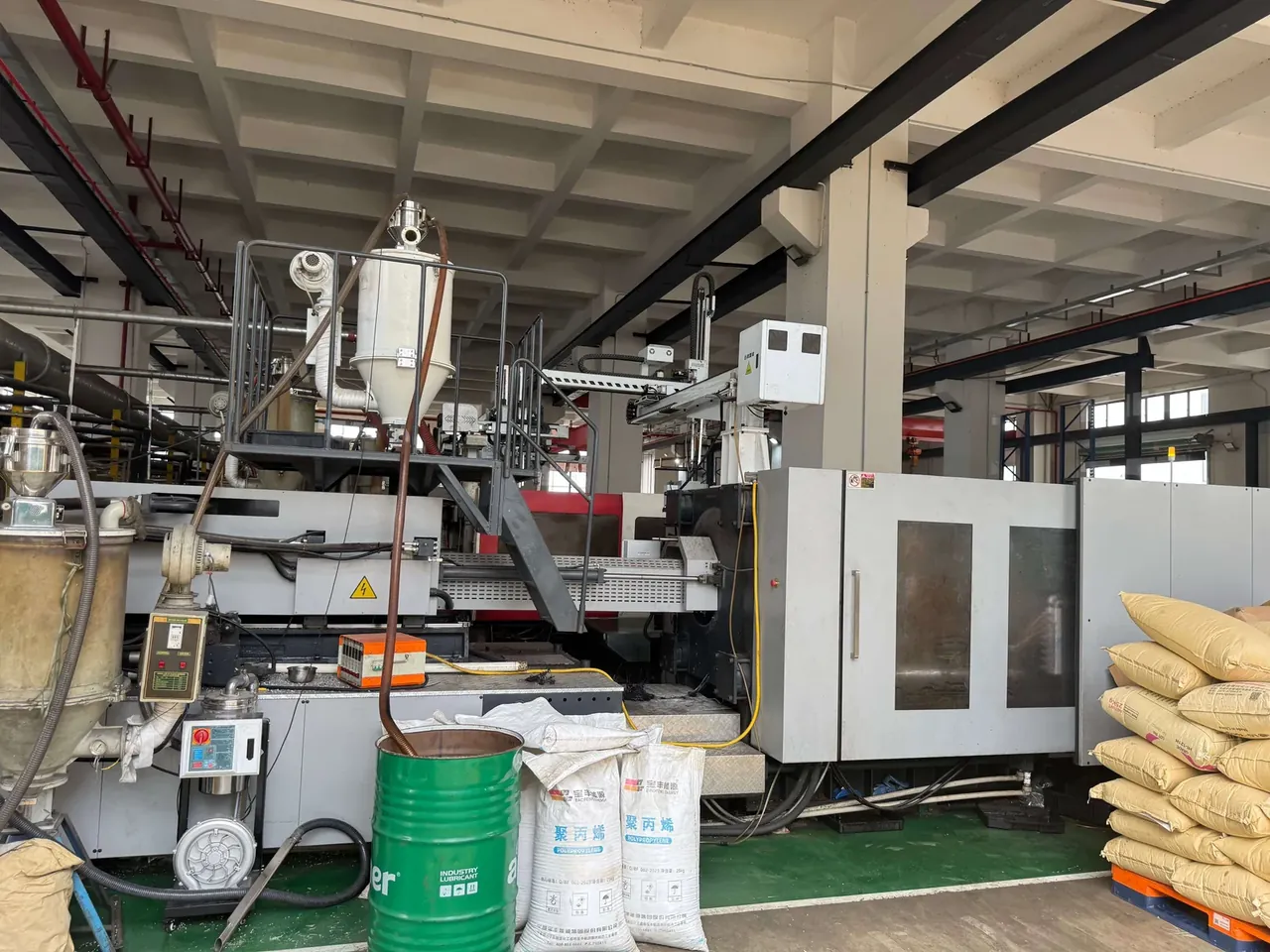
Venting is not drilling a hole. The 1200 mm² is split into four φ20 mm ports, each backed by a hydrophobic membrane passing about 0.6 L/min at 150 Pa, enough to follow a temperature cycle while stopping particles above 5 μm.
3. Sizing the 5 kPa valve against 1200 mm² of vent
Neither number is arbitrary. Vent area sets the differential in normal service; the relief valve sets the ceiling when something fails.
Take the fastest credible swing: -20 ℃ to 60 ℃ in 4 hours. Air at 60 L expands about 31%, and if none of it escapes the result is 32 kPa. Four ports passing 0.6 L/min at 150 Pa move 18 L in 4 hours, half the expansion, with the rest escaping past the gasket. Measured peak differential is 150 Pa, or about 62 N of suction on the door.
The abnormal case is a blocked vent: six months without cleaning leaves 0.3 mm on the membrane and flow drops below 0.1 L/min. That is when the 5 kPa valve opens and caps internal pressure, at which a 3 mm PP wall deflects about 1.2 mm, still elastic.
One valve location makes sense: the roof, on the hinge side. Beside the door the jet blows at the gasket and lifts it; in the floor, dust settles until it seizes.
4. Seal hardness and the 80 N door force
The 80 N limit is the item most often skipped. It sums pressure load, gasket hardness and hinge friction, and it moves with temperature.
| Temperature | Hardness | Compression | Door force |
|---|---|---|---|
| 60 ℃ | 48 Shore A | 30% | 62 N |
| 20 ℃ | 55 Shore A | 30% | 77 N |
| -20 ℃ | 70 Shore A | 22% | 95 N |
| -40 ℃ | 78 Shore A | 15% | 120 N |
Ordinary silicone climbs from 55 to 70 Shore A at -20 ℃, compression drops from 30% to 22%, and the door force walks past 80 N. The answer is a different compound, not a bigger handle: phenyl silicone holds 60 Shore A at -40 ℃, bringing the -20 ℃ figure back to 74 N and leaving 6 N of margin.
The door edge matters too: an 80 N pull over a 25 mm lip is 0.2 N/mm², but at 12 mm the same force stings.
5. 150 mm lettering and the door swing
Cabin lighting is typically 100 lx, and the label has to be read from 3 m, which puts the minimum cap height at 150 mm, a figure derived from a 3′ viewing angle.
| Face area | Content | Cap height |
|---|---|---|
| Door centre | Name, quantity | 150 mm |
| Door top edge | Opening arrow | 80 mm |
| Right side | Date, owner | 25 mm |
The door swings to 90°. Hinged on the left it ends parallel to the wall and never blocks the walkway, and a 15 mm strap stops a gust from slamming it to 180°. The case sits 900 mm up, so the top extinguisher comes out without bending.
Empty weight is 18 kg, loaded with two 9 kg extinguishers plus a 25 m hose it reaches 45 kg. That cannot hang from one bracket: two 40 mm bearers run under the base, with anchors no more than 400 mm apart.
Conclusion
A storage fire case is designed in reverse order: settle the differential, then the seal, then talk about water. A 50 Pa cabin, a -20 ℃ to 60 ℃ cycle and an 80 N door limit point at IP54 with a 5 kPa relief valve, not at IP67. Fix the vent area, valve position and gasket compound, and the rest follows the site layout.
This article only covers the enclosure side: its dimensions and what the design values mean. It does not address handling, loading or use of anything carried inside.
Related Reading
- Sizing a fire equipment case: capacity, zoning and mounting
- Layout for hose and forcible-entry tools in a fire case
- Structural requirements for cases in explosive atmospheres
- Protection and transport rules for battery storage module cases
- Humidity control in unmanned substation enclosures
Related Products
- 8 Series — Gun Cases; Military Equipment Cases; Camera Equipment Cases; Drone Cases; Watch Cases; Knife Cases; First Aid Cases; Electronics Equipment Cases
- WL8-2812 PP Gun Case — model WL8-2812
- All protective cases and toolboxes: 7 series, 158 models