

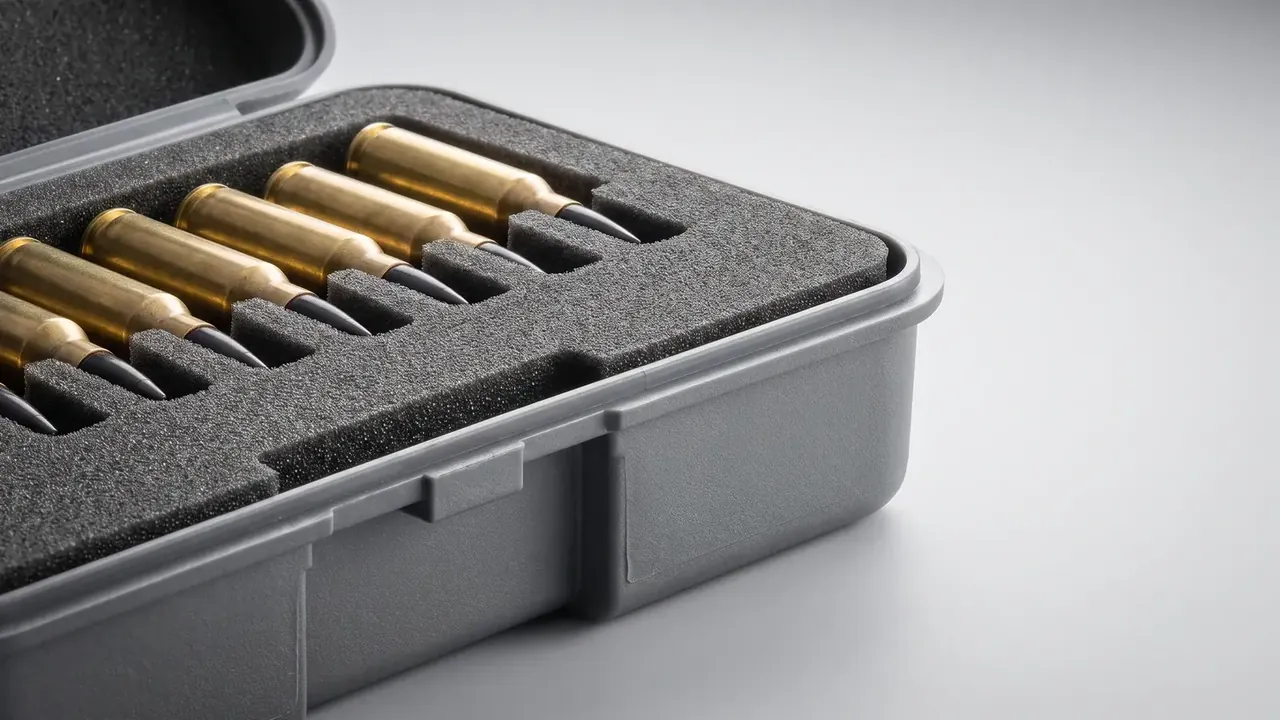
Quick answer: A quote from an equipment protective case manufacturer covers only what is visible. Mould ownership, spares, batch consistency and claim wording sit outside the unit price and return as real cost on the second and third order.
Table of contents
- Why the lowest quote rarely stays the lowest
- Who owns the mould, and who holds the spares
- Checking batch consistency at goods-in
- What a factory visit should actually look at
- Warranty and claims that can be enforced
- Closing the gap between sample and production
- FAQ
1. Why the lowest quote rarely stays the lowest
One drawing to three suppliers can produce quotes 40% apart. The gap rarely comes from process; it comes from four items that never reach the unit price.
| Quote says | Behind it | Cost later |
|---|---|---|
| No mould charge | Tool stays in the plant, owner unclear | 80,000 yuan to re-tool elsewhere |
| Sampling included | First round only | 12,000 yuan per revision, 12 days |
| Bulk packing | Inserts and cartons out | 6 to 9 yuan per unit |
| 12 month warranty | Material only | Batch cracking is yours |
A unit price has four parts: material, labour, mould amortisation, yield loss. When a quote lands 25% under the field, the likely moves are to shift the mould cost, assume 98% yield, or subcontract the latches. None is illegal, and all return to the buyer's account later.
2. Who owns the mould, and who holds the spares
Mould ownership is the line most often skipped and the most expensive. Under buyer funding the tool is invoiced separately and transfers on payment with drawings and a spare parts list; highest price, but no new tool on a supplier change. Under shared funding it is amortised per unit, for example 12 yuan each until 3,000 units, and the stop condition must be written. Under supplier funding the price is lowest and a retrieval clause is mandatory.
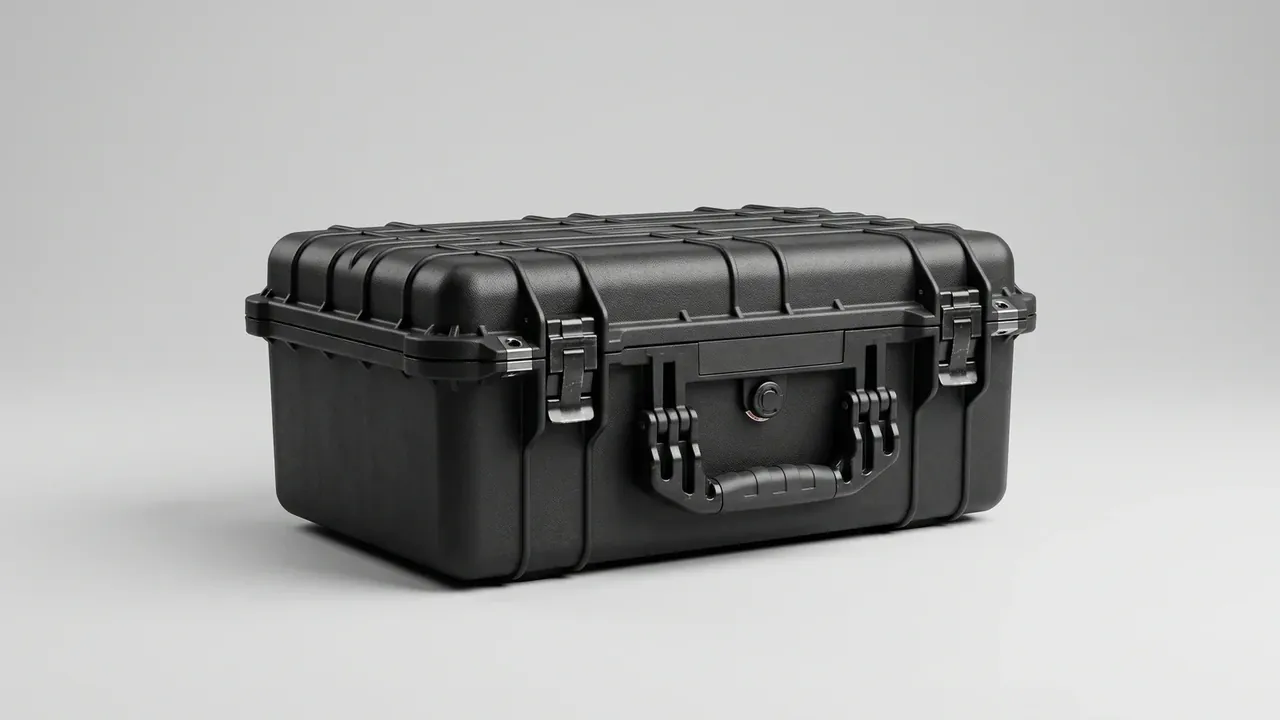
Spares are the second hidden line. Latches, hinge pins and gaskets are what fail, so an equipment protective case manufacturer should commit to five years of supply after discontinuation, a minimum order no higher than 200 pieces, and mould repair within seven days.
3. Checking batch consistency at goods-in
A good first article does not mean a good three hundredth. Batch consistency is the only criterion an equipment protective case manufacturer cannot hide, because it is measured at goods-in.
| Item | Method | Limit | On failure |
|---|---|---|---|
| Colour | Spectrophotometer, 3 per lot | Delta E within 1.5 | Reject the lot |
| Wall thickness | Ultrasonic gauge, 5 points | Plus or minus 0.25 mm | Double the sample |
| Weight | Scale, every unit | Within 2% | Stop after 3 in a row |
| Latch effort | Force gauge, 5 units | Within 10% of sample | Change the latch lot |
Colour drifts before strength does, because it moves with masterbatch lot, regrind ratio and melt temperature: the same mould can swing from Delta E 0.8 to 2.5 on a supplier change. Five thickness points catch eccentricity, since the spread between corner and centre reflects mould temperature, and one point never shows it.
4. What a factory visit should actually look at
A visit can cover a great deal, but capability comes down to press tonnage and test equipment.
Projected area times 0.5 t per square centimetre is a rough clamp force rule; a case with 3,200 square centimetres needs a 1,600 t press. Below that, an equipment protective case manufacturer subcontracts the moulding, which means the tool leaves the plant and lots get mixed.

Test equipment should include five items: ultrasonic gauge, spectrophotometer, drop tower, climatic chamber, melt index tester. Without a drop tower, reports go to a lab, and the lab sample is rarely the production lot.
5. Warranty and claims that can be enforced
A warranty needs a decision method, not the words quality problem. What an equipment protective case manufacturer can actually sign looks like this.
- 24 months from acceptance, not from the shipping date;
- Three defective units per thousand triggers full inspection, at supplier cost;
- Claims split: defective units replaced by piece, stoppage costed by hour;
- Mould repair charged by ownership;
- Disputes settled on the signed sample and a third-party report.
The value of a claim clause is not the compensation but the place your order holds in the production queue.
6. Closing the gap between sample and production
Drift between sample and production is inevitable; the question is whether it is recorded or waved through. First article approval gets 72 hours, silence counts as approval, and that clock belongs in the contract.
| Criterion | Weight | Full marks | Deduction |
|---|---|---|---|
| Mould ownership | 25 | Buyer funded, drawings handed over | Free tooling, owner retained |
| Batch consistency | 20 | Delta E within 1.5, five points | First article only |
| Factory capability | 20 | Above 1,600 t, drop tower | Key steps subcontracted |
| Warranty and claims | 20 | 24 months, three per thousand | Material only |
| Sample discipline | 15 | Deviation list signed | Verbal promises |
A supplier under 70 points does not reach the next round, and that line works harder than any single judgement.
Handling has three fixed steps: approve the first article in 72 hours, sign each deviation on a list, and finish the second sample in 12 days with the deviations written into the signed sample. That sample is the reference for every later dispute.
Conclusion
Choosing an equipment protective case manufacturer is not a race to the lowest price; it is a test of who writes mould, spares, batch and claim terms clearly enough to sign. Every yuan saved on the quotation returns in another form on the third order.
This article discusses only the container (case body) side of specifications and design intent, and does not cover any handling, loading or use of the contents.
Related Reading
- Applications and configurations for OEM cases
- Selection criteria for OEM protective cases
- How to read a protective case quotation reply
- What a protective case manufacturer actually does
- Inspection items used by protective case manufacturers
Related Products
- 8 Series — Gun Cases; Military Equipment Cases; Camera Equipment Cases; Drone Cases; Watch Cases; Knife Cases; First Aid Cases; Electronics Equipment Cases
- WL8-2812 PP Gun Case — model WL8-2812
- All protective cases and toolboxes: 7 series, 158 models