

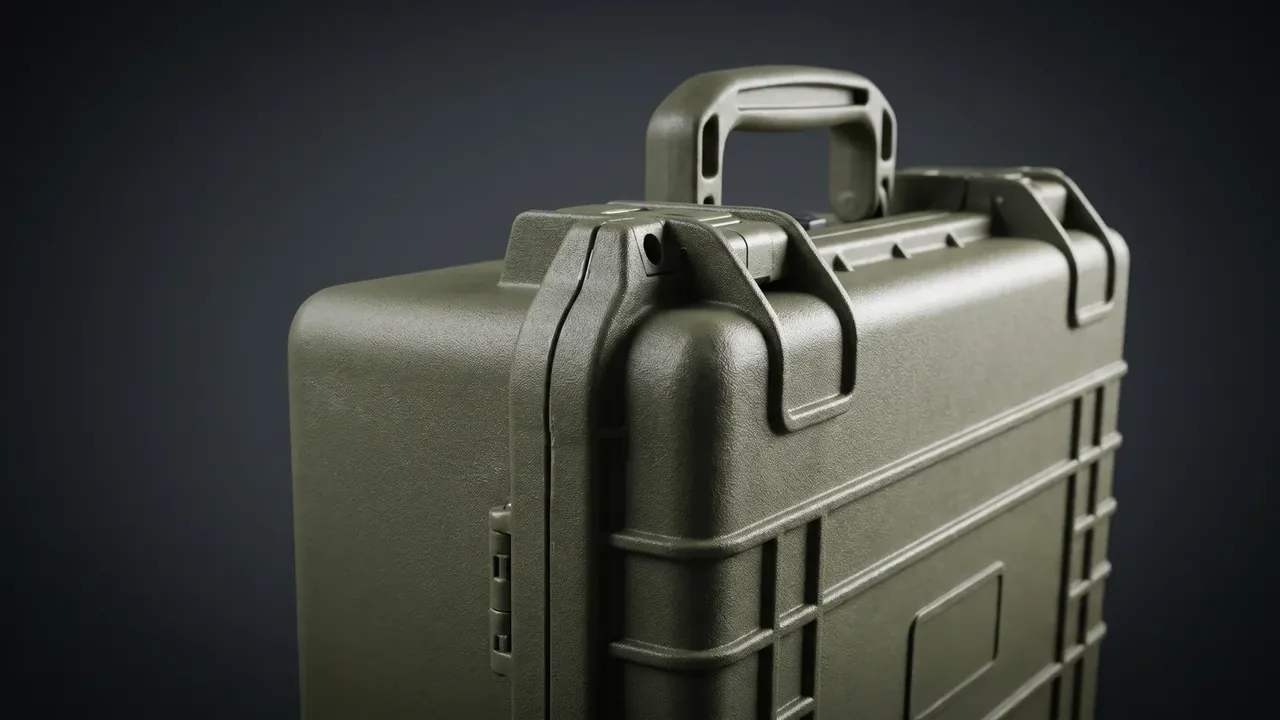
Quick answer: A firearm transport case is only as good as five structural decisions: how the shell is formed, how thin the wall gets at its worst point, how gasket and valve work as a pair, how latch and hinge share load, and how the insert stops movement in three axes.
Table of contents
- How a Firearm Transport Case Body Is Formed
- Wall Thickness and Rib Geometry
- Gasket Compression and Pressure Equalisation
- Latches, Hinges and the Load Path
- Foam, Dividers and Movement Control
- FAQ
1. How a Firearm Transport Case Body Is Formed
Rotational moulding swings a welded 3 mm steel tool through an oven at 280 to 300 degrees Celsius on two axes at 8 to 12 revolutions per minute; powder fuses against the wall and a seamless shell drops out after 25 to 40 minutes. Injection moulding pushes melt into a 718H tool on an 800 to 1300 tonne press in 60 to 90 seconds, but the wall can only be 3 to 4 mm, so ribs carry stiffness.
Bodies longer than 1.2 m belong in rotomoulding, where corners stay smooth; stable sizes under 600 mm suit injection, for lower unit cost.
| Item | Rotomoulding | Injection moulding |
|---|---|---|
| Wall | 6 to 8 mm | 3 to 4 mm |
| Tool | Welded 3 mm steel | 718H mould steel |
| Cycle | 25 to 40 minutes | 60 to 90 seconds |
2. Wall Thickness and Rib Geometry
Nominal wall on a rotomoulded firearm transport case runs 6 to 8 mm, held to plus or minus 0.8 mm. Thin spots appear in internal corners and at panel centres, so ultrasonic gauging at four points per face is the working check; below 5.5 mm is a reject.
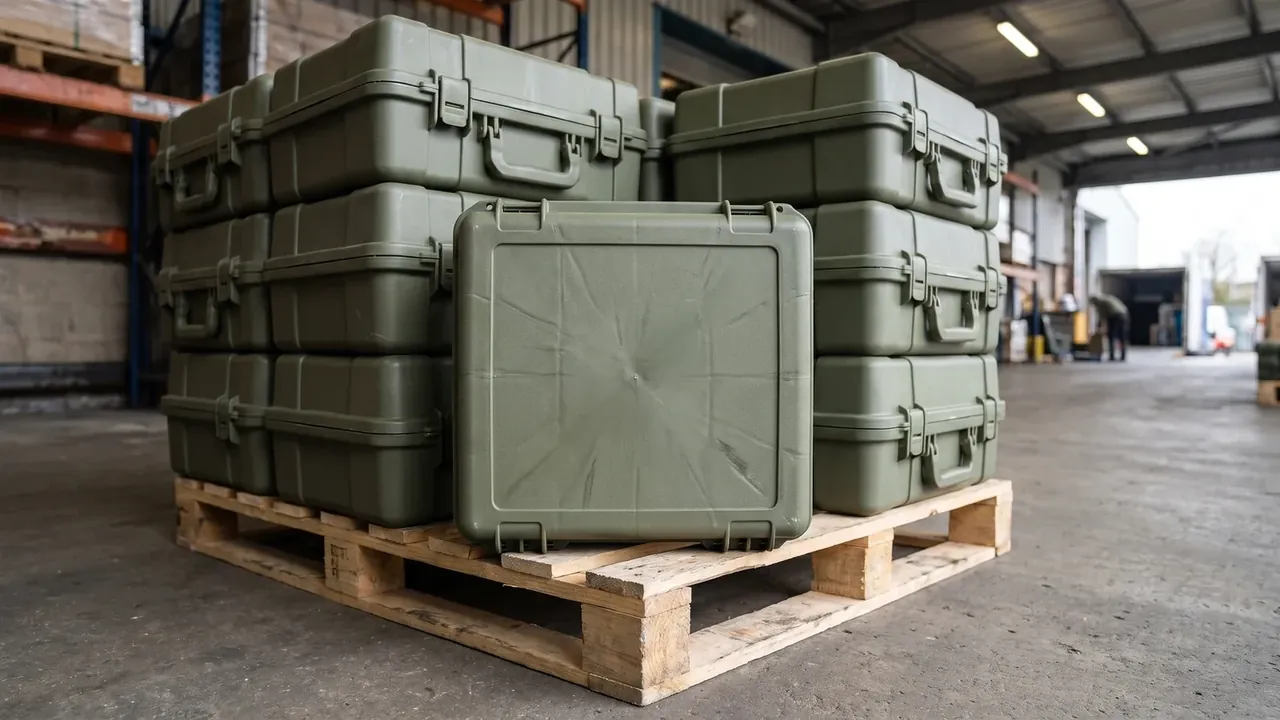
A workable rib grid is 12 mm tall, 6 mm wide at 90 mm pitch, with radial ribs carrying load toward the corners. Keep the root fillet at 3 mm or more, or shrinkage stress starts the first crack.
| Zone | Design value | Check | Failure mode |
|---|---|---|---|
| Flat panel | 6 to 8 mm wall | Ultrasonic, four points | Centre dishing |
| Side ribs | 12 mm tall, 90 mm pitch | Caliper sampling | Root cracking |
| Rim flange | 8 mm minimum | Visual with magnifier | Whitening at latch |
3. Gasket Compression and Pressure Equalisation
Sealing a firearm transport case is a compression problem. A D-profile gasket in a 6 mm wide, 4.5 mm deep groove is compressed 25 to 30 percent at closure in 55 to 60 Shore A. Too little leaks; too much takes a permanent set within two closings.
The valve handles the opposite failure. Altitude or temperature swings build a differential, and beyond about 5 kPa the lid cannot be opened by hand. A valve cracking at 5 kPa equalises first, so the gasket is never sucked over its groove; rate the diaphragm from minus 30 to 70 degrees Celsius. The two parts only work as a pair: seal without venting and the case fights the user.
4. Latches, Hinges and the Load Path
Latches keep the lid shut in a drop. Design 900 N retention per latch on the firearm transport case, four along the long sides, with 0.3 to 0.5 mm interference between catch and keeper so closure gives a detent you can feel.
A 6 mm stainless pin in a self-lubricating bush should hold bore clearance under 0.4 mm after 5000 cycles. Swap it for a moulded plastic lug and the first 500 cycles feel fine; after a thousand the lid is aligned by the gasket. Latch force also has to reach the rim flange, which spreads it into the side ribs.
5. Foam, Dividers and Movement Control
An insert stops motion on all three axes. Cut EVA at 38 kg per cubic metre for slow, dense rebound, or closed-cell PE at 30 for water resistance and lower cost. Cut cavities 1 mm oversize per side so items go in without scraping.
| Insert type | Density | Location method | Best fit |
|---|---|---|---|
| Cut EVA | 38 kg per cubic metre | Full cavity plus spacer bars | Complex, high-value items |
| Closed-cell PE | 30 kg per cubic metre | Deep cavity with slots | Large batches, wet routes |
A second layer is preload: 3 to 5 mm in the lid, so foam compresses slightly at closure. Too much and the lid needs body weight; too little and the load rattles.
Conclusion
Five numbers decide it: wall tolerance, rib pitch, gasket compression, latch retention, lid preload. Put them on the drawing and a sample review stops being an argument about feel; that is how a firearm transport case earns a service life you can plan around.
This article discusses only the container (case body) side of specifications and design intent, and does not cover any handling, loading or use of the contents.
Related Reading
- How to choose a firearm transport case
- Acceptance clauses for transport cases
- Common transport case problems and fixes
- Routine care for transport cases
Related Products
- 8 Series — Gun Cases; Military Equipment Cases; Camera Equipment Cases; Drone Cases; Watch Cases; Knife Cases; First Aid Cases; Electronics Equipment Cases
- WL8-2812 PP Gun Case — model WL8-2812
- All protective cases and toolboxes: 7 series, 158 models