

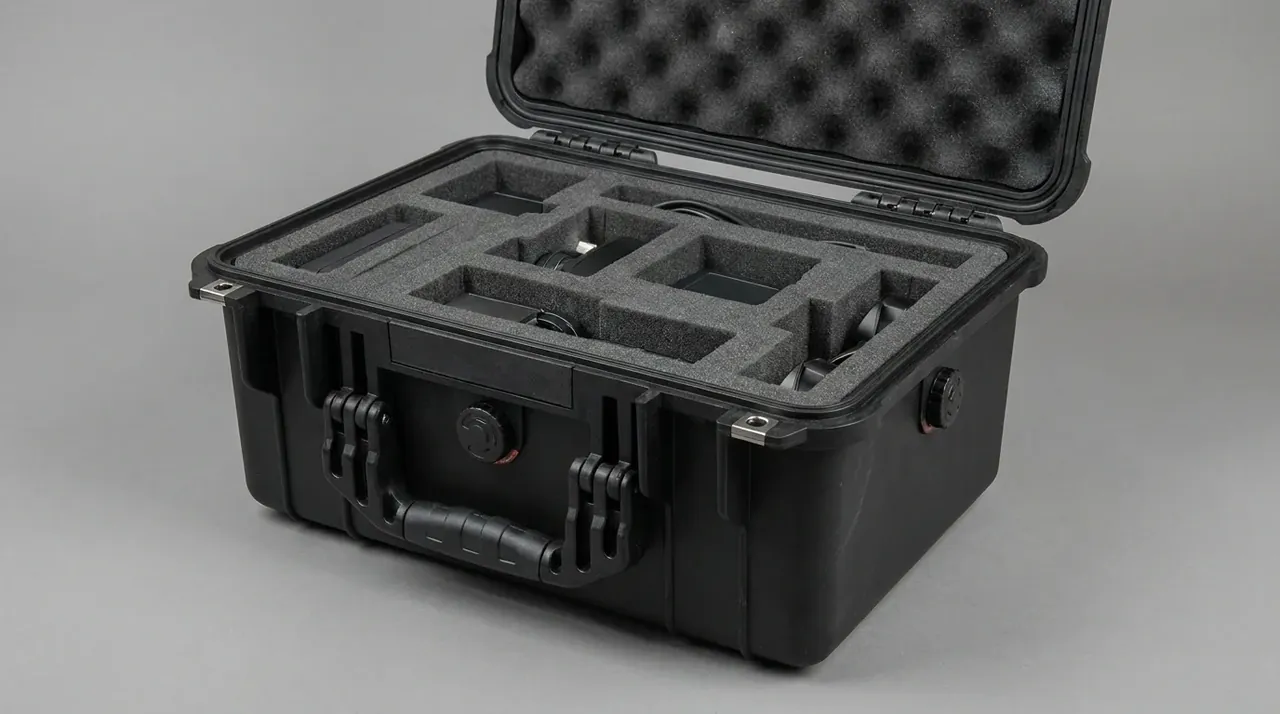
Quick answer: Case green procurement fails on proof, not on the target share. A supplier claiming 30% recyclate with no batch record scores zero.
Table of contents
- The first document: batch ratio records
- Three ways to verify 30% recyclate
- RoHS 10 substances and the SVHC list
- What the 2.8 kg CO2e boundary covers
- Recyclable marking and single material
- Twelve questionnaire items and a 10% weight
- FAQ
1. The first document: batch ratio records
Three suppliers quoted 30% recyclate and attached a self-declaration signed by sales. Case green procurement stops here: a ratio is a formula, and it only counts on a batch.
A batch record carries four things: recycled pellet weight, virgin pellet weight, both lot numbers and the weighing record at the hopper. With all four, 30% is calculable; with three, it is a claim.
The requirement screens out plants without ratio control, because a moulder that never weighs its feed also drifts on wall thickness.
2. Three ways to verify 30% recyclate
A ratio record proves what went into the hopper, not the origin. Case green procurement cross-checks with three more routes.
Infrared comes first: compare the carbonyl band near 1720 cm⁻¹ and the methylene band at 1450 cm⁻¹ with virgin PP. Recyclate carries more heat history and adds small peaks. It proves material, not percentage.
Melt flow comes second: virgin PP runs 8 g/10min, 30% recyclate lifts it to 10 to 12, and 5 lots between 9 and 13 with a deviation under 0.8 hold. The PCR report comes third: EN 15343 returns ±3%, so 30% lands between 27% and 33%.
| Evidence | Proves | Does not prove |
|---|---|---|
| Declaration | The promised ratio | Actual feed |
| Batch record | Weight and lot | Recyclate origin |
| Infrared, melt flow | Material and ratio | The percentage |
| PCR report | An interval of ±3% | Each batch |
The four only work together: a report without a record covers the sample sent, and a record without a report is the supplier's own number. State the source type too, post-industrial or post-consumer, because their factors differ by more than double.
3. RoHS 10 substances and the SVHC list
RoHS covers 10 substances: lead, mercury, cadmium, hexavalent chromium, PBB, PBDE and four phthalates. Cadmium is limited to 0.01%, the rest 0.1%; risk sits in masterbatch, stabilisers and mixed recyclate.
Read three places: whether the sample is pellets or a case and matches the part number; whether the method is X-ray screening or ICP measurement, since a screen cannot release; and the date, as anything over 12 months expires.
| Substance | Limit | On a case |
|---|---|---|
| Lead Pb | 0.1% | Masterbatch, stabilisers |
| Cadmium Cd | 0.01% | Mixed recyclate |
| Mercury Hg | 0.1% | Pigments |
| Chromium VI | 0.1% | Plated hardware |
| PBB | 0.1% | Flame-retardant parts |
| PBDE | 0.1% | Flame-retardant parts |
| Four phthalates | 0.1% each | Soft parts |
SVHC is a duty to declare, not a limit: anything above 0.1% passes downstream and is notified. The list updates twice a year, so a declaration must name its version. Recyclate is the high-risk zone, so source type belongs in the contract: post-consumer needs an origin note and washing record, post-industrial scrap one grade.
Case green procurement compresses the check into one line: 10 substances by report and limit, SVHC by version and the 0.1% threshold.
4. What the 2.8 kg CO2e boundary covers
A 2.8 kg CO2e footprint compares only once the boundary is stated; move it and the same case reads 1.9 kg or 4.5 kg.
This figure runs from pellet to factory gate: production, drying, moulding, regrind and in-plant transport, excluding foam, hardware and packaging, which add 0.6 kg, so a whole case is 3.4 kg.
Three inputs: net weight 2.4 kg, virgin PP at 1.45 kg CO2e/kg, recycled at 0.55. Blending 70/30 gives 1.18, and 2.4 kg gives 2.83 kg, matching the claim.
The factor is easiest to swap: a grid factor and a supplier green-power factor differ by 0.4 kg, so the sheet names source and year. State trade-offs: 95% regrind at zero, drying 0.12 kWh per kg, transport 30 km.
Compare on one boundary: 2.1 kg may mean moulding was dropped, and a footprint without a boundary column does not score.
5. Recyclable marking and single material
Recyclability rests on one material, parts that come apart and marking that survives. Do all three and a 3.2 kg case holds value.
Body and lid in the same PP, one masterbatch system, no PC or ABS mixing: mixed scrap fetches 60% of single-material prices and recyclers refuse it. Hardware on screws not heat-staked inserts, hinges and latches replaceable, lining lifting out in one piece: four minutes to strip keeps a recycler interested.
Under ISO 11469, parts over 50 g carry the material code and recycled content, moulded in where it will not wear; paper labels last two years.
Case green procurement writes these three into the drawing, not the inspection note: the drawing delivers marking from the first shot, while the note means a tooling change and another 3 weeks.
6. Twelve questionnaire items and a 10% weight
Twelve items are enough. Four cover compliance: environmental permit, discharge licence, hazardous waste contract and ISO 14001. Five cover process: moulding and drying energy, regrind rate, wastewater route and recyclate source. Three cover product: RoHS report, SVHC declaration and carbon sheet. Four need a file and eight a number with a stated basis.
The 10% weight is deliberate: on 100 points green holds 10 and price plus delivery 90, since green measures add 3% to 5% to the unit price, enough to justify investment without crowding out capacity.
Split it in the tender: recyclate and carbon 3 each, RoHS and SVHC 1.5 each, design 1; an unsplit 10 becomes an impression score. Then grade: all 12 pass, A and main supply; 9 or more, B and backup; under 9, 6 months to fix.
Conclusion
Case green procurement is not a debate about whether to be green, but whether each claim can be proven. Recyclate at 30% rests on a batch record, a melt flow series and a PCR report; RoHS 10 on the sample, method and date of a report; 2.8 kg CO2e on a boundary, a factor and stated trade-offs; recyclability on one material, detachable parts and moulded marking. With those four sets in place the 10% weight means something. Every row needs a pass line rather than a tick, because the second-year review asks only two things: is the evidence still valid, and has any indicator slipped? A pass line outlives any slogan and any slide. Run it in order: questionnaire and grade, sampling and checks, and only then the contract annex.
| Check | Evidence | Pass line |
|---|---|---|
| Recyclate share | Batch record, PCR report | 27% to 33% is 30% |
| Ratio stability | 5 lots of melt flow | 9 to 13 g/10min |
| RoHS 10 | Quantitative report | 0.1%, cadmium 0.01% |
| SVHC | Declaration with version | Above 0.1% declared |
| Footprint | Sheet with boundary | 2.8 kg, one boundary |
| Marking | ISO 11469 on drawing | Required above 50 g |
| Detachability | Strip time | Under 4 minutes |
| Questionnaire | 12 items, 4 documents | 9 or more passes |
This article discusses container-side specifications and design implications only, and does not cover any handling, loading or use of the contents.
Related Reading
- RoHS and REACH compliance points for cases
- Judging and accepting recycled-content cases
- Virgin versus recycled case material
- Reading a RoHS report with 6 or 10 substances
Related Products
- 8 Series — Gun Cases; Military Equipment Cases; Camera Equipment Cases; Drone Cases; Watch Cases; Knife Cases; First Aid Cases; Electronics Equipment Cases
- WL8-2812 PP Gun Case — model WL8-2812
- All protective cases and toolboxes: 7 series, 158 models