

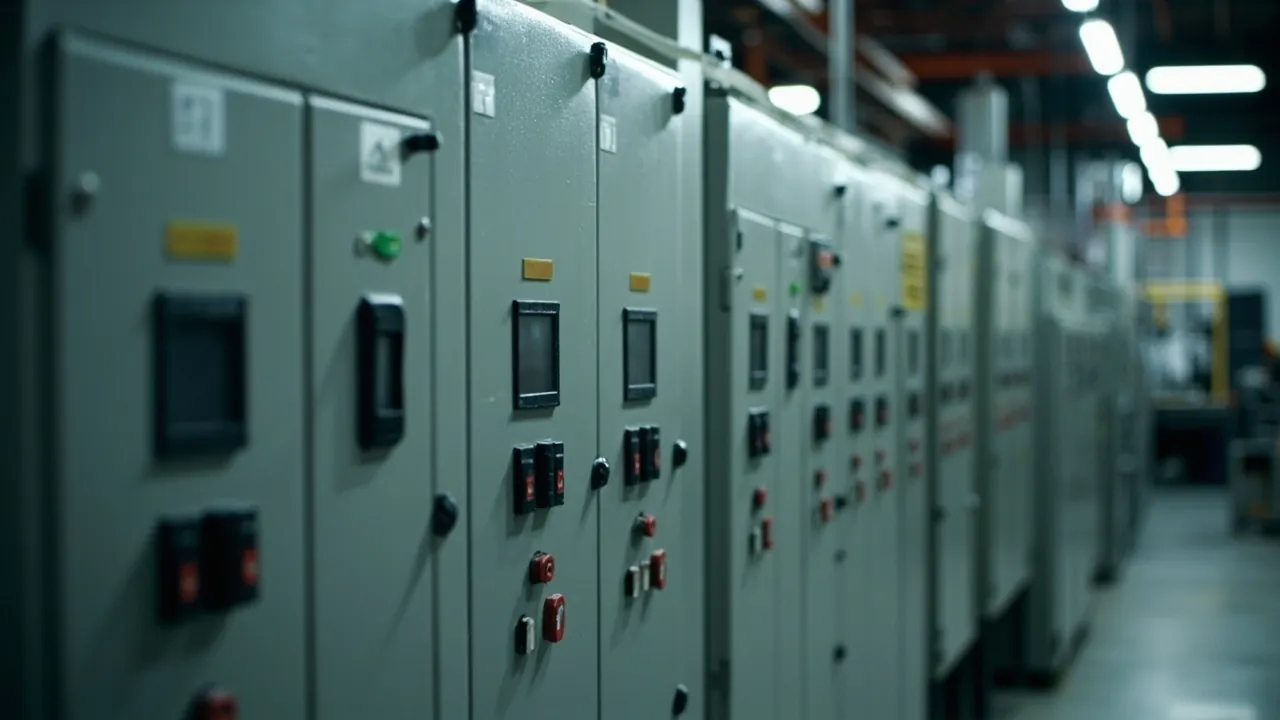
Selecting a waterproof control enclosure usually gets compressed into one sentence: give me an IP65, about this size. It arrives, it gets fitted, and three months later the problems start. Terminals corrode, modules restart from overheating, water gets in during wash-down, a latch snaps. Retrace almost every one of those failures and it leads back to a handful of questions nobody asked at the selection stage.
What separates industrial applications from domestic ones is that the cost of failure is not the price of the box. It is the price of an hour of downtime. One hour on a production line can be tens of thousands in lost output. Water in a pump station control panel can take two days to repair and recommission. A control enclosure that harbours contamination in a food plant draws an audit non-conformance measured in months to close out. The return on doing selection properly is therefore enormous: two or three extra hours spent pinning down parameters saves uncounted rework later.
This article sets out five parameters that must be confirmed one by one, plus two supplementary items that are routinely overlooked, a worksheet you can fill in directly, worked selections for three real applications, and the ten most common mistakes. Every criterion is quantifiable and can be written straight into a purchase specification, which is the best defence against the phrase that causes the most trouble of all: near enough.
Contents
- What a Bad Selection Actually Costs
- Parameter One: Ingress Protection, and the IK Code Alongside It
- Parameter Two: Usable Internal Volume and Thermal Capacity
- Parameter Three: Material, Weathering and Chemical Resistance
- Parameter Four: Cable Entry, Holes and Glands
- Parameter Five: Certification, Flammability and Liability
- Two Items Routinely Forgotten: Mounting and Mechanical Interfaces
- A Worksheet You Can Fill In
- Three Worked Industrial Selections
- Ten Common Selection Mistakes
- Twelve Items to Supply When You Ask for a Quote
- Incoming Inspection Checklist
- Frequently Asked Questions (FAQ)
- Closing Notes and Further Reading
What a Bad Selection Actually Costs
Put the numbers on the table first, so the rest of the discussion has a scale.
Take a mid-sized automotive components plant with sixty control enclosures on its lines. At 120 yuan each, the purchase order is 7,200 yuan. Suppose poor selection produces eight failures in a year. Each costs an average of two hours of downtime and two man-hours of labour. At thirty thousand yuan of output per line-hour and eighty yuan per man-hour, one incident costs roughly 60,200 yuan, and eight of them come to about 480,000 yuan. A purchase of 7,200 yuan generating 480,000 yuan of failure cost is a ratio of sixty-seven to one.
That ratio is not unusual in industry. And it excludes the items that never appear on a spreadsheet: delivery penalties from the customer, warranty disputes with the machinery builder, and worst of all the fact that nobody can establish whether the box was at fault or the installation was, so the next batch repeats the same specification.
Now the other side. How much extra effort does doing it properly take? Confirming the five parameters item by item, two to four hours. Running a thermal check for the project scale, one hour. Incoming sampling and inspection, half a day. Under two working days in total.
The position taken here is therefore straightforward. Selecting a control enclosure is a design activity, not a purchasing activity. It should be led by the electrical or machine design engineer with procurement executing, not the other way round.
Parameter One: Ingress Protection, and the IK Code Alongside It
The IP code is defined by IEC 60529, adopted in China as GB/T 4208-2017. The first digit covers solid objects and access to hazardous parts, the second covers water. The ratings that matter for industrial enclosures:
| Rating | Dust, First Digit | Water, Second Digit | Typical Industrial Use |
|---|---|---|---|
| --- | --- | --- | --- |
| IP54 | 5, dust protected, limited ingress permitted | 4, splashing water | Indoor panels in dry workshops |
| IP65 | 6, dust tight | 5, water jets, 6.3 mm nozzle, 12.5 L/min, 3 m, 3 min or more | General workshops, wash-down that is not high pressure |
| IP66 | 6, dust tight | 6, powerful water jets, 12.5 mm nozzle, 100 L/min, 3 m, 3 min or more | Outdoor equipment, docks, vehicle wash bays |
| IP67 | 6, dust tight | 7, temporary immersion, 1 m for 30 min | Locations that flood briefly, buried or low-lying mounting |
| IP69K | 6, dust tight | 9K, high-pressure high-temperature wash, 80 C, 80 to 100 bar, 14 to 16 L/min, four angles at 30 s each | Food, beverage, pharmaceutical, daily high-pressure cleaning |
Note that IP69K comes from ISO 20653 and DIN 40050-9 rather than from the numbered sequence in IEC 60529, and it is usually written alongside IP66 or IP67 rather than instead of them.
The IK code, defined by IEC 62262 and GB/T 20138, describes resistance to mechanical impact, measured in joules. In industrial service this is the most neglected rating and one of the most frequent causes of trouble.
| IK Rating | Impact Energy | Equivalent | Recommended Application |
|---|---|---|---|
| --- | --- | --- | --- |
| IK07 | 2 J | 0.5 kg hammer from 40 cm | Indoors generally, no collision risk |
| IK08 | 5 J | 1.7 kg hammer from 30 cm | Workshop wall mounting, possible tool contact |
| IK09 | 10 J | 5 kg hammer from 20 cm | Aisles used by forklifts, low-level mounting |
| IK10 | 20 J | 5 kg hammer from 40 cm | Beside heavy machinery, open yards, frequently carried portable units |
Why the two must be specified together: an enclosure rated IP67 with only IK07, mounted beside a forklift aisle, cracks on the first impact and its IP67 becomes zero. Conversely an IK10 enclosure rated only IP54, installed in a wash-down area, takes water just the same. Protection stands on two legs, sealing and structure, and it will not stand on one.
The correct way to write the requirement is: IP66 plus IK08, with third-party reports to IEC 60529 and IEC 62262. Specifying IP without IK hands structural strength to the supplier to interpret. The practical differences between the three water ratings are set out in more detail in the article on IP65, IP66 and IP67 compared.
Parameter Two: Usable Internal Volume and Thermal Capacity
This is the second great trap. Almost every selection looks at external dimensions and ignores both the usable internal volume and the heat.
Start with usable space. A box nominally 300 by 200 by 150 millimetres loses wall thickness at 2.5 to 4 millimetres per side, so 5 to 8 millimetres in total, ribs at 2 to 5 millimetres, and bosses plus rail mounts at 10 to 20 millimetres. Usable space is typically 15 to 25 millimetres smaller than nominal on each dimension. The first thing to look for in a catalogue is the internal dimensions column. If it is not printed, ask.
Then fill ratio. A useful rule of thumb: components and terminals should occupy no more than 40 percent of the usable internal volume. The remaining 60 percent serves three purposes: cable bending radius, which runs at six to ten times the cable outside diameter, air space for heat to move, and room to get a hand in during maintenance later. Cases where a box is packed so tightly that you cannot get a screwdriver onto the terminals are far too common.
The important part is heat. Almost nobody does this calculation, and it is the most common root cause of unexplained equipment restarts.
For natural convection the rough relationship is:
Delta T equals P divided by h times A
where P is total internal dissipation in watts, h is the effective heat transfer coefficient, taken as 5 to 10 watts per square metre kelvin and around 8 for a plastic enclosure, and A is the effective radiating area in square metres.
Worked example. A plastic control box 300 by 200 by 150 millimetres, wall mounted, with the front, two sides and the top radiating effectively, gives A of roughly 0.16 square metres. Inside is an 18 watt switch and a 6 watt supply, so P is 24 watts. With h at 8:
Delta T = 24 divided by (8 times 0.16) = 18.75 kelvin
At an ambient of 35 degrees the internal air sits near 54 degrees. That is not the end of it. Installed outdoors or beside a window, solar radiation adds another 20 to 30 kelvin, putting the internal peak at 75 to 85 degrees.
The criterion: sustained internal temperature should not exceed 60 degrees. Above that, apply the rule that electrolytic capacitor life halves for every 10 degrees of rise and convert it into equipment life. The example above is already at the boundary in summer.
Four remedies for insufficient cooling, in order of preference.
One, reduce the dissipation. Fit lower-power modules or move the power supply outside the enclosure. This is the most complete solution.
Two, increase the radiating area. External fins raise capacity by 20 to 40 percent, or change to a metal enclosure: cast aluminium conducts at roughly 96 to 120 watts per metre kelvin against 0.15 to 0.25 for plastic, a difference of three orders of magnitude.
Three, improve the mounting. Leave at least 50 millimetres of air gap behind the box, avoid direct sun, and fit a sun shield.
Four, cool actively. Fit a fan or an air conditioner. Be aware that a fan destroys the IP rating: it needs dust and water filtering, and you accept that the rating falls to roughly IP54.
Parameter Three: Material, Weathering and Chemical Resistance
Material decides how many years the enclosure lasts and in which environments it fails.
ABS is the highest-volume material in industrial control enclosures. It is cheap, stiff, easy to process and easy to print on. Its weakness is weathering: ABS without UV stabilisers begins to chalk, discolour and lose impact strength after one to two years of outdoor exposure. For outdoor use you must confirm that UV stabiliser is present, or choose an ASA capped grade or a painted finish. Chemically, ABS copes with cutting fluids and mild acids and alkalis but is sensitive to ketones, esters and aromatic solvents, which attack and crack it.
Polycarbonate has three to five times the impact strength of ABS, high transparency, useful where a viewing window is needed, better weathering and a continuous service temperature of 100 to 125 degrees. It has two drawbacks. The first is stress cracking: polycarbonate with internal or assembly stress, in contact with oils, plasticisers or certain solvents, develops microcracks, so it must not be over-tightened or exposed to some greases. The second is cost, roughly 1.8 to 2.5 times ABS.
PC and ABS alloys are the compromise, combining the processability of ABS with the toughness of PC, with better low-temperature performance and weathering than straight ABS, at a middling price. They are a common choice for mid to high range enclosures.
Glass-reinforced polyester, SMC or GRP, is the standard answer in heavy industry, chemicals and water treatment. It resists chemicals and weathering, has high strength and dimensional stability, and can be moulded large. The drawbacks are weight, the need for specialised cutting tools, and a limited colour range.
Cast aluminium, ADC12, dissipates heat well, screens electromagnetically and has high mechanical strength, suiting large drives and servo controllers. It is heavy, needs a finish such as powder coat or anodising, carries a galvanic corrosion risk in coastal or chloride-bearing environments, and must be earthed reliably.
Stainless steel, 304 or 316L, is the first choice for food, beverage, pharmaceutical, coastal and chemical service. 304 is adequate in ordinary atmospheres, but in the presence of chlorides, at the coast, with salt water or with some cleaning agents, it pits, and the specification must move to 316L with its 2 to 3 percent molybdenum.
How to verify chemical resistance: do not accept a claim of acid and alkali resistance. List the media the enclosure will actually meet - the cutting fluid grade, the cleaning agent composition, the type of oil, whether solvents evaporate nearby - then ask the supplier for the chemical resistance table for the material and check item by item. ABS cracking with ester-based cutting fluid, polycarbonate stress cracking with plasticisers, nylon changing dimension as it absorbs moisture: all of these have happened.
Quantifying ultraviolet: ABS without UV stabiliser, exposed for two years in southern or eastern China, can lose 40 to 60 percent of its Charpy impact strength and show a colour shift beyond five delta E, visibly whitened or yellowed to the eye. Grades carrying UV stabiliser and carbon black hold the loss to within 15 to 25 percent under the same conditions. So for outdoor service, whether UV stabiliser is present belongs in the purchase specification as an explicit clause, not as an assumption that all plastics tolerate sun.
Material comparisons in more depth are available in the article on plastics used in protective enclosures and the one comparing the three common grades.
Parameter Four: Cable Entry, Holes and Glands
This is where industrial installations fail more often than anywhere else. An enclosure that is IP67 as a shell drops below IP54 the moment somebody drills a hole on site and fits a gland that does not match.
Selecting a gland means checking three dimensions.
| Check | What It Means | Common Mistake |
|---|---|---|
| --- | --- | --- |
| Actual cable outside diameter | Measure the sheath in three directions with callipers and take the largest, not the nominal figure | Sizing from the cable's nominal rating when the real diameter is 1 to 2 mm smaller, so the clamp never grips |
| Gland clamping range | Every gland carries a range, M20 commonly 6 to 12 mm | An 8 mm cable in a 10 to 14 mm gland leaves the sealing lip unable to compress |
| Hole diameter and wall thickness | M20 takes 20.5 mm plus 0.5, with at least 3 mm of wall at the hole | Tapping a thread in a thin wall, leaving two turns of engagement that pull out |
Thread sizes and quantities: M12, M16, M20, M25 and M32 are the common ones. The drawing should state the position and size of every hole and whether spare positions are provided, fitted with plugs. Spare plugs must match the enclosure rating: closing an IP66 spare hole with an IP54 plastic cap makes the whole assembly IP54.
Three rules for hole position.
One, enter from the bottom where possible. Water runs downhill, and a bottom entry is far less likely to admit water than a side or top entry even if the sealing is marginal.
Two, sides second, top avoided. Where side entry is unavoidable, give the hole a downward tilt or fit a rain shield. Top entry almost always causes trouble unless a raised weatherproof fitting is used.
Three, spacing and edge distance. Centre-to-centre spacing should be at least the hole diameter plus 6 millimetres, and the edge of the hole should sit at least half a diameter from the enclosure edge, or the material between holes cracks. Thin-walled enclosures should use a backing nut from inside rather than self-tapping screws.
After drilling, three things must happen. Deburr, because a burr stops the sealing washer seating. Remove swarf, because metal chips falling into a terminal block are a short-circuit waiting to happen. And inspect the hole edge for microcracks. On a metal enclosure, restore the corrosion protection afterwards.
Seal material must match the environment. Gland seals are commonly nitrile for general use, silicone or EPDM outdoors for weathering, and fluoroelastomer where oil is present. Any O-ring between gland and enclosure needs the same check.
One point that is routinely overlooked: two cables through one hole is absolutely forbidden. The gap between two cables cannot be sealed by a single gland, and it is the most common shortcut on site.
How a waterproof structure avoids these problems at the design stage is covered in the article on outdoor enclosure waterproof design.

Parameter Five: Certification, Flammability and Liability
An enclosure is not an isolated product. Once it is built into a machine it affects the compliance of the whole, and if this item is not confirmed the liability lands on the machine builder.
UL 94 is the baseline flammability rating for plastic enclosures.
| Rating | Test Condition | Requirement | Application |
|---|---|---|---|
| --- | --- | --- | --- |
| UL 94 V-0 | Vertical burn, two 10 second applications | Afterflame 10 s or less per application, 50 s total, no flaming drips | Enclosures containing arcs or relays; recommended |
| UL 94 V-2 | Vertical burn, two 10 second applications | As above, but flaming drips permitted | General low-voltage signal use; acceptable |
| UL 94 HB | Horizontal burn | Burn rate 40 mm/min or less at 3 to 13 mm thickness | Only where there is no ignition source |
For industrial control enclosures, V-2 is the minimum and V-0 is required where power supplies, relays or contactors are present. One caution: V-0 applies only at a specific thickness. V-0 at 1.5 millimetres does not mean V-0 at 3 millimetres, nor the reverse. Confirm the rating at the actual wall thickness of the enclosure.
The glow-wire test, IEC 60695-2-11, assesses behaviour when a hot element simulating an overloaded conductor is applied. The key figures are GWIT, the glow-wire ignition temperature, and GWFI, the glow-wire flammability index. Industrial control equipment enclosures commonly require GWFI of 850 degrees or better, and 960 degrees where current-carrying parts are supported.
Complete-equipment approval depends on the market. For Europe, the CE marking brings the Low Voltage Directive 2014/35/EU. For North America, UL 508A covers industrial control equipment. In China, complete assemblies fall under the GB 7251 series and the CCC catalogue. RoHS and REACH are the baseline for environmental compliance and are mandatory for the European Union.
For hazardous areas, in chemicals, oil and gas, or combustible dust, explosion protection certification is required, using Ex d flameproof or Ex e increased safety concepts under ATEX or IECEx. Never drill or modify a certified enclosure in these services: any change voids the certificate, and this one is a life-safety red line rather than a commercial one.
The chain of liability is worth stating plainly. If a machine builder fits an enclosure with no flammability certification and exports the machine, and an incident follows, the liability is the machine builder's. Documents to obtain at purchase therefore include, at minimum, the flammability certificate, meaning a UL yellow card or third-party test report, third-party IP and IK reports, and an RoHS and REACH material declaration. These cost little and their absence is very expensive.
Two Items Routinely Forgotten: Mounting and Mechanical Interfaces
The first is mounting method. The same enclosure behaves completely differently on a wall, on a pole, buried, or on a rail, both thermally and mechanically.
Wall mounting is the most common. Check the position of the rear fixing holes, the load capacity, and whether the box stands off the wall; a gap of 50 millimetres or more helps both cooling and drainage. When mounted flush, water penetrating the wall can travel behind the box and into the fixing holes, so use a sealed mounting plate or seal the holes.
Pole mounting serves street lighting, surveillance masts and pipe racks. Confirm the clamp diameter range and wind load capacity, and outdoors allow for vibration loosening threads, using spring washers or thread-locking compound.
Semi-buried and buried mounting is used for landscape lighting and municipal work. The thermal environment is the most stable of all, since soil is a buffer, but long-term water pressure, soil corrosion and access for maintenance all need thought.
Rail mounting is common for small enclosures, on 35 millimetre standard DIN rail. Confirm whether the rail is pre-fitted and whether it is galvanised steel or aluminium, and its load rating.
The second forgotten item is the mechanical interface, meaning latches and hinges. Where the enclosure is opened often for commissioning or inspection this matters enormously, and it is the part that fails first.
Latch types include plastic snap catches, metal toggle latches, quarter-turn fasteners and screw-down covers. Plastic catches are cheap but break with repeated use. Metal toggles last, but the material matters, with 304 stainless better than zinc-plated steel. Screw-down covers give the most even sealing pressure but are slow to open.
Cycle life is published by serious manufacturers, commonly 1000 to 5000 operations. Opened once a day, a thousand cycles is only three years. High-frequency inspection sites need a structure specified for the duty.
For hinges, look at the material and how they attach. A metal pin in a plastic hinge body is common, and outdoors the pin rusts. Lift-off hinges make replacement easy but can also separate when you would rather they did not.
More detail on this is in the article on latch selection for protective cases.
A Worksheet You Can Fill In
Everything above compresses into one table. Fill it in at project kick-off and you have a complete purchase specification.
| No. | Parameter | Entry | Typical Value |
|---|---|---|---|
| --- | --- | --- | --- |
| 1 | IP rating | Workshop IP65; outdoor IP66; possible flooding IP67; high-pressure wash IP69K | |
| 2 | IK rating | No impact IK07; general workshop IK08; beside aisles IK09; heavy area IK10 | |
| 3 | Component list and total dissipation | watts | List each item including inrush peaks |
| 4 | Usable internal dimensions required | length x width x height, mm | Nominal less 15 to 25 mm per side |
| 5 | Fill ratio | percent | Component volume over usable volume, keep at or below 40 |
| 6 | Thermal result, delta T | kelvin | Delta T = P divided by h times A, h at 8 |
| 7 | Expected internal peak temperature | degrees C | Ambient plus delta T plus solar correction of 20 to 30 outdoors |
| 8 | Ambient temperature range | to, degrees C | Include extremes, add solar correction outdoors |
| 9 | Chemical media present | List each and obtain the resistance table | |
| 10 | Exposed to sun | yes or no | If yes, UV stabiliser is mandatory |
| 11 | Cable count and diameters | cables at mm | Measured diameters, not nominal |
| 12 | Gland sizes and quantities | M at count | Clamping range must cover the measured diameter |
| 13 | Hole position | bottom, side or top | Bottom preferred, top avoided |
| 14 | Flammability rating | UL 94 | V-0 with a power supply, V-2 for signal only |
| 15 | Glow-wire requirement | GWFI at or above | 850 or 960 degrees C |
| 16 | Market approvals | CE, UL, CCC, RoHS | |
| 17 | Mounting method | Wall, pole, buried or rail | |
| 18 | Opening frequency and latch life | cycles per year | Choose a structure rated for the duty |
| 19 | Quantity and lead time | units in days | Affects tooling and how holes are produced |
| 20 | Customisation required | Holes, printing, colour, assembly |
Three Worked Industrial Selections
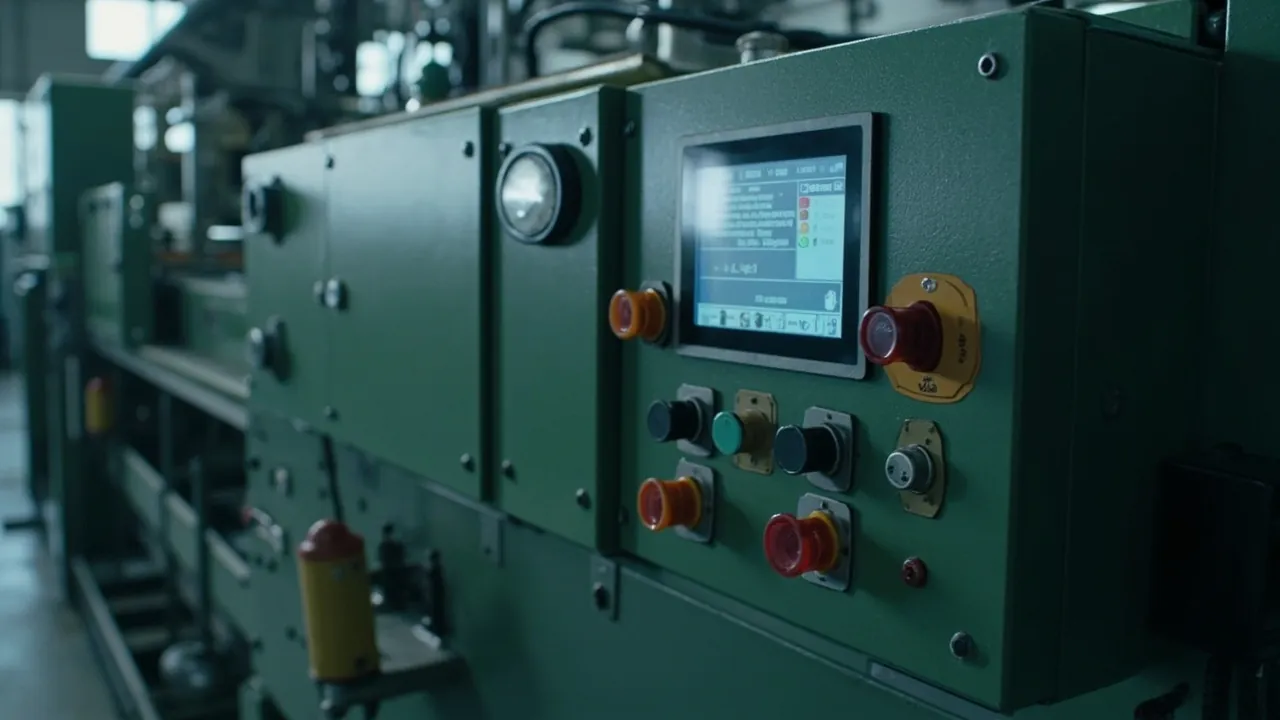
Case one: a machine-side control box on an automotive components line.
Conditions: indoors, cutting oil mist present, ambient 10 to 38 degrees, no direct sun. Inside are a 24 volt supply at 60 watts, a small PLC at 15 watts and a terminal strip. Four cables enter, at 8, 10, 10 and 12 millimetres outside diameter. The box is opened once a day for inspection.
Reasoning: no wash-down, but oil mist is present, so IP65 is sufficient and IP66 unnecessary. The first digit must be 6 because metallic dust and oil mist conduct, so IP65. The box stands beside an aisle used by forklifts, so IK08. The 75 watt dissipation is the real problem: for a 400 by 300 by 180 millimetre box, A is about 0.25 square metres, so delta T equals 75 divided by (8 times 0.25), which is 37.5 kelvin, giving an internal peak of 75.5 degrees. That is far too hot.
The fix: move the 60 watt supply to a separate enclosure outside, dropping internal dissipation to 15 watts and delta T to 7.5 kelvin, an internal peak of 45.5 degrees, which is safe. Alternatively use a cast aluminium housing with fins, raising h above 12 and A to 0.35, giving delta T of 75 divided by (12 times 0.35), about 17.9 kelvin, acceptable but costly.
Material: PC and ABS alloy, or ABS with UV stabiliser since diffused daylight reaches the shop floor. With oil mist present, check the material against the cutting fluid; polycarbonate carries a stress cracking risk, so PC and ABS or a liner is preferable. Flammability V-0, since a power supply is inside. Glands: one M16 at 6 to 10 millimetres and three M20 at 10 to 14 millimetres, entering from the bottom. Latch: a metal toggle, and at one opening per day over 250 days for five years, that is 1250 cycles, so specify a structure rated for 5000.
Case two: an outdoor control enclosure at a municipal sewage pumping station.
Conditions: exposed, southern China, air temperature to 38 degrees and skin temperature reaching 70; hosed down periodically; hydrogen sulphide and damp air in the atmosphere; a variable speed drive at 150 watts plus a controller at 20 watts; six cables; opened quarterly.
Reasoning: hosing means IP66, and since storm water can pond briefly the safer choice is IP67, or else raise the mounting at least 300 millimetres above any water line. Hydrogen sulphide and damp mean metal parts must be 316 or heavily coated, and a plastic enclosure beats metal on corrosion. The 150 watt drive must be cooled: for a 500 by 400 by 200 millimetre box, A is about 0.44 square metres, so delta T is 170 divided by (8 times 0.44), about 48 kelvin, and with 30 kelvin of solar gain the internal peak is 38 plus 48 plus 30, or 116 degrees. Quite impossible.
The fix: mount the drive's heatsink outside the enclosure, or move to a cast aluminium or stainless housing with fins plus forced ventilation with a rain hood and filter, or move the drive indoors and leave only the controller in the box.
The correct answer for this application is usually a zoned design: the control section stays at IP66, and the drive sits in its own ventilated IP54 enclosure, the two joined through wall terminals. No manufacturer can put 150 watts inside a sealed IP66 box and make it work.
Also required: a waterproof vent, because the temperature swing and humidity make breathing severe; desiccant and a humidity indicator card inside; bottom entry with drip loops; raised mounting with a sun shield; and a silicone gasket, which weathers and resists hydrogen sulphide better than nitrile.
Case three: a control enclosure in a high-pressure wash area of a food and beverage plant.
Conditions: washed daily with water at 80 degrees and alkaline detergent at 80 to 100 bar; ambient 5 to 35 degrees; 25 watts of input and output modules; three cables; opened several times a day for changeovers.
Reasoning: IP69K is mandatory. Material must be 316L stainless, since 304 pits under chloride-bearing detergent and plastic ages quickly under 80 degree high-pressure washing and scratches in a way that harbours bacteria. Structurally the requirements are: no ledges where water can stand, continuously ground welds, radiused transitions of 3 millimetres or more for cleanability, latches and hinges free of hygiene dead spaces, and seals of food-contact grade silicone or EPDM with a declaration to that effect.
Cooling is easy here: 25 watts in a 316 housing, which conducts at roughly 15 watts per metre kelvin against 0.2 for plastic, gives a rise well under 10 kelvin.
What matters in this application is hygienic design rather than ingress design. IP69K is the entry ticket; what the auditor examines is cleanability. Obtain the IP69K report, the material certificate including proof of molybdenum content for 316L, the food-contact declaration for the gasket, and surface roughness data, typically Ra of 0.8 micrometres or better.
Ten Common Selection Mistakes
One, specifying IP without IK. Structural strength goes unaddressed and one impact resets protection to zero.
Two, using external dimensions in place of internal ones. The terminal strip does not fit, or it fits but a screwdriver cannot reach it.
Three, doing no thermal calculation at all. Equipment restarts every summer, the cause is never found, and somebody eventually props the lid open, at which point the rating is gone.
Four, drilling holes wherever convenient, on the top or the side. The easiest thing for the installer and the most likely to admit water.
Five, a gland that does not match the cable. An 8 millimetre cable in a gland clamping 10 to 14 millimetres leaves 2 to 4 millimetres of gap once tightened, and there is no seal at all.
Six, using PVC tape or silicone sealant as the primary seal. Tape fails within six months, and acetoxy-cure silicone releases acetic acid while curing, which corrodes terminals and metal parts. Sealing comes from structure, gasket plus closing force. Sealant is only an aid.
Seven, ignoring chemical media. An ABS enclosure at a station using ester-based cutting fluid shows stress cracking within three months.
Eight, using ABS without UV stabiliser outdoors. It chalks and discolours in one to two years, impact strength halves, and a minor knock cracks it.
Nine, not bonding a metal enclosure to earth. If a damaged cable makes a cast aluminium or stainless enclosure live, the whole housing is live, which is a serious personal safety hazard. Metal enclosures need an earth stud and an earth symbol.
Ten, comparing price and not documentation. A quote 30 percent cheaper with no flammability report, no third-party IP report and no material declaration transfers every problem to the machine builder.
Twelve Items to Supply When You Ask for a Quote
Send these twelve to a supplier and you will cut the correspondence dramatically, and you will also filter out the suppliers who are not serious. Anyone who quotes without asking for this information can usually be eliminated immediately.
One, the internal component list: quantity, outline dimensions, dissipation each, including inrush peaks.
Two, the usable internal dimensions required: minimum length, width and height.
Three, the cable schedule: count, measured outside diameter of each, type, meaning power, signal or screened, and whether armoured.
Four, mounting method: wall, pole, buried or rail, and what the mounting surface is made of.
Five, ambient temperature range: minimum, maximum, whether outdoors, whether shaded.
Six, chemical media: a list of liquids and gases present.
Seven, washing and spraying: whether high pressure, water temperature, pressure and frequency.
Eight, mechanical risk: whether impact is possible and an estimate of the energy.
Nine, required ratings: IP and IK separately.
Ten, certification required: target market and the certificates needed, such as CE, UL, CCC, RoHS or explosion protection.
Eleven, customisation: colour, legend printing, hole drawings with positions and sizes, whether rails or terminals are pre-fitted.
Twelve, quantity and lead time: first batch, annual volume, expected delivery.
Incoming Inspection Checklist
Sampling: for a first order or a new supplier, sample to AQL 2.5, or at least 5 percent of the batch with a minimum of five units.
Visual: check for sink marks, flash, cracks and colour variation; check the gasket groove for short moulding or burrs; check that the gasket is fully seated with no twist or break; check that latches open and close smoothly without noise.
Dimensional: verify external and internal dimensions with callipers; check the gap between lid and base with feeler gauges, where uniformity matters more than the absolute value and variation around the perimeter should not exceed 0.5 millimetres.
Sealing: with the lid closed, press the four corners to check for rocking; after even tightening, inspect the impression on the gasket for continuity, dusting the gasket lightly with talc before closing and reopening.
Documentation: third-party IP and IK reports, flammability certificate, material declaration. Critically, check that the model on the report matches the model delivered, because this is the most frequent substitution.
Sampling verification: take one or two units per batch and run a spray or immersion screen, one metre for thirty minutes or a three-minute IPX5 nozzle test, with dry tissue inside as the indicator. It does not replace accredited type testing but it reliably catches assembly faults.
Frequently Asked Questions (FAQ)
Q: Should I specify IP65 or IP67 for an industrial control enclosure, and is the upgrade worth paying for? A: Base it on the actual condition rather than the code. IP65 covers water jets; IP67 covers temporary immersion. The mechanisms differ: one tests the kinetic effect of water at a joint and its ability to drain, the other tests slow penetration under static pressure. The deciding question is whether the enclosure can be submerged. Mounted on the side of a machine, a metre or more above the floor, subject to hosing and rain only, IP65 is enough. Mounted at floor level, in a cable trench, in a pit that holds water, or anywhere storm water can cover it briefly, IP67 is required. Conversely, if the enclosure never meets liquid water and the exposure is dust and oil mist, the first digit matters and the second does not. Spend the money on the real risk rather than chasing the highest code.
Q: My enclosure has to dissipate 80 watts. Can I use a sealed plastic box? A: Run the thermal calculation first, because 80 watts is usually too much for a plastic enclosure cooled only by natural convection. Using delta T equals P divided by h times A: take a 400 by 300 by 180 millimetre plastic box with an effective area of about 0.25 square metres and h at 8, and delta T is 80 divided by 2, which is 40 kelvin. At an ambient of 35 degrees the interior reaches 75, above the 60 degree guideline. There are three routes. Move the large heat sources out of the enclosure and leave only low-power modules inside. Change to a cast aluminium housing with fins, raising the effective coefficient above 12 and the area above 0.35, which brings delta T to about 19 kelvin. Or zone the design, putting the high-power parts in a separate rain-protected ventilated enclosure and keeping the control section at the high rating. No brand can make 80 watts work in a small sealed plastic box.
Q: What is the most reliable way to blank off a spare hole? A: Use a purpose-made plug rated to the same level as the enclosure, preferably in the same material as the glands, nickel-plated brass or stainless rather than plastic, complete with sealing washer and O-ring. Four points. The plug rating must not be lower than the enclosure, so no IP54 plastic cap in an IP66 housing. The thread must match the hole, M20 plug in an M20 hole. Tighten to nominal torque, since too little leaves the seal uncompressed and too much strips the thread in a thin wall. And for outdoor use, confirm that a plastic plug carries UV stabiliser. Where a spare hole is long-term, adding a backing nut inside is more secure, and it should be checked periodically for loosening. Tape, sealant or a home-made plastic patch are never acceptable.
Q: Is a polycarbonate viewing window more likely to fail than an ABS housing? A: It depends what you mean by fail. On impact, polycarbonate is clearly stronger, with notched impact strength typically three to five times that of ABS and better low-temperature toughness, so it is less likely to be broken by a knock. Its real weakness is stress cracking: with residual moulding stress or assembly stress present, contact with oils, migrating plasticisers, some solvents or cleaning agents produces microcracks that then propagate. Three precautions. Do not over-tighten fasteners; use a torque driver set to the nominal value. Keep polycarbonate away from silicone oil, cable jackets that migrate plasticiser, and solvent-based cleaners. And choose a stress-crack-resistant grade or a PC and ABS alloy. On weathering, polycarbonate beats ABS, chalking and discolouring more slowly outdoors, so on that count it has the advantage.
Q: Do I need a metal enclosure outdoors? A: Usually not, and plastic is the better answer in most cases. Metal brings good heat dissipation, since cast aluminium conducts at roughly 96 to 120 watts per metre kelvin against 0.15 to 0.25 for plastic, a difference of three orders of magnitude, plus electromagnetic screening and high mechanical strength. Against that: weight, cost, with 304 stainless running five to eight times ABS, corrosion risk in coastal and chloride environments, and the requirement to bond to earth. Plastic is corrosion resistant, insulating so no earth is needed, light and cheap. The test is this. Above roughly 80 to 100 watts of dissipation, or where screening is needed, choose cast aluminium. In food, pharmaceutical and heavily corrosive coastal service, choose 316L stainless. For the great majority of outdoor low-voltage control, monitoring and communications duties, a UV-stabilised PC or PC and ABS enclosure is the more economical choice.
Q: Does UL 94 V-0 mean it will not burn? A: No. UL 94 assesses the ability to self-extinguish once the ignition source is removed, not non-combustibility. V-0 means that a vertically clamped specimen, after two ten-second flame applications, has afterflame of ten seconds or less per application, fifty seconds or less across five specimens, and no drips that ignite cotton below. The material still burns; it simply stops within the time allowed and does not spread fire through dripping. The value of the rating is limiting fire spread, not fire resistance. Two details are routinely missed. First, V-0 holds only at a stated thickness: V-0 at 1.5 millimetres does not confer V-0 at 3 millimetres, so confirm the rating at the actual wall thickness. Second, V-0 does not assess flammability after long-term thermal ageing, which is why the glow-wire figure GWFI, typically 850 or 960 degrees, is also needed.
Q: A hole has already been drilled in the top of the enclosure. Is there any remedy? A: There is, graded by severity, and the best remedy is to replace the unit. Three levels. If the hole is small and the interior is dry, fit an external fitting with a rain shield, such as an angled cable gland with the outlet facing down, add a sealing washer between the fitting and the wall, and form a drip loop in the cable inside. If a better result is needed, close it from outside with a metal plug of the same rating as the enclosure, with sealing washer and backing nut; that comes closest to the original condition. If the hole is in the centre of the top face on a thin-walled box, no closure will be reliable long-term, so replace the housing or fit a rain cover over the whole top, projecting at least 50 millimetres beyond the edges. One thing to weigh: an enclosure that has been drilled has lost its IP certification, so any subsequent water problem is no longer claimable against the manufacturer.
Q: Can I replace the gasket myself, and does it affect the rating? A: Yes, provided the replacement matches, otherwise the rating falls. Five points. Match the material: silicone or EPDM outdoors, fluoroelastomer with oil present, never an unidentified rubber strip. Match the section: a difference of half a millimetre in diameter or section height can mean too little compression or a lid that will not close. Match the hardness, commonly 40 to 60 Shore A, since too hard will not seat and too soft extrudes. Clean the groove and remove old sealant, and fit the gasket without twisting or stretching it in, because stretching thins the section. Finally tighten the fasteners in diagonal sequence, in stages, to nominal torque. With a genuine spare part of the same type, fitted as described, the enclosure returns to its designed rating. With a substitute, run a spray or immersion screen to confirm.
Closing Notes and Further Reading
Selection is essentially the translation of a vague need into verifiable parameters. The five parameters compress into five sentences.
Specify IP and IK together, because omitting one leaves structural strength to chance. Derive usable dimensions by subtracting wall and rib allowances, and keep 40 percent of the volume free for wiring and cooling. Calculate the heat using delta T equals P over h times A, and keep the internal peak below 60 degrees sustained. Choose material against an actual list of chemical media and the real ultraviolet exposure, not against price. And treat the cable entry system as the highest-risk area: the gland clamping range must cover the measured cable diameter, and holes belong in the bottom.
What remains is process. Fill in the worksheet at kick-off. Supply the twelve items when asking for a quote. Inspect against the checklist on delivery, and confirm that the model on the report matches the model in the box. Done consistently, this reduces failures attributable to the enclosure by an order of magnitude.
JUNZHJIA, made by kexinMaterials in Zhongshan, Guangdong, supplies waterproof control enclosures and sealed electrical boxes in ABS, polycarbonate, PC and ABS alloy, cast aluminium and stainless steel. Third-party reports from IP65 to IP69K and IK07 to IK10 are available, together with flammability and glow-wire certification, OEM and ODM customisation including drilled holes to drawing, printing, pre-fitted rails and terminals, and global volume supply.
- Further reading: Waterproof structural design for outdoor enclosures
- Further reading: Dust protection design in industrial service