

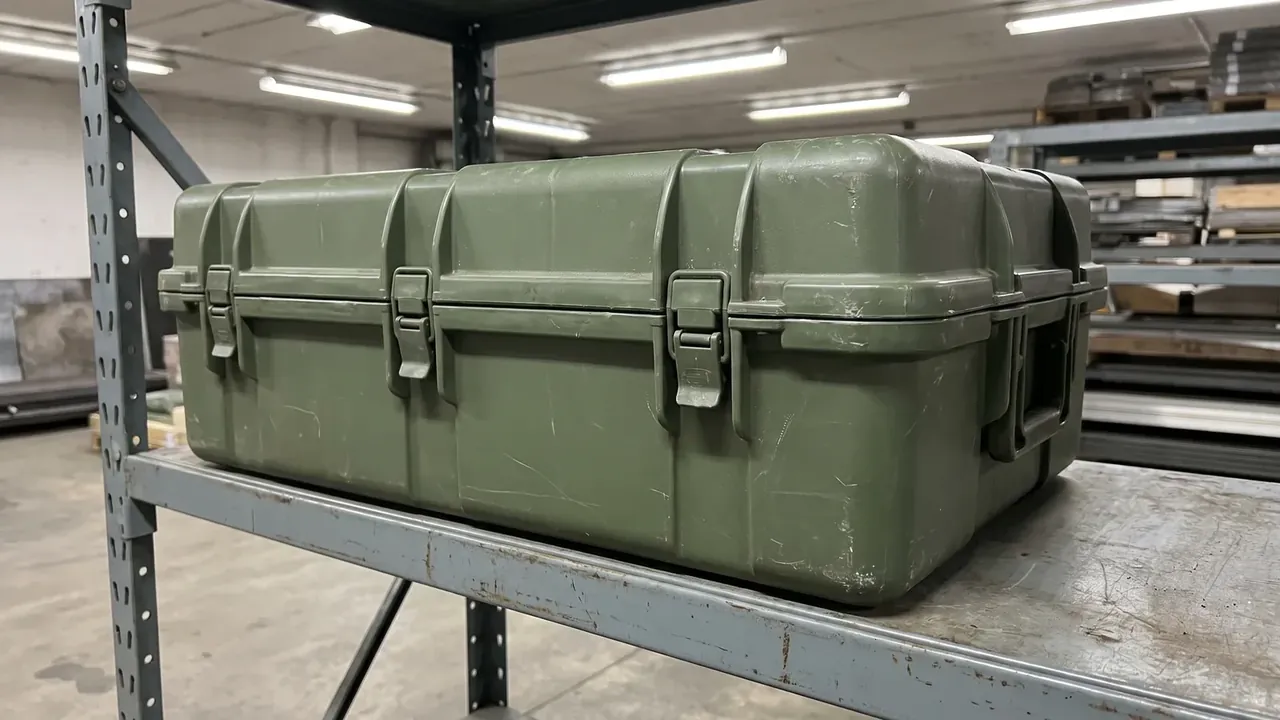
Quick answer: An Industrial grinder/cutter matching plastic box sets the divider step at 8 mm, holding slot shift to 0.6 mm after a 1.0 m drop.
Table of contents
- Divider step height of the Industrial grinder/cutter matching plastic box
- Clearance allocation at the lid press frame
- Accessory slot shift after a drop
- Lid deflection under three-layer stacking
- Step rejection line for matching lots
- FAQ
1. Divider step height of the Industrial grinder/cutter matching plastic box
The outer envelope of an Industrial grinder/cutter matching plastic box measures 580×420×240 mm, the cavity 515×360×175 mm, and the wall 4.1 mm; those figures set the shell stiffness budget. Four moulded dividers split the base into accessory slots, and the 8 mm step along each divider crest is the datum the lid press frame lands on.
A step cut too low lets the frame miss the crest and frees the slot during a drop; a step too high bottoms the frame first and loads the sealing edge. The 8 mm value balances a 4.1 mm wall, a 5.6 kg empty shell and a 12 kg load, so any change there forces a fresh clearance measurement.
An Industrial grinder/cutter matching plastic box is measured on a coordinate bench with the shell flat on a granite plate and no clamp on the base, or the slight warp of a 4.1 mm wall folds into the reading.
2. Clearance allocation at the lid press frame
The lid press frame carries the closing-direction restraint on an Industrial grinder/cutter matching plastic box, bearing on the 8 mm step to give each slot a fixed upper limit. The clearance between frame underside and divider crest is what this section allocates: zero jams the frame, too much lets the slot travel upward and strike it.
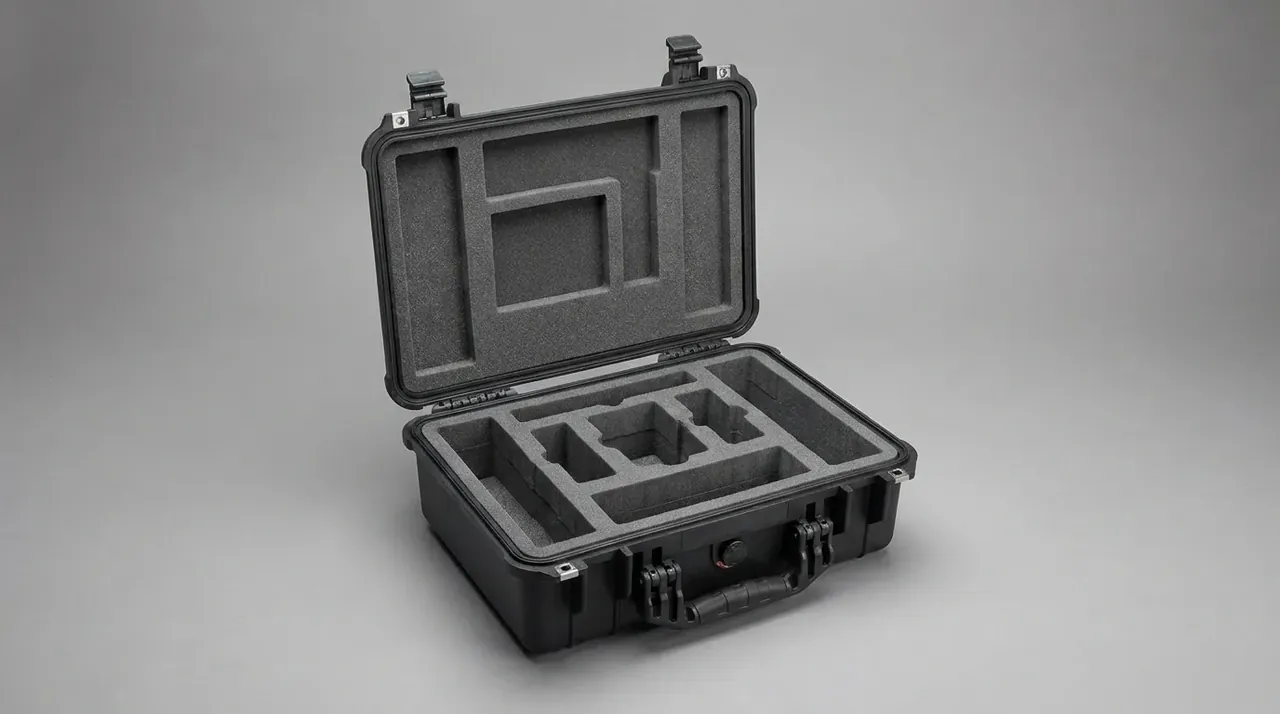
Clearance is set cell by cell across the four dividers, not as one case-wide mean. Four catches at 390 N each are closed in diagonal order, then the four corner clearances are re-read with a feeler gauge and pulled to one band. A wide cell leaves its slot room to move in a drop; a tight cell dents the crest after repeated openings.
The frame is a thin rib with a return flange, held to the step by catch preload; a single gasket runs the mouth and closes the lid-to-rim gap. A hydrostatic hold method benchmarks the interface behaviour associated with IP65 with the lid at working height, treating frame, step and gasket as one joint. The grade is a reference, not a label attached in advance. Mouth flatness shifting after a 1.0 m drop sends clearance back for a cell-by-cell re-read.
3. Accessory slot shift after a drop
The slot criterion for an Industrial grinder/cutter matching plastic box is ≤0.6 mm shift after a 1.0 m drop. Each slot wall is marked and logged on the coordinate bench before the drop, then the same numbers are re-read and the largest offset taken. The reading is slot creep against the base datum, not divider bending.
| Step grade | Frame clearance | Post-drop slot shift |
|---|---|---|
| 6 mm | 0.4 mm | 0.9 mm |
| 8 mm | 0.2 mm | ≤0.6 mm |
| 10 mm | 0.0 mm | ≤0.6 mm |
A 6 mm step with 0.4 mm clearance reaches 0.9 mm and fails; 8 mm with 0.2 mm clearance holds ≤0.6 mm; 10 mm closes the clearance to zero and the lid fights to latch. An Industrial grinder/cutter matching plastic box is judged on the whole four-cell pattern, since all cells moving together is base flex while one high cell points to its own clearance.
4. Lid deflection under three-layer stacking
The stacking side of an Industrial grinder/cutter matching plastic box is held to ≤1.4 mm lid deflection at three layers for 24 h. Boxes sit mouth-up and centred, the hold clock starts once load settles, and five checkpoints at the lid centre and four edge midpoints give the largest displacement as the reading.

Deflection follows the 4.1 mm wall, the lid ribs and catch preload. An Industrial grinder/cutter matching plastic box takes base load and lid pressure on one shell at once, the worst combination rather than an empty box.
| Slot number | Load | Shift reading |
|---|---|---|
| S1 | 12 kg | 0.4 mm |
| S2 | 12 kg | 0.5 mm |
| S3 | 12 kg | 0.6 mm |
| S4 | 12 kg | 0.3 mm |
A second reading 30 min after unloading separates elastic recovery from residual set. Both constraints hold only when all four cells stay within ≤0.6 mm and lid deflection stays under ≤1.4 mm.
5. Step rejection line for matching lots
Drop and stack results land on one lot sheet before an Industrial grinder/cutter matching plastic box ships. The step rejection line is tied to the 8 mm nominal: any divider point below it is rejected, and surplus on the broad faces cannot average it out. Beside it sit the 1.0 m drop shift and the three-layer 24 h deflection columns, all three passing for release.
| Deflection reading | Verdict | Action |
|---|---|---|
| ≤1.0 mm | Pass | Release directly |
| 1.0–1.4 mm | Retest | Re-run stack and recheck step |
| >1.4 mm | Reject | Inspect step height and catch preload |
The record needs lot number, step points, frame clearance, drop face, slot shift and deflection reading; without the step column a failed shell cannot be traced to a short mould or a mis-set catch. Sampling is layered by lot, with divider-root pieces pulled aside because their rejection share runs above the broad faces. A rejected shell is isolated rather than fed into the next lot, and its neighbours are retested alongside. Two retest verdicts in one lot send every step height back through the coordinate bench. Records are filed by lot and a judged reading is not edited later. A 4000-cycle rig run re-measures frame sag once more, and only a reading ≤0.3 mm joins the release sheet.
Conclusion
The specification of an Industrial grinder/cutter matching plastic box reduces to three interlocked readings: ≤0.6 mm slot shift after a 1.0 m drop, ≤0.3 mm frame sag after 4000 cycles, and ≤1.4 mm lid deflection under three layers for 24 h. They watch the 8 mm divider step, the frame clearance and the lid stiffness of a 4.1 mm wall in turn. JUNZHIJIA logs step points, slot shifts and stacking deflection on one sheet before any lot is released.
Related Reading
- Power tool carrying case loading and site handling
- Portable power tool plastic latch case
- Power tool and lithium battery case design
- Surface grinder component case protection
Related Products
- 8 Series — Gun Cases; Military Equipment Cases; Camera Equipment Cases; Drone Cases; Watch Cases; Knife Cases; First Aid Cases; Electronics Equipment Cases
- WL8-2812 PP Gun Case — model WL8-2812
- All protective cases and toolboxes: 7 series, 158 models