

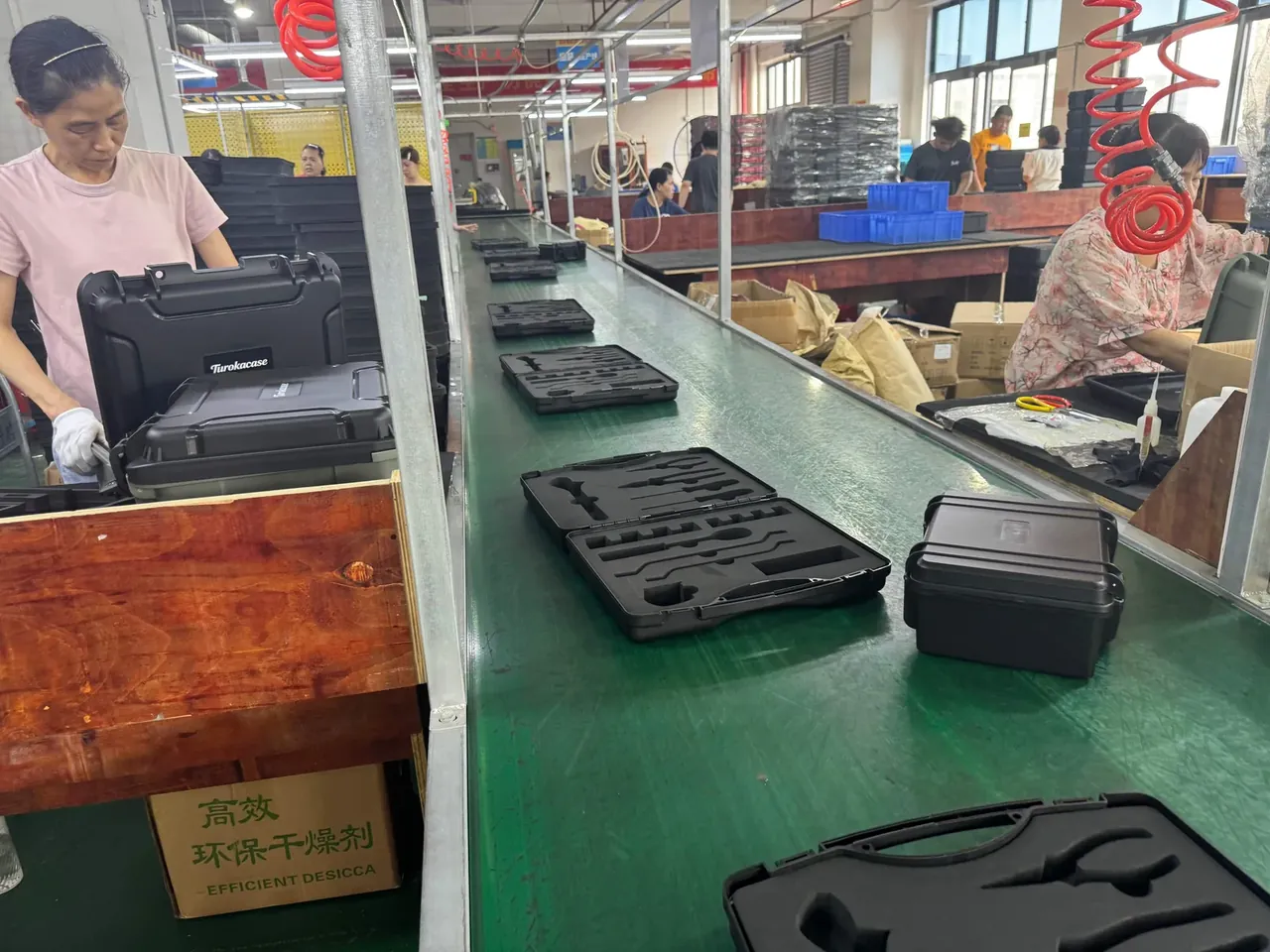
Quick answer: Industrial sensor tester latch briefcase lid sag rests on latch tongue overlap 5.4 mm and rim mould offset 0.4 mm, holding sag under 0.6 mm at 5000 cycles.
Table of contents
- Latch tongue overlap of the Industrial sensor tester latch briefcase
- Rim mould offset of the shell mouth
- Lid sag by open-close cycle
- Tongue wear after salt spray recheck
- Overlap convergence across briefcase batches
- FAQ
1. Latch tongue overlap of the Industrial sensor tester latch briefcase
Lid sag is the joint give of tongue overlap and rim mould offset; latch tightness alone hides the margin. The tongue is the metal tab by which the lid catches the rim, and overlap is how far it enters the seat. Overlap sets how much the closed lid is held and whether each cycle's displacement is absorbed. Outer dimensions of 480×355×165 mm, an inner cavity of 420×295×110 mm and a 3.7 mm wall leave fixed travel for the tongue. Below a limit the lid still drops after closing, so the rim sinks each time. The Industrial sensor tester latch briefcase keeps a flat rim straight so the tongue seats firmly.
The baseline overlap of 5.4 mm was set on a test bench. Rim height was measured at an empty 3.3 kg and a loaded 6 kg: below the baseline the loaded sag is larger, while at 5.4 mm the two converge, which says the tongue has taken hold. This step of the Industrial sensor tester latch briefcase concerns only the fit between tongue and seat, and says nothing about what sits inside the case.
| Overlap grade | Loaded behaviour | Effect on rim height |
|---|---|---|
| Below baseline | Rim sinks cycle by cycle | Least margin |
| Baseline 5.4 mm | Sag absorbed by tongue | Matches 110 mm cavity |
| Above baseline | Sag held but opening stiff | Squeezes seat travel |
2. Rim mould offset of the shell mouth
The tongue governs only the catch point; the whole rim still needs the upper and lower shells aligned. A rim mould offset of at most 0.4 mm in the Industrial sensor tester latch briefcase is the mismatch of the parting faces at the mouth; too large an offset loads the two latches unevenly, so one tongue slackens first and the rim drops on that side.
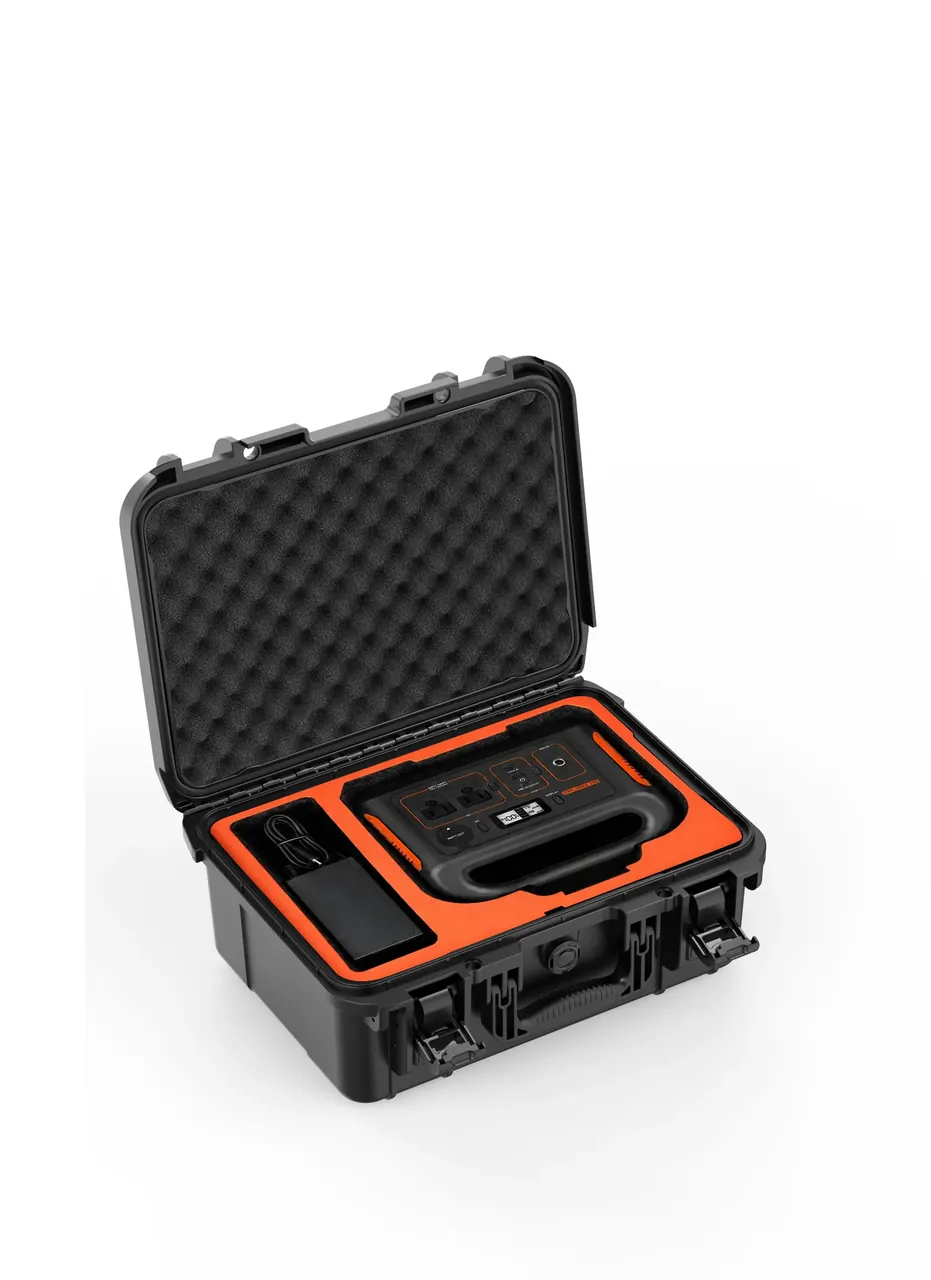
Mould offset and tongue overlap are a pair, so offset is read with overlap. A 5.4 mm overlap with an offset at or below 0.4 mm holds the rim end to centre; lengthen the tongue without tightening offset and one side still gives. Two latches rated at 330 N pass force into the seat, one seal ring at 18% compression stops spring-back, and the rim is checked against water spray by the IP65 method.
Offset is mould-side and overlap catch-side; the reading is the pair's outcome.
3. Lid sag by open-close cycle
The open-close sequence runs to 5000 cycles with lid sag measured after each one, the criterion being sag still at or below 0.6 mm at the 5000th cycle. The bench for the Industrial sensor tester latch briefcase joins the cycle readings into one curve that says more about progressive give than any single last reading, and a 6 kg load runs throughout.
| Open-close cycle | Lid sag reading | Verdict |
|---|---|---|
| First cycle | Clearly below 0.6 mm | Pass |
| Mid run | Near the threshold | Track |
| 5000th cycle | Holds 0.6 mm | Converged |
Lid sag grows as the tongue gives a fraction at a time; a steeper late slope means the offset yields first and the tongue is then worn. A 1.0 m drop and 5000 cycles are logged apart, one for shell impact and one for tongue life, each against its own threshold. The Industrial sensor tester latch briefcase keeps the two ledgers apart so impact margin cannot mask tongue decay.
4. Tongue wear after salt spray recheck
The tongue is metal, so repeated opening plus a salt-laden atmosphere leaves a polished trace on the contact face. The Industrial sensor tester latch briefcase caps tongue wear at 0.15 mm, the loss of contact-face thickness across a 96 h salt spray run rather than a loss in the lid itself.
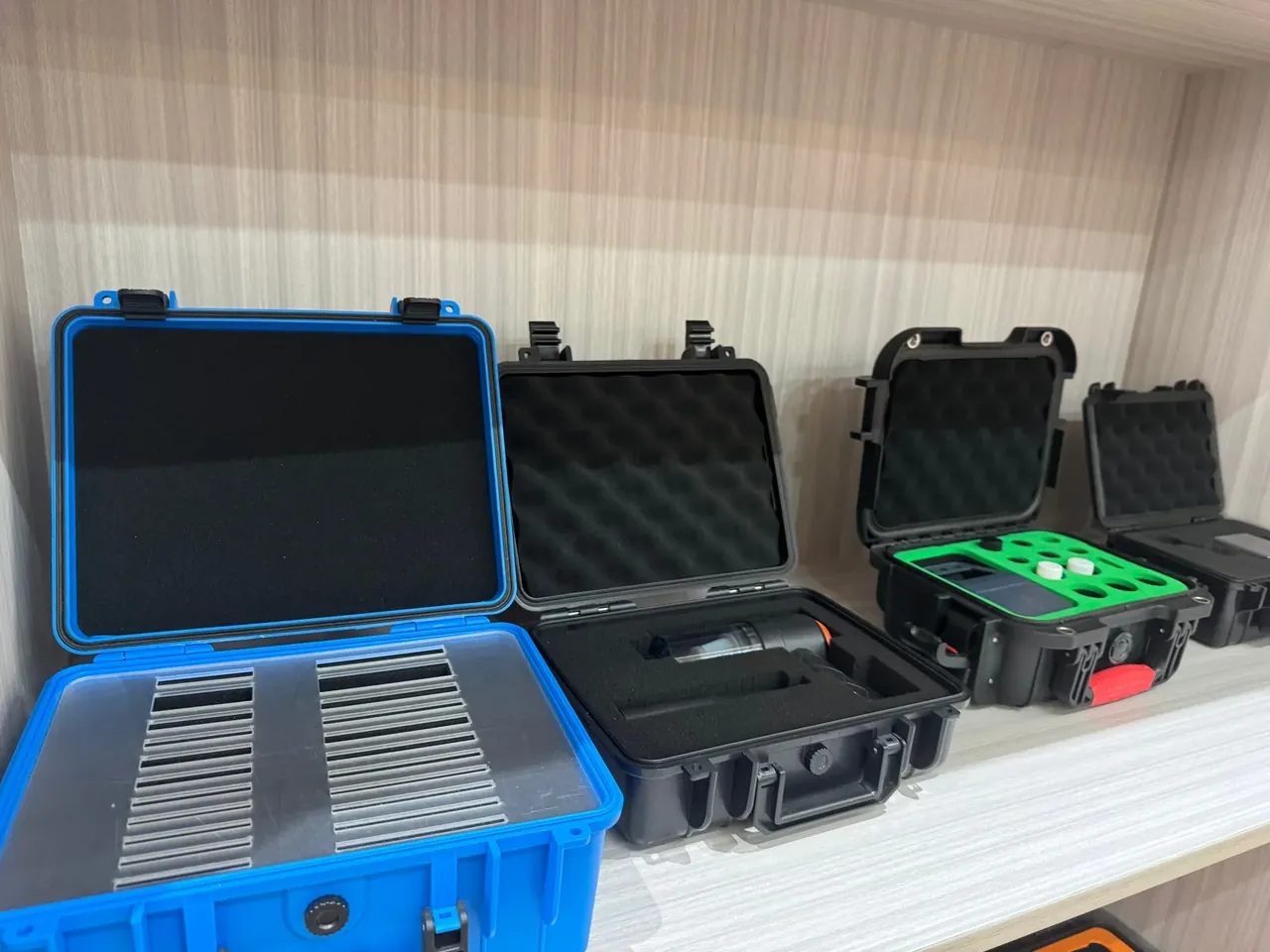
Once wear bites, the tongue presses less far and sag falls faster at the same cycle count, so salt spray recheck sits beside open-close recheck. The Industrial sensor tester latch briefcase keeps both numbers on one row under a 96 h salt spray and a 6 kg load, alternating 5000 cycles against the spray recheck.
5. Overlap convergence across briefcase batches
Put overlap and sag reading from three batches side by side, change only tongue overlap per batch, lock the mould offset at or below 0.4 mm and hold a 6 kg load, and the difference is attributed cleanly to overlap, which is why the Industrial sensor tester latch briefcase files results by batch.
| Sag reading | Converged | Action |
|---|---|---|
| Clearly above 0.6 mm | No | Whole batch back to retool |
| Holds 0.6 mm twice running | Yes | Write into drawing |
| Holds but opening stiff | No | Trend record only |
The overlap convergence value is locked one step before sag first reaches 0.6 mm; a shorter tongue combination goes back to retooling as a whole batch.
The value settles at 5.4 mm with the offset at or below 0.4 mm on the drawing. Batch release reads 5000 cycles, tongue wear at or below 0.15 mm and a 96 h salt spray together; a crossed line goes back to the tongue-and-mould pairing. The Industrial sensor tester latch briefcase freezes this criterion, and JUNZHIJIA has the batch moulded to drawing by Kexin New Materials (Guangdong) Co., Ltd., with bench readings kept per shell batch.
Conclusion
The rim stability of the Industrial sensor tester latch briefcase comes down in the end to how tongue overlap pairs with mould offset. A 5.4 mm overlap, an offset at or below 0.4 mm, lid sag at or below 0.6 mm after 5000 cycles and tongue wear at or below 0.15 mm make tongue location repeatable. Compare the three tables of overlap grade, open-close cycle and sag reading to see whether every batch converges alike.
Related Reading
- Industrial auto repair plastic latch briefcase
- Industrial endoscope protective hard latch case
- Industrial tester tools hard briefcase
- Industrial sensor drop-proof portable case
Related Products
- 8 Series — Gun Cases; Military Equipment Cases; Camera Equipment Cases; Drone Cases; Watch Cases; Knife Cases; First Aid Cases; Electronics Equipment Cases
- WL8-2812 PP Gun Case — model WL8-2812
- All protective cases and toolboxes: 7 series, 158 models