

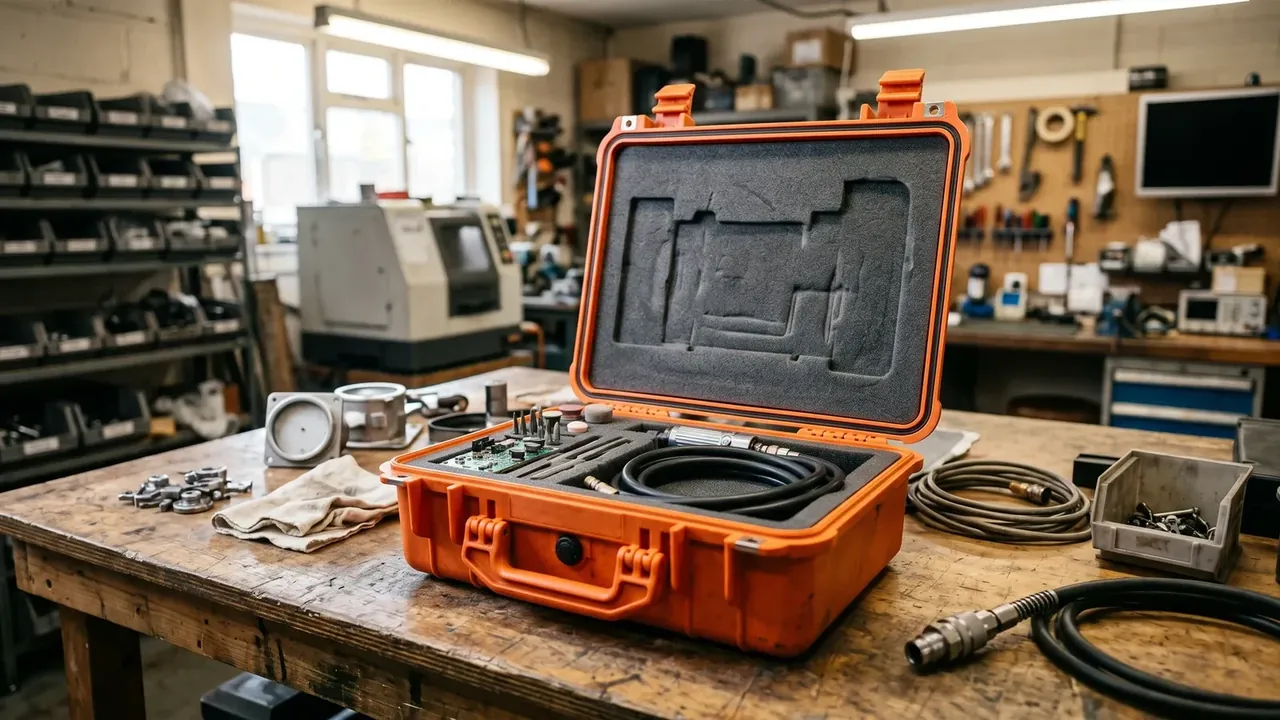
Quick answer:An Industrial Testing Equipment Case holds a calibration state, not a housing: a 5 °C internal rise and a 1.2 m drop decide the recalibration cycle.
Table of contents
- Secure and bond before the van leaves
- Vibration and attitude records on the road
- Opening sequence once on site
- What the case does to the recalibration cycle
- Temperature, humidity and condensation
- FAQ
1. Secure and bond before the van leaves
Instruments rarely fail in the metrology room; they fail on the way out. A loose pack lets the unit absorb road energy itself, while a pack that is too tight pushes stress from the shell into the front panel.
Location has to work in three directions, and not by pressure. Vertical play goes into liner compression, fore-and-aft travel is stopped by locating blocks, and the unit cannot slide at all. An Industrial Testing Equipment Case cavity cut to the outline of the instrument makes the cavity wall the locator and the floor the seat, so the unit sits rather than clamps.
A 300 N static load is the acceptance step. Close the lid, press 300 N at the centre, and the deflection must not reach the panel or leave a hard spot in the liner. Egg-crate lid foam spreads that load into the walls before it reaches an edge of the instrument.
Static control is not optional here. The shell is an insulator, friction during handling collects charge on the liner, and a sensitive input stage does not survive many discharges. An anti-static liner plus a bonded path from the instrument housing to the body gives the charge somewhere to go.
2. Vibration and attitude records on the road
Road vibration is a continuous spectrum with hard handling knocks on top. Liner density for an Industrial Testing Equipment Case sits at 25–45 kg/m³: below that the instrument is not held, above it the liner transmits. One case can mix densities, denser under the heavy end.
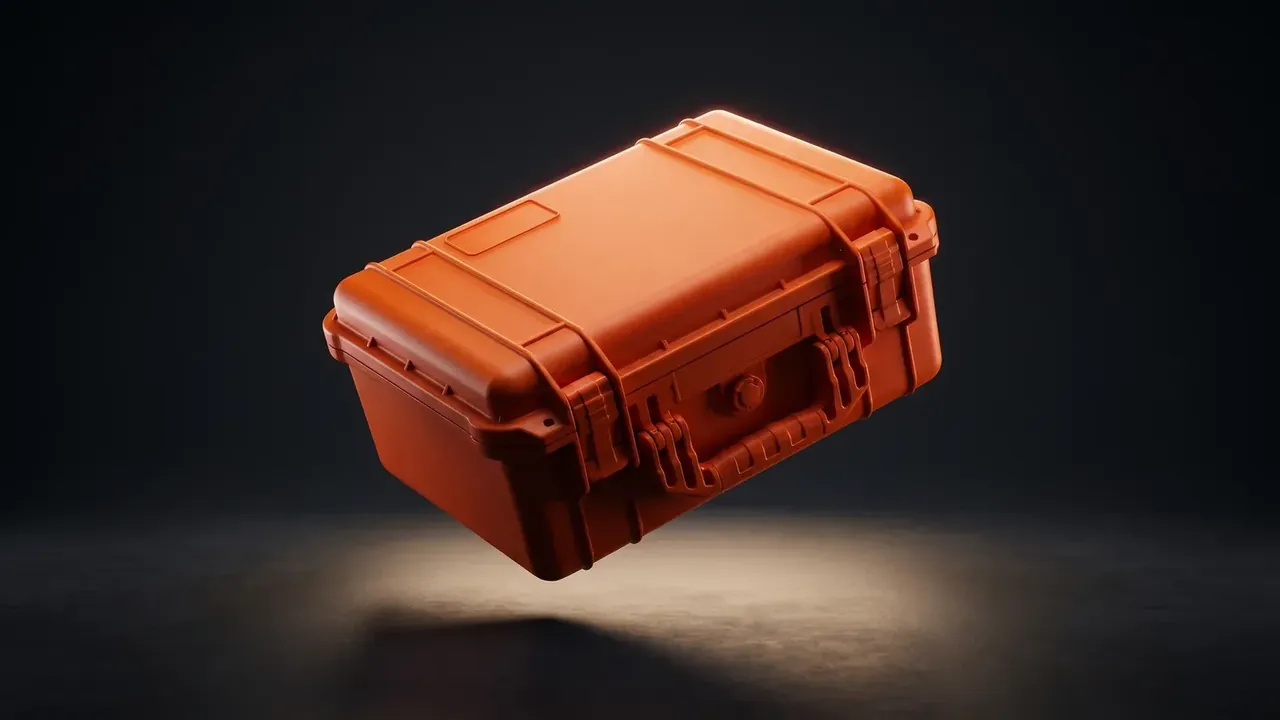
Drop testing of the Industrial Testing Equipment Case runs at 1.2 m. After six faces the case must stay closed, latches engaged and cavity intact, with no movement inside. The face that rejects most designs is the corner, where force enters diagonally, the liner shears, and the next drop opens along that shear.
Attitude labels record tilt, shock and tip-over, and none proves the instrument is still good. If three boxes in a batch change colour, those units get checked first.
| Leg | What the case must hold | Field check | Symptom when it fails |
|---|---|---|---|
| Packing | Location firm, no hard spot under the lid | 300 N on the lid, no contact | Panel dents, keys feel wrong |
| Transit | Liner not collapsed, latches engaged | Still closed after a 1.2 m drop | Instrument shifts, probes roll loose |
| Unloading | Corners sound, attitude traceable | Labels clear, corners uncracked | Readings drift with no known cause |
3. Opening sequence once on site
Site time for an Industrial Testing Equipment Case is often squeezed into 10 min, which is why the opening order cannot be improvised. Set the case flat before releasing anything so liner and instrument settle back; open a lid while the box lies on its side and the instrument follows the liner slope down to the panel.
In an Industrial Testing Equipment Case, weight decides the order, not position. Cables, probes and fixtures come out first, the instrument last; leave the small parts in place and they ride out on the instrument. If the lid carries straps, undo them before lifting, or a lid caught halfway swings back onto the rim.
Do not power up on arrival. The case has sat for hours at a temperature the site does not share, and switching on stacks warm-up on top of that gap. No Industrial Testing Equipment Case removes the gap; a good one narrows it, and waiting for the reading to settle is practice rather than caution.
Repacking fails more often than unpacking. Small parts go back into their pockets, and latches close diagonally: one side at a time lifts the lid edge and the next trip lets water in.
4. What the case does to the recalibration cycle
The 12-month cycle is set by the instrument, but the Industrial Testing Equipment Case bends it either way: two units on the same schedule arrive in very different states.
Three paths carry that influence. Vibration is direct: wrong density or a loose locator lets the instrument shake inside its own box, and a month accumulates what should take half a year. Temperature is slower, adding distortion to an optical datum degree by degree. Humidity is quietest, since one condensation event changes board leakage and the reading follows.
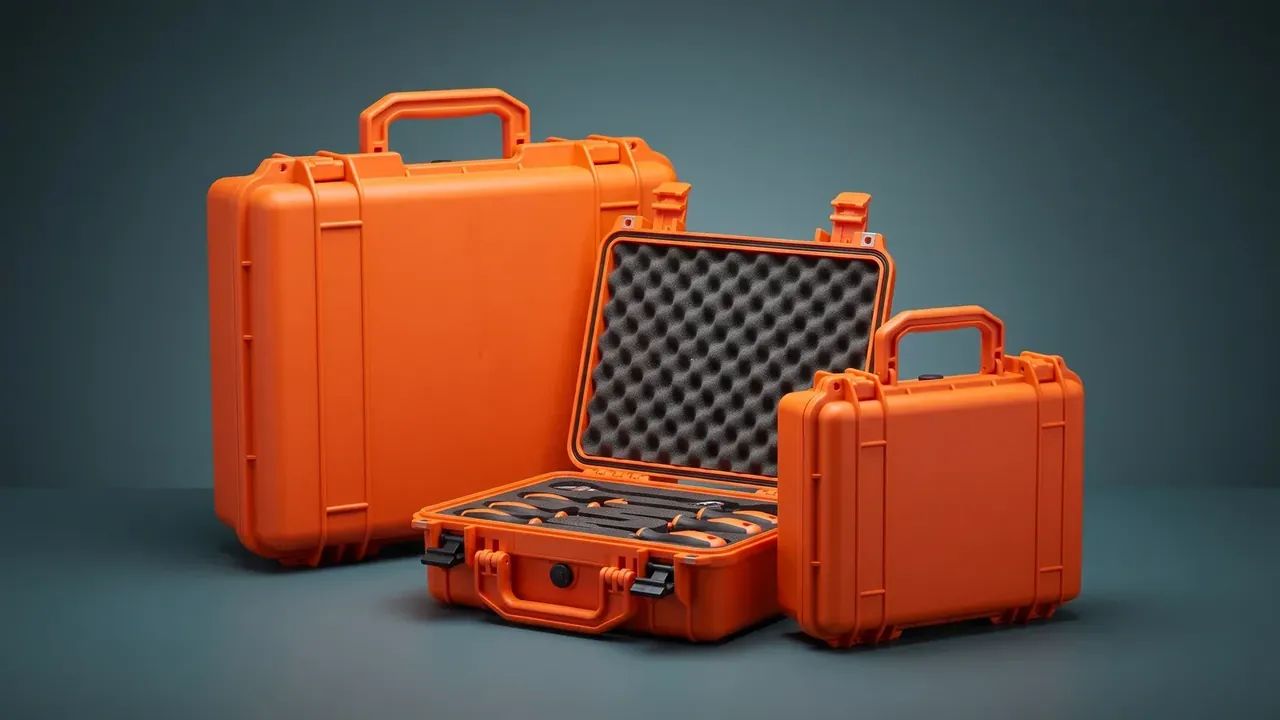
Case verdict: if the reading after transport deviates by more than one third of the instrument's maximum permissible error, the case is judged to have protected it inadequately.
That rule puts responsibility in one place: cross a third of the tolerance band and the Industrial Testing Equipment Case is examined before the instrument is doubted.
| Deviation at recalibration | Most likely case-side cause | Where to look first |
|---|---|---|
| Whole reading shifted | Drop or hard knock, cavity movement | Corner cracks, locating blocks |
| Repeatability worse | Liner collapsed, unit micro-moving | Compression set of the liner |
| Drifts only in wet weather | Condensation with no escape path | Gasket and breathing route |
5. Temperature, humidity and condensation
Internal rise has to stay within 5 °C, a hard line for the Industrial Testing Equipment Case. A van in direct sun heats its skin far above ambient, and wall thickness, an air gap and a light colour have to keep that out; dark shells run hotter on long summer runs.
Condensation is a difference plus moisture. Move a case from a 5 °C cold store into a 25 °C shop and the wall sees a 20 °C split, so water forms outside first and on the instrument the moment the lid opens. The fix is a controlled escape route: a gasket stops water, while vapour still needs a path, and one small breathing point low on the side wall beats a fully sealed box.
Feel the wall before opening and wait if it is much colder than the hand; after opening, leave the instrument in its liner to warm and keep the lid ajar.
Dry the interior before repacking. A liner that looks dry can still be damp under the hand, and a damp liner turns the Industrial Testing Equipment Case into a moving humidity source. JUNZHIJIA puts the breathing point low on the side wall of this body, so vapour travels down and away.
Related Reading
- Measurement instrument case: matching scenes to configurations
- Field testing equipment case: the rough leg of the trip
- IP67 NDT instrument case: where immersion ends and jets begin
- Calibration equipment transport case: slot pitch and base flatness
- Factory inspection tool briefcase: one item, one pocket
Related Products
- 8 Series — Gun Cases; Military Equipment Cases; Camera Equipment Cases; Drone Cases; Watch Cases; Knife Cases; First Aid Cases; Electronics Equipment Cases
- WL8-2812 PP Gun Case — model WL8-2812
- All protective cases and toolboxes: 7 series, 158 models