

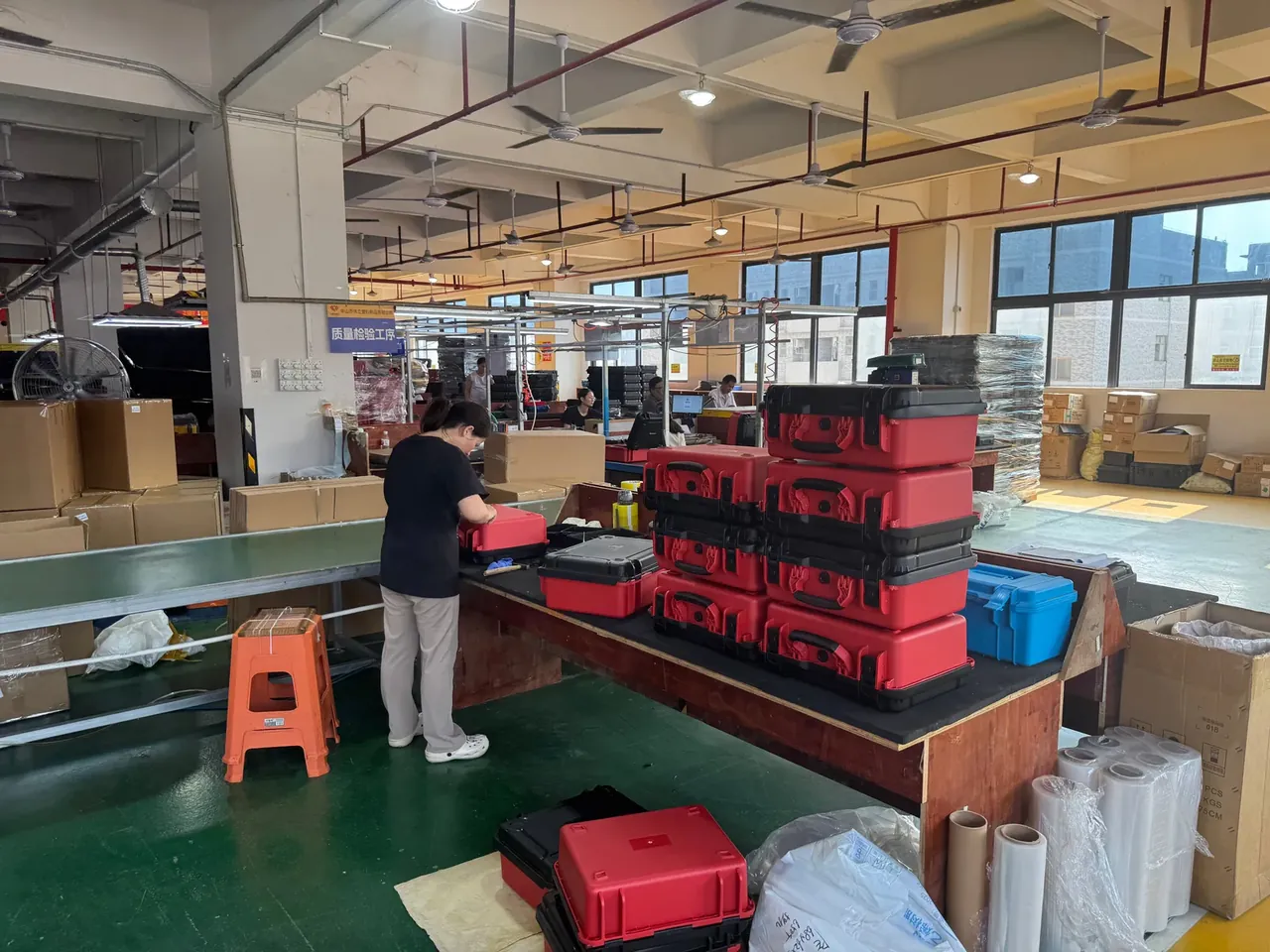
Quick answer: JIS case tolerance is set by three grades, f, m and c, giving ±0.5, ±1.2 or ±2.0 mm at 600 mm, all measured at 20±2 ℃ with three readings averaged.
Table of contents
- Three Grades, One Letter on the Drawing
- What ±0.5, ±1.2 and ±2.0 mm Buy You
- Flatness, Gap and Shrinkage: Building the Tolerance Chain
- Measuring Conditions: 20±2 ℃, Three Readings, 0.02 mm
- FAQ
1. Three Grades, One Letter on the Drawing
A 600 x 400 x 300 mm export case is not specified by wall thickness. It is specified by the ± trailing each outside dimension, and by the grade that ± belongs to: f for fine, m for medium, c for coarse. Japanese buyers look for that letter first, and most of the tolerance argument happens there.
Tighter grade, higher mould and inspection cost. Looser grade, a lid that will not close.
JIS B 0405 supplies the grading language, not a set of finished numbers. Its table steps up with nominal size bands and addresses machined dimensions that carry no individual tolerance. A moulded shell cannot borrow that table directly, because shrinkage, tool tolerance and draft all sit between the cavity and the finished part. What the drawing states is an acceptance limit for the moulding; the standard only names the grade.
| Grade | Acceptance at 600 mm | Where it is used | How it is checked |
|---|---|---|---|
| f fine | ±0.5 mm | Seal groove, panel face, liner seats | CMM or gauge, every part |
| m medium | ±1.2 mm | Lid joint, latch and handle bosses | 0–1000 mm caliper, sampling |
| c coarse | ±2.0 mm | Outline, base, lifting lugs | Tape and template, first-off |
2. What ±0.5, ±1.2 and ±2.0 mm Buy You
At 600 mm the grades sit 1.5 mm apart end to end, and that 1.5 mm decides whether a liner drops in or has to be forced.
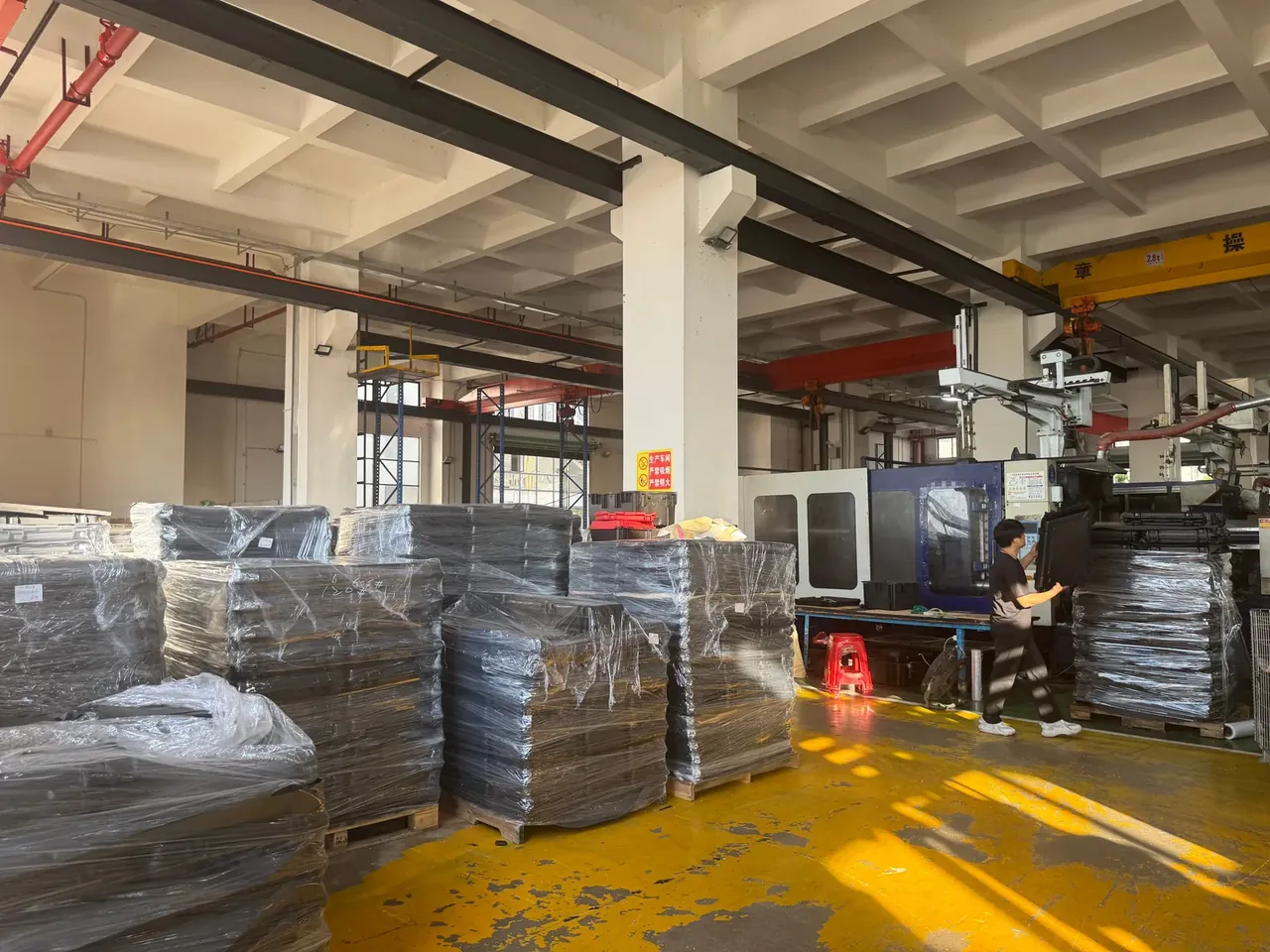
Grade f is reserved for surfaces that mate. A seal groove runs at ±0.5 mm with flatness held to 0.5 mm per 100 mm, so the gasket compresses evenly instead of hanging over a hollow. Panel mounting faces belong here too: a 0.5 mm error in stud spacing tilts the panel, and the shell deforms as the screws come down.
Grade m is the default for export shells. Lid joint, latch seats and handle bosses run at ±1.2 mm, with the gap held separately under 0.8 mm. The tool does not change, but every batch has to be measured, because once the process window drifts the 600 mm direction moves first.
Grade c covers what does not mate. Outline, base and lifting lugs are fine at ±2.0 mm, and the caliper gives way to a tape. Marking a c-grade surface as m-grade doubles inspection hours without changing one accept-or-reject decision.
| Measured item | Drawing tolerance | Method | If it drifts |
|---|---|---|---|
| Length, 600 mm | ±1.2 mm | Caliper, median of three | Recheck melt and pack pressure |
| Width, 400 mm | ±1.2 mm | Same | Compare measured shrinkage |
| Height, 300 mm | ±1.2 mm | Depth gauge on a plate | Check ejection and cooling |
| Flatness | 0.5 mm per 100 mm | Plate and feeler gauge | Adjust pack pressure |
| Joint gap | ≤0.8 mm | Feeler at eight points | Fit, or swap the lid |
| Wall | 3.0 ±0.15 mm | Ultrasonic gauge | Check cavity and shot size |
3. Flatness, Gap and Shrinkage: Building the Tolerance Chain
Tolerance is a chain, not a number. The ±1.2 mm splits into ±0.05 mm of toolmaking, about 0.6 mm of shrinkage variation, 0.3 mm of assembly and post-moulding movement, and 0.03 mm of measurement uncertainty underneath.
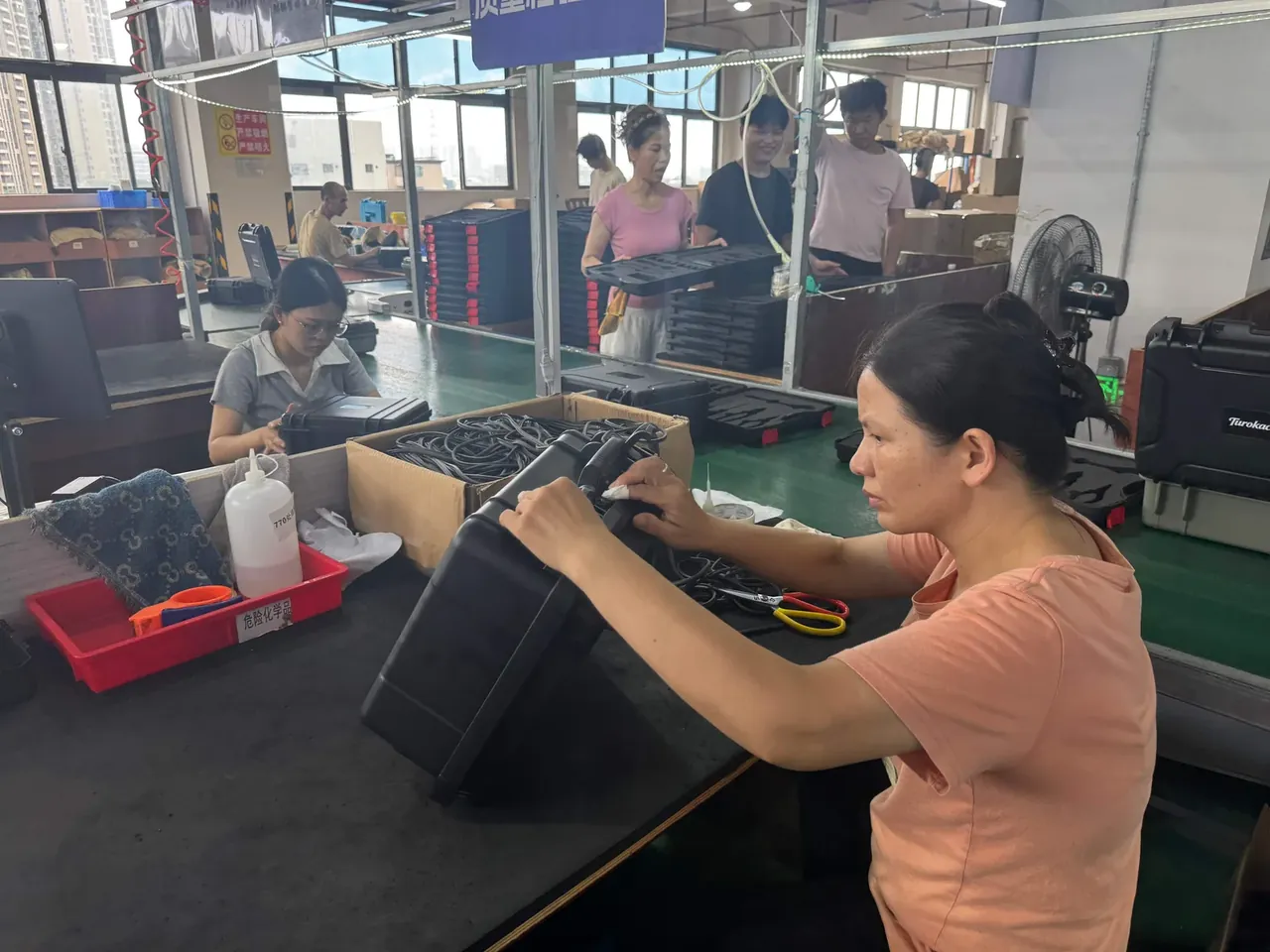
Shrinkage is the largest link. Polypropylene runs at 1.5% to 2.0%, so a 600 mm direction contracts 9 mm to 12 mm and the cavity is cut oversize by that range. A wide range covers more grades; a narrow one settles size but forces a tool change later.
Flatness and gap must be read together. Past 0.8 mm of joint gap the gasket never seats, yet flatness at 0.5 mm per 100 mm still allows 3 mm of bow across 600 mm. Sealing faces therefore take a separate full-length limit of 0.6 mm.
Step mismatch is the quiet third item: a lid offset above 0.4 mm is felt by hand and looks worse after painting, and no tolerance block ever shows it.
4. Measuring Conditions: 20±2 ℃, Three Readings, 0.02 mm
Dimensions are taken at 20±2 ℃, after the shell rests four hours so the wall reaches one temperature. A shell straight off the line reads about 0.5 mm long over 600 mm at a 40 ℃ surface.
Resolution should be 0.02 mm or better. Outside dimensions use a 0–1000 mm caliper or a CMM, anything under 300 mm uses a 0–300 mm caliper, and flatness uses a plate with feeler leaves from 0.02 mm.
Three readings per dimension, median recorded. A spread above 0.1 mm sends the part back, because the cause is usually grip rather than geometry. Clamping above 20 N flattens a thin wall and pulls the reading down 0.1 to 0.2 mm, enough to turn a pass into a false reject.
Temperature can be calculated instead of argued. Polypropylene expands about 1.5 x 10⁻⁴ per ℃, so a 600 mm part moves 0.09 mm per degree, or 7.5% of the ±1.2 mm band. An uncontrolled floor drifts 0.3 mm between morning and afternoon.
| Condition | Setting | Reason |
|---|---|---|
| Room temperature | 20±2 ℃ | 1 ℃ shifts a 600 mm part by 0.09 mm |
| Soak time | 4 h | Wall within 1 ℃ through thickness |
| Resolution | 0.02 mm | 1.7% of the ±1.2 mm band |
| Readings | 3, median taken | Removes grip and reading scatter |
| Clamping force | 20 N maximum | Thin walls compress and read small |
| Record | Temperature, gauge ID, readings | Lets a dispute be reconstructed |
Conclusion
JIS case tolerance is a grading decision before it is a measurement: f buys fit, m buys flexibility, c buys cost. On a 600 x 400 x 300 mm shell those grades read ±0.5, ±1.2 and ±2.0 mm, and the figures hold only at 20±2 ℃ with three readings averaged. Put grade, method and decision rule on one inspection card, and the argument stops at the drawing.
This article covers case-side specifications only and does not address any handling, loading or use of the contents.
Related Reading
- Case tolerance: 2 mm versus 0.5 mm
- Compliance documents for the Japanese market
- Outgoing inspection checklist for cases
- How AQL 2.5 sampling works
- Reading a third-party test report
Related Products
- 8 Series — Gun Cases; Military Equipment Cases; Camera Equipment Cases; Drone Cases; Watch Cases; Knife Cases; First Aid Cases; Electronics Equipment Cases
- WL8-2812 PP Gun Case — model WL8-2812
- All protective cases and toolboxes: 7 series, 158 models