

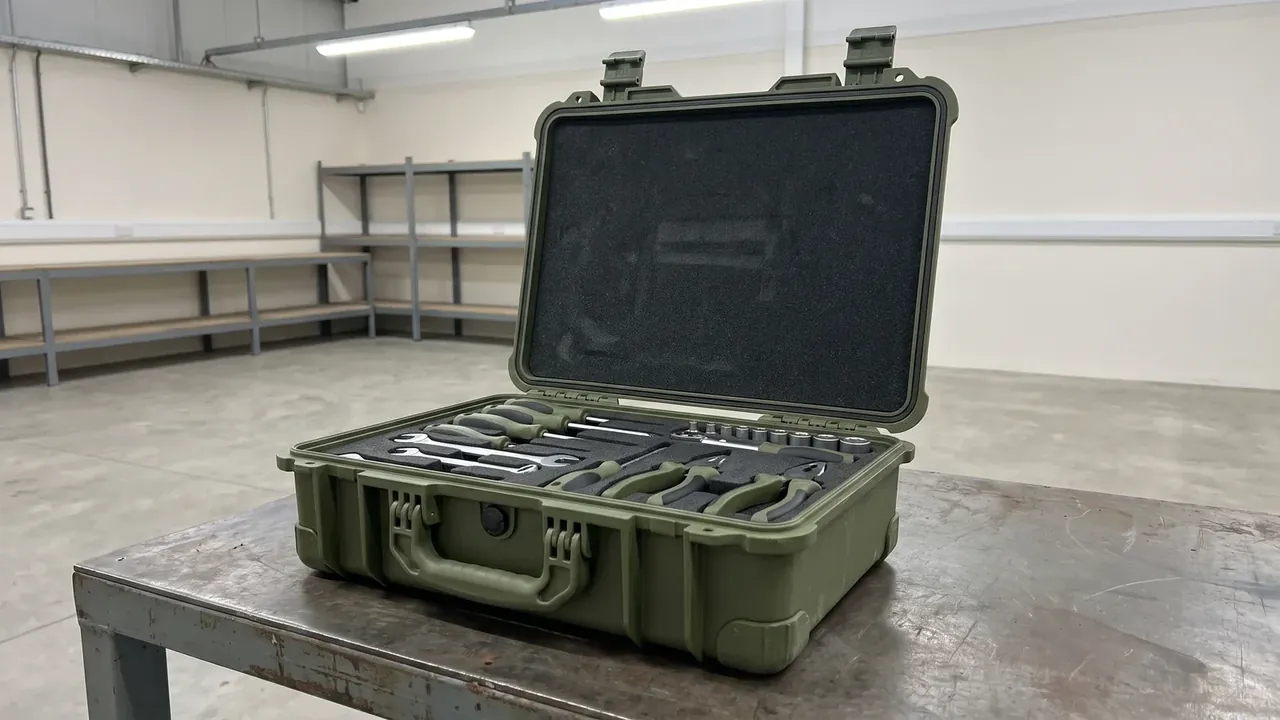
Quick answer: A Kids Tool Box fails at the latch, the handle and the wall behind them, not at the paint. Four numbers decide it: wall thickness, three radii, a latch force band, and a report that names its material class.
Table of contents
- Where a Kids Tool Box Fails First in a Cold Trailer
- Six Steps from Pellets to a Finished Case
- Ribs and Wall Thickness Carry the Stack
- The Places Hands Touch and the Radius Rule
- Compliance Lines That Belong on the Drawing
- Three Dimensions Measured Before the Carton
- FAQ
1. Where a Kids Tool Box Fails First in a Cold Trailer
A run of 480 Kids Tool Box cases went from Ningbo to Shenyang in November. The trailer read -5°C for 26 hours. Unloading into a 24°C warehouse at 65% humidity left water film on every shell, and by morning 11 sampled cases opened with a gritty drag.
Condensation is not the damage. The damage sits in the 2 mm latch gap, where water with release-agent residue freezes and turns a clean snap into sand.
| Condition | Measured | Part that fails first | Symptom |
|---|---|---|---|
| Winter road freight | -5°C, 26 hours | Latch tongue | Gritty travel |
| Unload into warehouse | 24°C, 65% RH | Lid face | Bloomed ink |
| Summer container | 38°C inside | Rib roots | Permanent set |
Only the third row leaves a mark that stays, and bloomed ink alone earns a return.
2. Six Steps from Pellets to a Finished Case
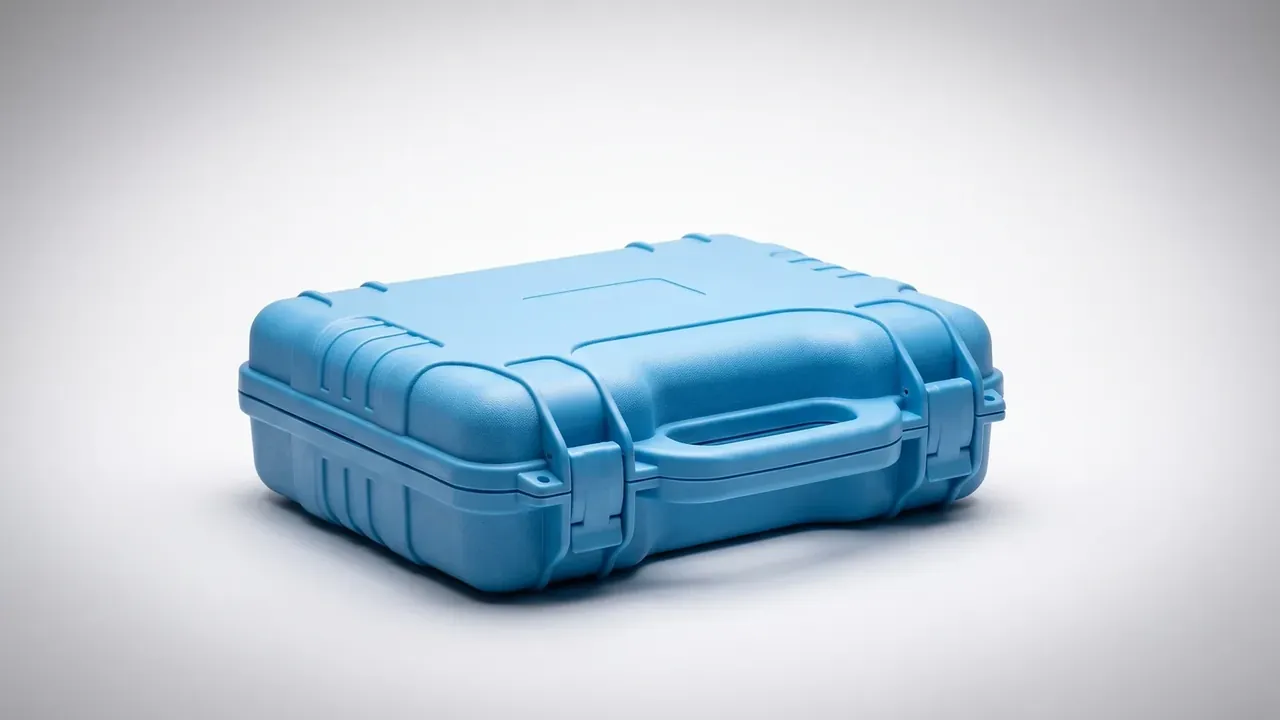
The shell is PP copolymer, dried to 0.005% moisture before it reaches the barrel. Injection runs at 215–225°C melt and 40°C mould with 18 seconds of cooling, at 2.6 mm on the load-bearing face and 2.0 mm on the sides. Two seconds less cooling adds 0.3 mm of lid warp, enough to make a stack wobble. Trimming takes gate and flash only, never the radius, and sanding runs with the ribs.
Assembly stakes two latches and one handle ultrasonically, since an exposed screw head invites a fingernail. Printing follows, ink chosen against toy migration limits, then packing in five-ply corrugate with two 6 mm vents per bag.
3. Ribs and Wall Thickness Carry the Stack
Stacking is never about one case but the case at the bottom of nine, where 0.86 kg empty becomes 6.9 kg of dead load, verified at 12 kg, a margin near 1.7.
- Load-bearing face 2.6 mm, tolerance -0.1 mm.
- Side walls 2.0 mm, 0.6 mm under the lid face, the lead-in when closing.
- Ribs 3.0 mm high, 1.2 mm at the root, 45 mm apart.
- Rib roots R0.8, where a drop crack begins.
- Four feet 4 mm tall, off a damp floor.
Get the wall right with poor ribs and the lid dishes between them. Get the ribs right on a thin wall and the whole face bows as one sheet.
4. The Places Hands Touch and the Radius Rule
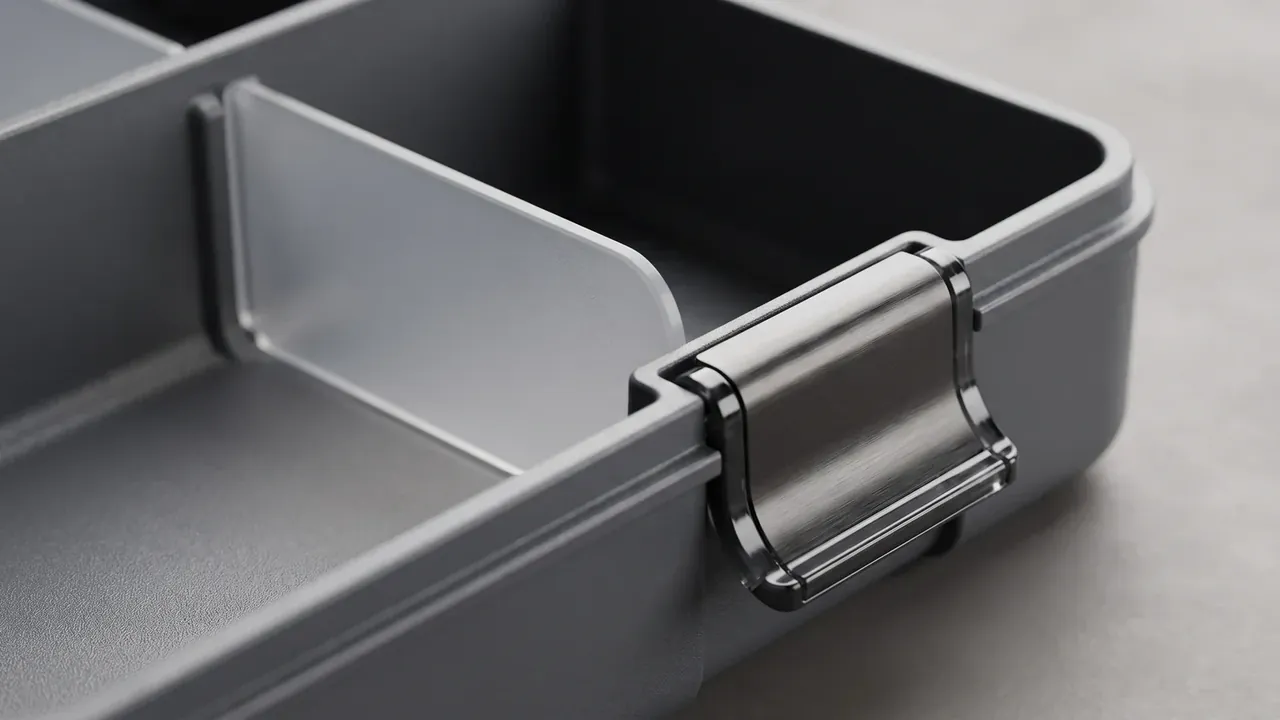
Exposed edges run R3, internal corners R2, gate marks sanded past R1. They follow a path rather than a taste: the rim takes a palm when lifting, the internal corner takes a knuckle when reaching in.
| Contact point | Dimension or force | Pass condition |
|---|---|---|
| Outer rim | R3 | No scrape under a thumb |
| Handle opening | 105 x 28 mm | Four fingers clear |
| Latch force | 25–35 N | Below 20 N a toddler opens it |
| Lid-to-base gap | 2 mm max | 0.5 mm feeler blocked |
The latch needs its own paragraph. The 25–35 N band is scaled to an adult thumb. A three-year-old can still work a latch at the low end. Loose removable parts therefore force an age marking of three and up. That marking goes on the carton and the listing. Above that age the same shell is fine.
That is an age classification, not a quality grade.
5. Compliance Lines That Belong on the Drawing
A buyer needs three documents: resin grades, a third-party migration report, and a declaration on the eight phthalates.
EN 71-3 limits follow material class, and the lead figure alone runs from 13.5 to 160 mg/kg across them. The shell is scraped-off material, so the report must name the category; a page that says compliant says nothing. CPSIA adds 100 ppm lead in substrate and 90 ppm in coating, so pad ink is a compliance decision.
One more line: any resin change voids the old report.
6. Three Dimensions Measured Before the Carton
Lid-to-base clearance is taken at eight points, and the spread must stay under 0.6 mm, or the fit wears on one side within a fortnight.
The handle takes 300 N for ten seconds, with no white mark past 1 mm and no loosening.
Residual set on the lid face is read after nine cases sit for 24 hours and recover for two; the centre may not sit more than 1.5 mm low.
Conclusion
Four numbers decide whether a Kids Tool Box holds up: wall thickness against rib layout, the three-radius set, the latch force band, and a report that names its material class. Fix them and a trailer's swing stays weather rather than a return, which is what a Kids Tool Box ultimately has to survive.
This article discusses only the container (case body) side of specifications and design intent, and does not cover any handling, loading or use of the contents.
Related Reading
- How a hard plastic tool box body is actually made
- Lid structure and the logic of sealing
- Lid shape and how it drives the parting line
- Handle and load design on a hand-carry tool case
- How dividers and compartments are laid out
Related Products
- 8 Series — Gun Cases; Military Equipment Cases; Camera Equipment Cases; Drone Cases; Watch Cases; Knife Cases; First Aid Cases; Electronics Equipment Cases
- WL8-2812 PP Gun Case — model WL8-2812
- All protective cases and toolboxes: 7 series, 158 models