

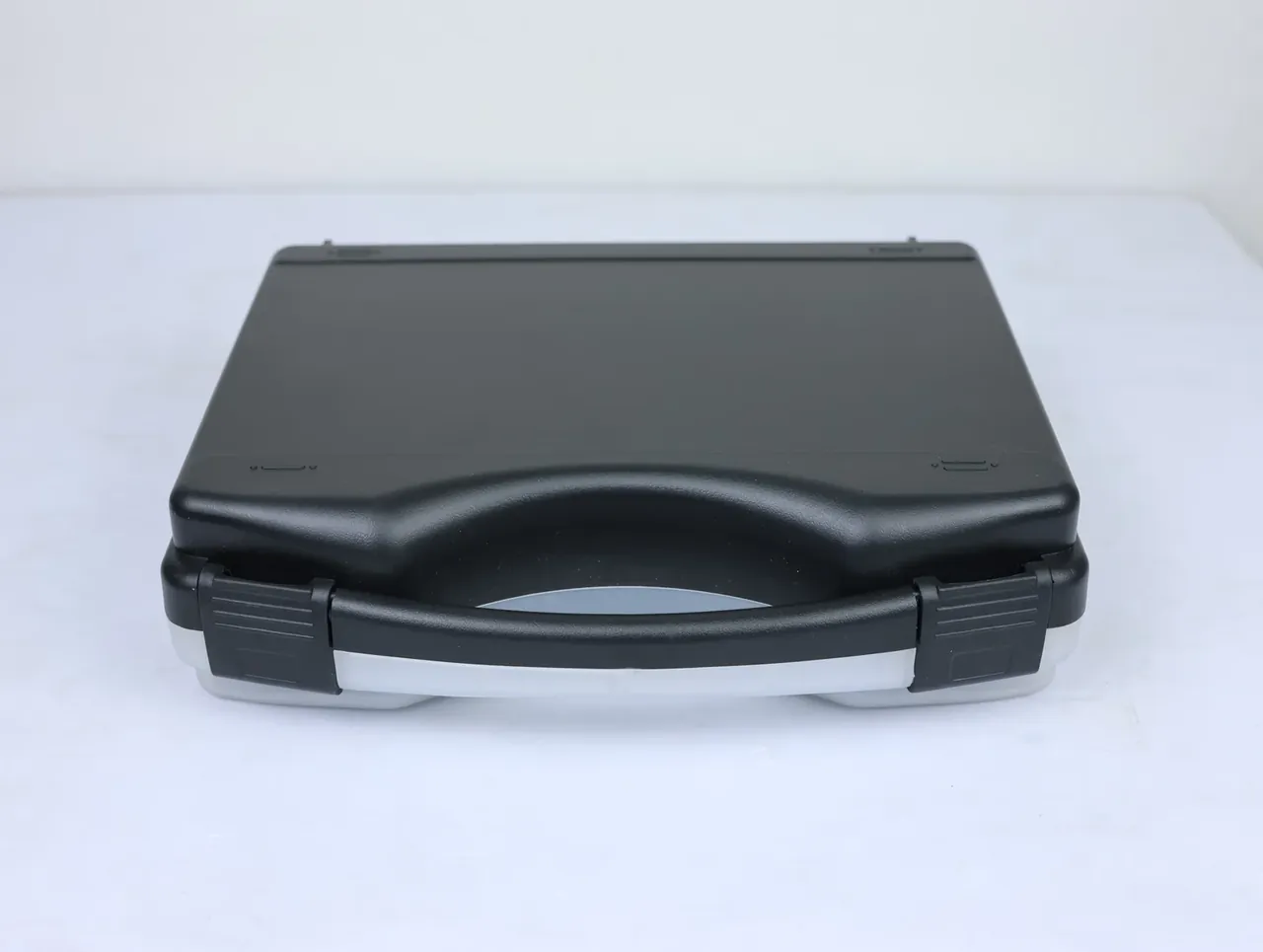
Quick answer: Build a knife case specification from three measured inputs — payload weight, internal clearance and drop height — then resolve wall section, envelope and hardware. Reverse that order and every drawing downstream is redone.
Table of contents
- Which three measured inputs a knife case starts from
- Wall thickness back-calculated from stack and drop
- Internal clearance from blade length
- Structure: hinge, latches and ribs
- FAQ
1. Which three measured inputs a knife case starts from
The first question at a tooling review is usually wall thickness. That has the causation backwards: section is an output.
A knife case chain takes three inputs. Payload weight sets what the bottom unit carries when stacked; internal clearance sets the envelope and where ribs may run; drop height sets corner overmould and the floor for wall section.
| Input | Field value | What it drives | Misread result |
|---|---|---|---|
| Payload weight | 9.4 kg | Stack, base section | Lid caves at tier three |
| Internal clearance | 340 by 210 mm | Envelope, rib layout | Handle fouls the lid |
| Drop height | 1.2 m | Overmould, minimum section | Corner splits, latches pop |
| Open cycles | 12 per day | Pin diameter, material | Bore turns oval in a year |
Only payload is hard data. Drop height follows handling: 1.2 m manual, 0.8 m pallet, 1.5 m air freight; get it wrong and the section lands 0.4 mm out.
2. Wall thickness back-calculated from stack and drop
Six tiers at 9.4 kg put 47 kg on the top face of the lowest knife case. The difficulty is creep in a 40℃ warehouse.
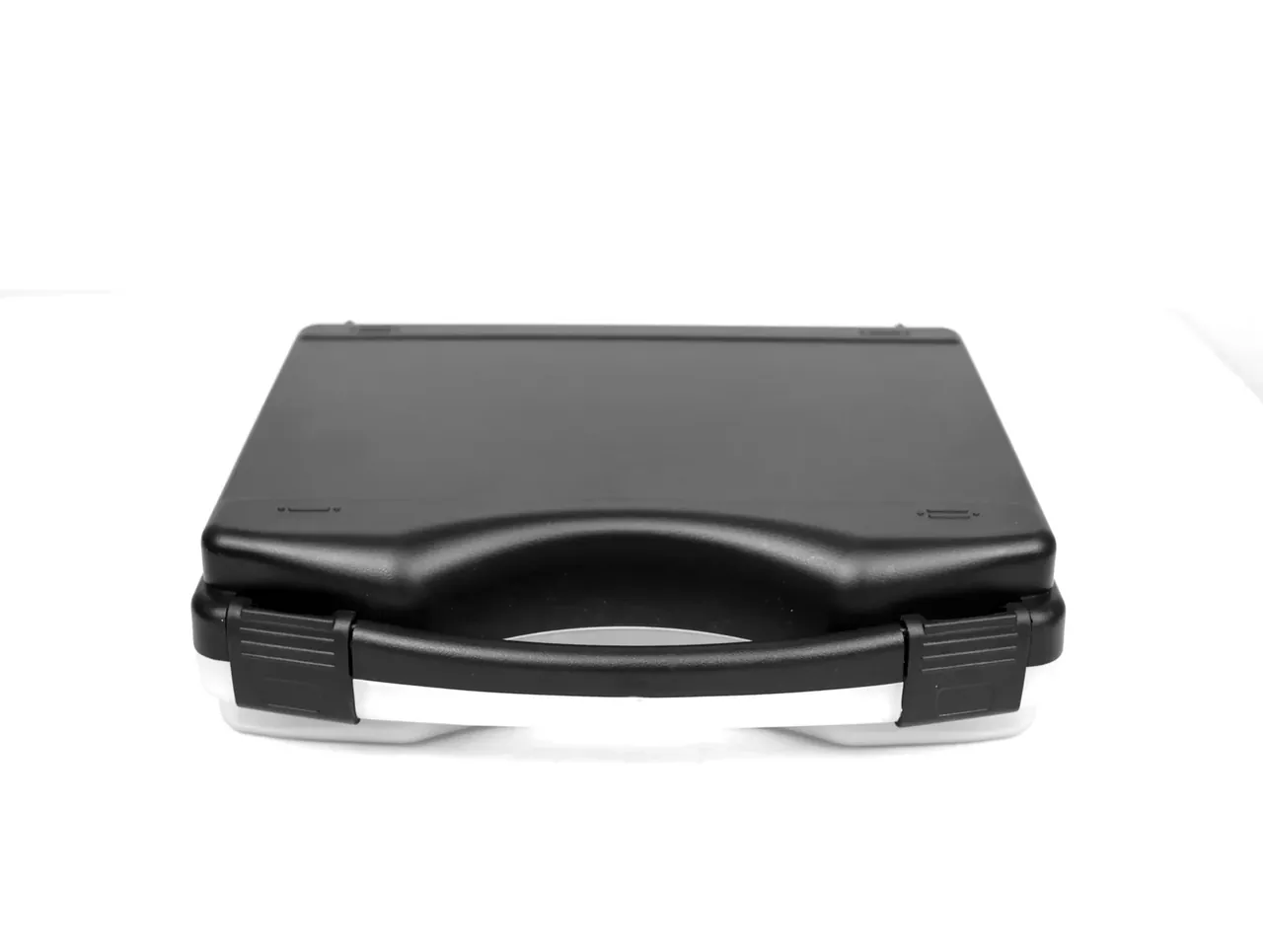
Polypropylene begins at 2.4 mm and holds four tiers. At six, base and lid go to 3.2 mm while walls stay at 2.6 mm, ribs carrying stiffness; thickening the whole shell costs 2.2 yuan and buys under 10% more crush resistance. Walls are judged on deflection: at 90 mm the bulge must stay inside 0.6 mm. Corners belong to the drop case — 1.2 m onto a corner drives 300 g, and a square 2.4 mm corner whitens on the third drop.
An R8 corner with 2 mm of overmould lasts six drops. A 380 mm body at a 3.2 mm lid and 2.6 mm walls weighs near 1.15 kg; a quotation claiming 0.9 kg has thinned something to 2.0 mm.
3. Internal clearance from blade length
Work inward from the longest blade: 316 mm with the handle fitted, plus 12 mm of travel at each end, gives a 340 mm internal length. The widest run of six blades is 186 mm, so width lands at 210 mm with 24 mm for dividers.
| Cavity parameter | Value | Derivation | Allowance goes to |
|---|---|---|---|
| Internal length | 340 mm | 316 mm blade plus 12 mm ends | Foam travel |
| Internal width | 210 mm | 186 mm run plus 24 mm | Dividers, finger access |
| Internal depth | 84 mm | 46 mm blade plus 25 mm foam | Lid foam, preload |
| Volume | 6.0 litres | Product of the three | Desiccant |
Depth is where knife case arithmetic slips. A 46 mm blade, 25 mm base foam, 10 mm lid foam and 3 mm preload call for 84 mm; mould at 78 mm and the lid foam is crushed by half.
The 6.0 litre figure has a second use: desiccant at 0.6 g per litre means 3.6 g per knife case, rounded to a 5 g sachet. Understate volume and 40 days at sea end with vapour on the walls.
4. Structure: hinge, latches and ribs
Knife case hardware follows open cycles. Twelve a day across 300 working days is 3,600 a year, so the hinge takes a 5 mm pin in 304 stainless; a 3 mm nylon pin shows play after 2,000.
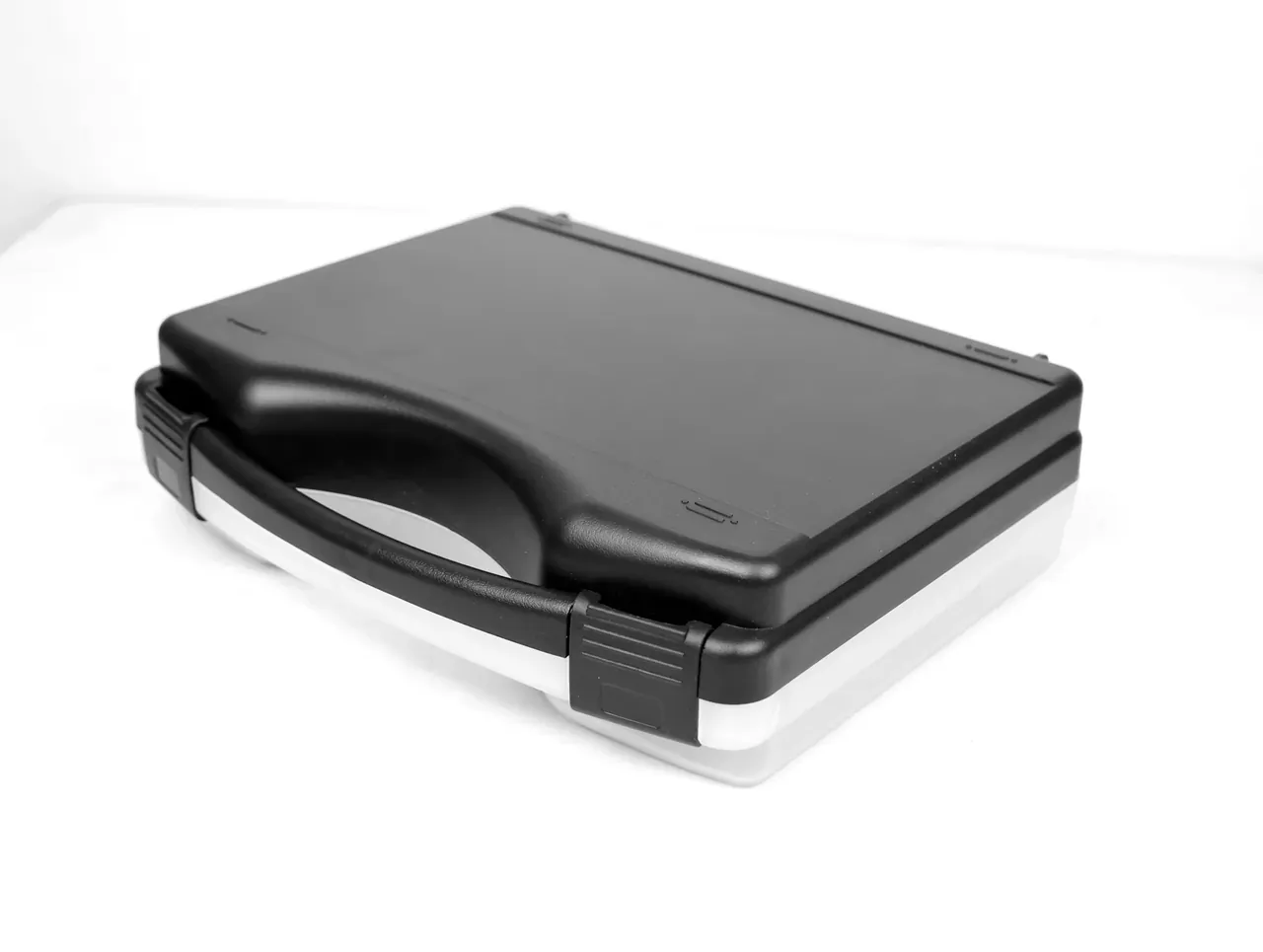
Two latches a third along the long side hold 160 N each, 320 N together, enough for the gasket in an 84 mm cavity.
Ribs run at 75 mm centres, 2.5 mm tall, R3 root. Past 100 mm the lid sinks under stack load; below 1.5 mm the melt never reaches the tip. A 1600 tonne press, one cavity and a 210 second cycle yield 400 units a day; an 800 tonne press reaches 150 seconds but the ribs must thin.
Conclusion
Section, cavity and hardware form a one-way chain: payload sets the wall, blade length sets the cavity, open cycles set the hardware. Fix a link out of order and every number behind it shifts. Written into the knife case specification, that chain stops most rework.
This article discusses only the container (case body) side of specifications and design intent, and does not cover any handling, loading or use of the contents.
Related Reading
- Slot, locator block and edge guard in three layers
- Deriving wall section from payload
- Cavity and cushion dimensions for airdrop cases
- Handle and latch load ratings on transit cases
Related Products
- 8 Series — Gun Cases; Military Equipment Cases; Camera Equipment Cases; Drone Cases; Watch Cases; Knife Cases; First Aid Cases; Electronics Equipment Cases
- WL8-2812 PP Gun Case — model WL8-2812
- All protective cases and toolboxes: 7 series, 158 models