

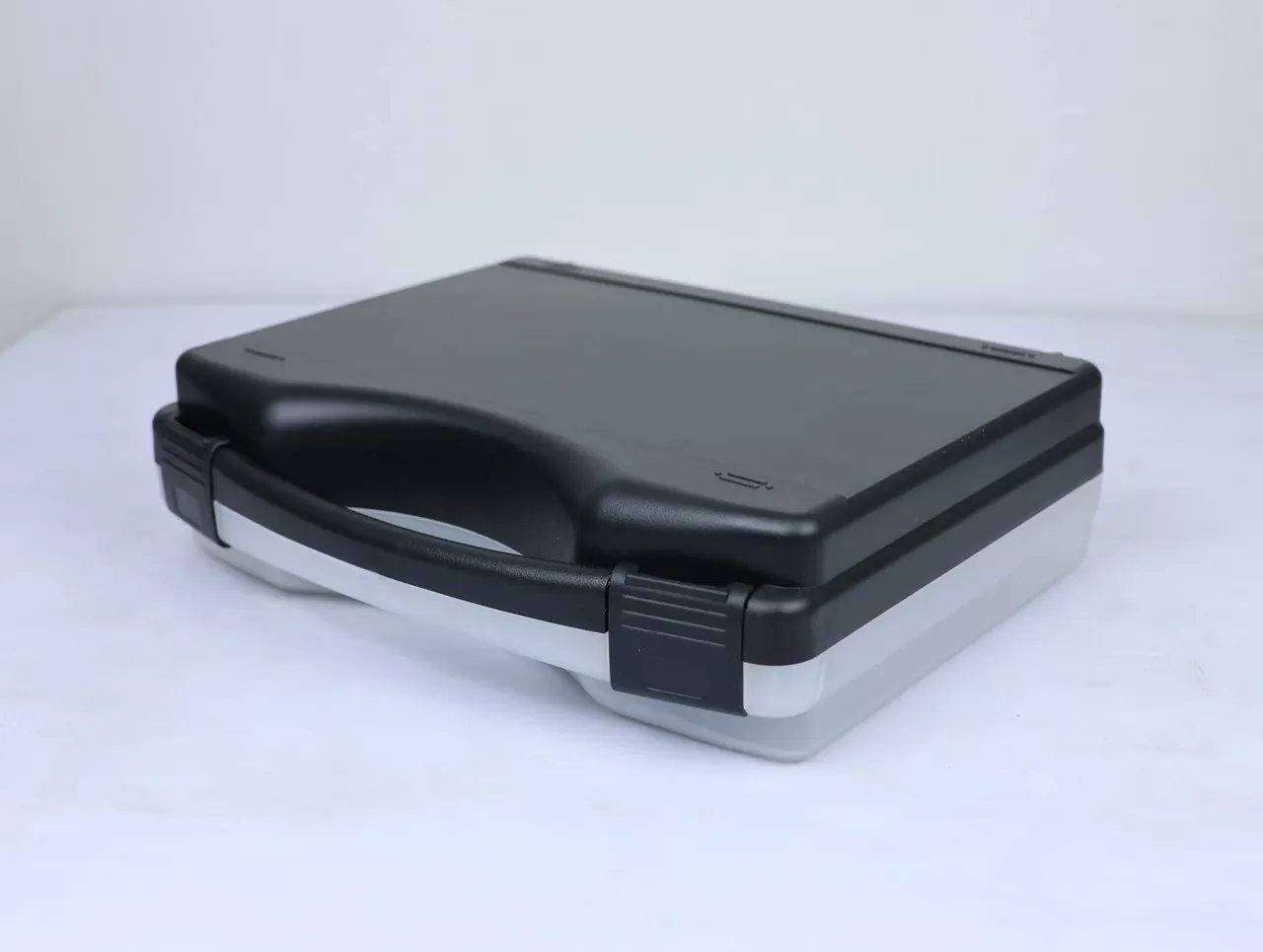
Quick answer: A knife case measured to a drawing in the factory and measured in service on site will not agree unless four checks are written down: dimensions, sealing, drop and stack, and disposition. Done properly, acceptance costs under 12 yuan per unit and returns stay below 1%.
Table of contents
- The three document layers behind knife case standards
- Appearance and dimensions a caliper can reproduce
- Sealing: pressure hold and immersion
- Drop and stack: reproducing them on site
- Disposition: rework, concession, rejection
- FAQ
1. The three document layers behind knife case standards
Acceptance arguments usually come down to three papers: a contract that says "to standard", a supplier inspection report, and a returns note. All three are genuine; none describes the same unit.
Knife case standards rest on three layers. The drawing carries cavity tolerance and minimum wall. The test method states hold pressure, drop height and stack tiers. The sampling plan states lot size and acceptance number, and that third layer is normally missing — under 500 units, sample 32 and accept on 3; above 500, sample 50 and accept on 5. Without it, each side reaches a different verdict on the same pallet.
2. Appearance and dimensions a caliper can reproduce
Colour shift and sink marks carry no units, so they only invite argument. Fold appearance into three measurable items: lid flatness read with a straight edge and feeler at 0.4 mm, seam width taken at four points with 0.3 mm allowed variation, and wall section.
| Check | Instrument | Limit | Action if exceeded |
|---|---|---|---|
| Lid flatness | Straight edge, feeler | 0.4 mm or less | Reject lot |
| Seam variation | Feeler gauge | 0.3 mm at four points | Adjust tool |
| Wall section | Ultrasonic gauge | 2.8 mm minimum | Scrap unit |
| Internal length | Caliper | 350 mm plus or minus 1.0 | Rework liner |
| Latch retention | Pull gauge | 150 N minimum | Change latch |
Knife case instruments belong in the same document. The same seam read with a 0.02 mm caliper and with a steel rule differs by 0.3 mm, which is the full width of the limit band. Name the instrument, or two parties each measure once and each feel right.
3. Sealing: pressure hold and immersion
There are two routes and the choice follows duty: units that circulate in storage get a pressure hold, units that travel get immersion. Running both doubles the cost.
Plug the vent before a pressure hold; a case that cannot be plugged goes to immersion. Charge the cavity to 0.3 bar, hold 90 seconds, pass at a drop of no more than 0.02 bar. That pressure sits inside the gasket's working range: higher takes a set, lower misses pinholes. Immersion sinks the knife case 200 mm for 30 minutes, then it is dried and opened; any water inside fails it.
A knife case trial in Sanya ran 48 samples through both routes. Of the 45 that held pressure, 3 took water in immersion, all traced to the latch axle bore: air creeps through that open bore slowly, water follows the axle fast.
4. Drop and stack: reproducing them on site
Drop tests go wrong more often than anything else. Push a case off a 1.0 m bench and it lands differently every time, so verdicts differ too. Do six faces over three rounds, one face per round, onto concrete, with ballast at 1.1 times loaded weight.
| Test | Site condition | Criterion | Record |
|---|---|---|---|
| Free drop | 1.0 m, six faces, three rounds | No crack, no latch release | Photo per round |
| Stack | 5 tiers, 48 hours, 35℃ | Deflection 1.2 mm or less | Four corner heights |
| Salt fog | 72 hours neutral | No red rust at hinge | Cross-cut rating |
| Thermal | -25℃ to 65℃, 6 cycles | Seam change 0.3 mm or less | Re-measure each cycle |
| Hinge life | 8,000 cycles | Play 0.5 mm or less | Log every 2,000 |
Stacking gets skipped because it occupies floor space. Five tiers for 48 hours at 35℃, with a lid sagging past 1.2 mm, fails; that figure comes from three months of warehouse creep. Measure the rig from the lowest point of the case, since reading to the bench adds 10 mm.
5. Disposition: rework, concession, rejection
A failed verdict is only the start; disposition decides the cost. Defects in a knife case fall into three classes, each with its own signatory.
| Defect class | Disposition | Signatory | Follow-up |
|---|---|---|---|
| Dimension out of tolerance | Rework or repair | Quality manager | Re-inspect lot |
| Cosmetic defect | Concession | Buyer and user | 3% price cut |
| Seal failure | Rejection | User | Supplier pays freight |
Knife case rework runs about 12 yuan per unit; a rejection costs 60 yuan or more in freight and credit. Concessions need a trail too: the batch is packed separately and tagged red with the defect and discount written on it, because an untagged concession is forgotten in three months and the same units come back.
Conclusion
Between a factory pass and a usable unit sit four reproducible checks: dimensions that can be measured, a seal that can be tested, a drop that can be repeated, a disposition that can be signed. Write them into the knife case standards and nobody argues from feel. Once a criterion reproduces, a return becomes a record.
This article discusses only the container (case body) side of specifications and design intent, and does not cover any handling, loading or use of the contents.
Related Reading
- How the slot, locator and edge guard are laid out
- Immersion criteria for ABS waterproof boxes
- Drop and stack lines for airdrop cases
- Sampling and acceptance numbers for ammunition boxes
- Lock and seal acceptance on ammunition chests
Related Products
- 8 Series — Gun Cases; Military Equipment Cases; Camera Equipment Cases; Drone Cases; Watch Cases; Knife Cases; First Aid Cases; Electronics Equipment Cases
- WL8-2812 PP Gun Case — model WL8-2812
- All protective cases and toolboxes: 7 series, 158 models