

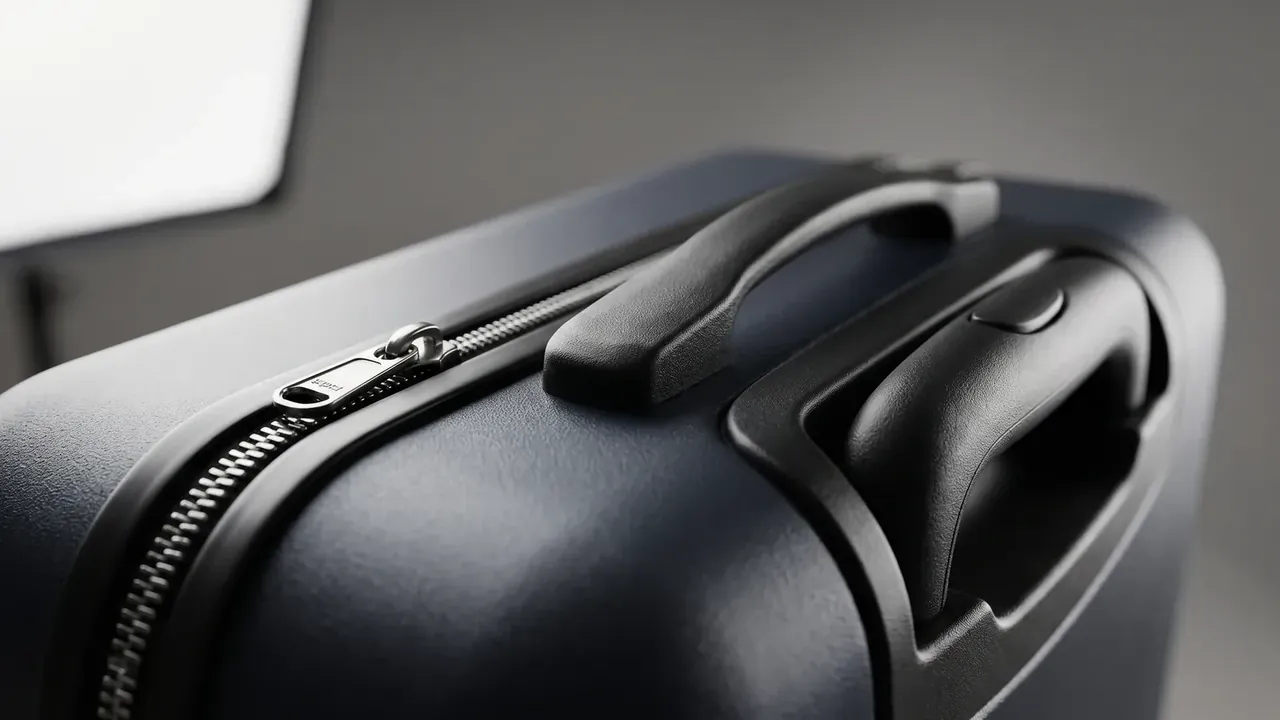
Quick answer: A Laboratory Equipment Storage Case sets 24 mm ribs and a 7.8 mm locator boss; three tiers held 120 h keep base deflection under 0.98 mm.
Table of contents
- Bottom Longitudinal Rib Height of the Laboratory Equipment Storage Case
- Depth of the Stacking Locator Boss
- Base Deflection After Five Days Under Three Tiers
- Lid-Rim Mismatch After Unloading
- Fixing Rib Height for the Warehouse Batch
- FAQ
1. Bottom Longitudinal Rib Height of the Laboratory Equipment Storage Case
Three tiers pressed for five days settle how far the base sags and the lid rim shifts; rib height and the locator boss answer first. Under a 675×465×285 mm shell the Laboratory Equipment Storage Case opens a 605×400×210 mm cavity with a 4.9 mm wall, the floor held by longitudinal ribs. Short ribs leave a long unsupported span; tall ribs eat cavity height. 24 mm is the start, and the three trials change only that height.
A dial gauge reads both ends and the centre of the base; the deepest point is that tier's deflection. The rig is levelled, and a changed gauge, point or stance restarts from hour 1. The Laboratory Equipment Storage Case writes this into the hold card so two shifts do not mismatch curves.
| Rib height tier | Rib height | Unsupported span | Trial ID |
|---|---|---|---|
| Short tier | 20 mm | Long | R1 |
| Middle tier | 24 mm | Inside the limit | R2 |
| Tall tier | 28 mm | Short, loses cavity | R3 |
2. Depth of the Stacking Locator Boss
The locator boss is a shallow seat in the four lid corners, and 7.8 mm is the bite the Laboratory Equipment Storage Case allows for a three-tier stack. Too deep binds feet; too shallow and an 82 kg stack load lets the upper tier slide, dragging deflection with it. Boss governs alignment, rib governs bending, and the rig books them apart.
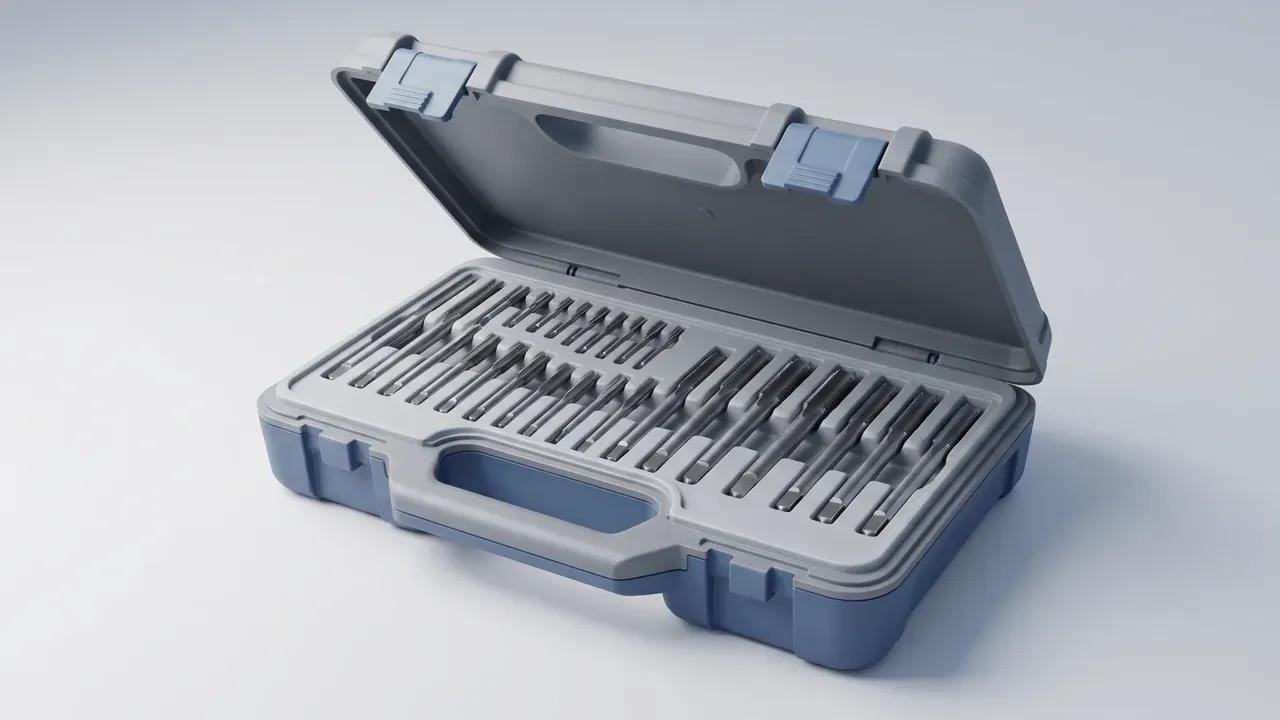
The trials are ballasted to shipped condition: 8.0 kg empty, 20 kg loaded, 82 kg on top, four latches at 425 N each and two gasket rings at 22%. With the lid shut, the tiers sit 120 h without opening, so the gauge reads only the ribs' sag. The Laboratory Equipment Storage Case keeps boss depth as its own tier. IP67 is only a typical sealing reference, checked against the method and never an obtained certification.
3. Base Deflection After Five Days Under Three Tiers
The rig stacks three tiers and reads the dial gauge at 24 h, 72 h and 120 h, stopping at five days. What the Laboratory Equipment Storage Case tracks is whether the base middle keeps sinking under a long unmoving load: the first cell drops fast, then the climb flattens. Readings stay under load, so they are deflection, not rebound.
| Hold period | Elapsed | R2 base deflection | Curve |
|---|---|---|---|
| Day 1 | 24 h | 0.34 mm | Dropping fast |
| Day 3 | 72 h | 0.71 mm | Climb easing |
| Day 5 | 120 h | 0.94 mm | Levelled |
All three tiers run to 120 h: short-rib R1 passes 1.20 mm, middle-rib R2 closes at 0.94 mm, tall-rib R3 only 0.62 mm. The 0.98 mm ceiling comes from lid tolerance. Observation is pinned to hour 120: on day one the tiers still sit close and the middle cells decide nothing. The Laboratory Equipment Storage Case would rather hold five days than judge before the curves pull apart.
4. Lid-Rim Mismatch After Unloading
After unloading the case rebounds on the rig, then the step between lid rim and mouth is measured — the lid-rim mismatch. 0.44 mm is the second line the Laboratory Equipment Storage Case draws for a long hold: a tier bent past 0.98 mm carries a skewed rim.
| Deflection reading | Rib tier | Unloaded mismatch | Tier disposition |
|---|---|---|---|
| 1.20 mm | Short R1 | 0.61 mm | Diverted to single-tier use |
| 0.94 mm | Middle R2 | 0.38 mm | Fixed as the rib height |
| 0.62 mm | Tall R3 | 0.29 mm | Held as reserve |
R2 clears both 0.98 mm and 0.44 mm: 0.94 mm under load, 0.38 mm after unloading. Short-rib R1 leaves the floor too soft — 1.20 mm of deflection brings 0.61 mm of mismatch, diverted wholesale to single-tier use. 0.98 mm governs bending, 0.44 mm governs rim skew at two moments, and the Laboratory Equipment Storage Case folds them into one vote.
5. Fixing Rib Height for the Warehouse Batch
The rib height is fixed at the shortest tier whose hour-120 deflection still stays within 0.98 mm, while shorter ribs are diverted wholesale to single-tier use.
Warehouse batches of the Laboratory Equipment Storage Case are split by rib-height stock, each pile sharing one base mould. Three cases per pile hold 120 h, the hour-120 deflection logged first and a lid-rim mismatch added after unloading. Only the shortest tier clearing both lines enters the drawing. Once 24 mm is fixed, boss depth 7.8 mm, gasket compression 22% and four latches at 425 N are frozen. JUNZHIJIA retakes the hold curve whenever the ridge changes. IP67 is only a typical sealing reference, with no certificate number or test grade; once 24 mm is on the drawing the base ribs do not move again.
Conclusion
A 24 mm base rib and a 7.8 mm locator boss each govern one face of the Laboratory Equipment Storage Case, and the 0.94 mm deflection with 0.38 mm lid-rim mismatch after 120 h under three tiers need both to hold. The fixed tier reads the levelled hour-120 value; the 24 h cell is only a start. Short-rib R1 diverted and tall-rib R3 held as reserve are written on the hold sheet. The drawing puts rib height, boss depth, gasket compression 22% and the 675×465×285 mm shell together. JUNZHIJIA fixes 24 mm into the batch drawing, and whenever stock changes the 120 h curve is walked again; an old curve never vouches for a new batch.
Related Reading
- Where an Instrument Case Goes: Scenes and Configurations
- Storing Cases: Temperature, Humidity, Stacking
- Detection Instrument Case: Protective Storage for Field Test Equipment
- Shockproof Case for Precision Equipment
- Sensor Equipment Case
Related Products
- 8 Series — Gun Cases; Military Equipment Cases; Camera Equipment Cases; Drone Cases; Watch Cases; Knife Cases; First Aid Cases; Electronics Equipment Cases
- WL8-2812 PP Gun Case — model WL8-2812
- All protective cases and toolboxes: 7 series, 158 models