

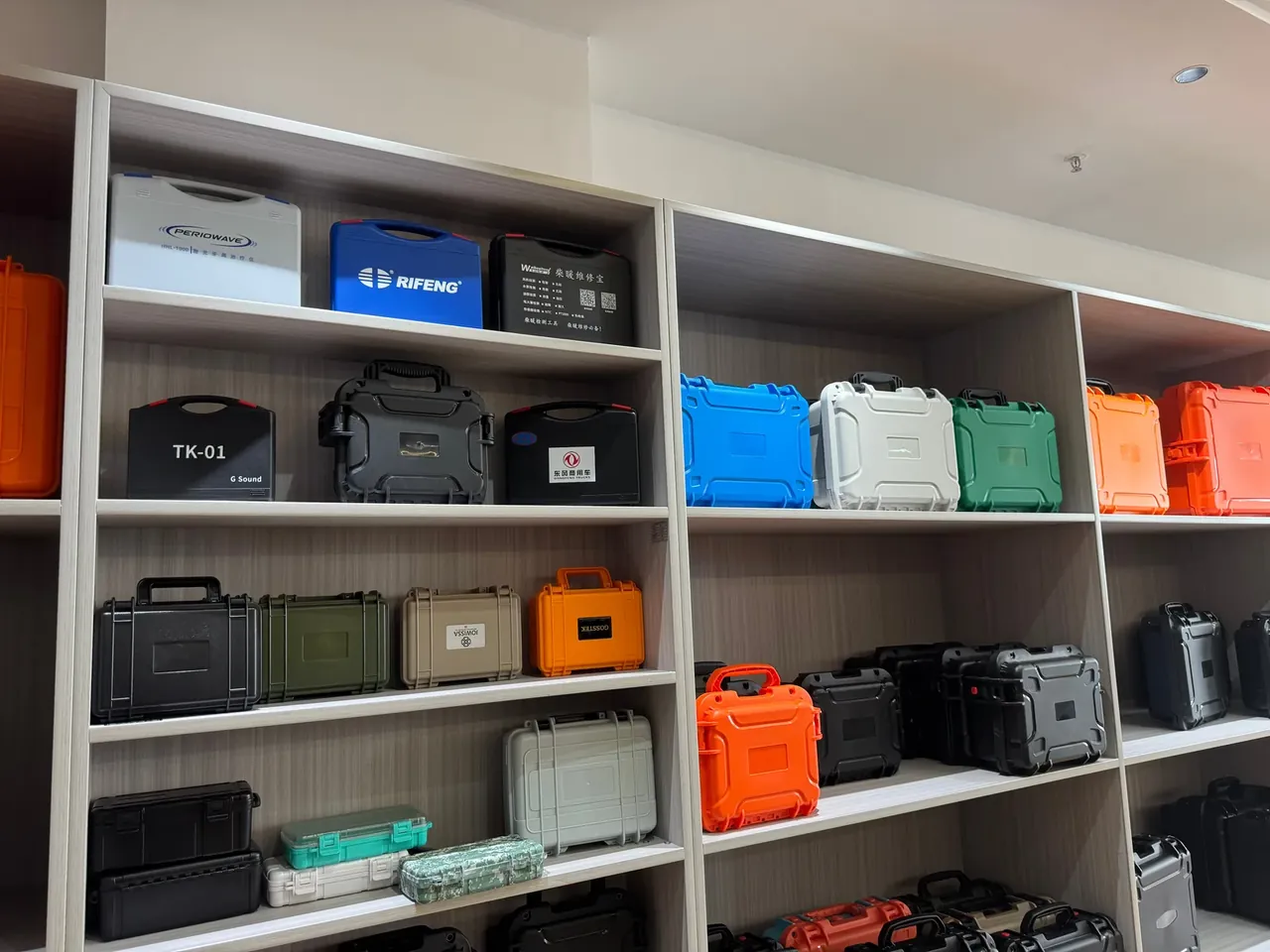
Quick answer: A Shockproof Case for Precision Equipment sets liner foam at 38 kg/m³ over a 10.5 mm base pad; a 5–80 Hz sweep must hold resonance shift above 12 Hz.
Table of contents
- Liner Foam Density Tiers in the Shockproof Case for Precision Equipment
- Thickness of the Base Damping Pad
- Resonance Shift After the Five-to-Eighty Hertz Sweep
- Foam Settlement Once the Liner Is Removed
- Fixing the Density for the Anti-Shock Batch
- FAQ
1. Liner Foam Density Tiers in the Shockproof Case for Precision Equipment
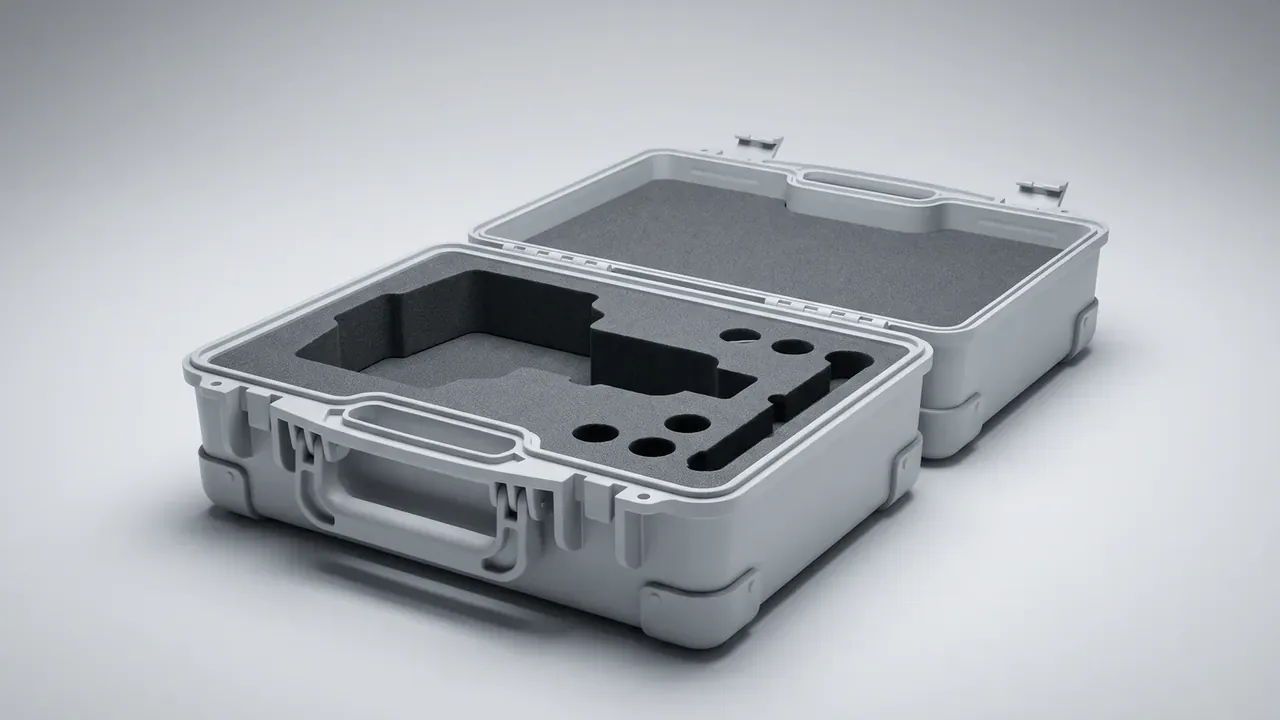
A sine sweep from five to eighty hertz shows where the peak drifts and how far foam settles before density tiers are ranked. The liner is the closed-cell sheet above the base damping pad; its blow ratio sets the support stiffness the shell offers the cavity. A Shockproof Case for Precision Equipment fixes it at 38 kg/m³, in a 545×385×205 mm shell with a 480×325×150 mm cavity and a 4.3 mm wall, cut as one piece. Softer foam lets the peak slip toward low frequencies; stiffer foam pushes it further along the band. Trial shells vary the blow ratio alone, so the shift belongs to the foam.
| Density tier | Foam density | Base pad |
|---|---|---|
| Low tier | 30 kg/m³ | 10.5 mm |
| Mid tier | 38 kg/m³ | 10.5 mm |
| High tier | 46 kg/m³ | 10.5 mm |
All three share the 10.5 mm pad; pin the base and the drift books against density.
2. Thickness of the Base Damping Pad
The pad sits between liner and floor at 10.5 mm, cavity depth minus liner thickness. Thinner and the foam bears on the floor ribs, so stiffness jumps; thicker and the lid prints a bright line and the 12.5 kg ballast will not sit flat. A Shockproof Case for Precision Equipment holds 10.5 mm for a fixed footing.
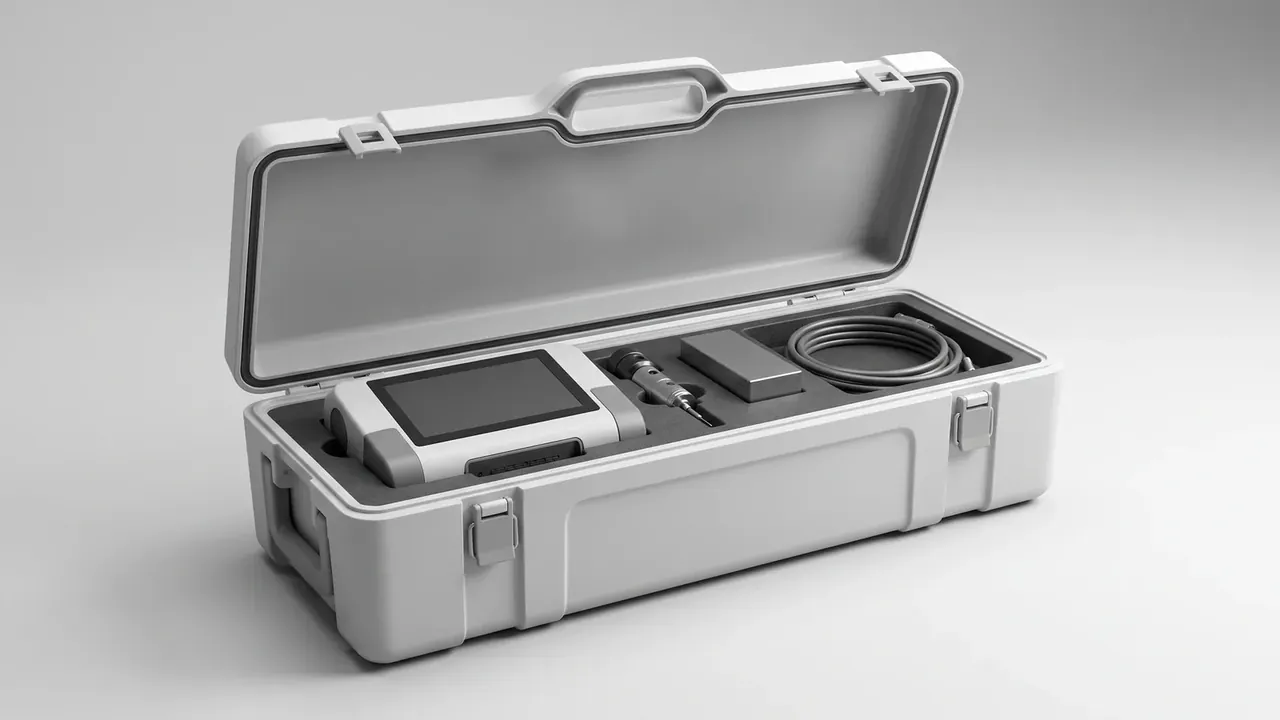
Durability comes before the sweep rig: 4350 open-close cycles leave the lid square, four latches press at 390 N each, two gasket rings take 20 percent apiece, and the 5.1 kg empty and 12.5 kg loaded ballast is clamped to the table. The resonance point then belongs only to the foam-and-pad pair, with no slack from a loose lid; each tier logs on its own page.
3. Resonance Shift After the Five-to-Eighty Hertz Sweep
The rig climbs from 5 Hz to 80 Hz under continuous sine excitation, logging the peak frequency. A tap before the run and another after the full 5–80 Hz pass bracket the resonance shift. Working densifies the foam and walks the peak higher; a larger drift means stiffer support. Reading waits for room temperature, so the logged shift is permanent.
| Sweep pass | Frequency span | Mid-tier peak |
|---|---|---|
| Before sweep | Unloaded | 31 Hz |
| Pass 1 | 5–80 Hz | 38 Hz |
| Pass 3 (full) | 5–80 Hz | 45 Hz |
The mid tier starts at 31 Hz, reaches 38 Hz after one pass and settles at 45 Hz at three, a 14 Hz drift clearing the 12 Hz line. The low tier manages 40 Hz, only 9 Hz up; the high tier runs to 50 Hz, a 19 Hz drift, but spends more stock than needed. The 12 Hz floor comes from pad-and-liner tolerance; a smaller shift leaves the peak on the shell. Observation is pinned to the third pass because the tiers overlap early; in-between readings are process notes. A Shockproof Case for Precision Equipment books the reading when the third pass ends, since stopping early misreads the foam.
4. Foam Settlement Once the Liner Is Removed
The shell rests in ambient air, then the full liner is lifted and measured for how much three passes thinned it; that loss is foam settlement. The 0.68 mm ceiling is the other half of the keep condition: a wide drift means little if the foam has sunk past it, for the liner-to-floor contact hangs loose next round. A Shockproof Case for Precision Equipment treats drift and settlement as one vote.
The mid tier settles 0.62 mm, inside 0.68 mm; the low tier 0.91 mm and the high tier 0.48 mm, each on its own page. A new batch clamps the 5.1 kg empty and 12.5 kg loaded ballast under the same conditions.
| Resonance reading | Density tier | Foam disposition |
|---|---|---|
| 9 Hz | Low tier | Diverted to plain buffer liner |
| 14 Hz | Mid tier | Fixed as the density |
| 19 Hz | High tier | Held as reserve |
The low tier falls below on both, drifting 9 Hz while settling 0.91 mm, so it is diverted wholesale to plain buffer liners. The mid tier holds 14 Hz and 0.62 mm; the high tier clears both but is kept only as reserve. A Shockproof Case for Precision Equipment reserves no destination in advance; the sheet is filled once readings land.
5. Fixing the Density for the Anti-Shock Batch
The density is fixed at the lowest tier whose resonance point still drifts back by more than twelve hertz, while foam below it is diverted wholesale to plain buffer liners. The 38 kg/m³ and 46 kg/m³ tiers both clear, and the lower 38 kg/m³ is taken, keeping 14 Hz of drift without extra blowing agent. The drawing, liner cutting card and sweep inspection sheet of a Shockproof Case for Precision Equipment are written to that one tier. JUNZHIJIA files IP66 only as a typical sealing reference, never written up as an obtained certification; two gasket rings at 20 percent and four latches at 390 N each are re-measured against a card with no certificate number. The 4350 cycles, 5–80 Hz sweep and 0.68 mm settlement belong to three separate rigs. The fabricator locks the blow ratio once 38 kg/m³ is on the drawing.
Conclusion
One change in blow ratio draws three resonance curves of unequal drift from one cavity, and a Shockproof Case for Precision Equipment accepts only the 38 kg/m³ tier that clears 12 Hz and stays inside 0.68 mm of settlement. A 14 Hz drift against 0.62 mm gives the 10.5 mm pad's footing a firm basis. The low tier diverted to plain buffer liners and the high tier held as reserve are written on the third-pass sheet, with no destination set aside beforehand. JUNZHIJIA puts 38 kg/m³ into the batch drawing, with liner moulding, gasket compression and pad cutting filed tier by tier. When the stock changes the fabricator walks the three passes of 5–80 Hz again; an old curve never vouches for a new batch.
Related Reading
- How to Choose a Precision Instrument Protective Case: Shock Protection and Safety for Metrology and Calibration Equipment
- Case Drop Sequence: Case Drop Test Sequence
- Foam for Instrument Cases: EVA vs EPE vs PU
- Sensor Equipment Case
- Microscope Equipment Transport Case
Related Products
- 8 Series — Gun Cases; Military Equipment Cases; Camera Equipment Cases; Drone Cases; Watch Cases; Knife Cases; First Aid Cases; Electronics Equipment Cases
- WL8-2812 PP Gun Case — model WL8-2812
- All protective cases and toolboxes: 7 series, 158 models