

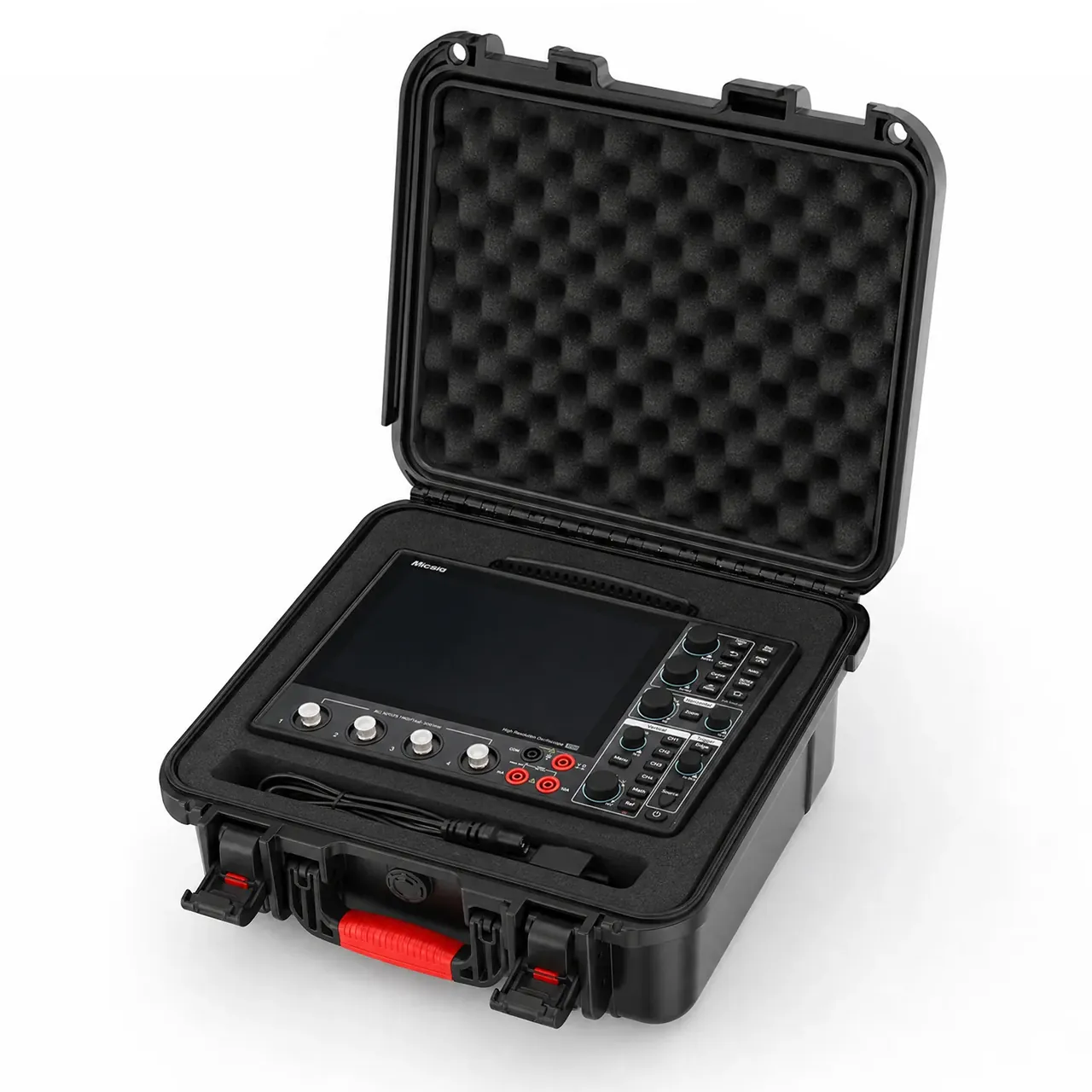
Quick answer: Microscope Equipment Transport Case: R17 cell corners and 3.1 mm corner wrap keep peak acceleration under 39 g after six 0.75 m face drops.
Table of contents
- Cell Corner Radius of the Microscope Equipment Transport Case
- Corner Wrap Thickness
- Peak Acceleration after Six 0.75 m Face Drops
- Corner Recovery on Static Re-Measurement
- Radius Setting for the Optics Batch
- FAQ
1. Cell Corner Radius of the Microscope Equipment Transport Case
Six faces take turns hitting the deck, and one acceleration peak settles whether the cell corner or the corner wrap eats the shock first. A cell is a liner pocket whose floor arc is drawn to R17. This Microscope Equipment Transport Case measures 620×440×255 mm outside and 550×375×190 mm inside, with a 4.7 mm wall and a 4180-cycle hinge rating; the rig checks only how much impact the radius and wrap turn aside at touchdown.
The R17 arc replaces a sharp pocket corner with a continuous transition, so a stress wave no longer bounces off a right angle. Enlarge it and the load path between shell and liner shifts; shrink it and the corner stiffens. Radius and wrap thickness never act alone, and the six-drop peak is the answer the pair gives together.
At 6.5 kg empty and 16 kg loaded, the Microscope Equipment Transport Case closes through four latches rated 415 N each. Two gasket rings sit at 21% compression, with immersion and dust benchmarked to IP67 as a typical value. The four latches resist twist-off during a drop, and both rings must still meet the rim after corner recovery, so wrap thickness reaches the sealing margin.
2. Corner Wrap Thickness
The 3.1 mm wrap on a Microscope Equipment Transport Case is the first part to crush on touchdown, turning an edge strike into a small flat patch and trimming the peak. Thinner bottoms out at once so force reaches the shell; thicker bulges enough to crowd stacking and lid fit.
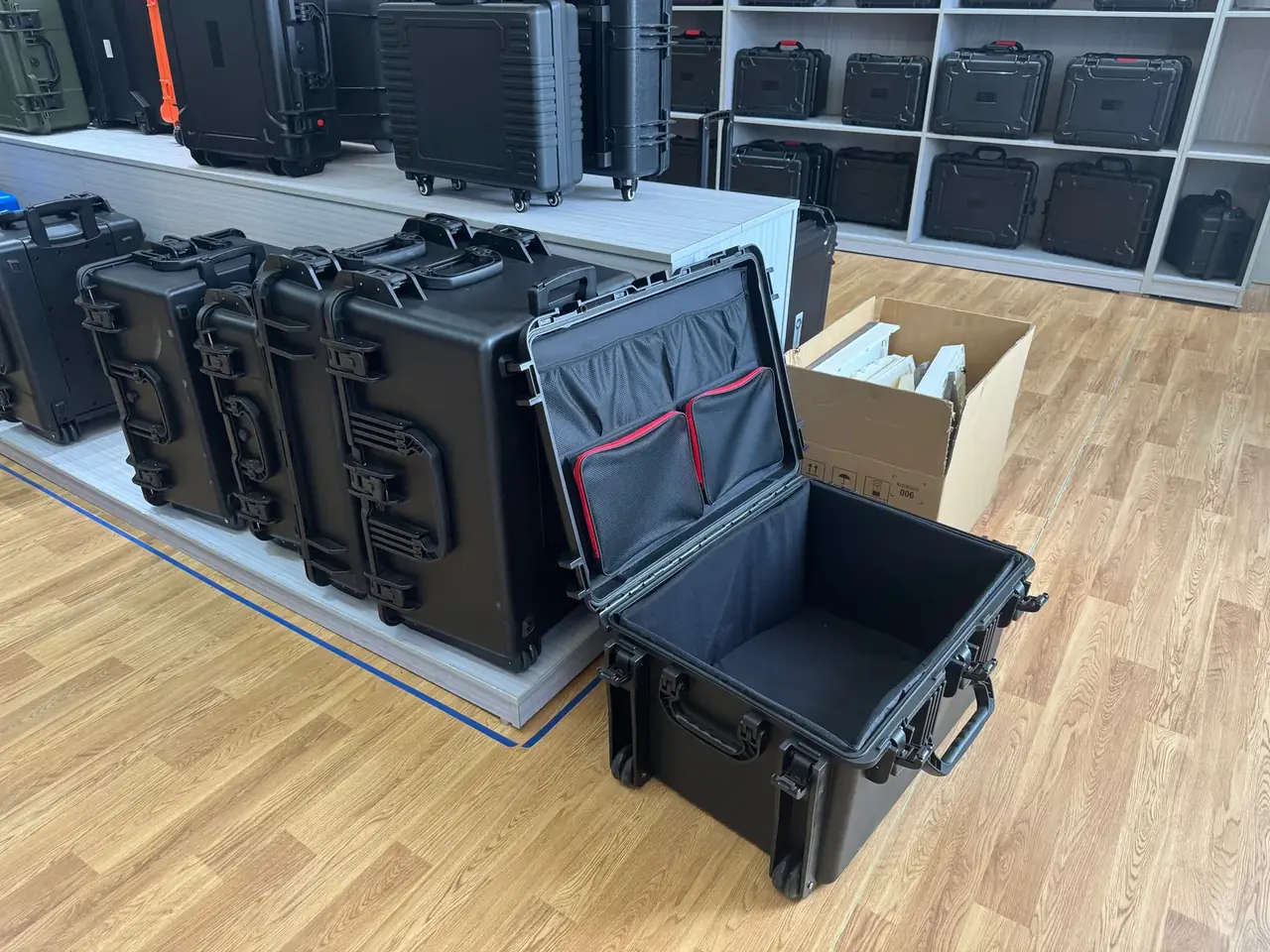
Three samples from one mould move radius and wrap one step each. The table lines up the corner-wrap steps against touchdown behaviour.
| Corner-wrap step | Cell radius | Corner wrap |
|---|---|---|
| Small | R13 | 2.6 mm |
| Middle | R15 | 3.1 mm |
| Large | R17 | 3.6 mm |
The small step is stiff and peaks highest; the large one spreads impact but bulges most. R17 with 3.1 mm sits above the middle, and JUNZHIJIA uses it as the base for the Microscope Equipment Transport Case optics batch.
3. Peak Acceleration after Six 0.75 m Face Drops
The rig lifts the Microscope Equipment Transport Case to 0.75 m and releases it face down, one face at a time, with an accelerometer fixed inside a corner wall logging one shock trace per drop. Face one is the base, face two the lid, three and four the long walls, five and six the short walls. The 0.75 m height is calibrated and does not move with payload. Peak acceleration is taken from the sixth face and held under 39 g. Empty and 16 kg loaded runs stay as separate traces.
| Drop index | Contact face | Watch item |
|---|---|---|
| Faces one to two | Base, lid | Flat-face peak |
| Faces three to four | Two long walls | Edge transfer |
| Faces five to six | Two short walls | Corner concentration |
Faces three and four land on edges and peak above the flat faces; five and six funnel force into the corners and test how much travel the 3.1 mm wrap still has. If any face crosses 39 g, that step stops and a Microscope Equipment Transport Case returns to the corner-wrap table for a thicker wrap. The call uses the worst face, not the average.
4. Corner Recovery on Static Re-Measurement
After the six drops the sample rests before corner recovery is read, letting the 3.1 mm wrap work its crush back out. Recovery is the share of original thickness returned, at least 91%, measured at all eight corners with a depth gauge; the cooled value meets the drawing, not the hot reading.
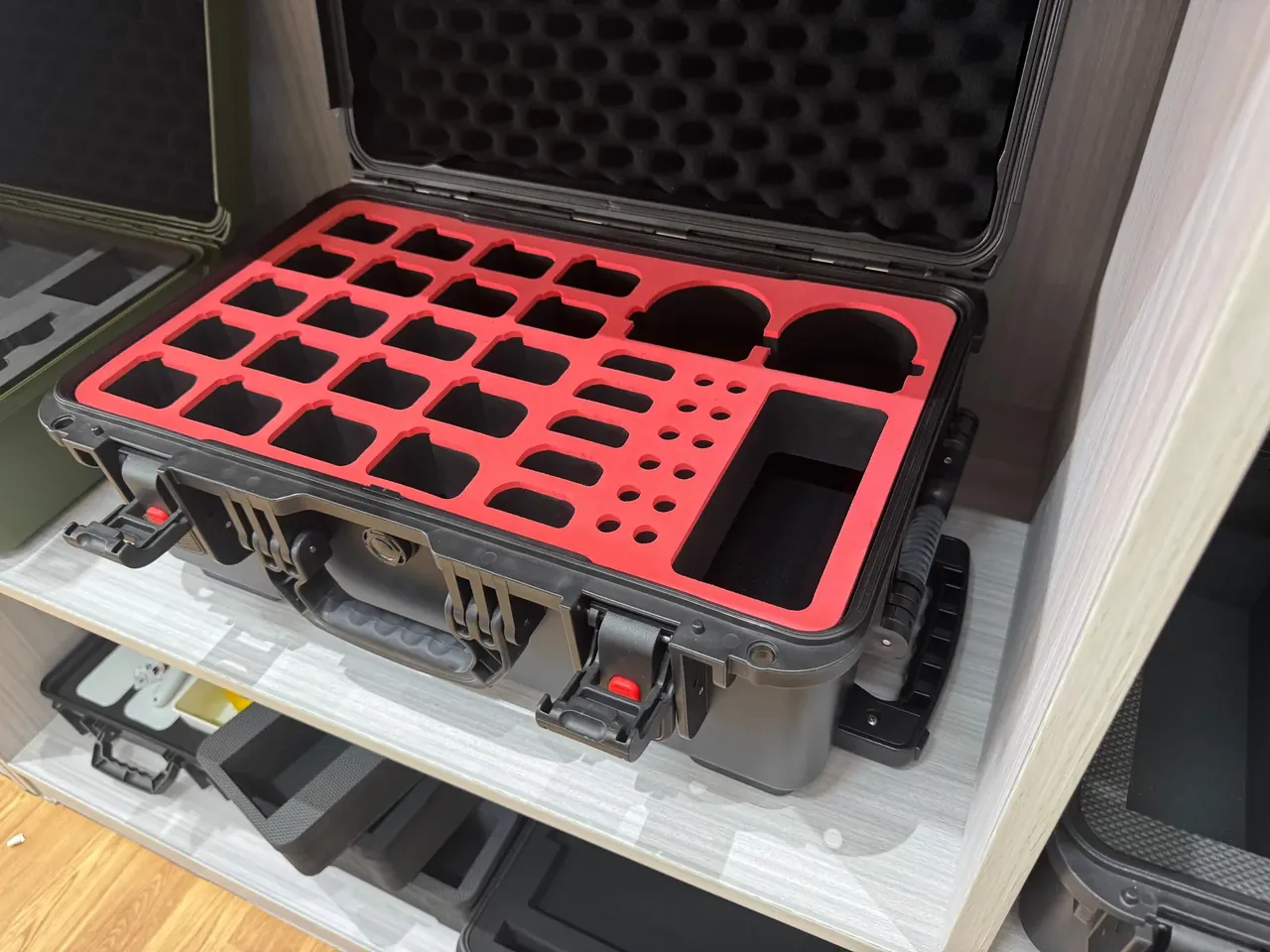
The re-measurement table keeps three rows, one each for peak, recovery and lid seam, with no conversion between measuring points. A crossed line then shows the cause.
| Peak reading | Measuring point | Drawing limit |
|---|---|---|
| Acceleration peak | Inner corner wall | ≤39 g |
| Corner recovery | Eight corners | ≥91% |
| Lid seam gap | Lid rim | ≤0.40 mm |
The 39 g peak and 91% recovery are judged cold, with the worst face setting the value and the two runs kept separate. With two rings at 21% compression, lost recovery leaves the lid rim loose, so this post-drop figure still reaches the dust margin of the whole Microscope Equipment Transport Case.
5. Radius Setting for the Optics Batch
For the Microscope Equipment Transport Case, the radius setting takes the largest step whose sixth-face peak stays under 39 g; any larger radius stays out of the optics liner drawing. Three corner-wrap steps, the six-face peak table and the eight-point recovery log must all be on file: certify the largest step if it passes, and add wrap only if even the largest fails. The setting just holds 39 g without bulging past the stacking limit.
Radii kept out of the optics liner drawing still open as a general cushioning liner, no longer benchmarked to IP67 immersion. JUNZHIJIA puts R17, 3.1 mm wrap and the 39 g peak line on a single corner detail sheet, and the inspection card checks peak face by face so the Microscope Equipment Transport Case optics batch and rig samples speak one language.
Conclusion
Setting the radius on a Microscope Equipment Transport Case puts R17 and the 3.1 mm wrap on the drop rig together, then checks the 39 g peak and 91% recovery after six 0.75 m drops. The 620×440×255 mm shell and 4.7 mm wall carry the body, but trimming shock falls to that corner pair. JUNZHIJIA draws peak, recovery and radius onto one corner sheet.
Related Reading
- Laboratory Instrument Case: Shock Protection and Re-calibration
- Custom EVA foam lined precision instrument case
- Case Vibration Test: Random vs Sine
- Calibration Equipment Transport Case
- Shockproof Case for Precision Equipment
Related Products
- 8 Series — Gun Cases; Military Equipment Cases; Camera Equipment Cases; Drone Cases; Watch Cases; Knife Cases; First Aid Cases; Electronics Equipment Cases
- WL8-2812 PP Gun Case — model WL8-2812
- All protective cases and toolboxes: 7 series, 158 models