

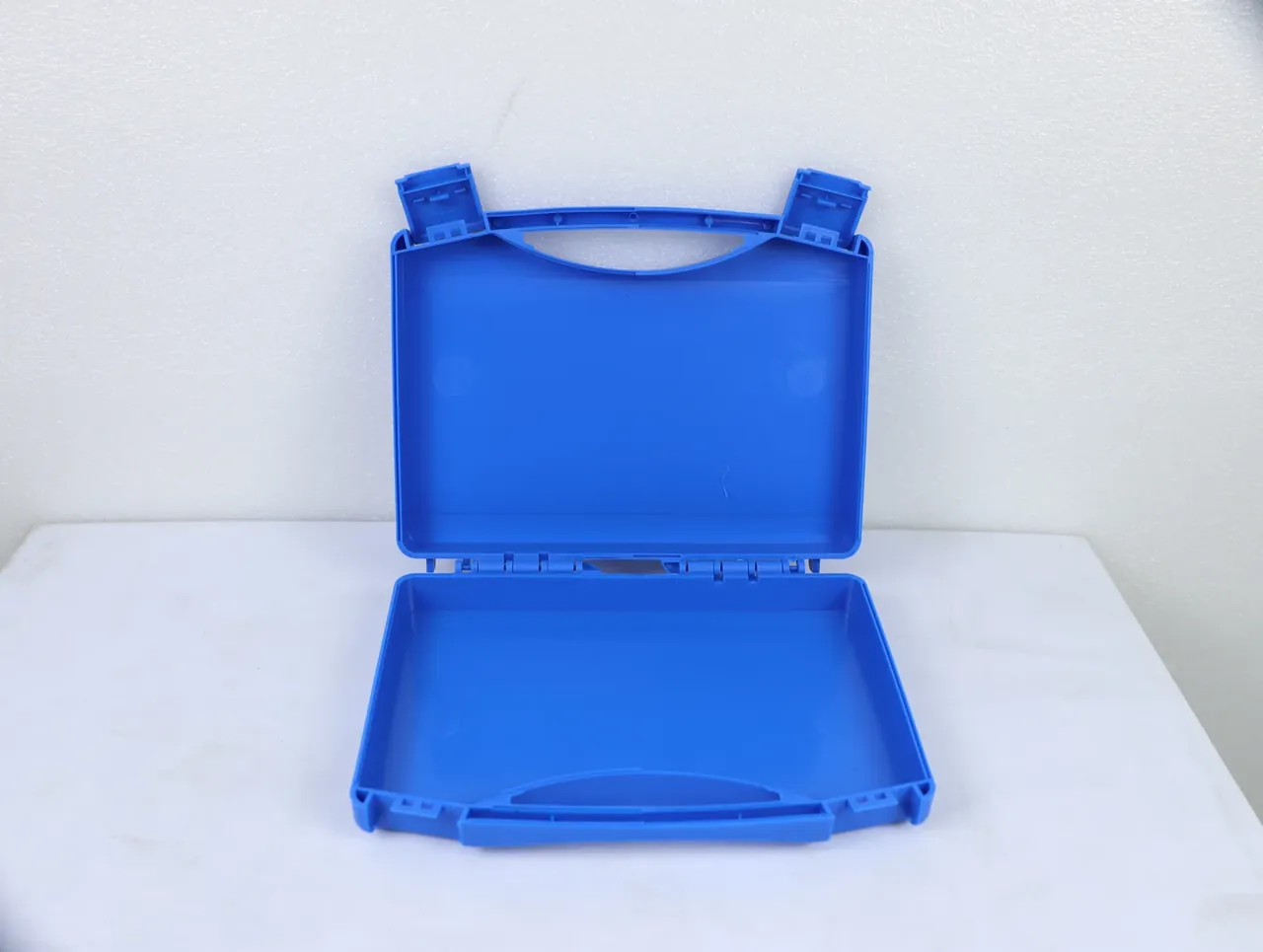
Quick answer: Never size a Large Protective Case by outside length. Start from load: 33.4 kg on 0.512 square metres gives 65 kg per square metre, 98 with the dynamic factor. That sets a 1310 by 420 by 350 mm cavity, a 1350 by 460 by 380 mm body, 7 mm walls and 260 mm ribs.
Table of contents
- Load First: The Weight Ledger of a Large Protective Case
- Deriving Cavity Clearance from Load
- Outside Dimensions and Wall Thickness
- Rib Layout: From Panel Span to Pitch
- Tolerance Stack and Weight Budget
- Turning the Chain into Drawing Parameters
- FAQ
1. Load First: The Weight Ledger of a Large Protective Case
Never size a Large Protective Case by equipment weight. Feet carry point load; the panel sees pressure per square metre, a threefold difference.
| Load item | Value | Why it counts |
|---|---|---|
| Machine | 26 kg | low centre, spread over the base |
| Clamp and straps | 3.4 kg | rides on the base, same shock |
| Cushion | 1.8 kg | 30 mm EVA, 45 kg per cubic metre |
| Cables and spares | 2.2 kg | side pocket, off the base |
| Static total | 33.4 kg | 1.5 times, so 50.1 kg |
The cavity base is 1.28 by 0.40 m, or 0.512 square metres; 33.4 kg over it gives 65 kg per square metre, and 98 with the 1.5 factor.
Drop sits outside it: 1.1 m at minus 20 degrees Celsius is about 360 joules, which decides corner thickness.
2. Deriving Cavity Clearance from Load
A Large Protective Case cavity starts at the machine footprint and grows by cushion each side. A 1250 by 360 by 280 mm machine gets 30 mm of EVA per side, so length is 1310 mm.
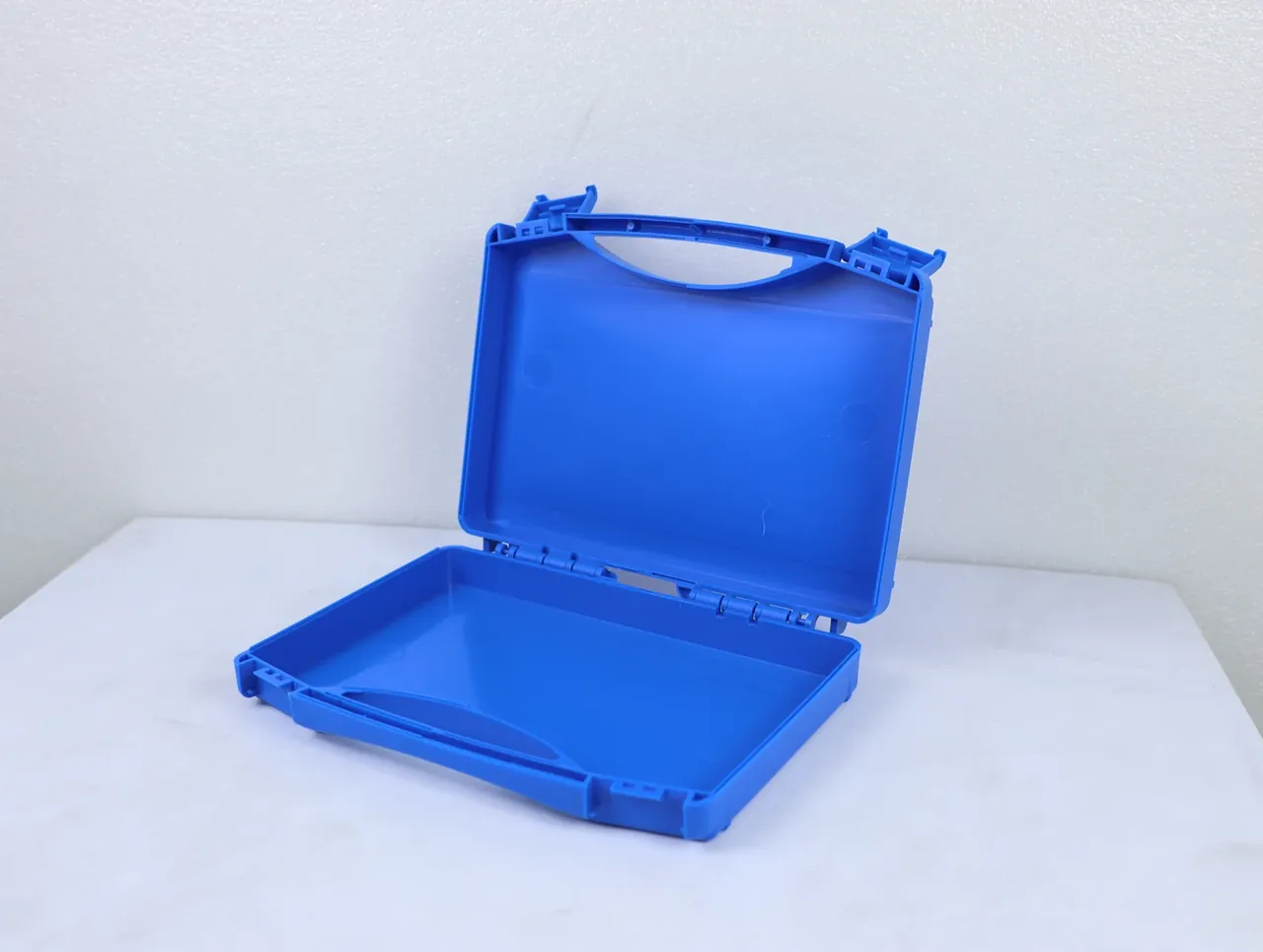
Cushion is calculated. At 98 kg per square metre a 30 mm pad compresses 6 mm and still absorbs a 1.1 m drop; at 20 mm it compresses 9 mm and the corner bottoms out. The lid gets 45 mm, the base 25 mm.
The three directions give a 1310 by 420 by 350 mm cavity, 192 litres. Freeze it: moving one edge 10 mm changes the body and the tool.
3. Outside Dimensions and Wall Thickness
Body equals cavity plus two walls plus two rim bosses. Length: 1310 plus 14 for 7 mm walls, plus 24 for the boss, 1348, rounded to 1350. Width: 420 plus 18 plus 24, 462, rounded to 460. Height: 350 plus 11 plus 9 plus an 8 mm lid boss, 378, rounded to 380. Wall cannot be read back from length: 12 kg and 40 kg at 1350 mm differ by 4 mm of wall.
| Area load, kg per sq m | Panel span, mm | Wall, mm | Deflection, mm |
|---|---|---|---|
| 65 | 400 | 5 | 0.7 |
| 98 | 500 | 7 | 1.1 |
| 130 | 600 | 9 | 1.2 |
The 1.2 mm limit comes from the seal: a 14 mm profile at 30 percent leaves 3 mm of travel, and a panel giving 1.5 mm more lets water in. Going to 9 mm cuts deflection to 0.6 mm but adds 5 kg.
4. Rib Layout: From Panel Span to Pitch
Ribs on a Large Protective Case cut a 500 mm panel into 260 mm squares.
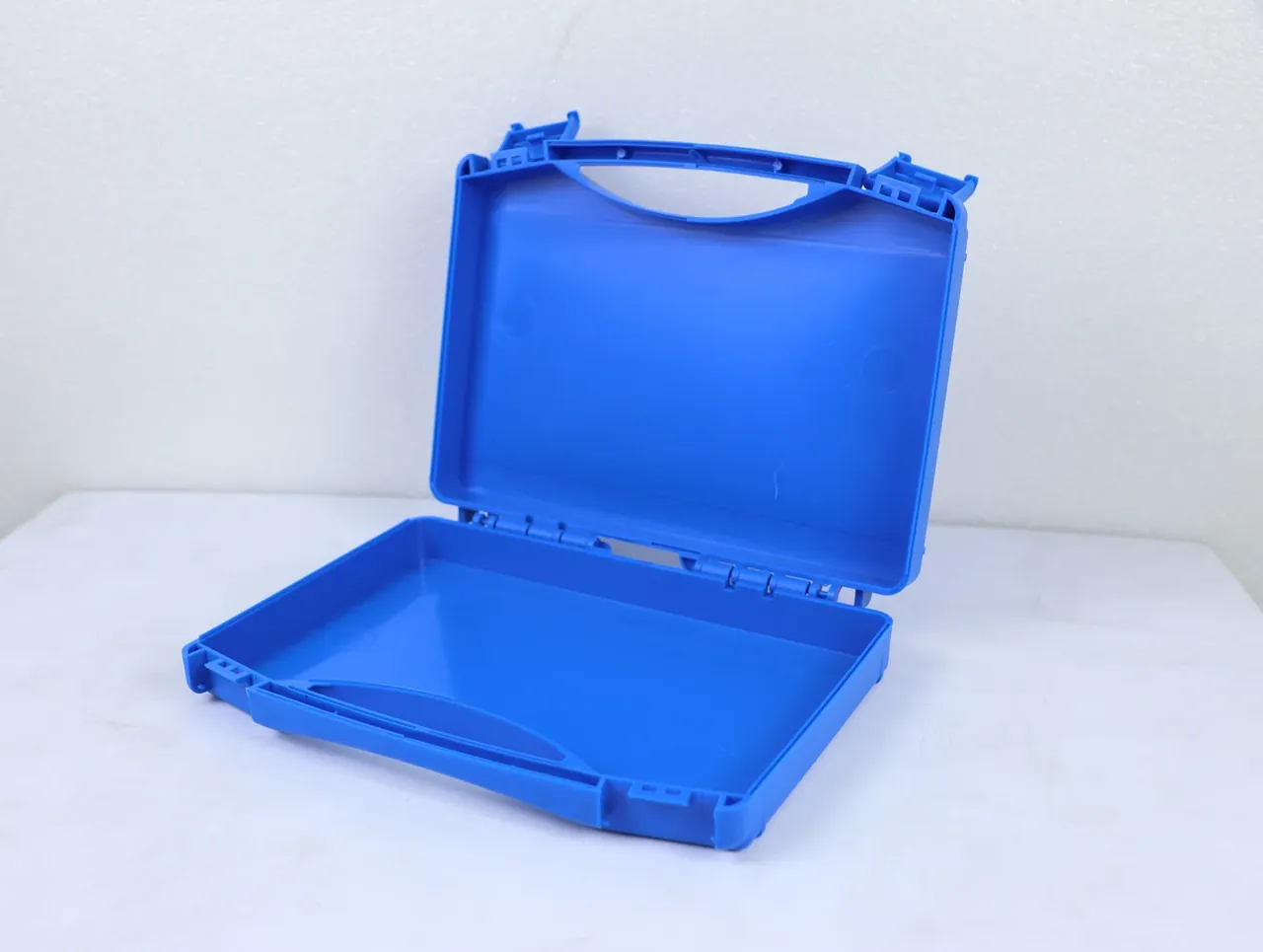
At 260 mm square, 7 mm wall and 98 kg per square metre, deflection is 0.9 mm; at 340 mm it jumps to 1.8 mm. Denser is worse: under 260 mm the melt never reaches the rib top, leaving a void that cracks on impact.
Height 9 mm, thickness 5 mm or 0.7 of the wall, root R3, draft 1.5 degrees. Ribs keep out of the 40 mm rim band, where latch seats sit, and the 60 mm base band, where wheels land. Four long-side ribs, two short-side ribs and 45 degree diagonals complete the grid.
5. Tolerance Stack and Weight Budget
Every number on a Large Protective Case drawing carries a tolerance, and the stack decides whether the assembly closes.
- Shrinkage 1.4 percent: 18.9 mm over 1350 mm, corrected after the first shot.
- Wall plus or minus 0.7 mm, corners plus or minus 1.1 mm.
- Body plus or minus 2.5 mm, cavity plus or minus 1.8 mm.
- Developed area 2.7 square metres, 17.7 kg at 7 mm.
- Each extra millimetre adds 2.5 kg, a two-person lift becoming three.
- Hardware 1.1 kg, total 19.5 kg.
Stack worst case, not root sum square: a cavity at plus 1.8 mm with a cushion at minus 0.5 mm leaves 1.3 mm of play that a drop sends straight into the latch seat.
6. Turning the Chain into Drawing Parameters
The finished Large Protective Case drawing carries results, not reasons.
- Cavity 1310 by 420 by 350 mm, plus or minus 1.8.
- Body 1350 by 460 by 380 mm, plus or minus 2.5.
- Walls 7 side, 9 end, 11 corner, marked minimum.
- Ribs: pitch 260, height 9, thickness 5.
- Four latches at 300 mm, 60 N opening force.
- Rim flatness 1.2 mm, seal groove 4.5 mm.
Conclusion
Sizing a Large Protective Case is a one-way chain: load sets pressure, pressure and cushion set the cavity, cavity plus wall sets the body, body and pressure set rib pitch. Run it backwards and stiffness disappears as the box grows, so fix the five steps as toleranced numbers and a Large Protective Case passes the weigh-in and the drop.
This article discusses only the container (case body) side of specifications and design intent, and does not cover any handling, loading or use of the contents.
Related Reading
- Wall thickness, ribs and lift points of a large case
- Where a large case is used: machines, long stock, crews
- Cartridge box specifications: cavity, wall, sealing
- Heavy duty case specifications and load classes
- OEM case configurations and size matching
Related Products
- 8 Series — Gun Cases; Military Equipment Cases; Camera Equipment Cases; Drone Cases; Watch Cases; Knife Cases; First Aid Cases; Electronics Equipment Cases
- WL8-2812 PP Gun Case — model WL8-2812
- All protective cases and toolboxes: 7 series, 158 models