

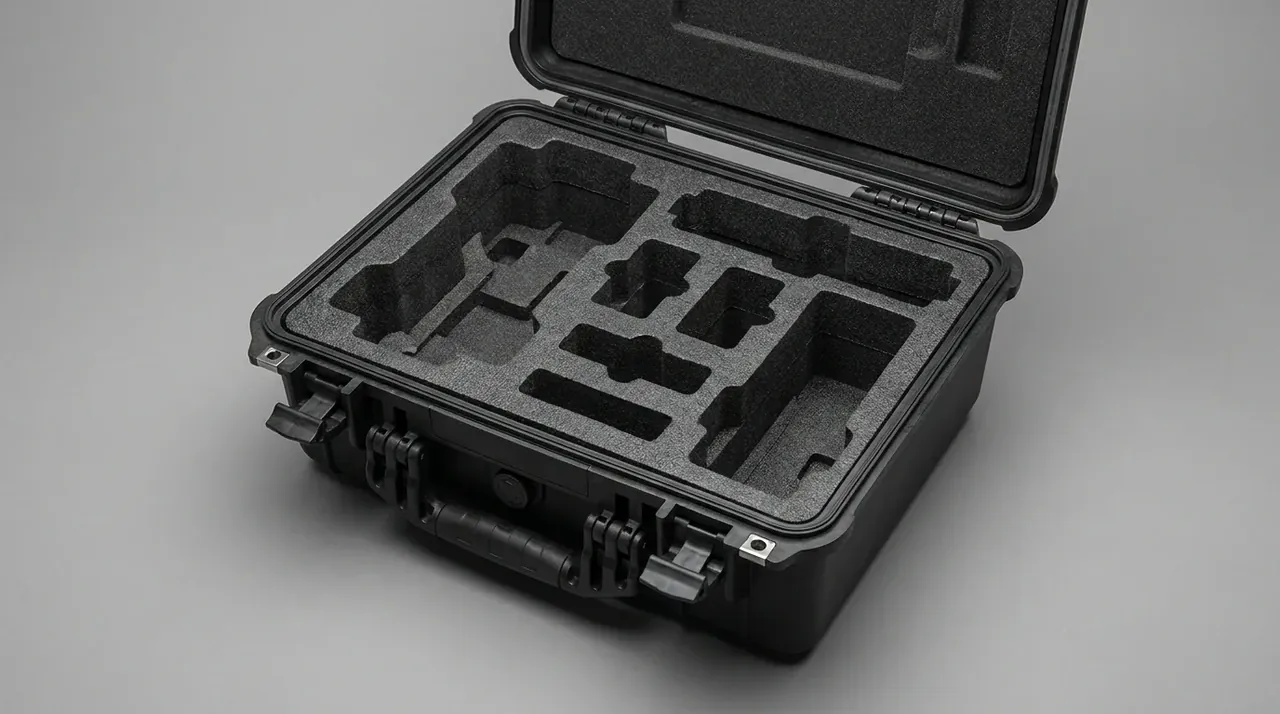
Quick answer: A Laser distance meter pre-cut foam protective box rests on six values: 0.5 to 1.0 mm clearance per side, a cavity 2 mm deeper than the body, 3 mm of lid compression, a 25 mm finger notch, foam density between 25 and 45 kg/m³, and an internal height derived from body thickness plus 12 mm. Those decide whether the meter drops in with one hand and whether the foam survives a fall.
Table of contents
- Cavity Tolerance on the Cut
- What Each Foam Layer Is Cut As
- Die Cutting, CNC and Waterjet
- Finger Notches, Reliefs and Entry Angle
- Lid Compression and Internal Height
- Batch Consistency and Foam Replacement
- FAQ
1. Cavity Tolerance on the Cut
A Laser distance meter pre-cut foam protective box is judged first on cavity tolerance. Measure the body at 128 × 56 × 32 mm and cut the pocket at 130 × 58 × 34 mm, which is 1 mm per side. Where the body carries rubber corner bumpers or a 0.6 mm surface ripple, 0.5 mm per side is enough. Cut it looser and the meter wanders inside the pocket; cut it tighter and every pick-up needs two hands and a fingernail.
Depth runs 2 mm over body thickness, which is the compression allowance for the lid pad. Too much pad and the meter is pushed up until it pops out on release; too little and the closed case still has 3 mm of free travel, so the unit accelerates before the foam catches it and sees a higher peak than a tighter box would give.
| Feature | Reference value | Direction of error |
|---|---|---|
| Pocket length and width | +0.5 to +1.0 mm per side | tight rather than loose |
| Pocket depth | body thickness +2 mm | shallow rather than deep |
| Pocket floor radius | R3 to R5 | follows the cutter |
| Divider rib width | 8 to 12 mm | never under 8 mm |
2. What Each Foam Layer Is Cut As
The lid layer is 20 mm egg-crate foam, left uncut, pressing on the body through its peaks. The 40 mm EVA middle layer carries the load and gets the full outline. A 10 mm flat pad at the bottom only cushions and does no locating. Together they fill a 100 mm internal height with the pad compressed 3 mm, so a finger on the lid edge feels a slight push-back.
Cut the middle layer in two grades. Take the body outline out as a through pocket, but convert protruding parts such as the lens housing and grip into 12 mm shallow trays with 8 mm of solid foam beneath. Cut every protrusion through and the middle layer reduces to a frame, losing half its shear capacity. In a drop, the frame is what tears first, not the shell.
Body 32 mm plus 40 mm middle, 10 mm base and 20 mm pad, minus 3 mm compression, gives 99 mm, rounded to 100 mm. Get the internal height wrong by 5 mm and the whole foam set has to be recut.
3. Die Cutting, CNC and Waterjet
Die cutting suits volume, and it is the usual route for this kind of box. A die costs 800 to 1500 yuan, and after about 200 parts the edge starts to fuzz, with cut accuracy falling from 0.8 mm to 1.5 mm and stringy edges appearing. Below 500 pieces the die rarely pays for itself.
CNC routing is flexible: drawings change without a new die and the cut holds about 1.0 mm. The trade-off is time, roughly 25 minutes for a three-layer set, stretching to 40 minutes when the pockets are dense and irregular. For prototypes and short runs this is the cheapest path.
Waterjet leaves the cleanest edge at 0.3 mm with no scorching, but the foam must be pre-compressed or the jet deforms soft material. A 25 kg/m³ soft foam will not survive it; 45 kg/m³ EVA will.
4. Finger Notches, Reliefs and Entry Angle
The finger notch is the first feature to be dropped and the one users notice most. A 25 mm wide, 15 mm deep half-round notch on each long side lets a thumb and forefinger pinch the body and lift. Cut it smaller and a gloved hand cannot get in; cut it bigger and a slice of side support disappears.
Reliefs follow the hardware. Where a battery door sits on the back, sink another 3 mm into the pocket floor; where a strap lug protrudes, cut a 10 mm vertical slot in the pocket wall. Every relief removes bearing area, so radius the relief edges at 5 mm to stop the foam tearing from a stress riser.
Entry angle shapes the pocket mouth as well. Users who drop the meter in vertically need a 3 mm flare at the mouth; users who lay it in and press need only a 1 mm chamfer. Skip the chamfer entirely and 30 insertions are enough for the body corners to scrape a rim of fuzz around the opening.
5. Lid Compression and Internal Height
Closing force comes from three parts working together: pad thickness, middle layer height and latch travel. A 20 mm pad squeezed to 17 mm is 15% compression. Under 10% nothing is held; over 25% keeps the latches under standing stress, and opening effort climbs from 70 N to 110 N within six months.
The height formula is short: internal height equals body plus middle plus base plus pad, minus compression. For a 32 mm body, 32 + 40 + 10 + 20 - 3 = 99 mm. Specify 100 mm and the extra millimetre absorbs foam thickness variation during assembly.
EVA from one batch commonly varies ±1 mm, which becomes ±3 mm across three layers. Ignore that and some shells will not close while others close without touching the pad. Weigh or gauge five sheets at goods-in and divert the outliers to base pads.
6. Batch Consistency and Foam Replacement
Consistency in a cut foam set is checked on three quantities: kerf width, pocket centre distance and density. Gauge kerf at four points around a pocket and keep the spread within 0.3 mm. Measure three pocket centres against the drawing and hold 0.5 mm. Weigh equal volumes and treat a 5% spread as a sign of mixed material.
| Check | Instrument | Limit |
|---|---|---|
| Kerf width | calipers, four points | spread ≤0.3 mm |
| Pocket centres | tape, three samples | deviation ≤0.5 mm |
| Weight per volume | bench scale | spread ≤5% |
| Rebound thickness | rule after 30 min flat | ≥90% of original |
Replacement is driven by compression set, not by the calendar. Take the pad out, lay it flat for 30 minutes, and if it returns to less than 90% of its original thickness it is done. At 20 openings a week a set lasts 18 to 24 months; above 40℃ ambient that shortens to about 12 months.
A collapsed pad is a pad-only job while the middle layer is still intact; cracks or fuzzed pocket walls mean the middle layer has to be recut. Stock spares at 10% of a layer rather than 10% of complete sets, and storage drops by half.
Related Reading
- Pick-and-pluck foam versus cut dividers
- Foam thickness at 5, 10 and 15 mm
- Common foam types for case interiors
- Replacing aged foam in a case
Related Products
- 8 Series — Gun Cases; Military Equipment Cases; Camera Equipment Cases; Drone Cases; Watch Cases; Knife Cases; First Aid Cases; Electronics Equipment Cases
- WL8-2812 PP Gun Case — model WL8-2812
- All protective cases and toolboxes: 7 series, 158 models