

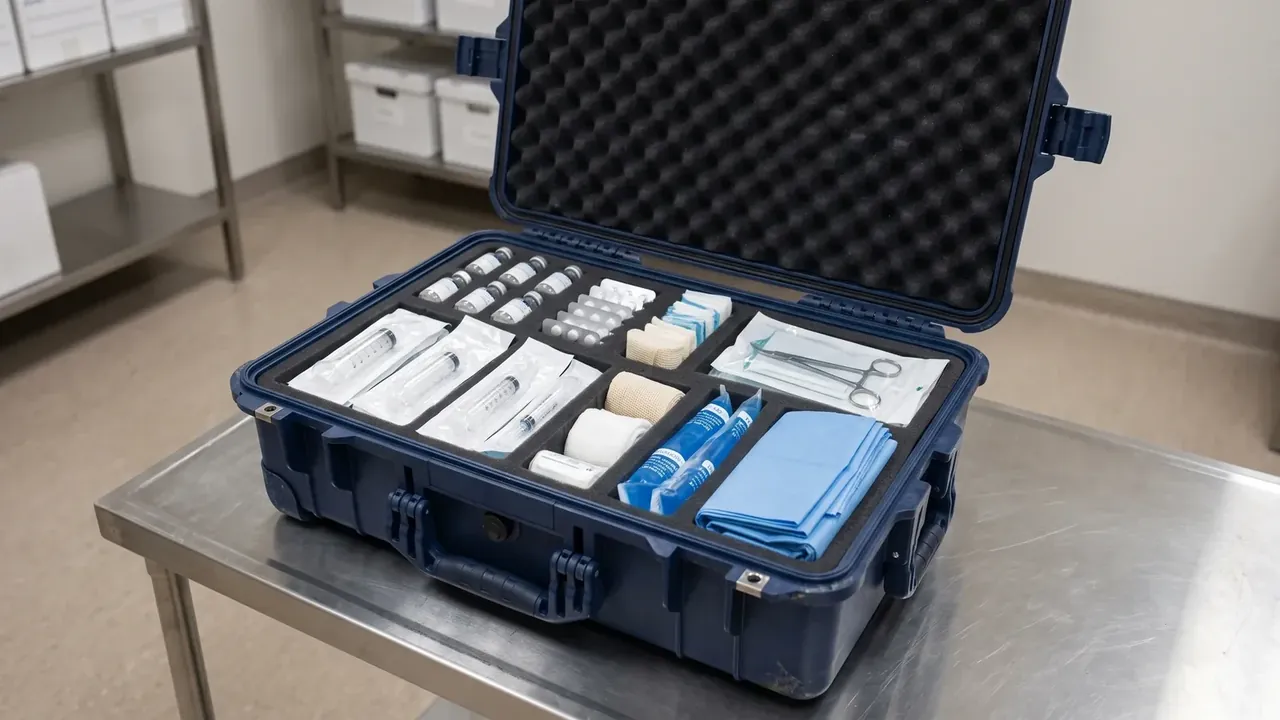
Quick answer: The Medical portable infusion pump safety case pairs a 12 mm lid frame with 0.6 mm groove clearance to hold pump shift within 0.8 mm.
Table of contents
- Shell moulding and wall-thickness control
- Lid frame clear height and moulding tolerance
- Bottom limiting groove clearance and insert assembly
- Closing system and seal compression
- Release testing and batch acceptance
- FAQ
1. Shell moulding and wall-thickness control
The Medical portable infusion pump safety case is moulded to a 520×380×210 mm outer envelope and a 455×320×150 mm cavity, with the wall fixed at 3.8 mm. That thickness sets the whole injection window: shear rate at the corners, hold pressure and cooling layout all follow it. If any patch drops below 3.4 mm, the side wall sinks after ejection and the rim line drifts out of register. Stiffness has to come from even wall stock.
Empty weight is the cheapest check: one shell is weighed every two hours, and a reading more than 0.15 kg from 4.5 kg stops the press.
The 9 kg loaded figure is the service load, carried on the four side walls and the bottom ribs, never on the rim, which stays clear as a sealing face. Ribs run in a grid 6 mm tall with 1.5 mm root fillets, so stress spreads instead of cracking. Stock around each moulded insert is thickened to 4.2 mm, since metal and plastic shrink at different rates. Shells rest 24 h at 23 °C before assembly, so a dimension taken then does not change two days later.
2. Lid frame clear height and moulding tolerance
A rib moulded along the inner rim forms the press frame. Its clear height is set at 12 mm, and on closing it alone provides the vertical constraint that pushes the insert back into the bottom groove. Cavity depth governs that height, and shrinkage removes 0.1–0.2 mm, so the tool is cut to 12.18 mm with the allowance left in the steel.
The Medical portable infusion pump safety case gauges this at first inspection: a depth gauge at four points on the frame, with 11.95–12.05 mm accepted.
| Frame setting | Measured clear height | Closing verdict |
|---|---|---|
| 11.8 mm setting | 11.75–11.85 mm | Insert top not pressed |
| 12.0 mm setting | 11.95–12.05 mm | Lid seats correctly |
| 12.2 mm setting | 12.15–12.25 mm | Rim bottoms out, catch travel short |
Too little height leaves a gap above the insert and hands the vertical job to the foam. Too much and the lid stalls: the two catches cannot finish their travel and the seal never reaches 21% compression. The frame starts the chain; every reading downstream moves with it.
3. Bottom limiting groove clearance and insert assembly
The bottom insert carries a limiting groove around its outer edge, held at 0.6 mm per side. That groove is what pins the insert horizontally inside the Medical portable infusion pump safety case. Open it to 0.9 mm and lateral movement in a drop pushes pump displacement past 0.8 mm; close it below 0.4 mm and ordinary shrinkage variation stops the insert entering the shell at all.
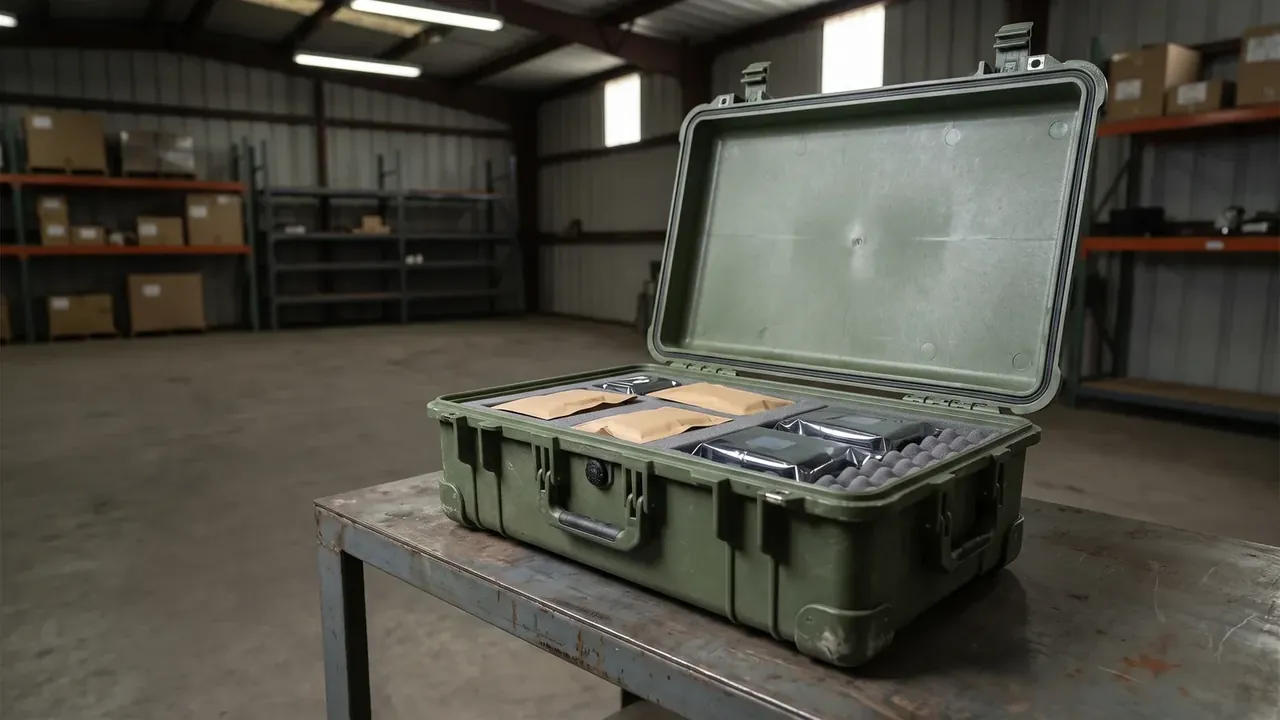
The 0.6 mm figure covers tolerance and foam rebound. Groove-mouth draft is held at 0.5° with flare under 0.05 mm; at 1° the mouth opens out and a gauge reads the mouth rather than the wall.
Four groove segments run along the four sides and must agree. Fitters on the Medical portable infusion pump safety case pass a feeler gauge along each segment and log to 0.05 mm, entering the four readings and the frame height on one assembly sheet signed per segment. A single segment out of tolerance is not sent back alone; the spread across all four is read first.
4. Closing system and seal compression
Two catches close the lid of the Medical portable infusion pump safety case, each rated at 340 N. Past 21% compression the seal cannot recover, and after a few dozen cycles the bead takes a permanent set. Catch travel is tied to frame height: 0.2 mm extra shortens the stroke, so the force reading looks high while the load reaching the seal is low.
One seal sits in a rim groove sized back from cord diameter and a 21% target. Below 18% the bead does not sit down on the rim; above 25% stress relaxation sets in and the bead stops springing back. After assembly every shell has its rim gap checked with a 0.05 mm feeler that must not enter.
Spray and dust are run through the IP65 sequence of moves and nothing more. The Medical portable infusion pump safety case reports whether water entered the rim and whether dust settled inside; the report carries no rating class and no certificate number. Sampling covers the rim, the frame and the insert.
5. Release testing and batch acceptance
Drop testing on the Medical portable infusion pump safety case runs from 1.0 m onto six faces — bottom, top, both long edges, both short edges. A sample is closed with a 9 kg payload and both catches engaged, then pump movement is read against a scribed floor baseline.
| Drop orientation | Drop height | Pump-body displacement |
|---|---|---|
| Broad face (bottom) | 1.0 m | ≤0.8 mm |
| Broad face (lid) | 1.0 m | ≤0.8 mm |
| Long edge one | 1.0 m | ≤0.8 mm |
| Long edge two | 1.0 m | ≤0.8 mm |
| Short edge one | 1.0 m | ≤0.8 mm |
| Short edge two | 1.0 m | ≤0.8 mm |
Endurance on the Medical portable infusion pump safety case runs 4000 cycles on a rig that lifts the lid to a fixed angle and releases it, pausing every 500 for a frame-height reading. One question closes the test: has frame sink passed 0.3 mm? The number measures how much limit margin the 12 mm height still holds, not collapse.
| Displacement value | Accumulated cycles | Disposition |
|---|---|---|
| 0.10 mm | 4000 cycles | Release |
| 0.20 mm | 4000 cycles | Release |
| 0.30 mm | 4000 cycles | Boundary release |
| 0.34 mm | 4000 cycles | Re-check |
| 0.40 mm | 4000 cycles | Reject |
Batch release reads the spread of the four groove clearances in one shell rather than any single unit. A spread past 0.1 mm sends the tool back for rework: cavities cool at different rates and uneven shrinkage splits the load between segments. Sampling re-measures the outer envelope and cavity, confirms the 3.8 mm wall has not thinned, and logs the 4.5 kg empty weight. JUNZHIJIA prints segment number, clearance and frame height side by side, so a deviation can be traced to one tool.
Conclusion
The Medical portable infusion pump safety case splits acceptance into three stages. Moulding watches 3.8 mm of wall and 4.5 kg of empty weight; assembly watches 12 mm of frame height and 0.6 mm of groove clearance; release watches 0.8 mm of pump displacement after a 1.0 m drop and 0.3 mm of frame sink after 4000 cycles. Each stage leaves a reading that can be taken again.
Related Reading
- Pump-body protection in infusion and syringe pump cases
- Sealing and labelling of CSSD transfer cases
- Medical cases at aid posts, in the field and in vehicles
- Medical equipment boxes and instrument boxes
Related Products
- 8 Series — Gun Cases; Military Equipment Cases; Camera Equipment Cases; Drone Cases; Watch Cases; Knife Cases; First Aid Cases; Electronics Equipment Cases
- WL8-2812 PP Gun Case — model WL8-2812
- All protective cases and toolboxes: 7 series, 158 models