

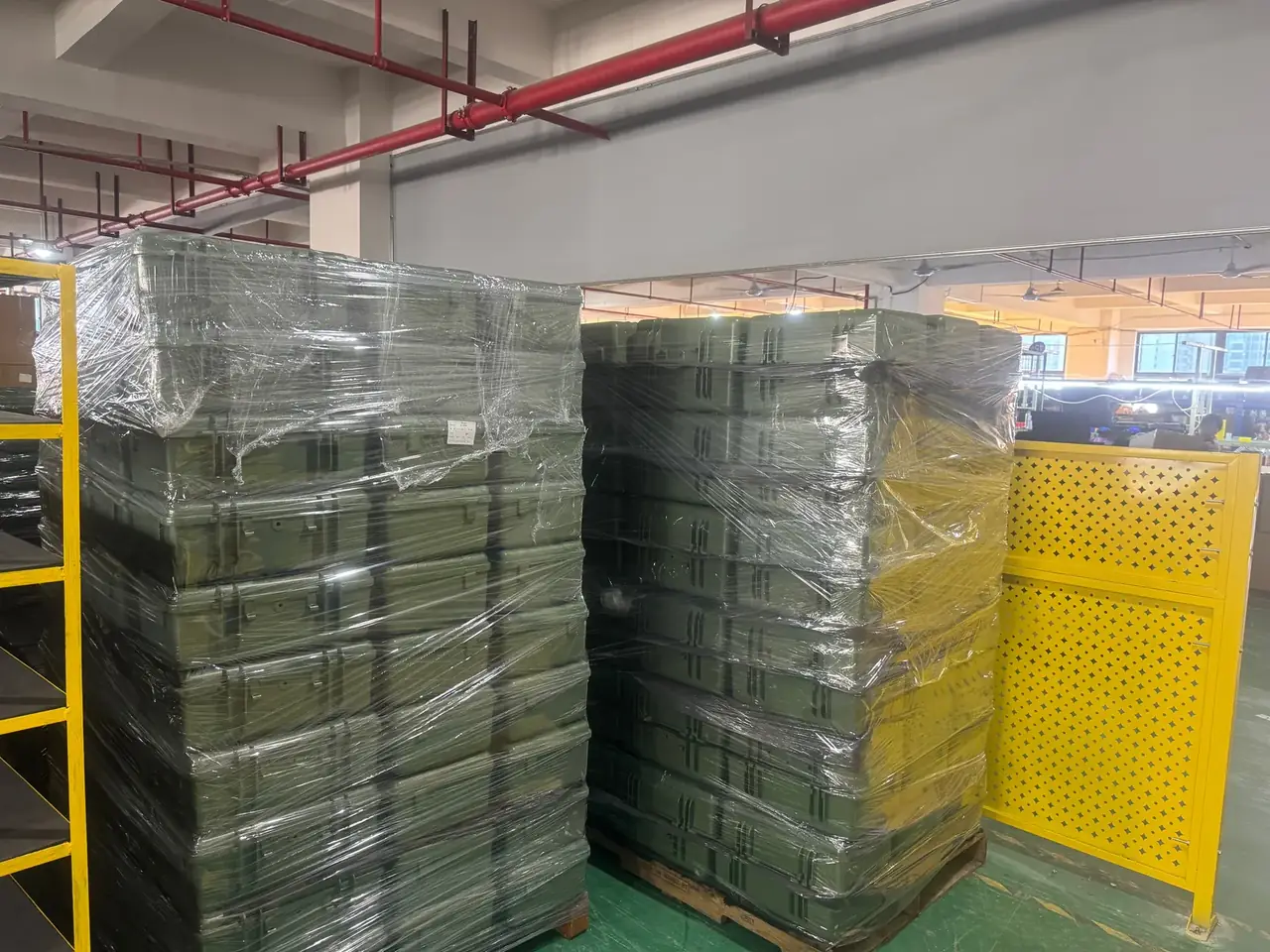
Quick answer: A Military Case Factory Audit reads three rigs together: 1.2 m drops, 10 min at -20 kPa with decay under 0.25 kPa, and a 320 kg stack held 24 h.
Table of contents
- Drop Tower Height in a Military Case Factory Audit
- The Reading Window for Pressure Decay
- Load and Duration at the Stack Station
- Agreement Across the Three Rigs
- Pass Lines in the Audit Report
- FAQ
1. Drop Tower Height in a Military Case Factory Audit
In a military case factory audit, 1.2 m runs from the lowest point of the shell to the impact plate, not from the handle. Handles sit further out than the base on most mouldings, so measuring from them shrinks the fall. The tower scale is zeroed on the plate and held inside ±2.5%; 1.2 m is 48 in, a transit figure reused for decades.
Two plates see service. The steel rig carries a 50 mm plate on a rigid base, the plywood rig the same thickness of hardwood over concrete. Steel returns more energy, wood absorbs some. The ten-drop sequence in a military case factory audit runs on steel; the 26-drop type test uses plywood to match the original transit set-up.
| Rig setting | Sequence | Impact plate | What to watch |
|---|---|---|---|
| Short form | Six faces, three edges, one corner, 10 drops | 50 mm steel | Corner cracks, latch release |
| Full form | 26 drops across 8 corners, 12 edges, 6 faces | 50 mm plywood | Through-cracks, weld-line splitting |
| Recheck | Three extra drops on the weakest corner | 50 mm steel | Whether the first crack grows |
On a 700×480×300 mm shell with a 630×415×225 mm cavity and 4.9 mm walls, bottom corners go first: three edges meet there and the weld line lands in the same zone.
Nothing is repaired between drops; adhesive at drop four hides what drop seven would show.
2. The Reading Window for Pressure Decay
The pressure window comes out of water head: 1 m of water is about 9.8 kPa, and IP67 immersion is 1 m for 30 min. A military case factory audit pulls to -20 kPa, roughly two metres of head, then holds 10 min while decay stays at or under 0.25 kPa.
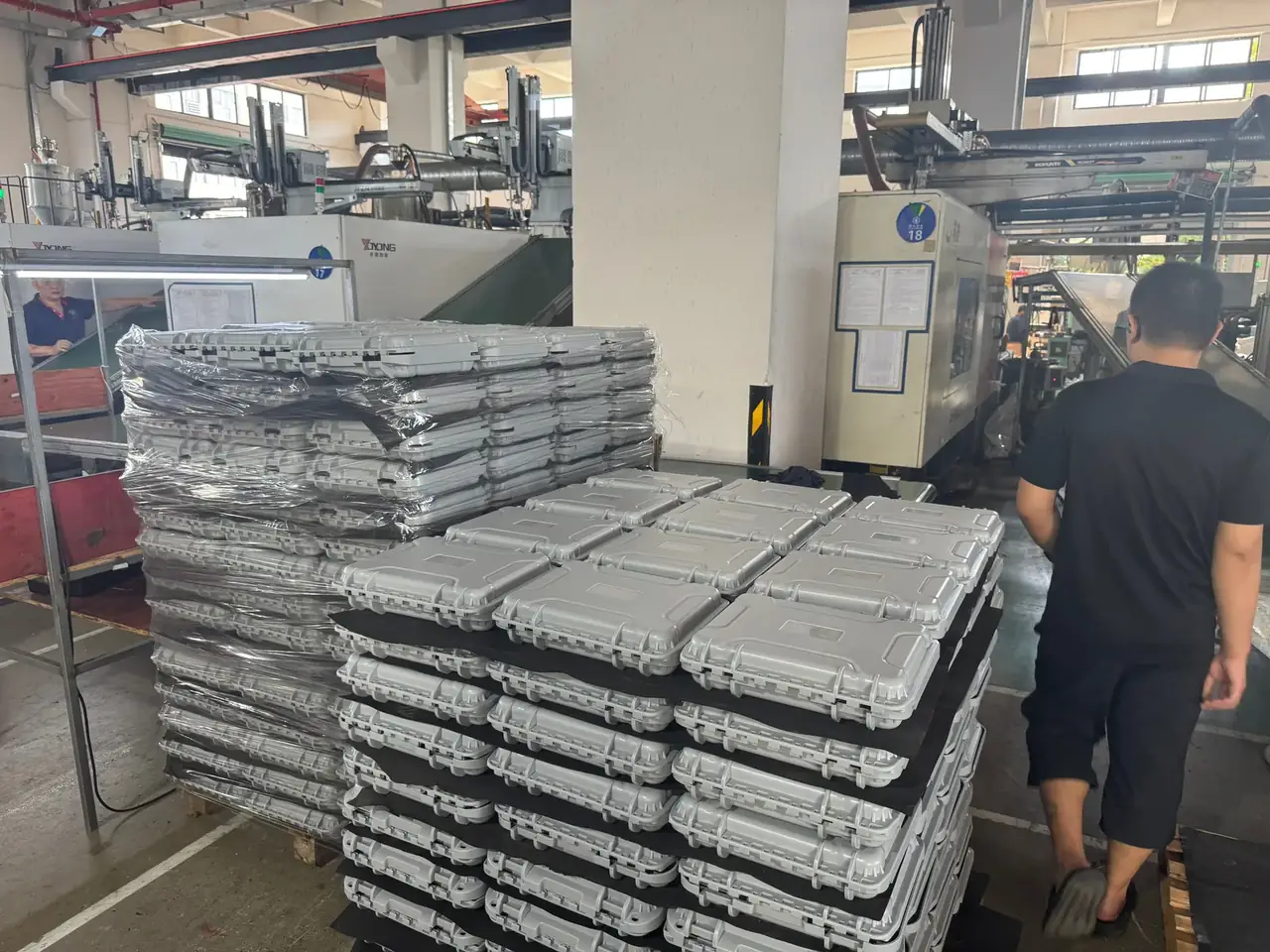
Vacuum leaves no water in the gasket groove but flips the load direction: atmosphere presses the gasket deeper into its channel and the reading turns optimistic, so only the decay curve is judged.
Three intervals get logged: 3 min for stability, 5 min for the mid-slope, 10 min for the end value. A fast early drop that flattens means the gasket has not seated; an even fall is a real leak.
| Hold interval | Vacuum | Decay reading | Action |
|---|---|---|---|
| 3 min | -20 kPa | 0.09 kPa | Log only, no verdict |
| 5 min | -20 kPa | 0.17 kPa | Recheck the slope |
| 10 min | -20 kPa | 0.22 kPa | Compare with the pass line |
Four latches at 420 N each set how evenly the gasket compresses; let one sit half a turn short and the 10 min decay splits a batch in two. A ten-degree swing shifts decay near 0.05 kPa, so shells rest half an hour before the pump starts.
3. Load and Duration at the Stack Station
Stack arithmetic is blunt in a military case factory audit: at 80 kg per loaded case, five high puts 320 kg on the bottom unit, left 24 h with no unloading or shifting.
Corner deformation is capped at 0.4 mm, read from four corner heights before and after loading, largest difference taken; that allowance eats nearly half the base-to-pallet clearance.
Thermoplastics creep, fastest in the first two hours, then flatten; by 24 h further change falls below gauge error. The same shell deforms about thirty percent more at 35 °C than at 23 °C, so the day's temperature goes in the record. Weights stay centred, never overhanging, or the corner reads worse than field service.
4. Agreement Across the Three Rigs
The three sets in a military case factory audit must corroborate one another. A dropped shell goes straight onto the pressure rig, where a hairline corner crack lifts decay at 5 min; a stacked shell is rechecked, and the largest corner set usually shows higher decay.
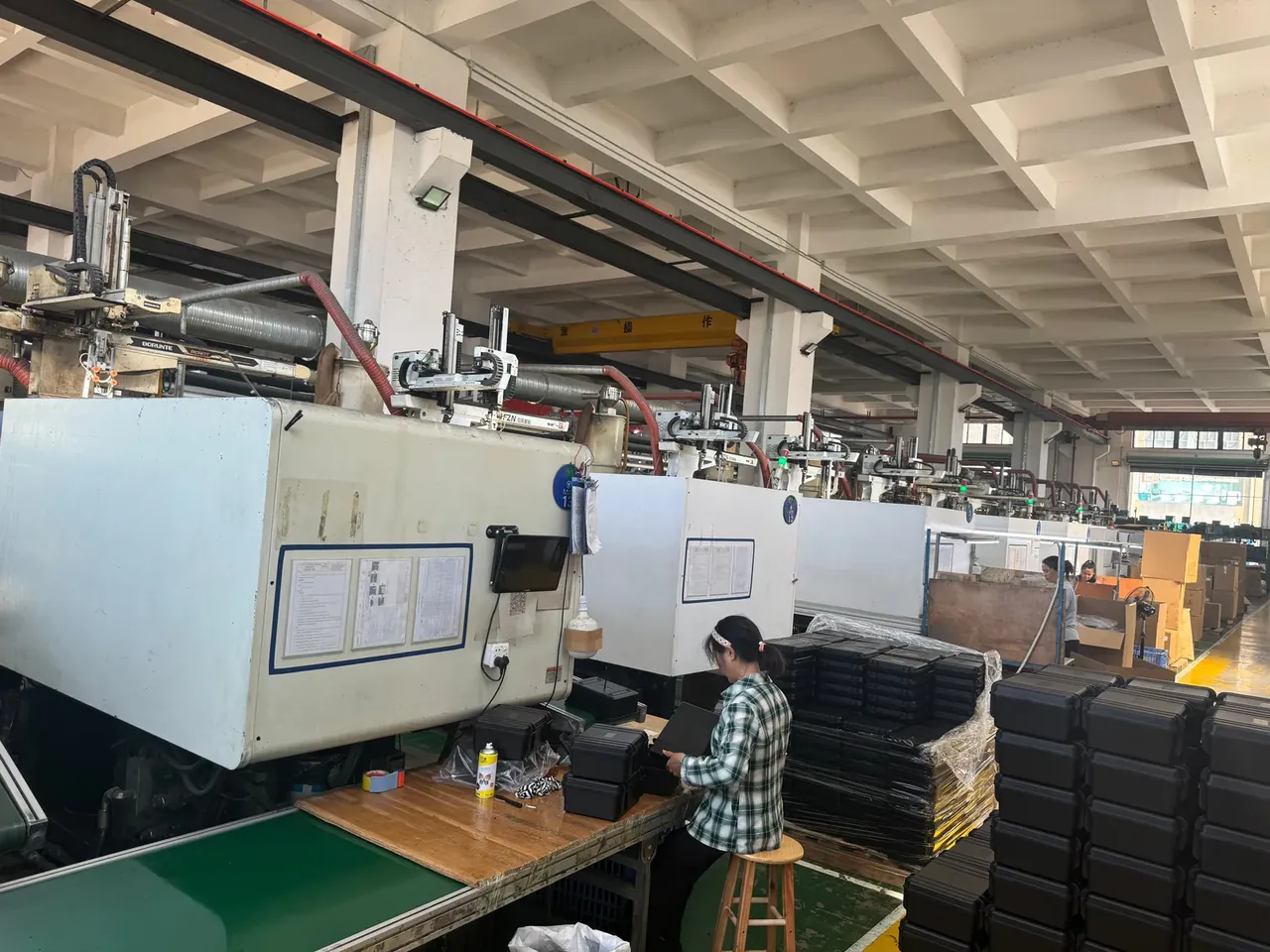
Cross-checking runs in two passes: deep dents, large set and high decay should belong to one batch and one mould cycle, and all three should sit within one step of each other.
The cycle rig gives a military case factory audit a fourth line of evidence: after 3950 open-close cycles, latch and hinge clearances move, gasket compression changes with them, and decay drifts.
One pattern looks consistent and is not: all three pass, each on the top edge of its band. Such a batch ships with two extra samples from the next run.
5. Pass Lines in the Audit Report
There is a single pass line in a military case factory audit: the setting that still holds 10 min decay below 0.25 kPa, and the lowest setting governs when the three rigs disagree.
| Decay reading | Corner set after stacking | Leak recheck | Verdict |
|---|---|---|---|
| 0.18 kPa | 0.22 mm | 0.19 kPa | Pass |
| 0.22 kPa | 0.31 mm | 0.24 kPa | Pass, watch list |
| 0.24 kPa | 0.47 mm | 0.29 kPa | Fail |
Row three breaks the 0.4 mm limit and the recheck passes the decay line too; two failures leave nothing to argue. Row two rides the line, so it ships with a note.
Three originals stay on file: drop numbers with photographs, the three-interval curve, and corner heights before and after stacking. IP67 is written as a benchmark, never as a certificate held, and no certificate number is filled in.
A military case factory audit record shares its number with the batch card, so a re-test can be pulled by number rather than memory.
Conclusion
A military case factory audit is less about one rig than about whether three rigs read as one story. Ten drops at 1.2 m expose weak points, 10 min at -20 kPa measures sealing margin, and 320 kg for 24 h tests corner stiffness. With all three the report carries a signature; missing one, it is half a page. Batch cards travel with the raw curves, so the next auditor reads the same sheet.
Related Reading
- Transit Cases vs Carton Packing
- Drop Sequence: Corner, Edge, Face
- Reading a Pressure-Decay Test
- Military Case OEM and ODM Factory
- Industrial Tool Case Factory Direct Supply
Related Products
- 8 Series — Gun Cases; Military Equipment Cases; Camera Equipment Cases; Drone Cases; Watch Cases; Knife Cases; First Aid Cases; Electronics Equipment Cases
- WL8-2812 PP Gun Case — model WL8-2812
- All protective cases and toolboxes: 7 series, 158 models