

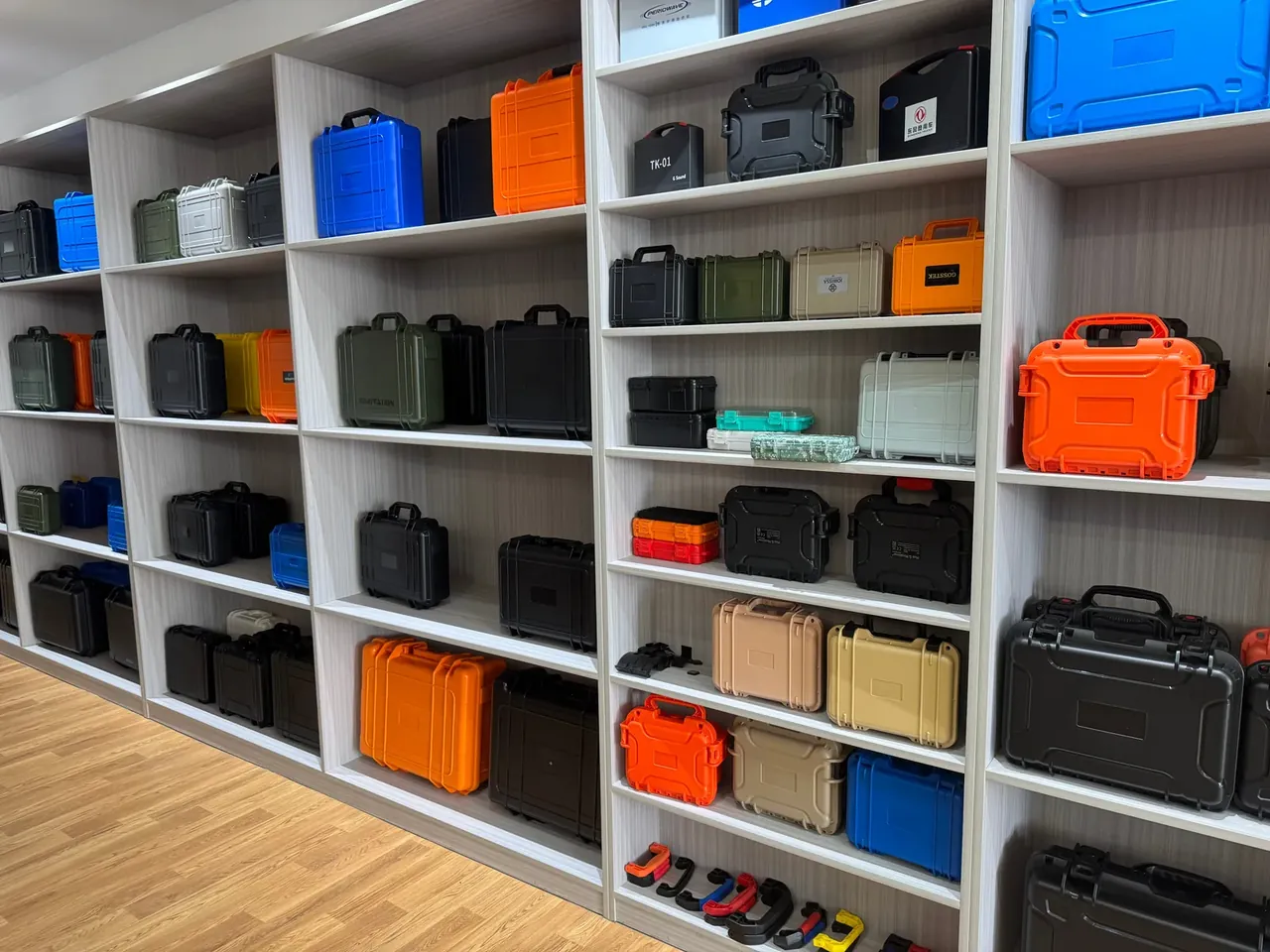
Quick answer: The Military Case OEM and ODM Factory runs one shared base across 480, 560 and 625 mm shell widths, holding 4.6 mm walls and ±0.25 mm after an insert swap.
Table of contents
- Military Case OEM and ODM Factory Shared Shell Boundary
- Dedicated Inserts and Changeover Hours
- Amortising Tooling Cost Across Batch Size
- Sampling Rounds and First-Article Sign-Off
- Where OEM Ends and ODM Begins
- FAQ
1. Military Case OEM and ODM Factory Shared Shell Boundary
How many shells one base can carry depends on where the first-article wall sits after an insert goes back in. The base fixes outline, parting surface and ejectors; the 480, 560 and 625 mm widths come from swapping side inserts, while lid, base, latch seats and handle recess stay in the same cavity blocks. Flow length grows with width, so pressure and packing are reset per tier while the base stays bolted. Buyers hear "shared" and expect no tooling, yet only the base and main blocks are saved.
At 625×430×245 mm outside and 560×370×185 mm inside, the wide tier carries a 4.6 mm wall, with gasket groove and four latch seats in shared blocks. The Military Case OEM and ODM Factory changes only the width insert between tiers, so lid ribs, latch spacing and handle-recess centres stay put.
The parting line sits 18 mm below the rim on all three tiers, keeping the joint independent of width. Draft runs at 1.0°, and the wide tier adds about 100 mm of flow, so hold time rises by 1.5 s or shallow sinks appear mid-wall. Colour, liner and print stay open; the outer profile does not.
Shared is not universal: the boundary is width, not colour.
| Shared tier | Cavity width | First-article wall |
|---|---|---|
| Narrow | 480 mm | 4.35–4.60 mm |
| Middle | 560 mm | 4.45–4.70 mm |
| Wide | 625 mm | 4.60–4.85 mm |
| Beyond | 640 mm | Re-quote as ODM |
2. Dedicated Inserts and Changeover Hours
At the Military Case OEM and ODM Factory, a dedicated insert is the steel block that pins one width inside the base. Its mating face is lapped until it bears evenly, and a 0.03 mm feeler gauge must not enter after refitting. Let it shift and the first-article wall drifts across the ±0.25 mm band.
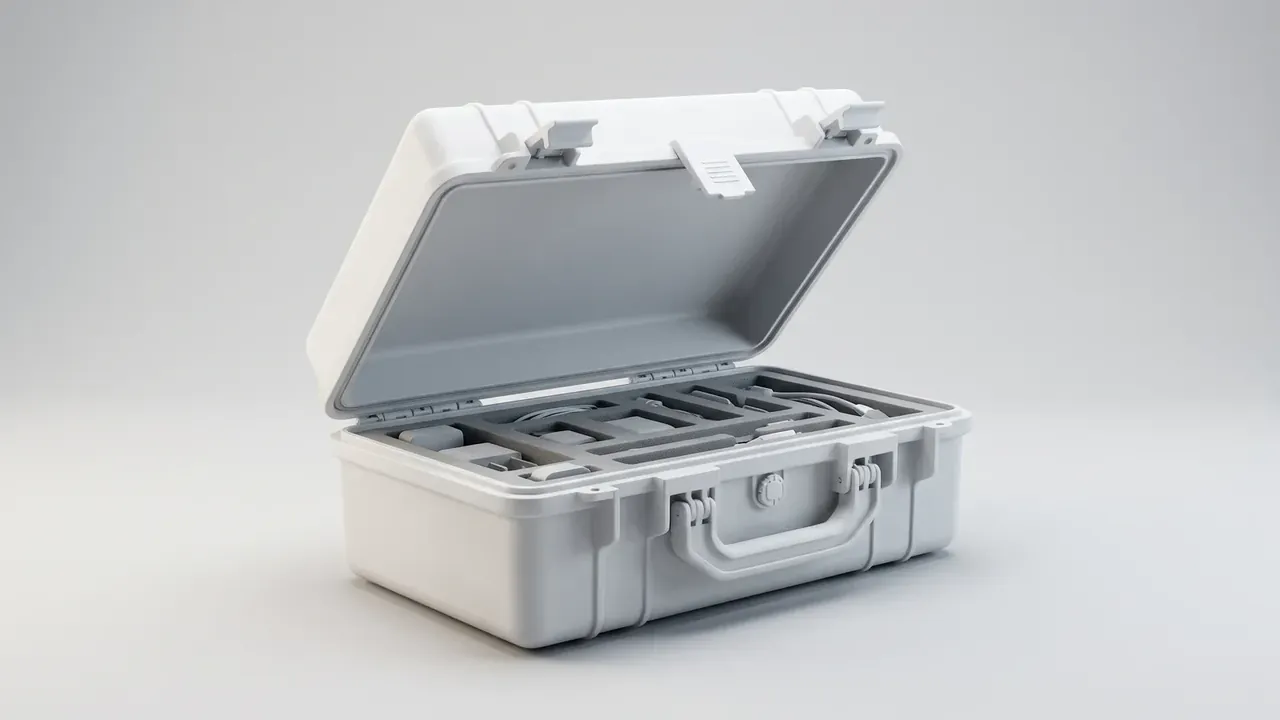
The 3.5 h changeover breaks into six steps: 40 min to pull the old insert, 20 min to clean the pocket and check the sealing face, 55 min to refit and align, 20 min for water lines, 45 min to settle mould temperature, 30 min to shoot three parts and measure wall and surface. The steps add to 210 min, the figure the schedule carries.
| Changeover step | Work performed | Time |
|---|---|---|
| Strip | Remove insert and clamp plate, break water lines | 40 min |
| Clean | Clear the pocket, inspect the mating face | 20 min |
| Align | Refit insert, match the parting surface | 55 min |
| Stabilise | Raise mould temperature and hold | 45 min |
| First part | Shoot three, measure wall and look | 30 min |
Inserts are pre-hardened steel, lapped to Ra 0.4 μm with 0.5 mm edge breaks, so handling does not chip them. Each has a matched clamp plate; past 0.05 mm of wear it is replaced, because a loose plate scatters first-article size. Three trial parts are sectioned and the rib root must stay above 4.2 mm. The 3.5 h belongs to the insert, not the order quantity.
3. Amortising Tooling Cost Across Batch Size
The Military Case OEM and ODM Factory prices base, three width inserts and one spare latch insert into CNY 186,000 of tooling. Over 3,000 units the share is CNY 62.0 per case; below that it climbs steeply.
At 5,000 units the Military Case OEM and ODM Factory sees the share fall to CNY 37.2, at 10,000 to CNY 18.6, each doubling saving less than the last. These readings compare batch sizes, not quotations.
| Amortisation reading | Cumulative units | Tooling per case |
|---|---|---|
| First tier | 3,000 units | CNY 62.0 |
| Middle tier | 5,000 units | CNY 37.2 |
| Final tier | 10,000 units | CNY 18.6 |
Changeover count belongs in the same sum at the Military Case OEM and ODM Factory. Six width changes a month at 3.5 h remove 21 h of machine time, often outweighing the tooling share, so mixed widths are grouped into one run.
4. Sampling Rounds and First-Article Sign-Off
Sampling runs for 2 rounds. The first checks structure: lid-to-base fit after the insert returns, latch travel, handle-recess depth. The second checks colour, where ΔE must stay at or under 1.5 against the same chip.
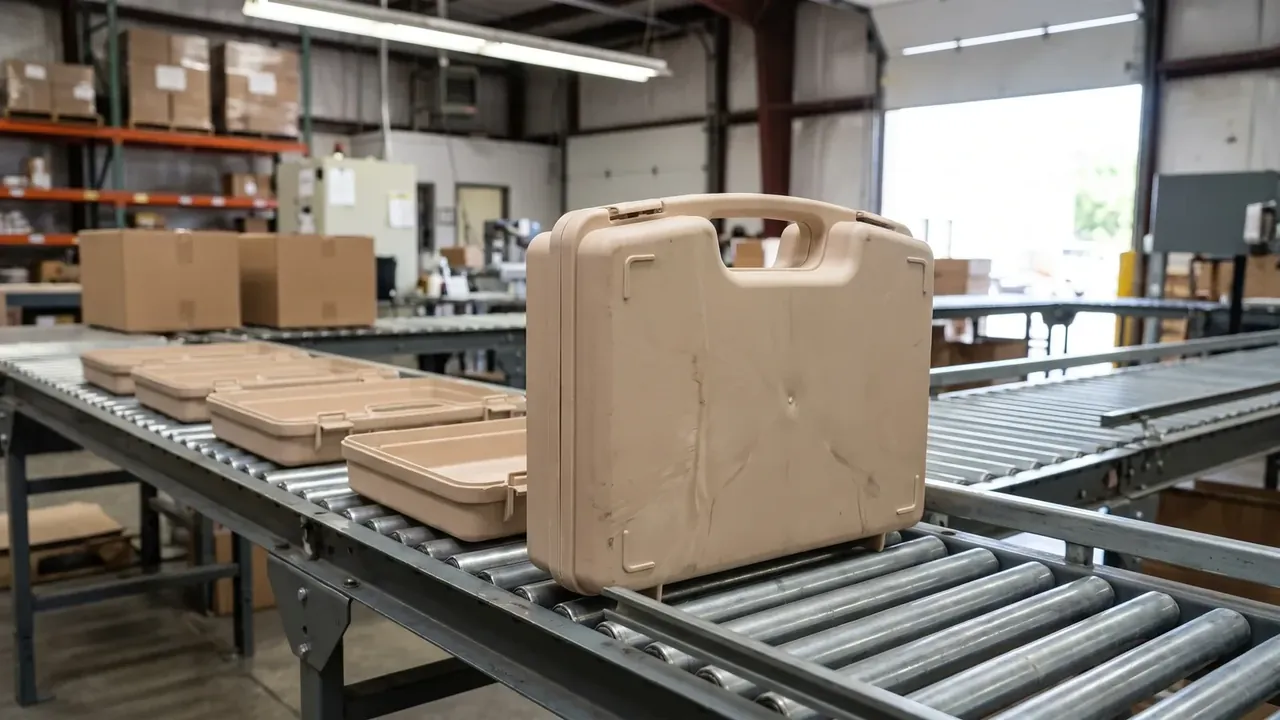
Sign-off finishes within 48 h and covers wall at nine points, outside length and rim flatness. Every latch is pulled to 400 N, three cases go on the 4,000-cycle rig, and 4-high stacking for 24 h ends with a rim re-measure. IP67 is checked as a type test, dust then immersion.
Five first articles are kept: one with the signed sheet, the rest split between tooling, moulding and assembly. The Military Case OEM and ODM Factory stores them for 24 months beside a colour chip and ties each sample number to an insert tier.
5. Where OEM Ends and ODM Begins
Inside the shared base, OEM covers colour, liner, print and nameplate recess without touching the parting surface. ODM covers lid ribs, latch position or cavity dividers, which moves inserts and sometimes recuts cavity blocks. The Military Case OEM and ODM Factory releases OEM samples against the first-article sheet; ODM starts with a structure drawing.
The widest tier still holding ±0.25 mm wall after an insert change is the last shared tier; anything wider moves to an ODM quote as a whole order. That line decides the tooling route and who carries its cost. Colour chips and liner hardness sit on the OEM side; ribs, parting surface and cavity blocks on the ODM side.
When ODM work recuts the parting surface, tooling is priced on a new base while old inserts may still be reused; rib or latch changes alone are billed as insert modification.
Conclusion
The shared boundary is a wall-thickness line: three widths by insert change, ±0.25 mm on the first article, anything wider quoted as ODM. A 3.5 h changeover, CNY 186,000 of tooling and a 3,000-unit base form one calculation; 2 sampling rounds and a 48 h sign-off lock ΔE ≤1.5. OEM changes colour and foam, ODM changes structure, and the Military Case OEM and ODM Factory closes both on one sheet.
Related Reading
- Usable Volume and Corner Allowance
- Plastic Case vs Wooden Crate Cost
- Case Factory Audit: Three Equipment Groups
- Military Case Factory Audit: Drop Tower Height, Pressure Decay, and Stack Station
- OEM Tooling Boundaries: Shared Mold Bases, Wall Stock, and Fixed Ribs
Related Products
- 8 Series — Gun Cases; Military Equipment Cases; Camera Equipment Cases; Drone Cases; Watch Cases; Knife Cases; First Aid Cases; Electronics Equipment Cases
- WL8-2812 PP Gun Case — model WL8-2812
- All protective cases and toolboxes: 7 series, 158 models