

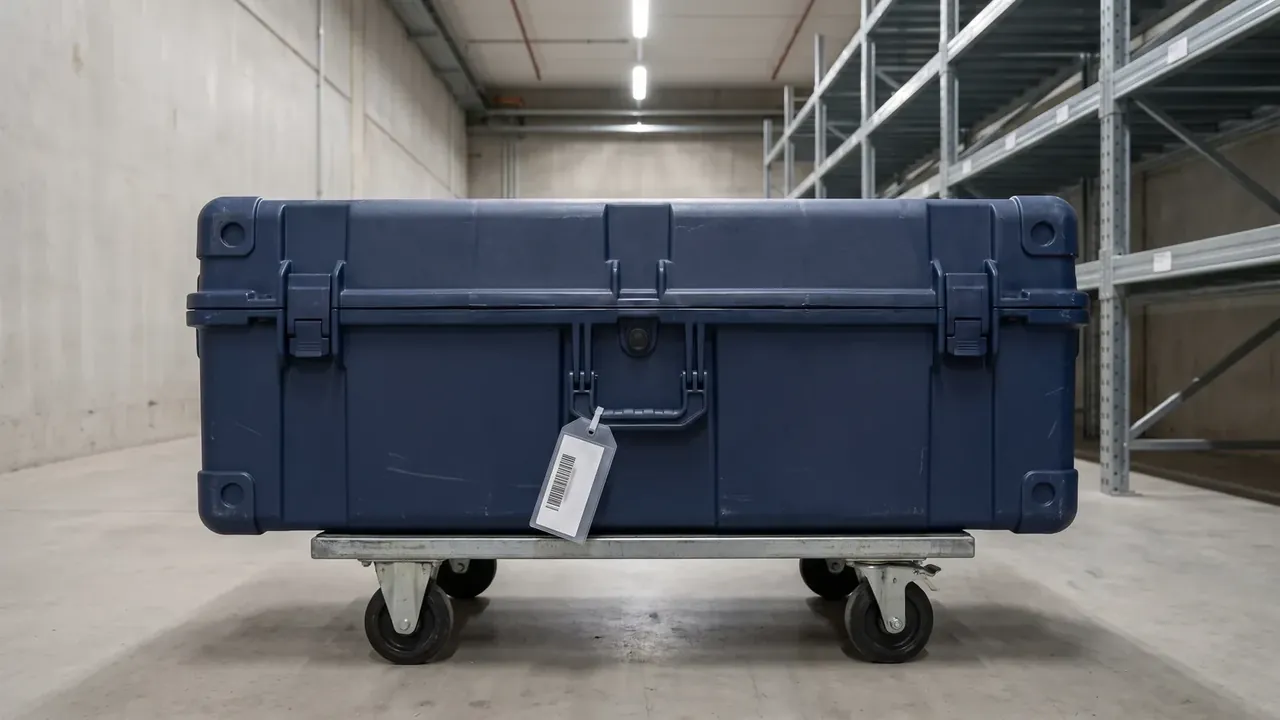
Quick answer: Military Case Material Comparison freezes three shell grades 24 h at -25 °C, drops 5 kg from 1 m, and keeps the grade denting under 0.42 mm.
Table of contents
- Three Specimen Wall Thickness Tiers in Military Case Material Comparison
- Resin Melt Flow and Stock Batches
- Drop Dents After a Minus-Twenty-Five-Degree Freeze
- Impact Retention After Rewarming
- Fixing the Grade for a Stock Batch
- FAQ
1. Three Specimen Wall Thickness Tiers in Military Case Material Comparison
Same three moulds, same wall, three resin grades; one cold night and one hammer drop sort the grades. Military Case Material Comparison sits on a 630×450×260 mm shell with a 560×385×195 mm cavity and a 4.7 mm wall, so only the grade varies; coupons are cut to 3.2 mm and clamped to within 0.1 mm, with no batch mixed and no mould swapped.
Military Case Material Comparison splits three grades by melt flow into 8, 12 and 16 g/10 min, with 8 g/10 min the lowest. A low-flow grade stays tough in the cold but fills slowly and starves corners; a higher flow fills the surface yet gives up sooner below zero. Coupons stay 3.2 mm, and stock batches B1, B2 and B3 stamp batch and melt flow on the back.
| Grade tier | Melt flow | Coupon | Stock batch |
|---|---|---|---|
| Low flow | 8 g/10 min | 3.2 mm | B1 |
| Middle flow | 12 g/10 min | 3.2 mm | B2 |
| High flow | 16 g/10 min | 3.2 mm | B3 |
Wall, coupon thickness and clamping are locked across the rows; the remaining difference comes only from melt flow, so one dent table can put the grades in order.
2. Resin Melt Flow and Stock Batches
Military Case Material Comparison books stock batches before the hammer falls, because melt flow drifts in storage: a strip from each of B1, B2 and B3 is retested, and a batch more than 0.5 g/10 min off nominal never enters the cold stage. Moulding runs one process card for the 4.7 mm wall, so forming scatter is not charged to the grade; stock cards and coupon tags are cross-checked again, and a mismatched number is recut.
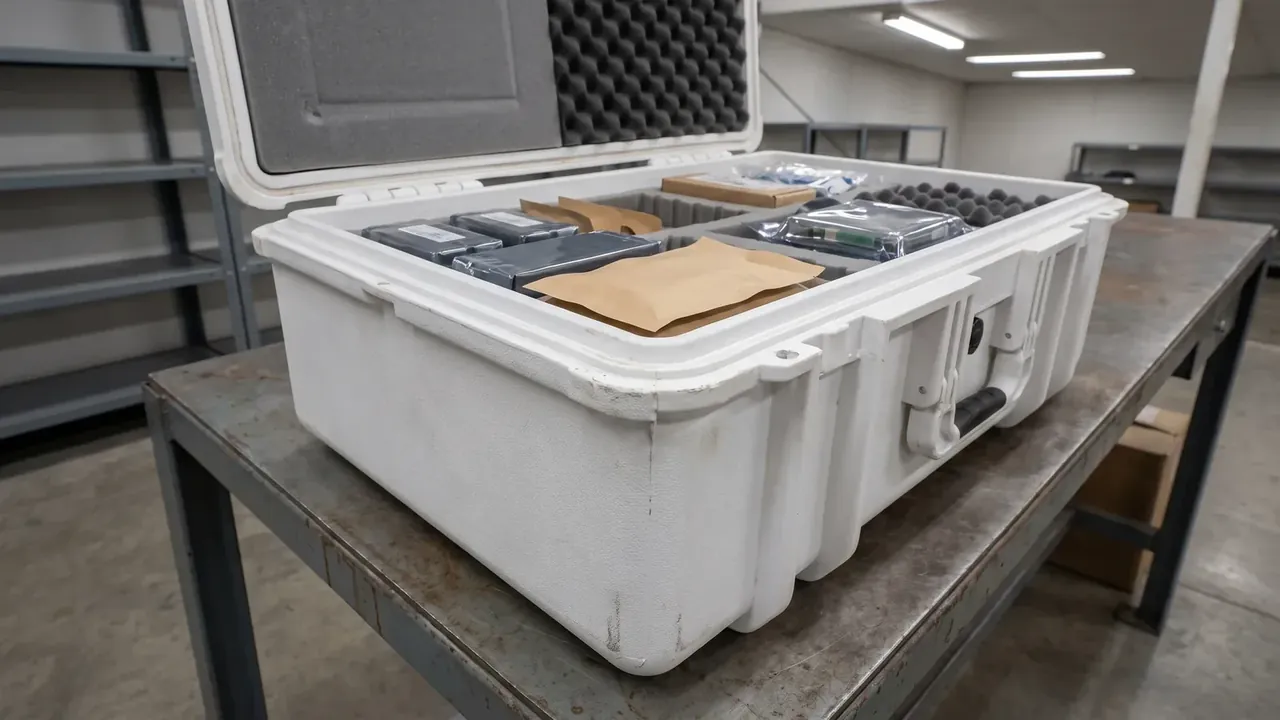
A rig logging 4100 open-close cycles checks the mouth at intervals, and only a lid still aligned after 4100 cycles clears the batch for the freezer. Four latches at 415 N each and two gasket rings at 21% compression seal the opening, and these figures decide whether the cold stage sees a true shell dent or a leak deformation.
Here Military Case Material Comparison lists structure and grade apart: the 8 g/10 min strip from B1 and the 16 g/10 min strip from B3 keep their own tags, and no reading is borrowed. A 16 kg loaded condition holds the shell on the drop rig in the same support state as a finished case.
3. Drop Dents After a Minus-Twenty-Five-Degree Freeze
The cold stage of Military Case Material Comparison sends all three coupons into -25 °C for 24 h, unopened and unmoved, then straight to the drop rig. What matters is the dent from a 5 kg hammer falling 1 m: lower temperature and higher melt flow dig a deeper pit, and the deepest of three gauge readings at the strike is that grade's dent reading.
| Freeze interval | Chamber | Low / middle / high dent |
|---|---|---|
| 0 h | Room | 0.00 / 0.00 / 0.00 mm |
| 12 h | -25 °C | 0.21 / 0.30 / 0.39 mm |
| 24 h | -25 °C | 0.34 / 0.44 / 0.58 mm |
At 12 h the dents sit within 0.2 mm of each other; at 24 h the middle grade crosses 0.42 mm and the high grade reaches 0.58 mm. This is why Military Case Material Comparison keeps 24 h as the shortest separating window, with the half-soak row filed only as history.
4. Impact Retention After Rewarming
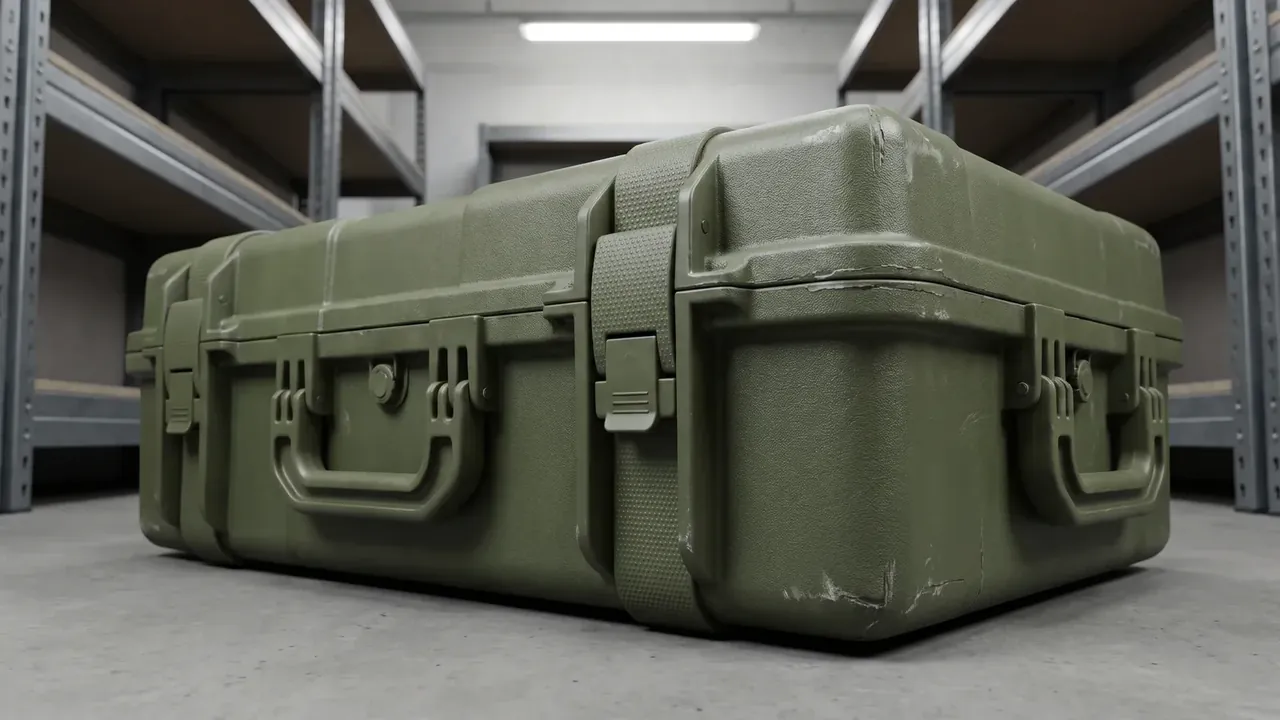
A coupon is not judged on leaving the chamber: the shell returns to room temperature, then a notch is struck again to see how much toughness survives a cold night. For Military Case Material Comparison, impact retention of at least 82% is the keep line — a shallow dent that cannot recover means embrittled resin — and each rewarm reading pairs with its own dent reading.
| Dent reading | Grade | Retention | Disposition |
|---|---|---|---|
| 0.34 mm | Low flow | 91% | Keep |
| 0.44 mm | Middle flow | 80% | Room shells |
| 0.58 mm | High flow | 69% | Room shells |
Only the low-flow row holds both the 0.42 mm dent and 82% retention. Military Case Material Comparison marks that disposition, with the 6.9 kg empty shell and 16 kg load noted beside it for a future resin change.
5. Fixing the Grade for a Stock Batch
The grade is fixed at the lowest melt flow whose dent after a full freeze stays shallower than 0.42 mm; higher-flow grades go to room-temperature shells. That narrows the choice to 8 g/10 min, so drawing, moulding card and inspection sheet lock to it. Military Case Material Comparison turns here from drop readings into a working stock document.
JUNZHIJIA rules that IP67 is a typical sealing reference, not a certificate held; two gasket rings at 21% compression and four latches at 415 N are rechecked by the test method, with no certification number on the card. The 4100 cycles, 24 h freeze and 82% retention belong to three separate rigs, and Kexin New Materials (Guangdong) Co., Ltd. does not return to another resin once 8 g/10 min is set.
Conclusion
Three moulds, one cavity, three grades: the drop rig lines 8, 12 and 16 g/10 min into a dent sequence, and Military Case Material Comparison wants the one row still inside 0.42 mm. Rewarm retention of 91% matches a 0.34 mm dent, so the 82% line is not a number standing alone. JUNZHIJIA writes 8 g/10 min into the stock card from the 24 h reading, with shell forming, seal compression and liner support filed apart; any later resin change repeats the -25 °C night and the 5 kg drop, and no old reading vouches for a new batch.
Related Reading
- ABS vs PP Case Bodies: Cold Brittleness and Cost
- ABS vs PP for Protective Cases: Which Material Should You Choose?
- Plastic vs Wood Crate: Plastic Case vs Wooden Crate
- Military Protective Case Cost Factors
- Military Field Deployment Case
Related Products
- 8 Series — Gun Cases; Military Equipment Cases; Camera Equipment Cases; Drone Cases; Watch Cases; Knife Cases; First Aid Cases; Electronics Equipment Cases
- WL8-2812 PP Gun Case — model WL8-2812
- All protective cases and toolboxes: 7 series, 158 models