

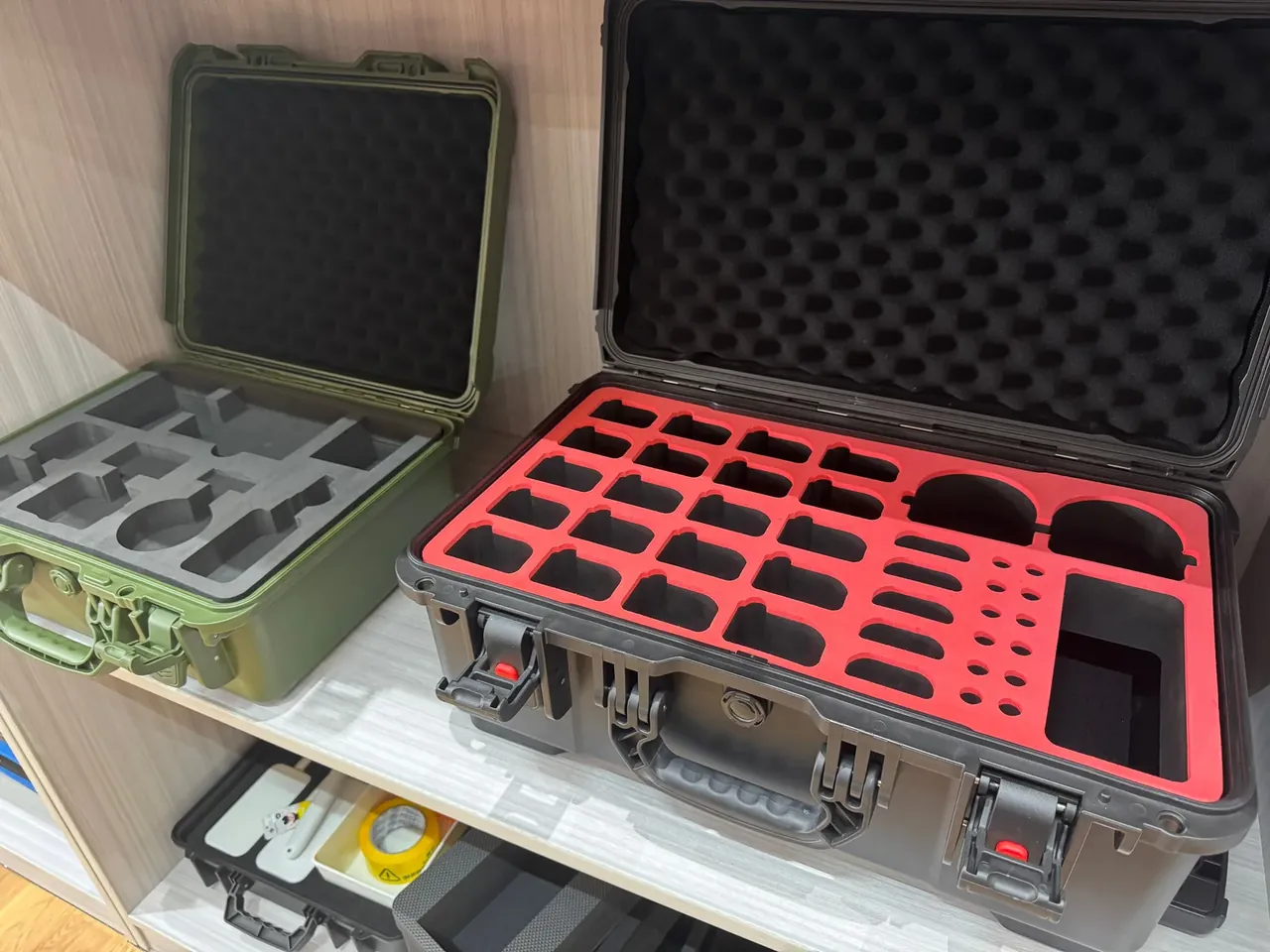
Quick answer: Military Protective Case Cost Factors weighs a 96 mm rib grid and a 3.6 mm lid panel: shot weight under 3.15 kg and a cycle under 78 s at 3000 shots.
Table of contents
- Rib Grid Pitch in Military Protective Case Cost Factors
- Lid Panel Thickness
- Weighing the Shot per Case
- Logging the Molding Cycle
- Fixing the Grid Pitch for an Amortized Batch
- FAQ
1. Rib Grid Pitch in Military Protective Case Cost Factors
How many shells one mold spreads across is settled by rib-grid spacing and lid panel thickness; weight and cycle fix the drawing before anything else. Military Protective Case Cost Factors takes a 640×450×250 mm footprint, a 575×390×185 mm cavity and a 4.8 mm wall, with stiffening ribs laid as a grid on base and lid.
Three pitches go on trial, 84 mm, 96 mm and 108 mm, with the lid pinned at 3.6 mm. The 84 mm tier reaches 3.42 kg, the 108 mm tier drops to 2.86 kg yet stretches the cycle to 86 s fighting warp, and 96 mm sits between at 3.08 kg and 74 s. Military Protective Case Cost Factors lets the weighing sheet pick the tier, not a round figure.
| Grid pitch tier | Rib spacing | Shot weight |
|---|---|---|
| Tight | 84 mm | 3.42 kg |
| Middle | 96 mm | 3.08 kg |
| Loose | 108 mm | 2.86 kg |
One tool and one 4.8 mm wall feed all three tiers; the gap needs the full 3000-shot run to show.
2. Lid Panel Thickness
By lid panel thickness we mean the flat plate alone, not the liner inside it. Military Protective Case Cost Factors holds it at 3.6 mm: thinner lets the panel billow between the latches once the grid opens, thicker lifts the weight on its own. Five points along a diagonal are measured after closing and the thinnest is kept.

Panel thickness and rib pitch pull against each other. A stout panel over a tight grid drags cooling out; a loose grid under a thin panel lets the lid soften first. Military Protective Case Cost Factors weighs both together.
3. Weighing the Shot per Case
Trimmed of flash and gate, each piece goes on the scale: Military Protective Case Cost Factors reads a run of shots, not one lucky piece. The balance is re-zeroed each shift, a shell is weighed three times and the middle value kept, and parts with flash left are excluded. Shots run from the first to number 3000 with resin and hold unchanged, so every figure ties to one sheet. The shell is weighed without latches or liner, as net resin only, or hardware would flatten the curve. The 6.8 kg empty case is an assembled reading, never converted into net resin. However exact the trial shot, it speaks for one shot only; over a run mold heat builds and the closing shots show whether the drawing holds.
Less resin should shorten the cycle, yet a loose grid packs the wall unevenly and the cycle grows fighting warp, which is where the 86 s at 108 mm comes from. Military Protective Case Cost Factors binds the trial-shot sheet and the running shot log into two books: one speaks for a shot, the other answers whether 3.15 kg and 78 s still hold at shot 3000.
4. Logging the Molding Cycle
The cycle runs from clamp closing to the ejected part dropping into the tray, and Military Protective Case Cost Factors logs it shot by shot, not as a shift average. Shot numbers are shared with the weighing sheet, so resin and cycle at a given shot point to the same shell.
| Shot sequence | Cycle | Shot weight |
|---|---|---|
| Shot 1 | 74 s | 3.08 kg |
| Shot 1500 | 75 s | 3.10 kg |
| Shot 3000 | 77 s | 3.12 kg |
The closing row decides the drawing: the cycle creeps from 74 s to 77 s and weight from 3.08 kg to 3.12 kg, both inside 78 s and 3.15 kg. 4050 open-close passes run on their own stand, filed apart from the cycle sheet.
5. Fixing the Grid Pitch for an Amortized Batch
Of the tiers keeping shot weight below 3.15 kg and the cycle under 78 s, the sparsest is written into the drawing; go sparser and the grid never reaches production. That leaves 96 mm: at shot 3000 it weighs 3.12 kg and runs 77 s, leaner than 84 mm and without the 86 s penalty of 108 mm. Military Protective Case Cost Factors folds the weighing records into one production drawing fixed to that tier, with one mold spread across 3000 shots.
| Shot weight reading | Pitch tier | Disposition |
|---|---|---|
| 3.08 kg | 96 mm | Into production drawing |
| 3.42 kg | 84 mm | Over 3.15 kg, returned |
| 2.86 kg | 108 mm | 86 s cycle, sample only |
An assembly page carries the 6.8 kg empty case, a 17 kg loaded weighing, four 420 N latches and two gasket rings at 21%; none is converted into shot weight or cycle. IP67 is a reference mark only, re-checked on a leak stand, with no number or grade on the drawing. The drawing closes on four lines: 96 mm pitch, 3.6 mm panel, shot weight under 3.15 kg and cycle under 78 s, 3000 shots in the footer.
Conclusion
Four numbers end the discussion in Military Protective Case Cost Factors: 96 mm of rib pitch, a 3.6 mm lid, 3.15 kg across 3000 shots and a 78 s cycle. The tight tier hits the weight line first, the loose one stalls on cycle, and 96 mm is kept because the two logs agree. The 3000-shot spread is entered only after drawing, weighing sheet and cycle log have each been closed on its own.
Related Reading
- How Is a Protective Case Costed? The Price Structure of Materials and Process
- Total Cost of Ownership for Protective Cases: Looking Past Unit Price
- Plastic vs Wood Crate: Plastic Case vs Wooden Crate
- Military Field Deployment Case
- Military Equipment Case Purchasing Checklist
Related Products
- 8 Series — Gun Cases; Military Equipment Cases; Camera Equipment Cases; Drone Cases; Watch Cases; Knife Cases; First Aid Cases; Electronics Equipment Cases
- WL8-2812 PP Gun Case — model WL8-2812
- All protective cases and toolboxes: 7 series, 158 models