

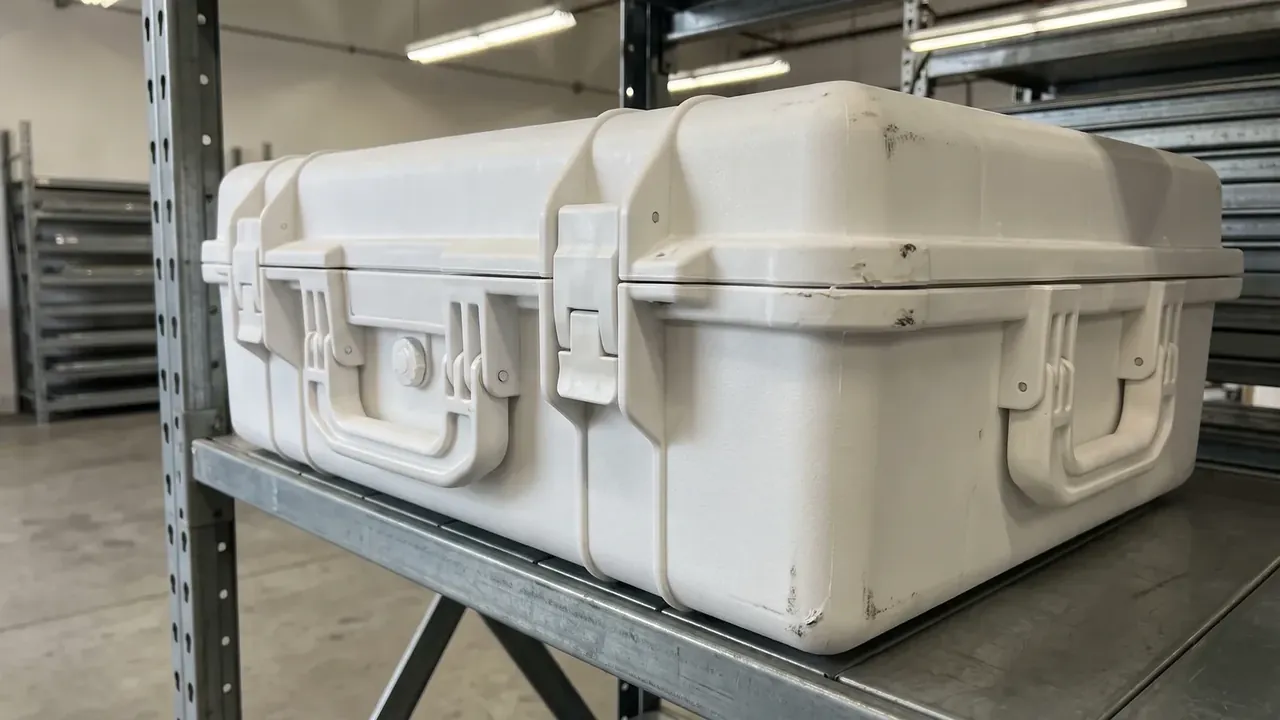
Quick answer: Military Field Deployment Case runs 5000 cycles at 112 mm insert spacing and keeps the tier whose hinge play stays under 0.26 mm.
Table of contents
- Handle-Seat Insert Spacing Tiers in Military Field Deployment Case
- Hinge Bushing Wall Thickness
- Hinge Play After Five Thousand Cycles
- Handle-Seat Drift After Re-Tightening
- Fixing the Spacing for a Carry Batch
- FAQ
1. Handle-Seat Insert Spacing Tiers in Military Field Deployment Case
The rig swings the lid up and down; whether the handle seat loosens first or the hinge wobbles first is settled by a feeler gauge after 5000 cycles. The 580×405×215 mm shell leaves a 515×350×160 mm cavity and a 4.3 mm wall; Military Field Deployment Case buries two inserts in the lid flange at 112, 128 and 144 mm, with one hinge spec and a 5.5 mm bushing wall shared by the lids.
Widen the insert spacing and the lever arm to the hinge axis grows, so more lid twist lands on the bushing. Military Field Deployment Case pairs each spacing with the same hinge and bushing batch, seating the lid and snapping all four latches shut before the rig starts; carry batches are tagged C1, C2 and C3.
| Bushing tier | Insert spacing | Bushing wall | Carry batch |
|---|---|---|---|
| Narrow thick | 112 mm | 5.5 mm | C1 |
| Middle | 128 mm | 4.8 mm | C2 |
| Wide thin | 144 mm | 4.1 mm | C3 |
The three bushing walls could match; dropping from 5.5 mm to 4.1 mm puts both effects on one sheet.
2. Hinge Bushing Wall Thickness
Military Field Deployment Case sets 5.5 mm as the C1 bushing wall, the most stock the lid flange can spare: thicker fouls the mouth on closing, thinner lets the hinge pin rub out play across the temperature swing. The bushing carries the lid twist, so a 0.7 mm wall difference shows as gauge drift after 5000 cycles.
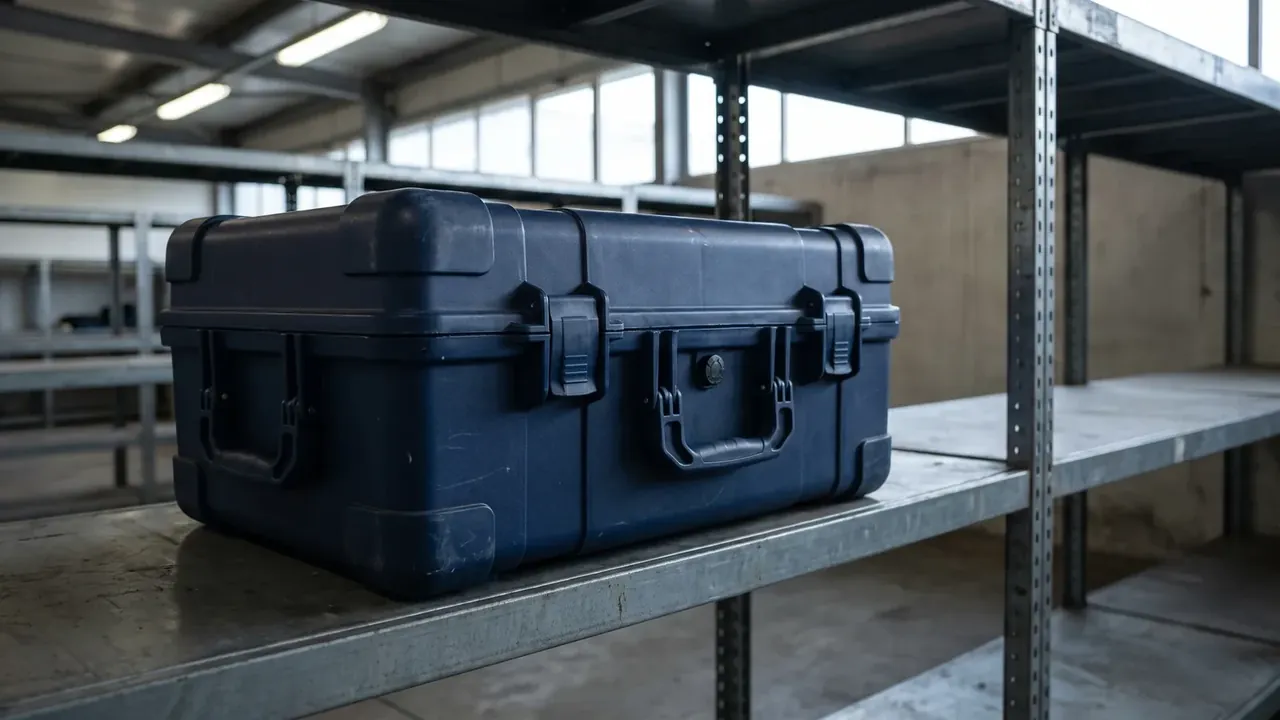
A temperature stage walks the lidded shell between -15 °C and 55 °C, stopping every 500 cycles to measure the gap. Four latches press 390 N each and two gasket rings sit at 20% compression; these figures stay out of the play column, and a 14 kg load holds the base down.
Bushing wall and insert spacing sit side by side on the Military Field Deployment Case inspection sheet: C1 pairs 5.5 mm with 112 mm, C3 pairs 4.1 mm with 144 mm, and neither is fixed alone. The 5.6 kg empty-shell weight is booked here too, and a lighter shell after a bushing material change signals the wall did not form to spec.
3. Hinge Play After Five Thousand Cycles
One cycle is the lid pushed to 90 degrees and closed again, and Military Field Deployment Case reads play only at 5000. A feeler gauge in the gap gives that tier's play reading; across -15 °C to 55 °C the first 2500 cycles show little separation, the last 2500 pull the tiers apart.
| Cycle number | Rig state | Narrow / middle / wide play |
|---|---|---|
| 0 | Off rig | 0.00 / 0.00 / 0.00 mm |
| 2500 | -15 °C to 55 °C | 0.10 / 0.17 / 0.23 mm |
| 5000 | -15 °C to 55 °C | 0.18 / 0.28 / 0.35 mm |
The half-way row shows no winner: 0.10, 0.17 and 0.23 mm sit 0.13 mm apart. The last 2500 cycles separate them, the middle tier crossing 0.26 mm and the wide reaching 0.35 mm; the Military Field Deployment Case reading rule accepts only the full 5000 row.
4. Handle-Seat Drift After Re-Tightening
After 5000 cycles the latches are snapped back to 390 N and the handle seat measured against the flange. 0.19 mm is the drift ceiling: a seat still crossing it has loose stock around its inserts, and Military Field Deployment Case lets each drift reading answer only to its own play reading.
| Play reading | Tier | Drift | Disposition |
|---|---|---|---|
| 0.18 mm | Narrow thick | 0.12 mm | Keep |
| 0.28 mm | Middle | 0.21 mm | Static sample |
| 0.35 mm | Wide thin | 0.29 mm | Static sample |
The C1 row holds both 0.26 mm play and 0.19 mm drift; C2 at 0.21 mm and C3 at 0.29 mm lose the drift line. Those two go to static sample records, with the 5.6 kg empty shell and 14 kg load beside them; in Military Field Deployment Case neither row re-enters the carry batch.
5. Fixing the Spacing for a Carry Batch
The fixed spacing is the narrowest tier whose play at the five-thousandth cycle stays below 0.26 mm; wider layouts stay as static sample records. That pins the choice to C1 at 112 mm with a 5.5 mm bushing, so the drawing, insert card and inspection sheet lock to it. Military Field Deployment Case turns here from cycle readings into a working carry document.
Targets and measurements are filed apart on this card for Military Field Deployment Case: IP66 is a reference notch, two gasket rings at 20% compression and four latches at 390 N are measured on re-tightening, and no certification number is entered. The 5000 cycles, the swing and the drift belong to three logbooks, and Kexin New Materials (Guangdong) Co., Ltd. follows the same 112 mm layout once C1 is set.
Conclusion
Swing the lid to 90 degrees and back, and the feeler gauge answers which of pin and bushing loosened first over 5000 cycles: C1's 0.18 mm play and 0.12 mm drift alone hold both 0.26 mm and 0.19 mm. Military Field Deployment Case fixes 112 mm spacing with a 5.5 mm bushing from this, writing both columns onto one card. C2 and C3 fall to static sample records because drift would not return under 0.19 mm after re-tightening. Kexin New Materials (Guangdong) Co., Ltd. runs the full 5000 again whenever the layout changes rather than letting an old figure vouch for a new batch.
Related Reading
- What Is a Deployable Hard Case: Design for Fast Field Setup
- Handheld, Shoulder-Strap & Wheeled Transport Boxes: Carry & Transport Design
- Electronic Equipment Case in Test, Field and Transport
- Military Protective Case Cost Factors
- Military Equipment Case Purchasing Checklist
Related Products
- 8 Series — Gun Cases; Military Equipment Cases; Camera Equipment Cases; Drone Cases; Watch Cases; Knife Cases; First Aid Cases; Electronics Equipment Cases
- WL8-2812 PP Gun Case — model WL8-2812
- All protective cases and toolboxes: 7 series, 158 models