

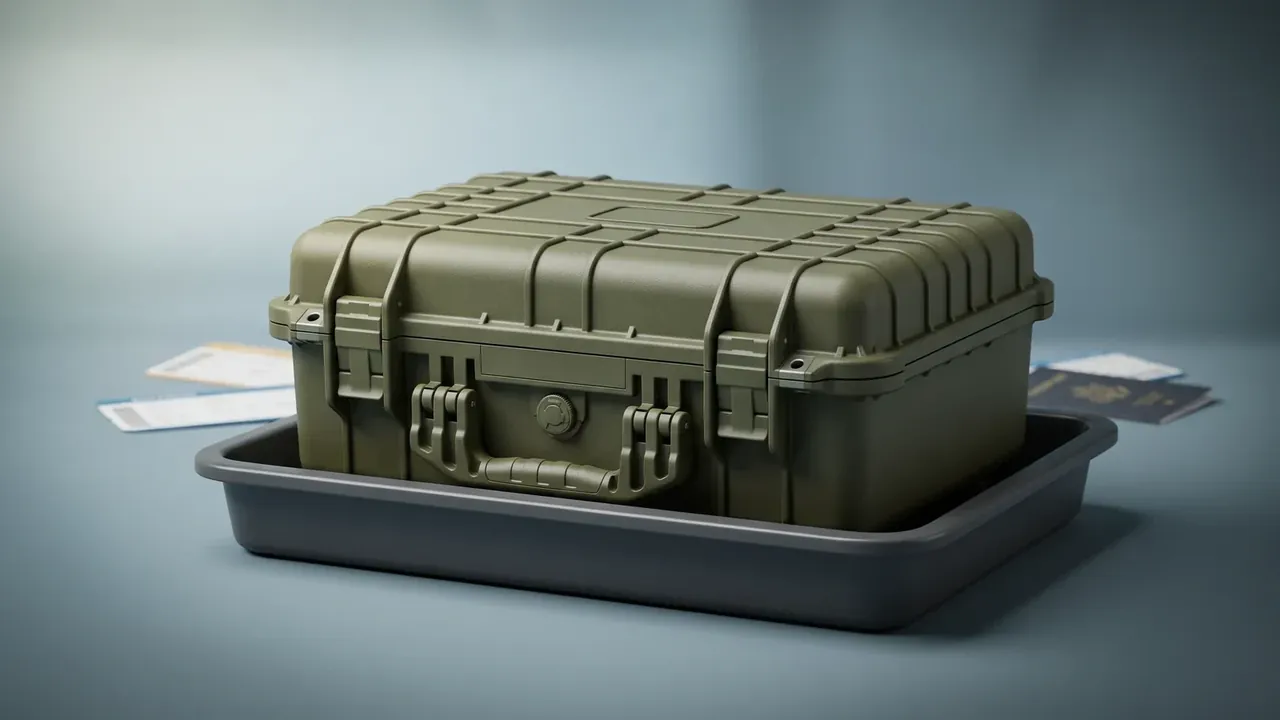
Quick answer: One 24-hour pressure clause turns upkeep of a military chemical agent container into three inspection levels and four replacement limits: a 20-second look at dispatch, a pressure drop each quarter, a teardown once a year. Past 1.2 kPa or under 4 mm of wall, the part comes off.
Table of contents
- Inspection Intervals for a Military Chemical Agent Container
- Seal Cleaning and Gasket Replacement Limits
- Latch Hinge and Handle Wear Calls
- Grading Wall Scuffs and Liner Attack
- Three Moves That Extend Service Life
- Spares Ledger and Cycle Review
- FAQ
1. Inspection Intervals for a Military Chemical Agent Container
The acceptance line reads: charge to 30 kPa, hold 24 hours, drop no more than 1.2 kPa. On a store floor that is a calendar, not a test.
Intervals are back-calculated from failure speed: a gasket sheds 4 points of compression a year, a latch loses 100 N over 5 years, scuffs pile up with every move.
| Level | Interval | Main items | Call |
|---|---|---|---|
| Dispatch look | Every move | Lid line, latches, corner damage | Any fault, go quarterly |
| Quarterly | 3 months | Gasket, hinge play, sample test | Drop past 1.2 kPa, go annual |
| Annual | 12 months | Gasket, pin wear, wall loss | Any breach, replace |
| Climate add-on | By site | Wet sites at 2 months, salt at 6 | Log it |
A 20-second dispatch look on a military chemical agent container covers the lid line, both latches and any hinge rock. Quarterly tests 1 case in 10 at 30 kPa; annually the gasket is pulled and the wall read on an ultrasonic probe.
2. Seal Cleaning and Gasket Replacement Limits
On a military chemical agent container the gasket ages first. A new cord is 8 mm across, dropping into a 6 mm groove at 25 percent compression. EPDM at 25 °C loses 4 points a year; by month 36 it sits at 12 percent and 30 kPa cannot hold 1.2 kPa.
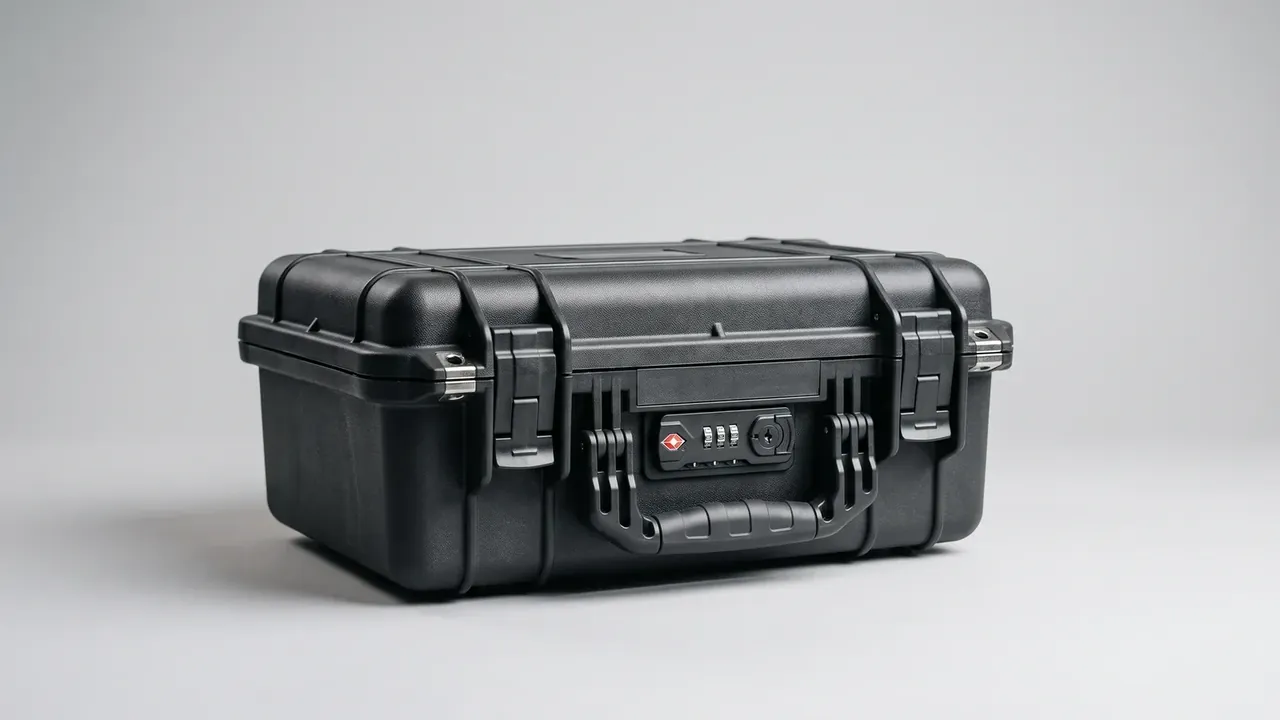
Cleaning is three verbs: wipe, rinse, air. Dilute neutral detergent to pH 6 to 8, keep water under 30 °C, then stand the case upside down for 30 minutes. Ketones add 3 points of hardness in 2 weeks.
| Part | New datum | Limit | Price |
|---|---|---|---|
| Seal gasket | 8 mm, 25 percent | 15 percent or 68 Shore A | 38 CNY |
| Draw latch | 320 N pull | 220 N pull | 26 CNY |
| Hinge pin | 4 mm, 0.1 mm play | 0.5 mm play | 5 CNY |
| Folding handle | 150 kg static, 60 seconds | Blooming or crack | 45 CNY |
Three readings make the call. Below 15 percent compression, replace. Shore A climbing from 60 to 68, replace. Recovery past 30 seconds after a 10-second press, replace. Any one and the whole ring goes, never a spliced section.
3. Latch Hinge and Handle Wear Calls
A latch announces itself through the hand before it fails. New, it closes at 320 N; by 220 N the tongue feels light and a swap beats an adjustment. Average 3 spring-scale readings.
Hinges fail at the pin. A 4 mm pin wears 0.3 mm after 5000 cycles, the bore opens and the lid rocks. Swap at 0.5 mm of play: 5 CNY and 10 minutes.
Test the handle alone. At 46 kg loaded it holds 150 kg static for 60 seconds, then the root is checked for blooming and the 4 M5 screws re-torqued to 3 N·m.
4. Grading Wall Scuffs and Liner Attack
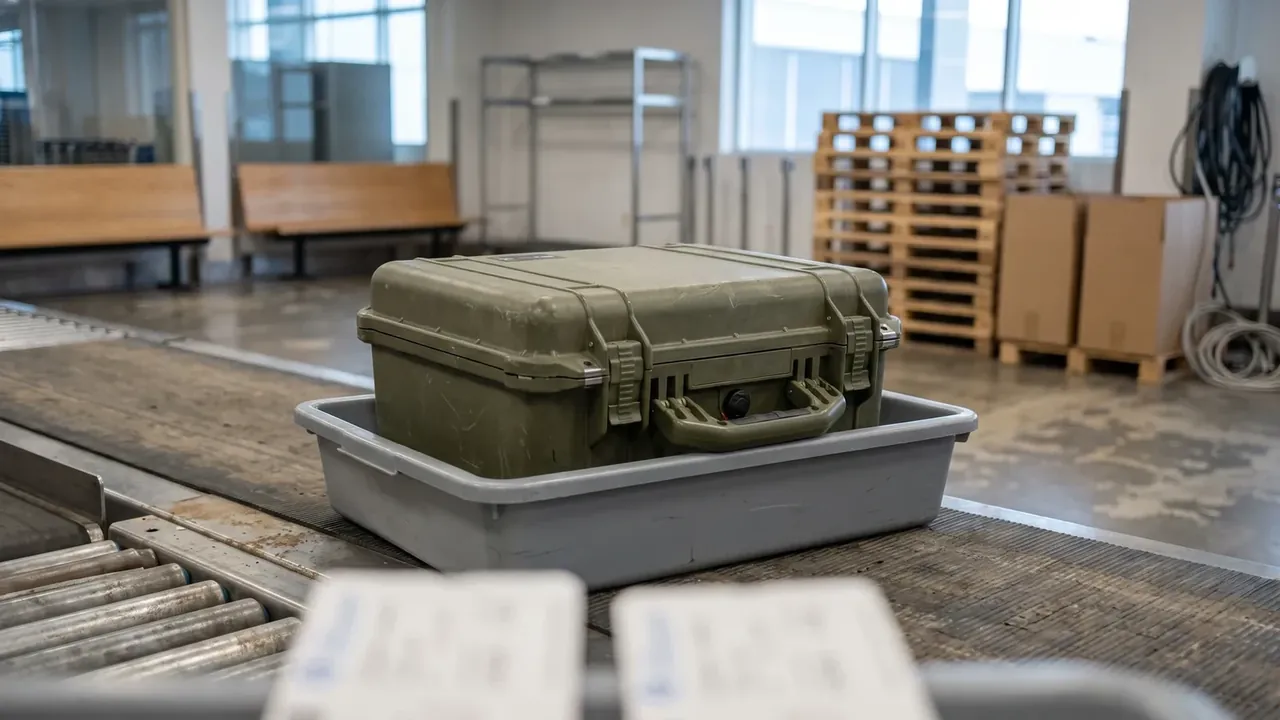
On a military chemical agent container the wall is 6 mm, rotomoulded in one piece with no seam inside. Scuffs are graded by remaining wall, not by how deep they look: 4 mm is the line, and below it a drop starts a crack no patch stops.
| Grade | Depth | Wall left | Action |
|---|---|---|---|
| Light | Under 0.5 mm | Over 5 mm | Sand, touch up, keep |
| Medium | 0.5 to 1.5 mm | 4 to 5 mm | Patch, local runs only |
| Heavy | Over 1.5 mm | Under 4 mm | Hold, re-test at 30 kPa |
| Pitting | 0.5 mm | Not counted | Neutralise, retire on the third |
Inside, residue does the damage: a dry wipe leaves liquid that pits the groove floor within 72 hours. A pit 0.5 mm deep is still a stress raiser, so pH paper goes against the liner; 6 to 8 means neutral.
5. Three Moves That Extend Service Life
The first move is a patch: over a zone with 4 to 5 mm of wall left, bond a 2 mm plate of the same resin, weld at 260 °C, test the seam at 30 kPa. A patched military chemical agent container drops one grade and stays on internal runs.
The second move is moisture. A 250 g desiccant suits a 300 L cavity, is dried every 6 months, and 4 hours at 120 °C returns 70 percent of capacity. Below 60 percent humidity the card stays blue.
The third move is watching the surface. UV blooms polyethylene, and after that white smear the wall loses an extra 0.1 mm a year.
6. Spares Ledger and Cycle Review
Four columns carry it: case number, last pressure reading, parts changed, next due date. On that alone a military chemical agent container is judged.
Review every 6 months on 5 percent of stock. A shift of 0.5 kPa means the batch has entered its wear band, so pull the quarterly item forward 1 month. Hold spares at 10 percent of the register.
Five conditions retire one: a through crack over 50 mm, a third repair in one place, a distorted groove, a drop still above 1.2 kPa, pitting joined into a patch.
Conclusion
The hard part is not repair but the call. Gasket, latch, pin and wall each decay on its own curve, and numbers give every check a target: 15 percent, 220 N, 0.5 mm, 4 mm. A ledger joins them into one line, and the life of a military chemical agent container is set by the record, not by feel.
This article discusses only the container (case body) side of specifications and design intent, and does not cover any handling, loading or use of the contents.
Related Reading
- Pressure hold and drop items in the acceptance clause
- Where the seal and leak path come from
- Grenade box inspection rhythm and part numbers
- A quarterly checklist for ammunition storage boxes
- Patching and retirement calls on shell storage boxes
Related Products
- 8 Series — Gun Cases; Military Equipment Cases; Camera Equipment Cases; Drone Cases; Watch Cases; Knife Cases; First Aid Cases; Electronics Equipment Cases
- WL8-2812 PP Gun Case — model WL8-2812
- All protective cases and toolboxes: 7 series, 158 models